
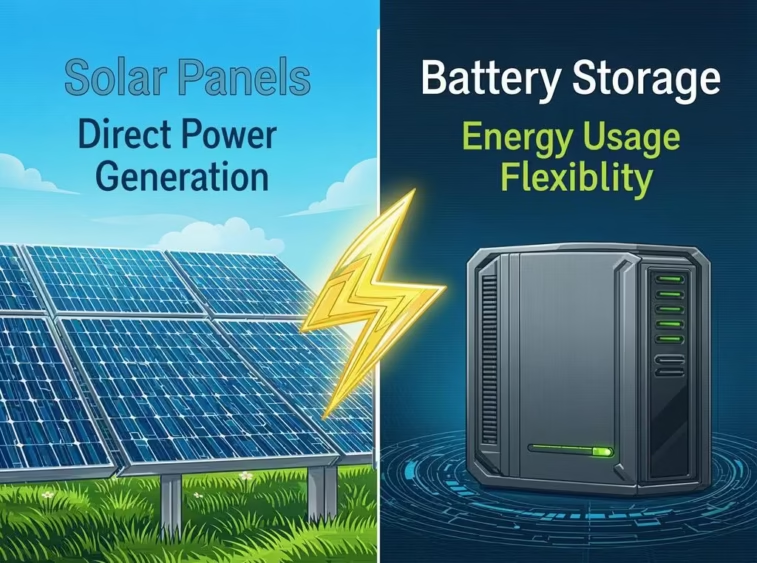
Adding battery storage doubles your solar ROI — or does it? Solar Panels vs Battery Storage Comparison upfront costs, payback period, energy independence, utility bill savings, and incentives available in 2026.
Solar Panels vs Battery Storage Comparison (2026): Should You Install Both or Just One?
Table of Contents
Show
Solar Panels vs Battery Storage Comparison; Here’s the short answer, then details.
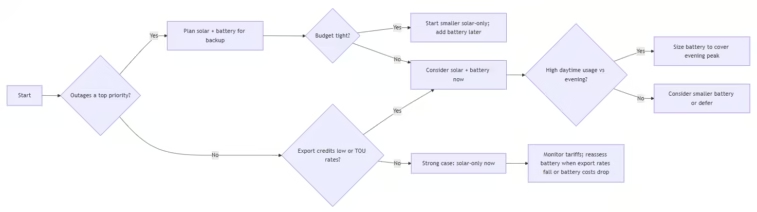
- Install solar only if: you mainly want to lower bills and you’re okay with no backup power; this is usually the highest ROI step in 2026 because it’s cheaper and simpler than adding batteries. In the U.S., a typical 5–6 kW (DC) residential system runs about $2.60–$3.10 per watt before incentives—roughly $15,700–$18,600 (DC basis), and U.S. datasets show most systems are 3–10 kW, so many quotes land in the low-to-mid $20,000s after incentives. Paybacks commonly fall in the 8–12 year range in good sun states, longer where electricity is cheap.
- Add a battery (solar + storage) if: you care about backup during outages and/or you’re on a time‑of‑use (TOU) or net metering tariff that pays little for exports (e.g., California’s NEM 3.0, many parts of Australia). In those cases, adding a battery and using more of your solar onsite can improve overall economics; properly designed, a solar‑plus‑storage system can shorten payback compared with solar‑only in high‑usage, high‑export‑price‑gap environments.
- For many households on standard flat-rate meters with modest outage risk, Solar Panels vs Battery Storage Comparison; the economics of adding a battery now are weaker than “solar first, add battery later” unless you strongly value resilience or rate arbitrage; battery-only (no solar) rarely makes financial sense for typical homes.
Decision map: both, solar-only, or battery-only?
1. What each option actually does
Option 1: Solar panels only
- What you get: lower day-to-day electricity bills by generating your own power and exporting excess to the grid. You still rely on the grid when the sun isn’t shining (night, cloudy days).
- What it costs (U.S. rough numbers in 2026):
- Median installed prices for residential PV systems in major markets like California have been around $3.7–$4.5/W (DC) in recent years, and data through 2024 show PV-plus-storage prices around $5.1/W (DC) for the PV portion—so solar-only is typically less expensive per watt than solar-plus-storage.
- Applying a typical 3–10 kW DC range and recent trends, many U.S. homeowners see final net costs (after incentives but before financing) in the low-to-mid $20,000s; consumer analyses cite national ranges like roughly $14,000–$28,000, with lifetime savings ~ $41,000–$62,000 over 25 years for a typical system.
- Payback/ROI:
- Where sun is good and electricity rates are high, 8–12 year paybacks are common for well-designed solar-only systems; payback can stretch beyond 12–15 years where rates are low or shading/roof orientation is suboptimal.
- Incentives (U.S. focus, 2026):
- Federal: the 30% Residential Clean Energy Credit (Section 25D ITC) for customer-owned systems ended for systems placed in service after Dec 31, 2025. If you bought and installed solar in 2025, you could claim 30% on your 2025 return (deadline April 15, 2026, with extension to Oct 15, 2026). In 2026, direct ownership by homeowners no longer qualifies; leases/PPAs can still indirectly benefit via the commercial credit (Section 48E) through 2032.
- State/local: many places still have rebates and performance-based incentives (SRECs, net billing, etc.) that can cut effective system cost substantially; these don’t depend on the federal credit.
- Pros in 2026:
- Lowest upfront cost among the options (panels + inverter + racking).
- Simplest, fastest to install; fewest points of failure.
- Still the backbone of long-term savings: one major U.S. analysis notes U.S. residential PV system LCOE fell about 76% between 2010 and 2024, which is why most solar-only systems still achieve solid lifetime returns.
- Cons:
- No blackout protection: if the grid goes down, a standard solar system shuts off for safety (unless you add a battery or a special islanding-capable inverter).
- Your savings depend heavily on net metering/export rules: if your utility cuts what it pays for excess solar (as with California’s NEM 3.0 or low feed-in tariffs abroad), pure solar-only economics worsen.
Option 2: Solar panels + home battery
- What you get:
- Bill savings from using more of your solar yourself rather than exporting cheaply, plus savings from avoiding expensive peak power (if on TOU rates).
- Backup power: when the grid fails, the battery can keep selected circuits running (sized correctly, often 10–15+ kWh for partial-home backup).
- More control: you can decide when to charge (from grid or solar) and when to discharge.
- Cost benchmarks (2025–2026 data):
- U.S.: Berkeley Lab’s “Tracking the Sun” data through 2024 show median prices for residential AC-coupled PV-plus-storage in California around $5,133/kW DC (PV) and $3,012/kWh of battery; note those are installed, bundled prices.
- Global price trend: NREL/LBNL report that installed PV-plus-storage system prices fell sharply in the 2010s; by 2024, residential PV-plus-storage costs were down ~76% vs. 2010—driven by both PV and storage cost declines.
- Ember’s 2026 analysis for India shows battery storage prices dropping so fast that solar-plus-storage can meet a large share of demand at lower levelized cost than many existing power sources—illustrating the global trajectory.
- Incentives (U.S., 2026):
- Federal: The 30% Residential Clean Energy Credit (Section 25D) for standalone storage and solar-paired storage ended for homeowner purchases placed in service after Dec 31, 2025. There is no partial credit; it’s 0% for new homeowner-owned batteries in 2026. Solar Panels vs Battery Storage Comparison; You could still claim the credit on 2025 installations filed by April 15, 2026 (extended to Oct 15, 2026). Batteries installed via third‑party ownership (e.g., some leases/PPAs) can still qualify under the Section 48E commercial credit through 2032.
- State: Many states (California, Connecticut, New York, Colorado, etc.) offer rebates for batteries alone or for solar-plus-storage, often in the $5,000–$16,000 range depending on program.
- Payback/ROI vs solar-only:
- A solar-plus-storage system costs more upfront (extra battery + inverter/switchgear), but it can capture more value per kWh of solar you generate:
- Under low export prices (FiTs) and/or TOU rates, using your solar onsite (via battery) instead of exporting cheaply can improve overall economics.
- California’s NEM 3.0 reduced export values significantly, so pairing with storage is increasingly recommended to optimize savings; sources note solar-plus-storage often has shorter payback than solar-only under those tariff structures when designed and used correctly.
- An integrator’s economics guide notes that, when systems are correctly designed to match your consumption patterns and tariffs, solar-plus-storage can shorten payback versus solar-only in high-usage environments by better using the solar you generate.
- A solar-plus-storage system costs more upfront (extra battery + inverter/switchgear), but it can capture more value per kWh of solar you generate:
- Pros:
- Backup power and resilience (valuably distinct from pure savings).
- Greater self‑consumption—less exposure to future cuts in export credits/FiTs.
- Potential access to utility programs (e.g., demand response, virtual power plants) that may pay you for using stored energy flexibly.
- Cons:
- Higher upfront cost; payback is usually longer than solar-only unless your tariffs really reward self-consumption or you have strong rebates.
- Complexity: more hardware, more space, and more software to manage.
- Round‑trip efficiency losses: storing and retrieving electricity isn’t free—typically ~10–15% energy loss per cycle, which slightly erodes the extra value.
Option 3: Battery-only (no solar)
- What you get:
- Pure backup/peak-shifting: you charge from the grid (often overnight at lower rates) and discharge during peak outages or expensive TOU periods. Solar Panels vs Battery Storage Comparison; Without solar, you’re paying for all the energy you store.
- When it can make sense:
- Areas with very large peak/off-peak price differences and TOU rates, where arbitrage (buy cheap, discharge when expensive) delivers decent savings.
- Rebate programs that pay down a large share of the battery cost for standalone storage.
- For most homes:
- Economics are weaker than solar-first: you’re paying both for the hardware and for the grid electricity you store. Solar Panels vs Battery Storage Comparison; A 2025 analysis suggests storage alone (not paired with solar) typically only becomes strongly cost-effective where you have demand charges or TOU, and even then, savings can be marginal.
- If you have the roof space and solar potential, the standard guidance is: solar first to generate cheap electrons, then add storage to time‑shift them; solar-only usually delivers higher ROI than battery-only.
2. How tariffs and net metering tilt the math
- High export value (generous FiTs or 1:1 net metering): exporting your excess solar is lucrative. Solar Panels vs Battery Storage Comparison; In that world, batteries primarily provide backup rather than extra savings; they extend payback vs solar-only.
- Low export value (NEM 3.0, low FiTs): exporting earns little, so your next solar dollar is best “spent” on self‑consumption. Batteries let you do that:
- Australia 2026: analyses show grid retail rates often 30–50 c/kWh while FiTs are only 2–10 c/kWh; experts emphasize focusing on self-consumption and battery storage over chasing FiTs.
- California 2025–2026: NEM 3.0 sharply cuts export compensation compared with NEM 2.0; multiple guides note that adding storage to solar under NEM 3.0 often improves economics and can reduce payback by maximizing self-consumption and avoiding peak rates.
- Time-of-use (TOU) rates with high evening peaks:
- Solar generates midday; you use or store that power and discharge in the evening when rates spike. Solar Panels vs Battery Storage Comparison; This is where batteries boost ROI the most.
- Studies using hundreds of utility rate schedules find that storage becomes cost-effective mainly where TOU or demand charges exist—and even then, pairing storage with solar (solar-plus-storage) yields more savings than storage alone.
3. Policy and incentive landscape (2026 snapshot)
- United States (federal):
- Solar: Section 25D Residential Clean Energy Credit (30% for customer-owned solar) ended for systems placed in service after Dec 31, 2025; third‑party owned projects (leases/PPAs) can still benefit via Section 48E through 2032 (savings usually passed to customers via lower rates).
- Storage: The 30% Residential Clean Energy Credit for standalone or paired storage also ended for homeowner purchases after Dec 31, 2025; as with solar, leases/PPAs can still use Section 48E. Solar Panels vs Battery Storage Comparison; Batteries installed in 2025 can still be claimed on 2025 filings (by April 15, 2026; extended to Oct 15, 2026).
- United States (state/local):
- Many states and utilities still offer rebates for solar, for batteries, and especially for solar-plus-storage; California, Connecticut, New York, and Colorado are examples with rebates commonly in the mid‑thousands of dollars.
- International context (briefly):
- EU/UK/Australia: no single federal rule, but feed-in tariffs have fallen and TOU/self‑consumption focus is rising; in many markets, 2024–2026 analyses stress solar-plus-storage economics improving as battery prices fall and tariffs penalize exports.
4. Quick when-to-do recommendations (2026)
- Choose solar-only if:
- Your primary goal is maximum ROI and lowest upfront cost.
- You’re on a stable net metering tariff with fair export credits, or you don’t yet have TOU.
- Outages are rare and brief, or you’re not yet willing to pay a premium for backup.
- Choose solar + battery (install both together or battery soon after solar) if:
- You experience meaningful outages (rural areas, storm-prone regions) and want backup.
- You’re on NEM 3.0 or a similar low-export regime, or on TOU with high peak prices and large evening loads (EV charging, AC, etc.), so a battery can materially improve economics. California guidance and installers in 2025–2026 increasingly recommend storage to optimize savings under NEM 3.0.
- Strong state rebates exist for batteries or solar-plus-storage, which shrink the incremental payback time for adding storage.
- Choose battery-only (no solar) if:
- You can’t or don’t want to install solar (rent/roof issues), but you have:
- Very large peak/off-peak spreads and/or demand charges; and
- A robust battery-only rebate program that lowers payback to ~10 years or better.
- For most others, this is financially weaker than solar-first; consider it only if your situation blocks solar or you explicitly prioritize backup/TOU arbitrage over maximum returns.
- You can’t or don’t want to install solar (rent/roof issues), but you have:
5. Practical design rules if you add a battery
- Right-size your solar first:
- Aim for a PV array that covers a large share of your annual electricity usage; this gives you plenty of excess energy to store rather than buying expensive grid power.
- Right-size your battery:
- For pure economics (self‑consumption), a smaller battery (e.g., ~5–10 kWh) often yields better ROI than oversizing, because you cycle it more frequently and export less.
- For backup comfort, go larger (e.g., 10–15+ kWh) to ride through multi-hour outages and cover critical circuits—but accept longer payback.
- Match usage and tariff:
- Set the battery to charge from cheap off-peak or excess solar, and discharge during the most expensive TOU periods.
- Avoid strategies that export a lot of cheap solar and then buy back expensive peak power from the grid—that’s where you lose money.
- Plan for future tariffs:
- Expect export rates to keep trending down and peak/time-differentiated pricing to become more common. A correctly sized battery gives you flexibility as the grid evolves.
6. When it makes sense to start solar-only and add storage later
- Budget is tight:
- Go solar-only first to capture most of the savings with the lowest upfront. Storage costs continue falling (Ember reports ~40% battery cost decline in 2024, then ~31% in 2025), so delaying the battery can be rational.
- You want to “test-drive” solar:
- Live with your PV system for a year to understand your real usage patterns and local tariff changes, then right‑size the battery for your actual behavior rather than assumptions.
- Tariffs are uncertain:
- If your regulator or utility is actively changing export rules or TOU structures, you can reassess storage once the rules settle; California’s NEM 3.0 transition is a live example where many homeowners are adding storage after going solar.
Bottom line
- In 2026, solar panels alone remain the best financial-first move for most homeowners: lower upfront cost, proven payback, and strong lifetime savings.
- Adding a battery makes the most financial and practical sense when: (a) you value backup power, or (b) your export compensation is low and/or you’re on TOU rates that reward storing solar and using it during peak periods. In those cases, solar-plus-storage can shorten payback versus solar-only and add resilience.
- Battery-only systems are niche financially; they mainly work where there are big price spreads or demand charges plus strong rebates, or when solar truly isn’t feasible. Solar Panels vs Battery Storage Comparison; For most homes with decent sun and roof space, “solar first, add battery later or as needed” beats battery-only.
Solar Panels vs Battery Storage Comparison; If you share your location (country/state/utility), typical monthly bill, and how often you have outages, you can narrow this to a concrete recommendation: system size, whether TOU is worth switching, and what battery size (if any) best fits your 2026 budget and goals.