
Can’t decide between the top AI tools? Our Claude vs ChatGPT vs Gemini 2026 deep-dive reveals the real winner — by task, budget & use case. No fluff, just facts.
Claude vs ChatGPT vs Gemini Comparison in 2026 — The Definitive AI Assistant Showdown
The definitive Claude vs ChatGPT vs Gemini comparison in 2026 — tested on writing, coding, reasoning & accuracy. See which AI assistant delivers the best results for your needs.
Main takeaway (short version):
Writers, coders & business teams — find your best AI match. Our Claude vs ChatGPT vs Gemini 2026 comparison covers pricing, speed, accuracy & real-world performance. Updated weekly.
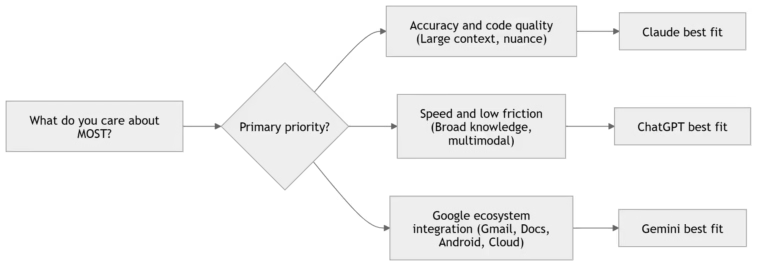
- Best general-purpose workhorse and ecosystem: ChatGPT (OpenAI).
- Best for careful reasoning, code quality, and big-context coding: Claude.
- Best for Google-integrated workflows, massive context, and speed: Gemini.
- The “best” for you depends mainly on: which ecosystem you live in, how you value accuracy vs speed, and what you’ll actually pay each month.
Claude vs ChatGPT vs Gemini; Below is a structured decision flow to pick your main assistant in 2026.
1. How each assistant positions itself in 2026
Claude vs ChatGPT vs Gemini; Compere table
| Claude (Anthropic) | ChatGPT (OpenAI) | Gemini (Google) | |
|---|---|---|---|
| Flagship models (2026) | Opus 4.6 (April 2026, 1M-token context) + Sonnet 4.6 + Haiku 4.5 | GPT‑5.3 Instant (128K context) and GPT‑5.4 Thinking (196K context) | Gemini 2.x family, including 2.5 Pro and 2.0 Flash; “Deep Research” planning/agent mode and massive context windows |
| Core positioning | Safety-first, careful reasoning, strong on coding and “agentic” workflows | Broad, general-purpose assistant with apps, agents, and Codex across many environments | Deeply integrated into Google (Search, Workspace, Android, Cloud) and very strong at long-context, multi-step planning and media (images/audio/video) |
| Notable constraints | Conservative safety filters; can sometimes be verbose or refuse more than competitors | Lower context ceilings than Claude/Gemini’s top-tier models; no 1M-token option in ChatGPT UI (via API you can orchestrate large windows yourself) | Occasional inconsistencies and weaker adherence to strict coding patterns vs Claude; can vary in reasoning depth |
| Business posture | Claude Code, Claude for Teams/Enterprise (admin, SSO, data governance, compliance) | ChatGPT Business/Enterprise with admin, SSO, compliance (SOC 2 Type 2, GDPR/CCPA support), and Codex for code/docs actions | Gemini Enterprise Agent Platform with enterprise agents, deep integrations into Google Cloud, support and compliance controls |
2. Models and capabilities in 2026
Claude (Anthropic)
- Model family (as of March–April 2026):
- Haiku 4.5: ultra-fast, low-cost, smaller context (good for classification/routing).
- Sonnet 4.6: “workhorse,” strong coding and complex reasoning at lower cost.
- Opus 4.6: flagship with 1M-token context; optimized for advanced coding, agentic workflows, and enterprise knowledge work. Opus 4.6 launched April 16, 2026 with stronger performance across coding, vision, and complex multi-step tasks.
- Context:
- Opus 4.6 and Sonnet 4.6 can ingest entire codebases, long documents, or months of business data in a single conversation (1M-token context).
- Benchmarks (2025–2026):
- Coding and agentic workflows: Claude Opus/Sonnet are at or near the top of independent benchmarks; one detailed guide notes Claude Code’s agentic coding score at ~80.8% on SWE-bench and Sonnet 4.6 at 79.6%.
- Safety style:
- Anthropic’s Constitutional AI approach aims to make Claude more cautious and aligned, which shows up as more conservative refusals and careful tone in practice.
ChatGPT (OpenAI)
- Model family (frontier, in ChatGPT in 2026):
- GPT‑5.3 Instant: 128K context, fast answers, “everyday tasks” model.
- GPT‑5.4 Thinking: 196K context, deeper reasoning mode for complex problems.
- Pro adds access to GPT‑5.4 Pro reasoning; Enterprise/Edu also have configurable model routing, including an option to route “Auto” reasoning requests to a cheaper “Thinking mini” with no credit consumption on flexible plans.
- Mini models (GPT‑5.4 mini/nano) for high-volume, lower-cost tasks.
- Ecosystem and tools:
- ChatGPT “Apps” ecosystem connects 60+ integrations (Slack, Google Drive, SharePoint, GitHub, Atlassian, etc.), Codex for reasoning over documents/codebases, Projects, Deep Research, and built-in web search.
- Business & enterprise:
- Business ($20/user/mo) and Enterprise bring admin controls, SAML SSO, SOC 2 Type 2 and GDPR/CCPA support, Codex, and no training on business data by default.
- Enterprise adds expanded context windows and advanced admin/security controls (SCIM, audit logging, data retention policies).
Gemini (Google)
- Model family (2026):
- Gemini 2.5 Pro: top-end text model for deep reasoning and complex tasks.
- Gemini 2.x Flash: low-latency, high-volume workhorse; earlier 2.5 Flash is $0.50 per 1M input tokens (as of a recent comparison).
- Imagen, Veo, Lyria, and audio/video models cover image generation and media understanding.
- Context and capabilities:
- Gemini API and Studio emphasize huge context windows and “Deep Research” for multi-step planning, plus tools like code execution, Google Search, and file search.
- Live audio (native) and text-to-speech (TTS) models enable voice-in/voice-out scenarios.
- Ecosystem fit:
- Deeply integrated with Workspace (Gmail, Docs, Sheets), Android, Google Cloud, and Firebase, making Gemini especially strong if your stack is Google-native.
3. Qualitative comparison: where each wins
The following Claude vs ChatGPT vs Gemini; Qualitative comparison below are
Claude: where it’s strongest
- Coding and complex reasoning:
- Multiple 2026 analyses and benchmarks put Claude’s Opus/Sonnet near the top for coding; one independent guide notes Sonnet 4.6 at 79.6% SWE-bench Verified and highlights that developers using Claude Code often prefer Sonnet 4.6 to the previous Opus 4.5 for speed/quality balance.
- A detailed coding comparison in January 2026 ranked Claude: best for complex logic, debugging, and code quality; ChatGPT: best all-rounder with breadth; Gemini: fastest with massive context.
- Very long, artifact-heavy tasks:
- 1M-token context windows (Opus 4.6/Sonnet 4.6) make Claude well-suited to large codebases and long-document workloads without chunking.
- Safety-conscious enterprises:
- Anthropic’s safety posture tends to align well with regulated environments; Claude Enterprise offers governance features (audit logs, data retention, compliance APIs, role-based access).
- Where Claude falls short:
- Sometimes slower and more verbose.
- Can be more cautious about content, which some users experience as over-refusals.
- Knowledge breadth: strong but not as encyclopedically broad as ChatGPT across niche frameworks and less common libraries.
ChatGPT: where it’s strongest
- General-purpose breadth:
- Strong across coding, writing, analysis, media, and everyday tasks. GPT‑5.x models plus OpenAI’s broader tooling (Codex, web search, apps) make ChatGPT the most versatile single assistant.
- Plugin/apps and ecosystem:
- 60+ apps (Slack, Google Drive, SharePoint, GitHub, Atlassian, etc.) let you bring your data into ChatGPT, build automations, and centralize work.
- Multimodal and productivity:
- Voice, images, and in-UI canvas are native strengths; ChatGPT Pro also expands deep research and agent mode for longer tasks.
- Business and admin:
- ChatGPT Business/Enterprise include SSO, SOC 2 Type 2, encryption, and no training on business data by default, plus Codex for document/code tasks.
- Where ChatGPT falls short:
- Context ceiling for a single chat in the UI (128K/196K) is lower than Claude’s 1M and Gemini’s multi-million-token approaches when used directly as a chat assistant.
- Very complex coding/debugging can sometimes be less precise than Claude, which many practitioners report excels at finding subtle bugs and explaining edge cases.
Gemini: where it’s strongest
- Speed and massive context:
- Multiple user comparisons and docs consistently highlight Gemini’s speed and very large context (up to 1M tokens in some contexts), great for big repos and long documents.
- Gemini 2.x Flash is tuned for high volume and low latency; earlier pricing data had 2.5 Flash at $0.50/1M input tokens and 2.5 Pro around $2–3/1M (illustrating aggressive pricing from Google).
- Google ecosystem integration:
- For Gmail/Docs/Sheets/Android/Google Cloud use cases, Gemini is hard to beat: deep ties into Search, Workspace, and Google AI Studio.
- Multimodal:
- Strong image generation (Imagen), video (Veo), and audio capabilities, with TTS and native audio.
- Enterprise agents:
- Gemini Enterprise Agent Platform and Deep Research aim at multi-step agent workflows and collaborative planning, which differentiates it in enterprise settings.
- Where Gemini falls short:
- In coding-heavy evaluations, Claude often ranks ahead on correctness and code quality, while ChatGPT and Gemini trade blows on complex logic.
- Consistency: some users report more variation in answers to the same question compared with Claude or ChatGPT.
4. Pricing and plans in 2026 (consumer and business)
Pricing and plans – Claude vs ChatGPT vs Gemini;
Claude — consumer & team
- Individual (claude.ai):
- Free: web, iOS, Android, desktop with daily usage limits.
- Pro: $20/mo (annual discounts apply); adds Claude Code (terminal), file creation and code execution, Google Workspace integration, remote MCP connectors, extended reasoning models.
- Max: $100/mo (5x usage) or $200/mo (20x usage) for power users who need much higher limits and priority access.
- Team & Enterprise:
- Team Standard: $25/user/mo (annual $30/mo); SSO, domain capture, centralized billing, basic admin.
- Team Premium: $150/user/mo; adds Claude Code access and early collaboration features for dev-heavy teams.
- Enterprise: custom pricing; all team features plus expanded context, SCIM, audit logging, compliance APIs, and custom data retention—aimed at regulated orgs.
ChatGPT — consumer & business
- ChatGPT consumer plans:
- Free: limited GPT‑5.3 access, limited messages/uploads and limited deep research.
- Go: $8/mo; more access to GPT‑5.3, messages, and uploads; plan may include ads.
- Plus: $20/mo; adds advanced reasoning models, expanded messages/uploads, more image creation, expanded deep research and agent mode, and longer memory/context, plus projects and custom GPTs.
- Pro: $100/mo and up; 5–20x higher usage, GPT‑5.4 Pro reasoning, maximum Codex tasks, unlimited GPT‑5.3/file uploads, and max deep research/agent mode.
- Business & Enterprise:
- Business: $20/user/mo (annual billing available); unlimited GPT‑5.4 messages with generous access to GPT‑5.4 Thinking, 60+ apps, SAML SSO, MFA, compliance support (GDPR/CCPA, SOC 2 Type 2 aligned), encryption, and no training on your data by default; includes Codex access.
- Enterprise: sales-led; adds expanded context windows, enterprise-level security and controls (SCIM, audit logging, user analytics, domain verification, RBAC), and advanced data-privacy policies (custom retention, data residency).
Gemini — consumer & business
- Gemini API (developer, token-based):
- Free tier: generous free limits and access to certain models, with free input/output tokens and Google AI Studio access.
- Paid: higher rate limits, access to advanced models (e.g., 2.5 Pro), context caching, batch API, and enterprise-grade features via Google Cloud and the Gemini Enterprise Agent Platform.
- Consumer access:
- Gemini is also available via Google AI Studio and integrations into Workspace, Android, and Search; many experiences are “free” or included in Google One/Workspace plans, though heavy API usage or advanced agent capabilities will incur pay-as-you-go or enterprise commitments.
5. Cost efficiency at the API level (high-level)
Claude vs ChatGPT vs Gemini; A late-2025–early-2026 pricing comparison (updated Feb 2026) summarizes relative API costs this way: GPT‑5.2 Pro is OpenAI’s main frontier; Gemini 2.5 Pro and Flash form Google’s; Claude Opus 4.6 and Sonnet 4.6 sit at premium tiers with big context windows.
Relative takeaways for “cost vs capability”:
- Claude’s Sonnet 4.6 and Opus 4.6 are priced higher than GPT‑5 mini but below GPT‑5.4 and many Gemini tiers on a per‑token basis; you’re paying for reasoning, large context, and strong coding performance.
- Gemini 2.5 Flash and Pro are positioned aggressively on price relative to top-end GPT/Claude models, which often makes Gemini extremely cost-efficient if you can work within its quality profile.
- GPT‑5.4 mini and nano are the cheapest OpenAI options for high-volume, simpler tasks.
6. Enterprise and compliance: how they differ
Enterprise and compliance compere – Claude vs ChatGPT vs Gemini;
| Claude | ChatGPT | Gemini | |
|---|---|---|---|
| Team/Enterprise baseline | Team Standard $25/user/mo; Team Premium $150/user/mo; Enterprise custom with expanded context, SCIM, audit logs, compliance APIs, data retention options | Business $20/user/mo; Enterprise adds expanded context, SCIM, audit logging, RBAC, advanced data-privacy, and optional data residency | Gemini Enterprise Agent Platform with enterprise agents, support, security, compliance, and volume discounts; detailed pricing via Google Cloud sales |
| Data residency | US-only routing available at 1.1x for Opus 4.7 (from Anthropic’s pricing page); via cloud providers (AWS Bedrock, GCP Vertex, Azure) you can choose region-specific endpoints | Data residency options available for Enterprise (per OpenAI docs) | Via Google Cloud you can choose regions and compliance frameworks familiar to GCP customers |
| Compliance certifications | Emphasis on safety and evaluation; Anthropic publishes extensive evaluations and safety docs; Team/Enterprise adds governance features | SOC 2 Type 2 and GDPR/CCPA support declared for Business; Enterprise adds SLAs and advanced controls | Leverages Google Cloud’s compliance infrastructure and controls; specific certifications depend on your GCP contract and Gemini Enterprise terms |
| “No training” commitments | Anthropic states Claude API does not train on customer data; team/enterprise add contractual data handling terms | Business/Enterprise: “no training on your business data by default”; consumer plans may use data to improve models unless you opt out | Google states content is not used to improve models for API customers with paid tiers; check your Google Cloud terms for details |
7. Practical recommendations by scenario
- If you want the smartest coding assistant overall:
- Use Claude (Sonnet 4.6 or Opus 4.6) as your “reasoning brain,” especially for debugging tricky bugs and large, multi-file refactors. Combine with ChatGPT if you need broader knowledge or ecosystem integrations.
- If you want the best all-rounder for daily work:
- Use ChatGPT (Plus/Pro) as your primary assistant. Its breadth of tools (apps, Codex, Deep Research, canvas, projects) and strong general reasoning make it the lowest-friction default choice.
- If you live inside Google:
- Use Gemini. It’s tightly integrated into Gmail/Docs/Drive/Android and Google Cloud; Deep Research and Flash make it fast for planning across Google data.
- If cost per token matters for high-volume coding:
- For APIs, consider Claude Sonnet 4.6 for most coding (good price/performance ratio), dropping to Opus 4.7 only for the hardest problems; use Gemini Flash or GPT‑5.4 mini when latency and cost are top priorities.
8. “Combo stacks” that work well in practice
Claude vs ChatGPT vs Gemini; Many teams in 2026 don’t pick one; they use a stack:
- Claude + ChatGPT:
- Claude for code correctness and large-context reasoning; ChatGPT for apps/ecosystem, brainstorming, Codex, and quick drafts.
- ChatGPT + Gemini:
- ChatGPT for general work and Codex; Gemini for Google ecosystem tasks and massive-context research.
- Claude + Gemini:
- Claude as reasoning core and for tasks where precision matters; Gemini for speed and Google-native integrations (Docs, Drive, etc.).
- Claude + ChatGPT + Gemini + IDE coding tools (e.g., GitHub Copilot, Cursor):
- Claude API for backend agents; ChatGPT as a general UI and for some coding; Gemini for large-context planning; coding done in your IDE with tools like Cursor (Claude-based) or GitHub Copilot (GPT-based).
9. A simple cheat sheet
- Pick Claude if:
- Code quality and correctness are top priority.
- You need 1M-token context for large codebases or long documents.
- You want safety-conscious, reasoning-focused behavior for sensitive work.
- Pick ChatGPT if:
- You want one assistant that does “everything well enough” with a huge app ecosystem.
- You value built‑in tools (Codex, Deep Research, canvas, projects), plugins, and ChatGPT’s wide integrations.
- You need enterprise controls, SSO, and compliance support today, with clear vendor (OpenAI).
- Pick Gemini if:
- You live in Google’s ecosystem (Workspace, Android, Firebase, Cloud).
- Speed and very large context windows matter more than top‑tier reasoning on every task.
- You’re building agents on Google Cloud and want native integration with Search/Docs/Gmail.
10. Reality check (no “perfect” winner)
Claude vs ChatGPT vs Gemini; Independent tests and user reports in 2025–2026 agree on a few things:
- There is no single “best” AI assistant for everyone; each provider optimizes for different profiles (reasoning vs speed, ecosystems, cost).
- Claude is widely considered best on careful reasoning and coding benchmarks; ChatGPT leads on ecosystem versatility; Gemini leads on speed and Google integration.
- The smartest move for most people is a combo stack: choose a primary assistant (often ChatGPT) and add Claude or Gemini for specific high‑value scenarios.
Claude vs ChatGPT vs Gemini; If you share your top two use cases (e.g., “complex debugging in a big monorepo” + “drafting and editing long docs with live web search”), I can recommend a concrete stack and plan-level options (which apps, which tiers, and roughly how much per user per month).