
Programmatic advertising now accounts for 90% of all US display ad spend. Best Programmatic Advertising Platform DSP; Compare the top DSPs — The Trade Desk, Google DV360, and Amazon DSP — on audience targeting depth, brand safety controls, and minimum spend thresholds.
Best Programmatic Advertising Platform DSP in 2026: The Trade Desk vs DV360 vs Amazon DSP
📋 Best Programmatic Advertising Platform DSP; Here’s a practical, 2026-ready comparison of The Trade Desk (TTD), Google Display & Video 360 (DV360), and Amazon DSP — focused on audience depth, brand safety, and minimum spend thresholds.
Main takeaways (short version)
- Programmatic is now the default for display: 90%+ of digital display spend in the U.S. is programmatic, and global programmatic display is approaching 95% by 2027.
- The Trade Desk: the “independent, open-web” DSP. Very deep omnichannel inventory (CTV/DOOH, audio, native, display, video), transparent cost-plus pricing, strong brand-safety Inventory Controls; typical minimums around $300k–$1M/month.
- Google DV360: the “Google ecosystem” powerhouse. Best-in-class access to YouTube/GDN and deep Google data integration; good brand-safety tools (digital content labels, sensitive categories, third‑party verification integrations); practical minimums often ~$50k+/month for effective use, with no fixed published floor.
- Amazon DSP: the “commerce and streaming” DSP. Unmatched first‑party shopping and streaming signals, clean-room based identity and lookalikes, strong Amazon/Twitch inventory and expanded third‑party supply; brand suitability controls (content exclusion categories, inventory tiers, 3P verification via DoubleVerify/IAS); realistic entry usually in the ~$35k–$75k/month range, though self‑serve via partners can dip lower.
Quick decision map
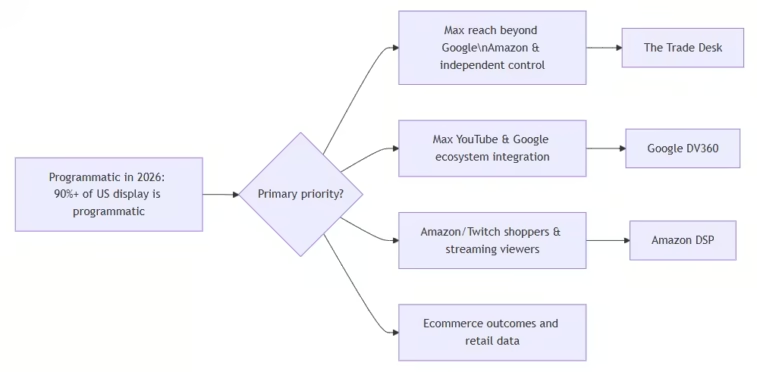
Best Programmatic Advertising Platform DSP; Use this as a starting point. Most large advertisers end up using more than one over time.
How programmatic fits into 2026 display spend
- Programmatic now accounts for 90%+ of digital display ad spend (U.S.) and is projected to surpass 95% of digital display by 2027.
- That’s why choosing the right DSP (or mix of DSPs) matters: Best Programmatic Advertising Platform DSP; you’re deciding where your 90%+ of display budget should live and under what rules.
Platform-by-platform comparison
1) The Trade Desk (TTD)
- Positioning: Independent DSP, agnostic to walled gardens; buys across open internet.
- “The leading independent DSP” for data‑driven marketers; audience‑first data-driven targeting; premium omnichannel inventory.
- Channels: Display, video, mobile, native, audio, CTV/OTT, digital out‑of‑home (DOOH).
- Differentiator vs Google/Amazon: no “own” media bias; works with 500+ exchanges/SSPs globally for broad, neutral access.
- Audience targeting depth
- First‑ and third‑party data: TTD emphasizes its “identity solutions” (Unified ID 2.0, EUID) and cross‑device graph to reach audiences without relying solely on third‑party cookies; supports your own CRM and data partnerships plus a marketplace of third‑party data segments.
- Audience-first tools: define ideal customers, then discover similar audiences (“find more relevant audiences”), with advanced forecasting to plan reach/frequency before campaigns go live.
- Data partners: wide third‑party data integrations (add‑on CPMs) plus strong retail data option; supports lookalikes and custom modeling for prospecting and retargeting.
- Brand safety and suitability controls
- TTD’s brand safety is anchored in Inventory Controls (within its Kokai feature set), allowing you to filter inventory by brand safety, viewability, and contextual alignment up front, and to refine as campaigns run.
- Controls are designed to exclude unsuitable sites, formats, or content categories so impressions concentrate in brand‑safe, high‑quality environments.
- Additional capabilities: third‑party verification, fraud protection, and IVT monitoring are supported via its partners and stack (TTD highlights fraud prevention and brand‑safety focus in its resources, though verification partners are managed via integrations; Best Programmatic Advertising Platform DSP; official docs highlight IAS/DoubleVerify/Scope3 for DV360, while TTD emphasizes its own Inventory Controls as its primary control surface).
- Minimum spend and pricing (practical reality, 2026)
- Pricing model: “Transparent cost‑plus” — you see a ~20% platform fee on media plus separately itemized media and data costs; minimum commitments typically in the $300k–$1M/month range depending on market and contract.
- Practical implication: TTD is generally not for small budgets; it fits mid‑to‑large brands and agencies that need transparent cost breakdowns and heavy cross‑channel/CTV scale.
2) Google Display & Video 360 (DV360)
- Positioning: Google’s enterprise DSP tightly integrated with the Google Marketing Platform.
- Part of Google Marketing Platform; Best Programmatic Advertising Platform DSP; integrates with Campaign Manager 360, Analytics 360, and Google Ads for a single view of campaigns, audiences, and measurement.
- Designed for large‑scale, complex programmatic with more control and inventory access than Google Ads (display and video focused).
- Audience targeting depth
- Data richness: Leverages first‑, second‑, and third‑party data within Google’s ecosystem; Best Programmatic Advertising Platform DSP; allows you to manage audiences from your own data, Analytics 360 segments, and Google Audiences, and apply them across display/video/CTV/audio.
- Inventory: reach across 80+ ad exchange networks with 90%+ of internet reach, plus privileged access to YouTube and Google Display Network inventory.
- Integration benefits: Analytics 360 and GA4 can feed audiences into DV360 for precise segmentation; YouTube and TrueView inventory are available to buy directly within DV360.
- Brand safety and suitability controls
- Brand safety targeting: you can target inventory by digital content label tiers (from “DL-G” for general audiences up to “DL-MA” for mature‑only), with support for mobile app and CTV inventory. Best Programmatic Advertising Platform DSP; Categories are classified into levels like Sexual, Derogatory, etc., and can be excluded by line item.
- Content themes and inventory modes: Google is unifying suitability controls across YouTube, Google Ad Manager, and third‑party inventory, with content theme exclusions and inventory modes — and these controls can be bypassed for non‑reservation deal line items when needed.
- Third‑party verification: DV360 supports Structured Data File (SDF) integrations with third‑party verification vendors (Integral Ad Science, DoubleVerify, Scope3) to apply labels for brand safety, suitability, fraud/IVT, and viewability across line items.
- Fraud & IVT: Built‑in fraud prevention and detection; Google advertises detection and filtering of fraudulent impressions and refunds where applicable.
- Minimum spend and pricing
- No official published floor, but industry guidance is clear: DV360 is enterprise‑grade, with practical minimums commonly around $10,000/month and more like $50,000+/month to use it effectively. Best Programmatic Advertising Platform DSP; A DV360 blog notes typical expectations in the U.S. at ~$10,000+/month and up for serious usage, and ~₹3–₹5 lakh/month in India for noticeable impact. Some partners cite ~$50k/month minimum to access DV360 directly.
- Pricing: “Bundled” platform fee (estimated ~15–20% of media) plus third‑party data and optional advanced/verification fees; total cost is often quoted as a single CPM or total media cost.
3) Amazon DSP
- Positioning: Commerce‑centric DSP with unique first‑party shopping and streaming signals.
- Officially: an omnichannel marketing solution that lets you programmatically buy ads across Amazon and third‑party apps/sites, with privacy‑centric identity and AI‑powered optimization; built for reach on Amazon properties and third‑party supply at scale.
- Premium supply: Amazon‑exclusive properties (Amazon.com, Prime Video, Twitch, Fire TV) plus third‑party sites and apps via direct integrations with leading SSPs/publishers.
- Audience targeting depth
- Unique signals: Amazon DSP leverages expansive browsing, shopping, and streaming signals to build deterministic and modeled audiences — with “Amazon Audiences” (in‑market, lifestyle, demographic) and cross‑source lookalike modeling that works without relying on traditional identifiers.
- Lookalikes and AMC: AMC lookalikes let you use cross‑source signals to build “seeds” based on engagement and conversion patterns on Amazon media and stores; rule‑based and custom audiences via AMC allow fine‑grained segments across Amazon Ads and DSP.
- Demographic and contextual targeting: strong demographic and contextual options combined with retail insights; Amazon highlights demographic and in‑market/lifestyle segments as core to Amazon DSP planning.
- Brand safety and suitability controls
- Content exclusion categories and inventory tiers: Amazon DSP supports content exclusion categories as on/off switches, plus Inventory Tier controls (three tiers) to choose inventory types with one‑time setup; Brand Suitability reporting shows coverage across tiers and exclusions.
- Twitch suitability: Amazon DSP added brand suitability controls for Twitch ads, giving advertisers more control over where their creative shows on Twitch.
- 3P verification: Amazon supports third‑party verification vendors (3P measurement) to check for fraud and invalid traffic, brand safety, and viewability across inventory; list includes vendors like DoubleVerify and others (Amazon’s help center references 3P measurement integrations).
- Minimum spend and pricing (practical 2026 reality)
- Official guidance: Amazon’s own DSP guide says “Budget minimums apply” for managed-service and self‑serve paths.
- Managed service: historically around $35,000/month minimum; many sources suggest realistic effective use in the $50k–$75k/month range.
- Self‑serve via partners: Amazon DSP self‑serve can be accessed through agencies/tech partners, sometimes with effectively lower practical entry points (e.g., ~$5k–$10k/month via approved resellers), but those are exceptions — Amazon’s own ad‑tech solutions page still says “Budget minimums apply.”
- Time to results: plan on a ~6‑month commitment (at least 90 days) to properly test and optimize before judging performance; Amazon DSP is not a short‑term, low‑budget tactic.
Side‑by‑side on your three key criteria
1) Audience targeting depth
- Breadth of data and identity:
- The Trade Desk: widest third‑party data marketplace and identity graph (UID2/EUID); strong for cross‑device, cookie‑free identity and multi‑partner data onboarding.
- DV360: strongest when you live inside Google’s ecosystem — rich first‑party (Analytics 360, GA4, Google Audiences) plus Google’s huge intent and behavior signals; works best for YouTube‑centric strategies and cross‑channel with Google Search/Analytics.
- Amazon DSP: unmatched for commerce and streaming — Amazon Audiences, AMC lookalikes, retail and streaming purchase/viewing signals, and built‑in demographic/lifestyle modeling; ideal if your customers are shoppers or streamers.
- Typical audience capabilities in 2026:
- All three: support behavioral, contextual, demographic, retargeting, and lookalike modeling.
- TTD and DV360: broadly support CTV, DOOH, audio, and in‑app environments; Amazon DSP is expanding CTV but is strongest in Amazon/Twitch inventory and third‑party apps.
- All three: moving to privacy‑safe identity (UID2/EUID, Amazon’s clean rooms, Google’s signals), reducing reliance on third‑party cookies.
2) Brand safety and suitability controls
- The Trade Desk:
- Inventory Controls: filter by brand safety, viewability, and contextual alignment; exclude unsuitable sites/formats up front; refine as campaigns run. Best Programmatic Advertising Platform DSP; Designed explicitly to keep impressions in high‑quality, brand‑appropriate environments.
- Complementary: third‑party verification and fraud protection available; TTD emphasizes that Inventory Controls are your primary in‑platform mechanism to enforce standards.
- Google DV360:
- Digital content label tiers: “DL‑G” (general) through “DL‑MA” (mature only); you can target or exclude inventory based on these labels across display, video, and audio.
- Sensitive categories: exclude Sexual, Derogatory, Violence, etc., across display/video/audio line items; Google updates classification monthly.
- Inventory modes/content themes: unified controls across YouTube, Google Ad Manager, and third‑party O&O; ability to bypass suitability controls for non‑reservation deal line items when needed (with controls like content themes coming).
- Third‑party verification: structured support for Integral Ad Science, DoubleVerify, and Scope3 labels for brand safety, suitability, fraud/IVT, and viewability via SDF.
- Fraud/IVT: built‑in fraud prevention and detection for invalid traffic, with ability to exclude flagged inventory and get refunds where applicable.
- Amazon DSP:
- Content exclusion categories: global set of content categories you can exclude via on/off switches; these apply across campaigns and simplify maintaining brand standards.
- Inventory tiers: three-tier framework to choose inventory types with a one‑time setup; combined with exclusions for precise control.
- Twitch suitability: brand suitability controls specifically for Twitch ads launched in 2025; you can set where your ads show on Twitch.
- 3P verification: use third‑party vendors (e.g., DoubleVerify, others) for fraud, IVT, brand safety, and viewability across inventory, including Twitch via DSP.
3) Minimum spend thresholds — what you actually need (2026 view)
- The Trade Desk:
- Typical: $300,000–$1,000,000/month minimums depending on your market and agreement; transparent cost‑plus model (~20% platform fee on top of media).
- Best fit: large advertisers/agencies with big cross‑channel budgets (especially CTV/DOOH) that need transparent cost separation and broad exchange access.
- Google DV360:
- Official stance: no fixed published floor, but access usually comes via Google or certified partners with practical expectations of tens of thousands per month; common benchmarks: ~$10,000+/month to get going, ~$50,000+/month for meaningful scale in the U.S., with similar patterns in India (₹3–₹5 lakh/month).
- Some industry sources cite ~$50,000/month as a common threshold for direct DV360 access.
- Best fit: brands already investing heavily in YouTube, Google properties, and GA4/Analytics 360 who want deep Google‑centric measurement and audiences.
- Amazon DSP:
- Official guidance: “Budget minimums apply” (managed and self‑serve).
- Historical managed minimum: about $35,000/month; many experts recommend $50,000–$75,000/month for meaningful results.
- Self‑serve via partners: partners may enable access at lower practical spends (e.g., ~$5,000–$10,000/month), but that’s partner‑dependent and not guaranteed.
- Best fit: brands selling on/off Amazon (or retail broadly) and/or using Twitch/Prime Video, with budgets in the mid–five figures monthly and a 6+‑month horizon.
What this means for your 2026 programmatic stack
- Choose The Trade Desk if:
- You want maximum independence from Google/Amazon walled gardens.
- Your plan is CTV‑heavy, with omnichannel (audio/DOOH/native/video) at significant scale.
- You need highly transparent cost breakdowns and sophisticated first‑party/identity graphs across the open internet.
- Choose Google DV360 if:
- YouTube, GDN, and Google properties are central to your media plan.
- You’re already using Analytics 360, GA4, and Campaign Manager 360 and want tight ecosystem integration and measurement.
- You need Google’s brand‑suitability tooling and third‑party verification (Integral Ad Science, DoubleVerify, Scope3) at scale.
- Choose Amazon DSP if:
- Ecommerce and retail signals are core to your targeting (shoppers on Amazon, Twitch/Prime Video viewers).
- You want privacy‑safe, commerce‑rich audiences and clean‑room identity, plus strong retail‑oriented measurement.
- Your budgets are in the ~$35k–$75k/month band and you can commit to at least ~90 days for proper learning.
Spotify Advertising fills the audio gap most programmatic stacks leave unaddressed. Podcast and music inventory on Spotify is accessible programmatically via the Spotify Ad Exchange, with integrations into The Trade Desk, DV360, and Amazon DSP — the same platforms this comparison covers.
Ads are matched to listener moments derived from real-time listening behavior rather than declared demographics or third-party cookies, making the signal privacy-safe and behaviorally grounded. For cross-channel buyers already operating at meaningful programmatic spend, Spotify offers audio, video, display, and carousel formats across 751M+ fans in 180+ markets inside a single platform.
Practical tips to choose (and run) in 2026
- Start with your “why”: Are you prioritizing YouTube/Google ecosystems (DV360), Amazon shoppers/streamers (Amazon DSP), or the broadest independent web/CTV supply (TTD)?
- Budget realistically:
- Sub‑$10k/month: usually better on Google Ads self‑serve or Amazon Sponsored Products/Brands rather than DV360/Amazon DSP.
- ~$10k–$50k/month: consider DV360 or Amazon DSP via partners for testing; still likely below TTD’s typical minimums.
- $50k–$100k+/month: you’re in the core zone for DV360 and Amazon DSP (and may approach TTD’s practical floors).
- Brand safety by design:
- Set categories/exclusions and inventory tiers up front (TTD Inventory Controls; DV360 digital content labels/sensitive categories; Amazon DSP content exclusion categories and inventory tiers).
- Turn on third‑party verification where risks are highest (DV360 via SDF labels; Amazon DSP via 3P).
- Measure against outcomes, not impressions:
- All three platforms support advanced measurement and attribution; tie programmatic to your sales/retail KPIs so you can see ROAS/merchandise impact, not just CTR.
Best Programmatic Advertising Platform DSP; If you share your monthly programmatic budget range, primary KPIs (brand vs response), and which ecosystems matter most (YouTube vs Amazon vs open web), I can sketch a more concrete platform mix and budget split for 2026.