
PPC management services average $60 CPC in Google Ads — meaning advertisers pay $60 per click to acquire clients. Compare the top PPC agencies and self-service tools by pricing, ROAS benchmarks, and industry specialization.
Best PPC Management Services in 2026: Agencies & Tools That Actually Deliver ROAS
Best PPC Management Services; Great question. Managing Google/Meta/Microsoft PPC in 2026 without the right stack is one of the fastest ways to burn money—or to print ROAS.
Quick takeaways (2026 view)
- Average Google Ads CPCs vary a lot by industry. Benchmarks from Growth.io for 2026 show a wide spread: Advocacy ~$1.43 CPC, Auto $2.46, B2B Services $3.33, Dating & Personals $2.78, Ecommerce $1.16, Education $2.40, Finance & Insurance $3.44, Travel & Hospitality $1.53. Those are global averages; your actual auction CPCs will differ by country, account history, and Quality Score.
- Self-serve PPC tools can be extremely cost-effective for hands-on teams: Optmyzr (~$249/mo+ for Essential), WordStream (~$264–$350/mo for Advisor), Google Ads Editor/Analytics 4 (free but limited), and GA4 (free). For advanced automation and cross-platform, Optmyzr stands out in 2026; if you’re managing >$50k–$100k/mo, Optmyzr’s Rule Engine and scripts often justify the fee.
- Agencies vary widely in approach and pricing. The best 2026 agencies specialize in data-driven execution, creative testing, and landing-page rate optimization (CRO); many also integrate third-party tools like Optmyzr, WordStream, or Klipfolio into their workflows. Expect retainers starting around $750–$2,000/mo, but performance-based and hybrid models are growing.
- “Average CPC” isn’t a ROAS benchmark. Two advertisers can both pay $3/click; if one gets 5x more conversions, their CPC is effectively $0.60. Your ROAS depends mostly on conversion rate, average order value, and margin—so focus on CPA and incrementality, not “cheap clicks.”
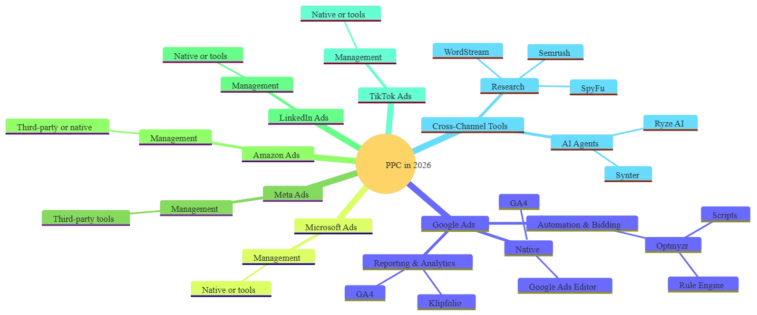
High-level PPC management stack for 2026
Best PPC Management Services; Here’s how the pieces fit together:
- Ad platform: Google Ads (core), Meta (Facebook/Instagram), Microsoft Advertising, LinkedIn, Amazon Ads, TikTok Ads.
- Management layer:
- Google’s native: Google Ads Editor, Google Analytics 4 (free).
- Automation & optimization:
- Keyword/bid management & scripts: Optmyzr, WordStream, Optmyzr vs WordStream.
- Cross-platform reporting & BI: Google Analytics 4, Klipfolio, Looker Studio, Power My Analytics, Supermetrics, AgencyAnalytics.
- AI agents/autonomous: Synter, Ryze AI, other AI agents (emerging in 2026).get-ryze+1
- Agency/human layer:
- Strategy, creative testing, feed optimization, CRO, and reporting layer built on top of the tools above.
Mermaid overview:
Channel Strategy Matrix
| Channel | Primary Management | Key 2026 Trend | Best For |
|---|---|---|---|
| Google Ads | Native (Editor) + Optmyzr | AI-driven bidding, PMax evolution, GA4 attribution | Search intent, high-volume campaigns, ecommerce |
| Meta Ads | Third-party (AdEspresso, Smartly, etc.) | Advantage+ automation, creative AI, privacy sandbox | Brand awareness, retargeting, visual storytelling |
| Microsoft Ads | Native or tools | Copilot integration, LinkedIn audience sync, lower CPCs | B2B, older demographics, Google overflow |
| Amazon Ads | Third-party or native | DSP self-serve, AMC analytics, retail media networks | Ecommerce, product launches, bottom-funnel |
| LinkedIn Ads | Native or tools (HubSpot, Metadata) | AI audience expansion, thought leadership formats | ABM, lead gen, professional targeting |
| TikTok Ads | Native or tools (TikTok Shop, Sprout) | Spark Ads, creator marketplace, live shopping | Gen Z, viral content, influencer collabs |
Top self-serve PPC tools in 2026 (focused on Google Ads)
Best PPC Management Services; These are the main options for hands-on teams and performance marketers.
- Optmyzr — best-in-class automation & rules for Google Ads (if you’re managing >$50k/mo)
- Strengths in 2026:
- Rule Engine: define if-then rules to automatically adjust bids, pause keywords, move budget, and enforce floor/ceiling CPCs by account, campaign, or portfolio. This is arguably Optmyzr’s defining advantage vs other tools.
- Scripts: run custom scripts (JavaScript-based) on a schedule to make bulk changes, e.g., refresh audiences, update exclusions, adjust budgets. groas
- Google & Microsoft Ads in one UI: manage Google and Microsoft Ads together from a single login.
- Portfolio budget pacing: allocate overall budget by channel/brand and auto-shift between channels.
- Anomaly detection & bid protection: helps avoid sudden CPC spikes and budget overshoots.
- Integrations: GA4, Google Analytics, Google Tag Manager, BigQuery, Looker Studio; good for larger marketing ops teams.
- 2026 pricing (publicly listed as of April 2026): Essential from ~$249/mo, Pro from ~$499/mo, and Enterprise quotes above $1,000/mo. Annual commitments; subscription scales with ad spend and account complexity.
- Best for:
- Medium to large accounts or portfolios (e.g., multiple brands or sub-accounts).
- Performance marketers who live in Google Ads and want to automate guardrails, scripts, and pacing.
- Watch-outs:
- Not a cheap “starter” tool; higher entry price.
- Still requires solid Google Ads know-how to design rules and interpret data.
- Use cases:
- Enforce max CPCs by portfolio/brand to protect ROAS at scale.
- Auto-pause low-performing search terms at scale.
- Reallocate budget weekly based on CPA and contribution margin by channel.
- Harmonize bid strategy across accounts.
- Strengths in 2026:
- WordStream — strong for multi-platform, heavy-feed accounts
- 2026 pricing: Advisor plans start around $264–$350/mo; Agency/enterprise tiers require custom quotes. Annual contracts common; subscription scales with spend and accounts.
- Strengths:
- Multi-platform: manage Google Ads, Microsoft Advertising, Meta, and Amazon from a single UI. Good for large feed-based accounts (especially ecommerce).
- Bid strategy & automation: robust bidding features and portfolio views.
- Feed-based campaign management: Shopping and Performance Max campaign management at scale (product feed, campaigns, bids).
- Cross-platform reporting & integrations: connects to analytics and data warehouses; strong for larger teams.
- Best for:
- Ecommerce and retail advertisers running Google Shopping, PMax, and Microsoft Shopping.
- Agencies managing multiple clients’ ad accounts across platforms.
- Watch-outs:
- Price is high for smaller accounts; best ROI when you have heavy feed-based spend.
- Semrush (part of a PPC “tool stack”) — best-in-class for research & competitor intelligence
- Pricing: starts around $129/mo (Pro plan) with higher tiers.
- Strengths:
- Massive keyword and competitor database; position tracking and SERP features; excellent for mining new opportunities and monitoring competitor ads.
- Integrations: exports to Google Ads, Microsoft Ads, etc.; often used alongside bid managers like Optmyzr or WordStream.
- Best for:
- Research and competitor intel: expand keyword lists, monitor competitor ads/landing pages.
- Supporting an existing bid management/automation tool with richer data.
- Google Ads Editor & Google Analytics 4 (free, from Google)
- Google Ads Editor: lightweight campaign management and bid rules (including max CPC and portfolio bid strategies) inside Google Ads. Good for simple safeguards and day-to-day management.
- GA4: Ads-linked analytics, exploration, pathing, and conversion modeling; strong for deeper post-click analysis and tying ad actions to revenue.
- Best for:
- Smaller accounts that need GA4-level analysis without paying for a separate BI tool yet.
- Use these free tools before layering on paid software.
Other notable tools and categories (2026)
Best PPC Management Services; These are typically layered on top of Google Ads or used by agencies.
- Reporting dashboards & BI (Klipfolio, etc.)
- Klipfolio: a BI/analytics connector to unify data from Google Ads, Meta, LinkedIn, etc., used by many agencies for client dashboards and attribution. Note: Klipfolio itself doesn’t manage campaigns; it aggregates and visualizes data from platforms and tools.
- Automation & AI agents (emerging in 2026)
- Synter: AI agent operator for Google/Meta/Microsoft/LinkedIn/X/TikTok/Amazon with conversational controls; executes campaigns and optimizations from a single interface.
- Ryze AI: autonomous PPC agent for Google, Meta, Microsoft; claims fully autonomous optimization 24/7 with minimal human intervention.
- Rule-based automation is still more predictable and auditable; AI agents are powerful but require guardrails and monitoring.
- Comparison sites and lead-lists for agencies
- OuterBox and 6S Marketers publish lists of PPC agencies; OuterBox also covers Google Ads management as a service line. Good for discovering agencies if you’re considering outsourcing.
- Software review aggregators (G2, GoodFirms, Software Advice) summarize user reviews and comparisons for PPC tools. Best PPC Management Services; Use them to sense-check current experiences.
How to choose between: agency vs self-serve tools
- Start with your situation:
- In-house team? How many people? How much time per week can you dedicate to optimization?
- Monthly ad spend: under $10k/mo vs $50k–$200k+/mo.
- Channels: Google-only vs Google+Meta+Microsoft/Amazon/TikTok/LinkedIn.
- Data maturity: do you have clear revenue tracking (GA4, server-side tracking, CRM)? If not, prioritize getting that right before paying for advanced tools.
- When an agency makes more sense (2026):
- Spend is large (often >$30k–$50k/mo across channels) and growing fast.
- You lack specialized in-house roles (e.g., no dedicated PPC data analyst, CRO specialist).
- Vertical is complex or highly regulated (legal, finance, health, SaaS with long sales cycles).
- You want creative & CRO as a core competency, not just bid management.
- You’re okay with hybrid model:
- Agency owns strategy, creative, CRO, and reporting.
- Your team uses self-serve tools for execution and to keep agency honest (GA4, Optmyzr, WordStream, etc.).
- When self-serve is better:
- You have a strong in-house performance marketer with solid analytics and tracking setup (GA4 or equivalent, CRM, revenue data).
- Spend is moderate and mostly on Google Ads (maybe some Meta).
- You need granular, day-to-day control over bids, negatives, and budgets—Optmyzr or Google Ads Editor + GA4 can cover this.
- You want to bring some functions in-house over time to reduce reliance on an agency (e.g., move reporting, learn scripts).
What “good ROAS” means in 2026 (and how PPC tools help)
- Don’t obsess over CPC; target CPA and incrementality:
- ROAS = (Revenue − Ad Spend) / Ad Spend.
- Two accounts can both pay the same CPC; if one converts at 3x the rate, their effective CPC is 1/3 of the other. Best PPC Management Services; Your PPC partner (agency or tool) should help you:
- Raise conversion rate, and/or
- Increase average order value, and/or
- Lower CPA by improving Quality Score, relevance, and landing page experience.
- Use benchmarks to diagnose, not set targets:
- Check whether your CTR, CVR, CPA are meaningfully better or worse than industry averages for your vertical. Use that to prioritize campaigns (e.g., low CTR? Review ad relevance and offers. Best PPC Management Services; Poor CVR? Test landing pages and forms. High CPA? Check bid levels, audience targeting, and funnel friction).
- Set improvement goals: “Improve CPA by X% and CTR by Y% over next 90 days,” not “Achieve industry average CPC,” because CPCs vary widely by auction and you can still win at profitable CPCs if your conversion rate and AOV are high.
- How PPC management tools move the needle:
- Automation (Optmyzr, WordStream, scripts): keeps bids in line with your strategy so you don’t overbid on low-intent queries; ensures budget is shifted to high-ROI areas automatically and frees time for testing and analysis.
- Analytics/GA4 (GA4, Klipfolio): connects ad actions to revenue and LTV so you optimize for profit, not just cheap clicks.
- Agency execution: strong creative and CRO can materially lift CVR and AOV; Best PPC Management Services; this is often the biggest ROAS lever you have, more than bid tuning alone.
- AI agents (Synter, Ryze): promising but still emerging in 2026; they work best when you give them clear KPIs, constraints, and safe budgets; avoid giving them carte blanche to make account changes.
CPC benchmarks you can use in 2026 (reality checks)
Best PPC Management Services; These are averages and should be used as reference points, not targets. Actual performance depends on your location, account history, and Quality Score.
Search CPC by industry (global averages; Growth.io, 2026) :
- Advocacy: $1.43
- Auto: $2.46
- B2B Services: $3.33
- Dating & Personals: $2.78
- Ecommerce: $1.16
- Education: $2.40
- Finance & Insurance: $3.44
- Real Estate: $2.37
- Technology: $3.80
- Travel & Hospitality: $1.53
Other benchmark sources:
- WordStream’s blog and vendor comparisons often cite CPC ranges by vertical (use these to sanity-check your own numbers).
- Adplex and LocaliQ frequently publish average CPCs by industry for Google Ads; useful for high-level comparisons.
- Store Growers and Upgrow aggregate advertiser-reported CPCs; more reflective of small-business ecommerce.
How to use these in practice:
- If your actual CPA is comfortably below your customer acquisition target and your CPC is in the same ballpark as industry averages for your vertical (after adjusting for Quality Score and relevance), your campaigns are roughly efficient—focus next on improving CVR and AOV to push ROAS higher.
- If your CPC is far above benchmarks but your CPA is still okay, you may be in a hyper-competitive vertical or submarket; consider long-tail keywords, competitor offers, or tightening relevance (quality score, landing page experience).
- If your CPA is far above benchmarks and CPC is near or above average, prioritize creative and landing page changes, bid reductions on low-converting terms, and audience pruning—before adding more budget.
2026 platform selection checklist
- Google Ads–centric:
- Do you run mostly Google Ads?
- If yes, prioritize:
- Optmyzr (rules/scripts/portfolios), or Google Ads Editor + GA4.
- Add Semrush for competitor/keyword research if scale justifies.
- If you also run Microsoft Ads, WordStream deserves a close look.
- Avoid overbuying overlapping tools; choose one “brain” for bid strategy and scripts, and another for research/analytics.
- Multi-platform heavy spend:
- If you’re buying media on Meta, LinkedIn, Amazon, TikTok, and Microsoft in addition to Google:
- Strong options include WordStream, Optmyzr (Google+Microsoft), and agencies that use those plus Klipfolio for reporting.
- Ensure Google Analytics 4 or an alternative is properly wired to revenue so ROAS is measurable.
- If you’re buying media on Meta, LinkedIn, Amazon, TikTok, and Microsoft in addition to Google:
- Data-first, revenue-aware organization:
- If you’re a SaaS/ecommerce with solid server-side tracking and revenue attribution:
- GA4 (free) may be enough “reporting layer” if combined with simple dashboards.
- If you want unified cross-platform dashboards, Klipfolio or agency analytics can add value.
- If you’re a SaaS/ecommerce with solid server-side tracking and revenue attribution:
- Small business/lead gen with modest spend:
- Start with Google Ads Editor + GA4.
- Add Optmyzr or lighter bid management only if your account is complex enough that manual management bleeds time.
- If you hire an agency, ask which self-serve tools they use or can integrate with (Optmyzr, WordStream, GA4, Klipfolio) to ensure transparency.
Practical ROAS-focused routine (2026)
- Daily:
- Check pacing and budget usage; ensure automated rules and scripts are working as intended (Optmyzr/WordStream).
- Watch impression share and CTR by campaign; pause or down-bid obvious losers.
- Weekly:
- Review CPA by campaign/ad group; rebudget from low-ROAS to high-ROAS areas.
- Sync with revenue reports: LTV, pipeline, and closed-won for last-click or view-based attribution.
- Monthly:
- Compare actual CPA and CTR to industry benchmarks (Growth.io, WordStream, vendor reports) and set realistic improvement priorities.
- Work with agency (if applicable) to align on next month’s tests, creative refreshes, and landing page tests.
Red flags to avoid with PPC management in 2026
- Tool overload: running five PPC tools that all overlap mostly causes confusion and stale data. Best PPC Management Services; Pick one system of record for strategy/rules/scripts, one for research, and one for analytics/reporting.
- Chasing “cheap clicks” at the expense of quality:
- Aggressive broad-match or auto-bidding without guardrails can generate low CPCs but terrible CVR/CPA.
- Focus on CPA and ROAS, not winning the lowest CPC. Best PPC Management Services; Use tools like Optmyzr to set maximum CPC constraints at the keyword or portfolio level.
- Over-automation with AI agents:
- Letting AI agents freely change budgets and bids without guardrails or regular review can tank performance quickly.
- Use AI agents within clear rules (e.g., “don’t exceed $X CPA without approval”; “do not pause campaigns without notifying me”).
- Choosing an agency by logo alone:
- Verify they have a clear process for:
- Strategy, creative testing, CRO, feed optimization (if ecommerce), reporting, and attribution.
- Confirm which self-serve tools they will use (Optmyzr, WordStream, Klipfolio, etc.) and how you’ll get access.
- Ask how they measure success: ROAS targets, CPA targets by campaign/quarter, and testing cadence (creative/landing pages).
- Verify they have a clear process for:
If you tell me a bit more, I can narrow this down
- To tailor recommendations, I’d want to know:
- Monthly ad spend (rough range).
- Primary channel(s) (Google-only vs multi-platform).
- Industry and country (this affects CPC benchmarks).
- Whether you have in-house team or are 100% outsourced to an agency.
- Whether you currently use any of these tools (Optmyzr, WordStream, Semrush, Marin, Klipfolio, GA4, Google Ads Editor).