
Most small businesses waste 40–60% of their Google Ads budget on clicks that never convert. Google Ads Management for Small Business; This guide compares DIY campaign management, white-label agencies, and automation tools — with real cost benchmarks.
Google Ads Management for Small Business in 2026: DIY vs Agency — What’s Actually Worth It
Expert Google Ads management for small business. Boost CTR, reduce wasted spend & drive more qualified leads. Get started today! Below explore the Google Ads Management for Small Business in 2026 (Complete Guide);
1. Main takeaways (short version)
- Budget waste is common, not inevitable. In B2B SaaS accounts, one 2025 audit found 36.1% wasted spend on average, with poorly managed accounts wasting 50%+; top-quartile accounts kept waste below about 15%. Many SMBs run high-waste accounts due to thin tracking, weak keyword/audience alignment, and over-reliance on “set and forget” automation.
- Benchmarks you can use (global aggregates from 16,446+ campaigns, Apr 2024–Mar 2025): average CTR 6.66%, CPC $5.26, conversion rate 7.52%, cost per lead $70.11. Google Ads Management for Small Business; Use these as sanity checks, not gospel—your industry and location will differ.
- Agency fees in 2025–2026 commonly cluster around 10–20% of ad spend or flat retainers of roughly $800–$2,500/month for most SMBs. Small-budget accounts often see 20–30% fees; mid/large budgets trend lower (10–20%).
- White-label fulfillment typically prices at flat fees per account ($500–$800/month under $3k ad spend; $800–$1,500 for $3k–$10k; $1,500–$3,000+ above $10k) or 10–20% of spend—then agencies resell to clients at a markup.
- Automation tools (beyond Google’s native) start around $29–$100/month for DIY-focused platforms; power-user tools like Optmyzr sit higher (often $100–$500+/month), with promises of major time savings and fewer manual errors.
- The “right” path in 2026:
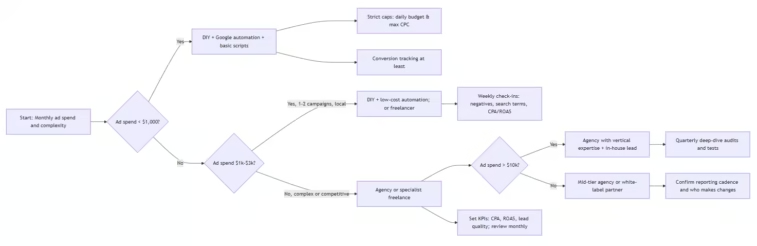
- Micro/low-budget (<$1,000/mo ad spend): DIY + Google’s built-in automation + strict tracking and limits.
- Small but serious ($1,000–$3,000/mo ad spend): DIY with a low-cost automation layer OR a small specialist/freelancer who actually works in your account (not just “report watching”).
- Growth-stage ($3,000–$10,000+/mo ad spend): Strong case for an agency (or white-label partner if you’re an agency) with clear KPIs; expect 10–20% of spend or a $1,500–$2,500/mo flat fee.
- High spend/complexity ($10,000+/mo, multiple campaigns/regions): An agency with deep experience in your vertical + your internal lead who owns strategy and data.
2. How much Google Ads budget actually gets wasted?
Google Ads Management for Small Business; It’s not a myth. A 2026 analysis of 43 enterprise B2B SaaS Google Ads accounts found 36.1% wasted spend on average, with worst-case accounts losing 50%+ of budget to non-converting traffic; top-quartile accounts ran under ~15% waste. That’s one vertical, but the pattern (misaligned targeting, weak negatives, thin conversion tracking) is similar in many SMB accounts.
Analytics studies show the majority of Google Ads budget waste concentrates in a few specific “leak” zones: misaligned attribution windows, keyword–audience mismatches, and automated bidding left unmonitored during its learning phase. improvado
Another 2026 assessment highlights that even a 15–25% efficiency gap between reported and real performance can create a meaningful annual shortfall—so “looks fine” in the dashboard does not mean efficient.
Google Ads Management for Small Business; Practically, for SMBs this often shows up as:
- No or weak conversion tracking → Google optimizes for the wrong signals (clicks or page views instead of leads/sales).
- Broad match and auto campaigns without enough exclusions → lots of low-intent clicks that never convert.
- No negative keyword hygiene → recurring spend on irrelevant queries.
- Single landing page for everything → poor Quality Score and lower conversion rates.
3. 2026 cost benchmarks you can actually use
Ad spend and CPC benchmarks (global averages, 2025 data)
- Global averages (16,446+ campaigns): CTR 6.66%, CPC $5.26, conversion rate 7.52%, CPL $70.11.
- CPC by industry examples (2025): Attorneys & Legal Services $8.58; Dentists & Dental $7.85; Home & Home Improvement $7.85; Education $6.23; Business Services $5.58; Career & Employment $5.16; Health & Fitness $5.00.
- Overall CPCs increased about 12.88% YoY to $5.26 in 2025, and cost-per-lead growth moderated to about 5.13%.
Google Ads Management for Small Business; What this means for you: compare your CPC and CPL against your industry. If your CPC is dramatically higher than the industry range (say, $12 when your sector average is $5), check Quality Score, targeting tightness, and competition.
Agency management fees: what’s normal in 2026?
Google Ads Management for Small Business; Across multiple sources, typical management fee structures cluster as follows:
- Percentage of ad spend:
- Common band: 10–20%. Some markets/competitors charge up to 30% on small budgets.
- Small ad budgets: 20–30%; medium budgets: 15–20%; large budgets: 10–15%. One UAE-focused study notes an “industry average” of about 17% of ad spend.
- In Australia, percentage-of-spend models are still common at larger agencies, typically 10–20% of spend.
- Flat monthly retainers:
- Typical small-business (local) combo: about $1,000/mo ad spend + $500–$750/mo management fee.
- Mid-sized e-commerce example: about $10,000/mo ad spend + $1,500–$2,500/mo management fee.
- Australian SMB “standard tier” (where most small businesses land): $800–$1,500/mo for serious management (reporting, optimisation, ad testing, basic tracking); “professional tier” $1,500–$2,500/mo; premium/enterprise $3,000–$5,000+/mo.
- Hybrid models:
- A lower flat fee plus a percentage of spend (or performance bonus) is increasingly recommended to align incentives while keeping costs predictable.
White-label Google Ads pricing (for agencies/marketers)
Google Ads Management for Small Business; If you’re considering a white-label partner (or you’re a small agency weighing white-label vs hiring in-house), typical wholesale costs look like this:
- Flat monthly wholesale fee per account (what you pay the white-label partner):
- Small accounts (<$3,000/mo ad spend): $500–$800/mo.
- Medium accounts ($3,000–$10,000/mo): $800–$1,500/mo.
- Large accounts ($10,000+/mo): $1,500–$3,000+/mo.
- Percentage-of-spend model at the wholesale level: commonly 10–20% of ad spend. Agencies often mark this up to clients to maintain 40–60% gross margin on services.
Google Ads Management for Small Business; For your own business, think of white-label as “agency via a partner”: you get the execution muscle at a defined wholesale cost, then your agency/marketer adds margin and client management.
Automation tools: what do they cost?
Google Ads Management for Small Business; Typical 2026 pricing for tools that go beyond Google’s native automation:
- DYNARES (end-to-end AI workflow: keywords to landing pages): free tier; paid tiers from ~$29/month (Starter) to ~$243/month (Pro), with Business/Agency tiers around $765/month, with discounts for annual billing.
- Optmyzr (rule-based PPC automation): offers a 14-day free trial; pricing tends to sit in the $100–$500+/month range depending on plan/seat, with strong focus on agencies and power users.
- Adspirer, WordStream, Adalysis and similar third-party tools: typically $100–$500+/month for SMB-focused plans; they bring pre-built workflows, automations, and dashboards.
4. Visual: how to choose between DIY, agency, and white-label
Google Ads Management for Small Business; Use this as a quick decision map based on budget and complexity:
5. Option A: DIY Google Ads for small businesses (2026 edition)
When DIY makes sense
- Ad spend under $1,000/mo, and you need to preserve cash flow.
- Simple setup: one location, one core offer, mostly brand or high-intent non-brand search.
- You or a team member is willing to invest a few hours per week learning and iterating.
DIY pros and cons
- Pros:
- No management fee (100% of budget goes to media).
- Full control: you can pause, adjust, or experiment instantly.
- You learn how the auction really works; this pays off even if you eventually hire an agency.
- Cons:
- High risk of waste if tracking is weak or you lean too much on default settings.
- It takes time to stay current with changes (new campaign types, attribution shifts, automated bidding nuances).
- Scaling to multiple campaigns/regions while maintaining quality is hard without tools and systems.
DIY cost reality (2026)
- Ad spend: Most small businesses land between $1,000–$10,000/mo when they’re serious; new campaigns often start around $20–$50/day (~$600–$1,500/mo).
- Tools:
- Free: Google Ads UI, Google Analytics 4, Google Tag Manager, Google Ads Scripts (if you’re comfortable with JavaScript), Google’s Recommendations and automated rules.
- Low-cost: DYNARES from $29/mo; many automation tools offer entry plans under ~$100/mo.
- Opportunity cost: If you or a key team member spends ~5–10 hours/week on Google Ads tasks, that’s 20–40 hours/month—essentially a part-time employee’s worth of time. Weigh that against agency fees.
Practical 2026 DIY playbook for small businesses
Week 1–2: Tracking and infrastructure
- Install GA4 and Google Tag Manager (GTM). Use GTM to:
- Track key events (form submits, calls, purchases, add-to-cart).
- Send offline conversions back to Google Ads (calls that turn into jobs).
- Create conversion actions in Google Ads aligned with revenue or high-quality leads (not just “viewed page”). Prioritize:
- Purchases (for ecommerce).
- Submitted contact forms, phone calls from ads (for lead gen).
- Define a target CPA or ROAS based on economics:
- Example: If your average customer is worth $500 and you’re OK with a 3:1 ROAS, your target CPA is about $167.
Week 3: Campaign structure for 2026
- Start with 1–2 tightly themed Search campaigns:
- Brand campaign (your company name and close variants).
- High-intent non-brand (e.g., “emergency plumber near me,” “best crm for small agencies”).
- Use Smart Bidding with guardrails:
- Use Maximize Conversions or Target CPA/ROAS once you have 15–30 conversions/month in the account.
- Set a bid ceiling (max CPA or max CPC) to prevent runaway spend during learning periods. improvado
- Resist the urge to over-automate immediately:
- Avoid starting with broad Performance Max + broad match and no exclusions. Use pMax only once you have good conversion data and clear negative lists.
Month 1–2: Optimization routine (weekly)
- Review search term reports: add irrelevant queries as negatives (phrase/exact). This is one of the highest-ROI activities you can do.
- Check impression share and average position: you don’t need position #1, but being consistently off the first page can indicate low bids or poor Quality Score.
- Monitor device/location performance: if mobile or a certain region converts poorly, consider bid adjustments or exclusions.
- A/B test ad copy: run 2–3 Responsive Search Ads per ad group; let Google auto-optimize, but pause clearly underperforming headlines/descriptions if they drag CTR down.
Month 3+: Automation that’s safe
- Use Google Ads scripts or a lightweight tool for:
- Automated budget pacing (e.g., reduce spend on weekends if conversions are weak).
- Alerts when CPA spikes above a threshold (e.g., >1.5x your target).
- Auto-pausing ads with zero conversions after X impressions.
Red flags: when DIY is likely costing you
- You’re not sure if your campaigns are profitable.
- You rarely check search term reports or negative keywords.
- Conversion tracking is missing or suspect, and you’re “optimizing by clicks.”
- Competitors appear consistently above you with more compelling offers and better ad formats.
6. Option B: Hiring an agency (or specialist freelancer)
When an agency is worth the fee
- You’re spending at least ~$1,000–$3,000/mo on ad spend and seeing real leads/sales, but you’re hitting a performance ceiling.
- You’re planning to scale beyond your current geography or launch new products.
- You lack in-house time and expertise; the opportunity cost of your time exceeds the management fee.
What agencies typically charge in 2026
- Flat fees:
- Small (local) businesses: ~$1,000/mo ad spend + $500–$750/mo management fee.
- Mid-sized: $3,000–$10,000/mo ad spend + $1,500–$2,500/mo.
- SMB standard (Australia): $800–$1,500/mo; professional tier $1,500–$2,500/mo; premium/enterprise $3,000–$5,000+/mo.
- Percentage of spend:
- Common band: 10–20%; some small-budget providers or specialized markets go up to 30% on very small accounts.
- Hybrid:
- Lower flat fee plus a performance bonus (CPA/ROAS targets) or percentage of spend above a threshold. This is increasingly recommended as a middle ground.
Agency pros and cons
- Pros:
- Specialized expertise, tools, and processes (scripts, automation, feed management) that most SMBs won’t build in-house.
- Faster responses to algorithm changes and new features.
- Cross-account learning: they see what works across many clients and can apply those insights to you.
- Cons:
- Incentive misalignment on %-of-spend models (higher spend = higher fee). Hybrid models can mitigate this.
- Quality varies widely: some agencies rely on “set and forget” automation; others do active, daily optimisations.
- Communication overhead and onboarding time.
What to demand from an agency in 2026
Contract scope:
- Clearly defined deliverables:
- Weekly or biweekly optimisations (not just “monthly reports”).
- Monthly deep-dive review with strategic recommendations.
- Conversion tracking, GA4/GTM setup, and regular audits.
- Access and ownership:
- Ensure the account is in your own Google Ads MCC (not the agency’s); keep owner access.
- Require that all data, audiences, and assets are exportable.
KPIs and reporting:
- Primary KPIs tied to economics:
- CPA (target based on your LTV or profit margin).
- ROAS (for ecommerce).
- Lead quality metrics (qualified leads, opp-to-close, revenue per lead).
- Secondary:
- CTR, CPC, impression share, Quality Score—use these for diagnostics, not vanity.
Guardrails you can write into the agreement
- Weekly or daily spend alerts, and an overall account budget cap (through tools if Google’s native cap isn’t enabled).
- Negative keyword and exclusion lists maintained weekly.
- Transparency on automation: what is automated by Google, by scripts, or by third-party tools? Who monitors it?
7. Option C: White-label agencies (for agencies and multi-location businesses)
Who should consider white-label?
- Agencies that want to offer Google Ads but don’t yet want to hire in-house specialists.
- Multi-location brands or franchise systems that want standardized execution across locations but need one “internal” lead to own the strategy.
Typical white-label pricing and models
- Wholesale flat fees (your cost to the white-label partner):
- Small (<$3k/mo ad spend): $500–$800/mo.
- Medium ($3k–$10k/mo): $800–$1,500/mo.
- Large ($10k+/mo): $1,500–$3,000+/mo.
- Wholesale % of spend:
- Often 10–20% of ad spend; agencies typically mark this up to retain 40–60% gross margin.
- Scope (what’s included):
- Campaign setup, ongoing optimisation, monthly white-labeled reporting, landing page management, call tracking, click-fraud protection, and a regular communication cadence.
When white-label is better than hiring in-house
- You have multiple clients/locations and need to scale quickly without recruitment cycles.
- You don’t want to carry the overhead of salaries, benefits, and training.
- You can find a partner with proven experience in your vertical (not generic “we do everything” shops).
Risks and watch-outs
- Quality opacity: you’re trusting them entirely with execution. Audit their work early (first 30–60 days).
- Client ownership: some contracts can muddy who “owns” the client; ensure your agreement protects you.
- Thin margins: if you underprice to your client and overpay your partner, your margin evaporates. Price to market, not below it.
8. Automation tools: DIY force multipliers
Google’s native automation
- Smart Bidding: Target CPA, Target ROAS, Maximize Conversions; essential once you have enough conversion data, but still require monitoring (especially during learning phases).
- Performance Max: powerful but needs structure: clean audiences, asset groups organized by intent, and exclusions/brand controls to avoid waste.
- Responsive Search Ads (RSA): let Google auto-test headlines/descriptions; you still provide the inputs and must prune weak components periodically.
- Automated rules & scripts: free, inside Google Ads. Use them for budget capping, bid adjustments, and pausing losers.
Third-party automation tools (when to add them) You likely don’t need expensive tools if you’re small.
Consider adding one when:
- You’re managing multiple accounts or campaigns and need efficiency.
- You want custom rules that are cumbersome to set up in scripts.
- You want better anomaly detection and reporting than Google’s UI offers.
Examples and typical use cases
- DYNARES: AI-first workflow to generate campaign structures, ad copy, and keyword-specific landing pages; strong for scaling granular campaigns. Pricing from $29/mo upward.
- Optmyzr: rule-based automation, bid workflows, monitoring/alerts, and cross-account reporting. Popular with agencies for “hands-on but automated” optimization. optmyzr
- Adalysis/WordStream-style tools: pre-built optimizations, alerts, and reporting; subscription often $100–$500+/month depending on scale.
ROI of automation tools
- The best tools can reduce manual management time by 10–20 hours/week and cut setup errors by ~90%, while enabling faster responses to performance changes.
- Always compare the tool cost vs your time saved or performance improvement (e.g., 10% reduction in CPA or 15–20% reduction in wasted spend).
9. Which path is actually worth it for your situation?
Google Ads Management for Small Business; Use these simple profiles as a guide:
- Profile 1: Very small or testing (<$1,000/mo ad spend, local, simple offering)
- Recommended: DIY + Google automation + basic tracking.
- Why: Agency fees (often 20–30% on small budgets or $800+/month) will take up too much of your total budget.
- Critical to succeed: strong tracking, weekly search-term review, strict budget caps, and a simple campaign structure (brand + high-intent).
- Profile 2: Small but serious ($1,000–$3,000/mo ad spend, 1–2 locations, clear lead gen or ecommerce)
- Recommended: DIY with a low-cost automation layer OR a specialist freelancer who works directly in your account.
- Avoid: generic “managed services” that charge $1,000+ per month but only send basic monthly reports.
- Success factors: define target CPA/ROAS up front; audit their work in month 1; ensure you own the account and tracking.
- Profile 3: Growth-stage ($3,000–$10,000+/mo ad spend, multiple campaigns, often competitive vertical)
- Recommended: Agency or white-label partner with demonstrable experience in your vertical.
- Typical fee: 10–20% of spend or a flat $1,500–$2,500/month; hybrid models are attractive to align incentives.
- Success factors: weekly or biweekly optimisations, transparent reporting, access to your own account, and a clear KPI framework (CPA/ROAS + lead quality).
- Profile 4: High spend or complex ($10,000+/mo, multi-region, multi-product or long sales cycle)
- Recommended: Strong agency + an internal “owner” who coordinates strategy, tracking, and data sharing with sales/Customer Success.
- Consider: white-label if you’re an agency reselling; advanced automation tools for cross-account workflow (Optmyzr, DYNARES, etc.).
10. 2026 checklist: reduce wasted spend quickly (DIY or agency)
Do this first (regardless of path):
- Tighten tracking:
- GA4 events + Google Ads conversion actions for leads/sales.
- Offline conversion import if possible (closed-loop leads).
- Audit search terms:
- Add negatives aggressively in the first 30 days.
- Exclude low-converting locations or devices if data supports it.
- Set economic KPIs:
- Choose target CPA and/or ROAS based on your actual LTV and margins.
- Use these KPIs to decide bid strategies and campaign pausing decisions.
Then, maintain discipline:
- Weekly rhythm: check negatives, budgets, CPA/ROAS; pause ads without conversions after meaningful exposure.
- Monthly deep-dive: review campaign structure, Quality Score, impression share, and attribution; plan next month’s tests.
- Quarterly strategy: ask whether you’re ready to move from DIY to agency, upgrade your agency, or add automation tools.
Google Ads Management for Small Business; If you tell me your monthly ad spend range and industry, I can map these benchmarks to your numbers and suggest a specific model (DIY vs agency vs automation stack) with a concrete plan for your 2026 setup.