
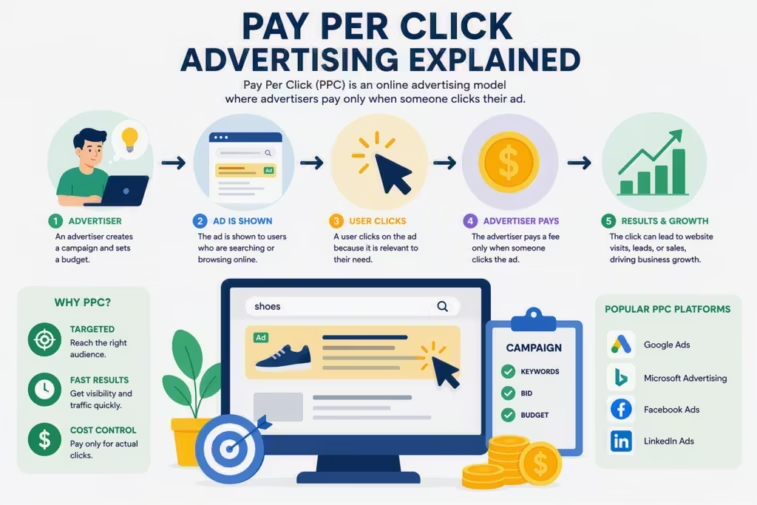
Pay Per Click advertising isn’t just something advertisers run — it’s also the mechanism that lets everyday website owners earn real income through programs like Google AdSense. This guide breaks down how Pay Per Click Advertising actually works from both sides of the transaction: what advertisers pay for, and what publishers can realistically earn, including which niches pay the most per click in 2026 and how to increase your own AdSense earnings.
What Pay Per Click Advertising Actually Is
Pay Per Click advertising is a digital advertising model where an advertiser pays a fee each time someone clicks on their ad, rather than paying a flat rate simply to display it. Google Ads (formerly AdWords, launched in 2000) is the model’s largest and most influential platform, running on an auction system where advertisers bid on keywords or audience targeting, and the highest combination of bid and ad quality wins placement.
What makes PPC different from traditional advertising is precision: you’re not paying to reach an audience broadly, you’re paying only when someone shows enough interest to actually click through. That’s exactly why PPC has become the dominant model for search advertising over the past two decades — it aligns cost directly with demonstrated interest rather than mere visibility.
The Two Sides of Every PPC Transaction
Most explanations of PPC only cover the advertiser’s side: bidding on keywords, targeting audiences, and paying for clicks. But every PPC ad that appears on the internet has to land somewhere, and a huge share of that inventory lives on ordinary websites, not just search results pages. That’s where Google AdSense comes in — it’s the publisher-facing half of the same PPC ecosystem, letting website owners earn a share of what advertisers are paying, in exchange for hosting their ads.
Understanding both halves of this system is genuinely useful even if you only care about one side: advertisers who understand publisher economics write better-targeted campaigns, and publishers who understand advertiser bidding behavior can make far smarter decisions about what content to build.
How Google AdSense Turns PPC Clicks Into Publisher Income
When you place AdSense on your website, you’re essentially renting out ad space to Google’s advertiser network. Pay Per Click Advertising; Advertisers bid through Google Ads for that inventory, Google matches the highest-relevance bid to your page, and you earn a share of what that advertiser pays — every time a qualifying click or ad impression occurs.
Google generally shares a substantial majority of that advertiser spend with publishers, commonly cited around 68% for standard AdSense for Content placements, with lower publisher shares on some ad formats like AdSense for Search. That revenue share, combined with your site’s traffic and niche, is what determines how much you actually take home.
The Three Metrics That Actually Determine Your Earnings
If you’re trying to earn through AdSense, three numbers matter far more than anything else:
- CPC (Cost Per Click) — what an advertiser pays each time someone clicks their ad on your page. This is entirely determined by advertiser demand for your specific topic, not by anything you personally negotiate.
- CTR (Click-Through Rate) — the percentage of people who see your ad and actually click it. This depends heavily on ad placement, page layout, and how well the ad topic matches what your visitor was actually looking for.
- RPM (Revenue Per Mille) — your earnings per 1,000 page views, combining both click-based and impression-based revenue. This is the single best metric for comparing performance across pages or time periods, since it captures your actual earning power rather than any one input in isolation.
A useful shift to understand for 2026 specifically: AdSense has moved toward a more CPM-first model than in earlier years, meaning publishers increasingly earn from qualifying ad impressions and ad refreshes on longer, more engaging pages — not exclusively from clicks. That rewards content that keeps visitors reading rather than content built purely to bait a click.
Why Some Niches Pay 50 to 100 Times More Per Click
Pay Per Click Advertising; This is the part most beginner guides underexplain, and it’s the single biggest lever available to anyone trying to earn seriously through AdSense. The gap between a high-paying niche and a low-paying one isn’t small — in the US market, it’s commonly 50 to 100 times per click, not a modest 2x difference.
The reason comes down to customer lifetime value on the advertiser’s side. A finance or insurance company converting a single new customer might earn thousands of dollars in annual premiums or account value, which makes it entirely rational for that advertiser to bid $20 to $50 or more for a single qualified click. An entertainment or general-interest site, by contrast, sits behind advertisers with far lower customer value, so the bids — and your resulting earnings — stay correspondingly low.
The Highest-Paying AdSense Niches in 2026
- Legal and insurance — keywords like accident attorney or insurance comparison content can command $50 or more per click.
- Personal finance — credit cards, mortgage refinancing, and loan comparison content remain some of AdSense’s most reliable high-CPC categories.
- B2B software (SaaS) — content targeting business buyers researching tools like CRM software or cybersecurity platforms draws premium advertiser bids.
- Health and medical — particularly content adjacent to insurance, treatment comparisons, or specialized conditions.
- Technology, particularly B2B and enterprise-adjacent content rather than general consumer tech news.
Within any of these niches, the specific topic still matters enormously. Pay Per Click Advertising; A generic tech blog post earns far less than one built around a phrase like “best CRM for small business” or “cybersecurity for startups” — content that signals commercial buyer intent rather than casual curiosity, which is exactly what pulls in higher-value B2B advertisers.
What Realistic AdSense Earnings Actually Look Like
It’s worth setting expectations honestly, since AdSense marketing content often overstates how quickly meaningful income arrives. For general-topic sites, realistic 2026 benchmarks look roughly like this:
- Around 100 visits per day: typically $3 to $30 per month, trending higher with a premium, US- or EU-heavy audience.
- Around 1,000 visits per day: typically $30 to $300 per month, still highly sensitive to RPM and niche.
- RPM benchmarks overall: most publishers fall somewhere between $3 and $25 per 1,000 page views, with high-CPC niches like legal, insurance, and SaaS earning meaningfully above that range.
Traffic source matters just as much as traffic volume. Organic search traffic tends to significantly outperform social media traffic for AdSense earnings, even at identical visitor counts, because someone arriving from a specific search query has already signaled a concrete interest that matching ads can capitalize on — social traffic, by contrast, is often browsing rather than actively searching for something.
Geography plays a real role too. Advertiser competition, and therefore CPC, tends to run highest in wealthier advertising markets — the United States, Australia, the UK, Canada, and several wealthy European and Gulf markets consistently post some of the strongest AdSense CPC rates globally, meaning identical content can earn very differently depending on where your visitors are actually located.
Practical Ways to Increase Your AdSense Earnings
If you’re building or already running a site monetized with AdSense, a few consistently effective levers stand out:
- Pick a niche with genuine commercial intent, not just personal passion. A site about “best budgeting apps” will out-earn a site about a hobby topic at identical traffic, simply because of what advertisers are willing to pay for that audience.
- Prioritize organic search traffic over social traffic. Search visitors arrive with intent already established, which consistently produces higher RPM than social referral traffic at the same volume.
- Write toward high-intent sub-topics within your niche. Comparison posts, “best of” roundups, and buyer-stage content (“best personal loan rates,” “cheapest term life insurance”) draw stronger advertiser competition than general informational posts in the same broad category.
- Let content length and engagement work in your favor. Longer, genuinely useful pages that keep visitors reading generate more ad impressions and refreshes under AdSense’s current model, rather than relying purely on click-baiting a single ad near the top of the page.
- Test Auto ads, then refine manually. Starting with Google’s automated ad placement, gathering a couple of weeks of performance data, and then testing manual placements against that baseline tends to outperform guessing at layout from day one.
- Track RPM over raw earnings. Comparing RPM across pages or time periods tells you what’s actually working, rather than being misled by a single high-traffic day that doesn’t reflect your underlying content quality.
The Bottom Line
Pay Per Click advertising is a single economic mechanism viewed from two different chairs: advertisers bidding for qualified attention, and publishers getting paid a share of that bid for hosting the ad that captures it. Understanding both halves — not just “how do I run PPC ads” or “how do I earn from AdSense” in isolation — gives you a far more accurate picture of why certain content earns dramatically more than others.
The publishers who consistently earn well from AdSense aren’t the ones with the most traffic; they’re the ones who understood early that a click from a health, finance, or B2B software audience is worth an order of magnitude more than a click from almost anywhere else, and built their content strategy around that reality rather than around traffic volume alone.