
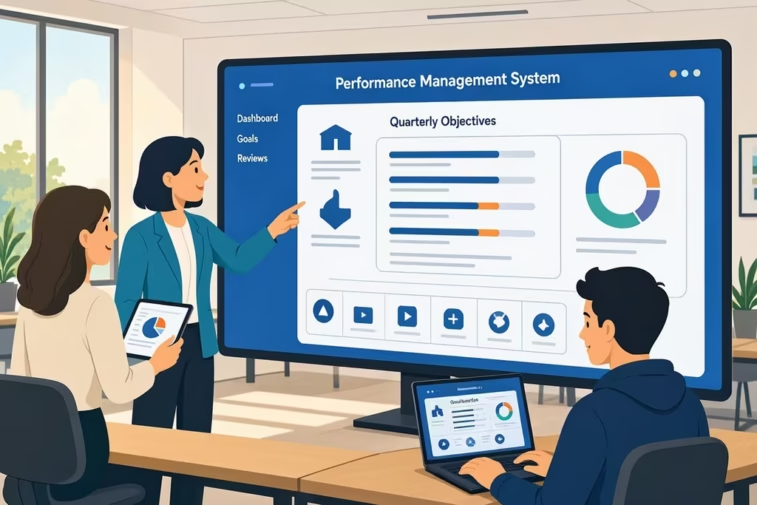
A performance management system is the structured framework of goals, feedback, reviews and data that a company uses to make sure every employee’s work moves the business forward. It is no longer optional hygiene: Gallup’s 10th meta-analysis of 112,312 business units across 54 industries links employee engagement to 11 bottom-line outcomes, including profitability, productivity and turnover, and engagement is shaped largely by how well performance is managed. Yet U.S. employee engagement fell below 30% in 2026 for the first time in 15 years, according to Gallup.
This guide breaks down how a performance management system works, its five components, the six main types with a side-by-side comparison, a seven-step implementation plan and the software criteria that matter. Whether you are fixing a broken review process or building one from scratch, you will leave with a system you can roll out this quarter. For the underlying theory, see ilearnlot’s guide to performance management meaning, elements and stages.
Table of Contents
- What Is a Performance Management System?
- Performance Management System vs. Performance Management vs. Performance Appraisal
- How a Performance Management System Works: The 4-Stage Cycle
- The 5 Core Components of an Effective System
- 6 Types of Performance Management Systems
- Traditional vs. Modern: Why 74% Went Continuous
- The Business Case: What the Data Says
- How to Implement One in 7 Steps
- Choosing Software: 8 Evaluation Criteria
- 5 Mistakes That Sink Performance Systems
- Performance Management Trends for 2026
- FAQ
What Is a Performance Management System?
A performance management system is the combination of processes, cadences and tools an organization uses to set expectations, monitor progress, develop people and evaluate results on a repeating cycle. It continuously answers four questions: What are we trying to achieve? How is each person progressing? Where do they need help? What did they deliver? Answer those systematically and performance becomes a managed outcome rather than an annual surprise.
It helps to separate the system from the activity. Performance management is the ongoing discipline; the system is the machinery that makes it repeatable: goals, check-ins, reviews, development plans and analytics. Modern systems are software-based, but a tool cannot rescue a company that sets vague goals and gives feedback once a year. This guide focuses on that machinery.
Performance Management System vs. Performance Management vs. Performance Appraisal
These three terms get used interchangeably, and the confusion costs real money: companies buy an appraisal tool and call it a performance management system. The distinctions are simple side by side. Performance management is the continuous process; the performance management system is the framework and tooling that operationalizes it; the performance appraisal is one event inside that process.
| Dimension | Performance Management | Performance Management System | Performance Appraisal |
|---|---|---|---|
| What it is | The ongoing discipline of aligning, coaching and evaluating work | The framework, cadence and software that operationalize the discipline | A formal evaluation event, usually annual or semi-annual |
| Nature | Continuous, everyday | Structural, always on | Periodic, episodic |
| Primary output | Improved performance and growth | Alignment, data and repeatable process | A rating, document or decision record |
| Owner | Managers and employees | HR plus leadership | HR or the reviewing manager |
Keep this hierarchy in mind: everything below serves the continuous process; none of it replaces it. The same logic positions performance inside the wider HR stack, which ilearnlot covers in its overview of personnel management meaning, definition and objectives.
How a Performance Management System Works: The 4-Stage Cycle
Nearly every effective system runs the same four-stage loop, repeating quarterly, monthly or continuously. It only creates value when it closes; skipping a stage is where most implementations fail.
- Stage 1: Plan. Leadership cascades company objectives into team and individual goals, each with a measure and deadline. Alignment is won or lost here: an employee should be able to trace their goals to company priorities in under a minute. This stage also sets development expectations, not just output targets.
- Stage 2: Act and monitor. Employees execute while managers track progress and deliver feedback close to the work, in weekly or biweekly check-ins rather than saved-up grievances. Updates, blockers and course corrections happen here. Gallup consistently identifies clarity of expectations as a leading driver of engagement, and this is where clarity is maintained or lost.
- Stage 3: Review. At cycle end, formal appraisals consolidate what happened: ratings or written assessments, calibration across managers, documented decisions. In continuous systems this stage is lighter but still exists, because organizations need consistent records for pay, promotion and legal defensibility.
- Stage 4: Reward and develop. Compensation, recognition, promotion and development plans flow from the review, and the lessons feed the next planning stage. This closing step turns the loop into a compounding system rather than a repeated ritual. Employees who receive meaningful recognition weekly are 2.9 times as likely to strongly agree they get valuable feedback, per Gallup-Workhuman research.
The 5 Core Components of an Effective System
Whatever type you run, five components show up in every system that actually improves performance. Treat this as your completeness check: if any one is missing, the other four underdeliver.
- 1. Goal setting and alignment. The system needs a goal framework that connects company strategy to individual work, whether that is MBO-style negotiated objectives, quarterly OKRs or Balanced Scorecard measures. Goals must be specific, measurable and visible, because employees cannot align with priorities they cannot see.
- 2. Continuous feedback. Feedback delivered weeks later is history; feedback delivered in the flow of work is coaching. Effective systems build structured check-ins with shared agendas and documented outcomes, so feedback does not depend on manager memory or mood, and small problems get corrected before they become review-cycle problems.
- 3. Performance reviews and appraisals. Even continuous systems need a periodic consolidation point for calibration, compensation and record-keeping. The design choice is frequency and weight: one heavyweight annual review, lighter quarterly reviews, or a continuous narrative with an annual calibration. Either way, criteria and scales must be consistent, so ratings mean the same thing everywhere.
- 4. Development plans. Performance and growth are inseparable, because most persistent performance gaps are skill gaps in disguise. Every employee should have a live development plan with two or three priorities tied to the roles the business needs next. Systems that track only output, without capability building, re-solve the same gaps every cycle.
- 5. Analytics, recognition and rewards. The data layer aggregates goal attainment, feedback frequency, review outcomes and turnover risk into dashboards leaders can act on, while recognition closes the motivational loop. If goal completion, feedback frequency and regrettable attrition are not moving over two or three cycles, the process needs redesign, not more forms.
6 Types of Performance Management Systems (With Comparison Table)
There is no single best type; there is a best fit for your size, strategy and culture. The six models below cover everything in the market today, and most mature organizations blend two or three.
| Type | How It Works | Typical Cadence | Best For | Watch Out For |
|---|---|---|---|---|
| Traditional rating-scale | Annual review with numeric ratings against competencies | Annual | Large or regulated organizations needing defensible documentation | Recency bias; once-a-year surprises |
| Management by Objectives (MBO) | Managers and employees jointly set and review concrete objectives | Quarterly or semi-annual | Organizations wanting clear, cascading alignment | Reward gaming without top-management commitment |
| OKRs | Ambitious objectives plus measurable key results, visible company-wide | Quarterly | Fast-growing companies needing focus and transparency | Stretch goals demotivate when tied directly to pay |
| Balanced Scorecard | Performance measured across financial, customer, internal and learning perspectives | Quarterly or annual | Strategy-heavy organizations wanting an enterprise view | Heavier to administer; more organizational than individual |
| 360-degree feedback | Input gathered from manager, peers, direct reports and self | Annual or semi-annual | Leadership development and behavioral insight | Time-intensive; requires trust and anonymity |
| Continuous / ratingless | Ongoing check-ins, real-time feedback and lightweight goals, often without numeric ratings | Weekly or monthly | Agile teams prioritizing coaching and engagement | Pay and promotion decisions need a separate calibration mechanism |
Two origin notes add context. Management by Objectives was outlined by Peter Drucker in 1954, and a review of the academic literature found that 68 of 70 MBO studies showed performance gains, which is why the framework still anchors so many systems. OKRs are its modern descendant: Andy Grove ran an MBO-derived goal system at Intel, and John Doerr carried the approach to Google in 1999, where it became today’s OKR standard. The 360-degree method, by contrast, is not a goal framework but a feedback geometry, so it layers cleanly on top of the other five types.
Traditional vs. Modern: Why 74% of Organizations Went Continuous
The biggest shift of the past decade is the move from episodic to continuous. According to a 2025 Gartner HR Research study, 74% of organizations have shifted to some form of ongoing performance feedback model, and 87% of HR leaders report that annual reviews alone are insufficient for driving engagement and retention. The reason is practical: twelve months is too long a feedback loop for how fast work changes.
Annual systems save issues for a year-end reveal and yield one low-resolution data point per person per year, while check-ins correct course in days and accumulate a genuine performance record. The implication for owners is not to abolish the annual review but to shrink it: let check-ins carry the coaching load and reserve the formal review for calibration, pay and promotion.
The Business Case: What the Data Says About Performance Management Systems
The evidence that disciplined performance management pays is unusually consistent. Gallup’s 10th meta-analysis, covering 112,312 business units across 54 industries, connects higher employee engagement to 11 business outcomes including profitability, productivity, absenteeism, turnover and customer ratings — outcomes manufactured largely by the goal clarity, feedback and recognition a performance management system institutionalizes. With managers accounting for at least 70% of the variance in team engagement, the quality of your performance conversations is the effective ceiling on your results.
The downside case is equally quantified. Gallup reported that only 20% of employees worldwide were engaged in 2025, and U.S. engagement, which measured 31% in the first half of 2026, dropped below 30% by September for the first time in 15 years. The cost scales with economy size: Gallup attributed $351 billion in lost productivity in India in 2025, nearly 9% of GDP, when engagement hit a four-year low. Recognition is one of the cheapest levers inside the system, and the arithmetic of disengagement gets large quickly at any headcount.
How to Implement a Performance Management System in 7 Steps
Implementation is where good designs die, usually because companies buy software in step one and define outcomes in step six. Run this sequence instead, and the tooling decision almost makes itself by step four.
- 1. Define outcomes and baseline. Pick three to five metrics the system must move in twelve months — goal completion, regrettable attrition, review completion, engagement — and record today’s numbers, because without a baseline you will never prove impact.
- 2. Cascade one goal framework. Choose a single language (MBO, OKR or rating-scale objectives) and cascade company priorities into individual goals with owners and deadlines. Resist running multiple frameworks in the first year.
- 3. Design the cadence. Set the rhythm explicitly: weekly or biweekly check-ins, quarterly goal resets, an annual or semi-annual review with calibration. Undocumented rhythms decay within two quarters.
- 4. Select and configure tooling. Only now choose software, per the criteria below, and configure goal visibility, check-in templates and review forms before anyone logs in.
- 5. Train managers first. Managers drive 70% of engagement variance, so train them on check-ins, specific feedback and difficult reviews before launch, not after the first cycle stumbles.
- 6. Pilot with one team. Run one full cycle, inspect the data, interview participants and fix the friction, then scale. A short pilot catches design errors at a fraction of the cost of a company-wide launch.
- 7. Launch, measure and iterate. Roll out with a clear calendar, track your metrics every cycle, and hold a quarterly retrospective on the system itself. Operating systems ship updates.
How to Choose Performance Management System Software: 8 Criteria
The market is crowded: Lattice, 15Five, BambooHR, Betterworks and dozens of others compete for the same budget, and feature lists look identical after an hour of demos. Score every vendor against the same eight criteria, weighted for your context.
- Goal-setting alignment: supports your framework (OKR, MBO or cascaded objectives) with visible company-to-individual lineage, not standalone goal fields.
- Continuous feedback tooling: structured check-ins, shared agendas, feedback requests and nudges that keep the rhythm alive between reviews.
- Review-cycle flexibility: configurable forms, rating scales, calibration and multi-rater options, because your review design will evolve.
- Analytics and reporting: dashboards for goal attainment, feedback frequency, review completion and turnover risk, exportable to your BI stack.
- Integrations: native connections to your HRIS, Slack or Teams, and calendar, so the system lives where work happens.
- User experience: an interface employees complete without training; adoption failure is the leading cause of dead performance systems.
- Security and compliance: role-based access, audit trails and data-residency options, especially in regulated markets.
- Vendor support and pricing: transparent per-seat pricing, onboarding assistance and responsive support; hidden implementation fees are common.
For current market options, ilearnlot maintains dedicated comparisons of the best performance management software for your business and the top performance management tools. Score your shortlist against the eight criteria above before sitting through a single demo.
5 Mistakes That Sink Performance Management Systems
Most failed implementations share the same five failure modes, and all five are avoidable at design time.
- 1. Goals with no line of sight. When employees cannot trace their goals to company priorities, the system produces activity without alignment. Fix: make goal lineage visible and limit each person to a handful of active goals.
- 2. Review theater. Elaborate forms and ratings that no one reads are bureaucracy, not performance management. If a review output changes no decision about pay, promotion, staffing or development, cut the field that produced it.
- 3. Underinvesting in managers. The system’s weakest manager sets its floor, and with managers driving 70% of engagement variance, skipping their training is the costliest shortcut available. Fund coaching skills before features.
- 4. Fragmented data. When goals live in slides, feedback in chat and reviews in spreadsheets, no leader can see performance whole, and fairness suffers. Consolidate into one system of record, even a modest one.
- 5. Set-and-forget rollout. Launching without iterating guarantees decay, because work changes faster than annual processes. Schedule a quarterly retrospective on the system itself, and treat the first two cycles as beta.
Performance Management System Trends for 2026
Three shifts will define the next planning cycle.
- First, AI is entering the review workflow. Gallup’s 2026 research finds that employees whose managers actively supported AI use were 2.1 times as likely to use AI several times a week, and 8.7 times as likely to strongly agree AI transformed how work gets done. Vendors are racing to add AI-drafted review summaries and conversational intelligence, but the organizations seeing gains pair the tools with clear expectations and manager support.
- Second, skills are becoming the performance currency. With AI absorbing routine tasks, development plans are moving from HR afterthought to the center of the performance record, and 360-degree feedback is back in fashion as a skills-intelligence input.
- Third, continuous is now the default. With 74% of organizations already running ongoing feedback models per Gartner’s 2025 research, the question is not whether to go continuous but how to keep the rhythm from fragmenting — which puts calibration and manager capability back at the top of the agenda.
FAQ: Performance Management System Questions, Answered
What is a performance management system in simple terms?
A performance management system is the set of tools and processes a company uses to set goals, track progress, give feedback and evaluate employee performance on a continuous cycle. Think of it as the operating system that connects individual work to business results.
What are the 5 components of a performance management system?
The five components are: (1) goal setting and alignment, (2) continuous feedback, (3) performance reviews and appraisals, (4) development plans, and (5) analytics, recognition and rewards. When all five work together, the system drives alignment and accountability instead of just paperwork.
What are the main types of performance management systems?
The six main types are: traditional rating-scale reviews, Management by Objectives (MBO), OKRs, the Balanced Scorecard, 360-degree feedback, and continuous or ratingless systems. Most modern organizations blend two or more types, such as quarterly OKRs with continuous check-ins and an annual calibration review.
What is the difference between performance management and a performance appraisal?
Performance management is the continuous, year-round process of setting goals, coaching and giving feedback. A performance appraisal is a single event inside that process, typically an annual or semi-annual evaluation. The appraisal documents performance; performance management improves it.
Which performance management system is best for a small business?
Small businesses usually get the best results from a lightweight continuous model: quarterly goals, monthly or biweekly check-ins, and one simple annual review, run through an affordable tool. Heavy Balanced Scorecard or multi-rater 360 programs tend to add admin cost without much benefit below roughly 50 employees.
What are examples of performance management systems?
Familiar examples include Management by Objectives, the framework Peter Drucker outlined in 1954; OKRs, the goal method Google popularized; the Balanced Scorecard; 360-degree feedback; and modern continuous performance platforms such as Lattice, 15Five, BambooHR and Betterworks. Each example pairs a goal framework with a feedback and review cadence.
Final Takeaway
A performance management system earns its keep when it changes decisions and conversations, not when it fills forms. Start small: pick one goal framework, install a check-in rhythm your managers can sustain, run one honest review cycle, and let two or three quarters of data tell you what to fix next. The organizations that treat performance management as an operating system — measured and versioned like any critical process — turn 2026’s engagement slump into a competitive advantage.