
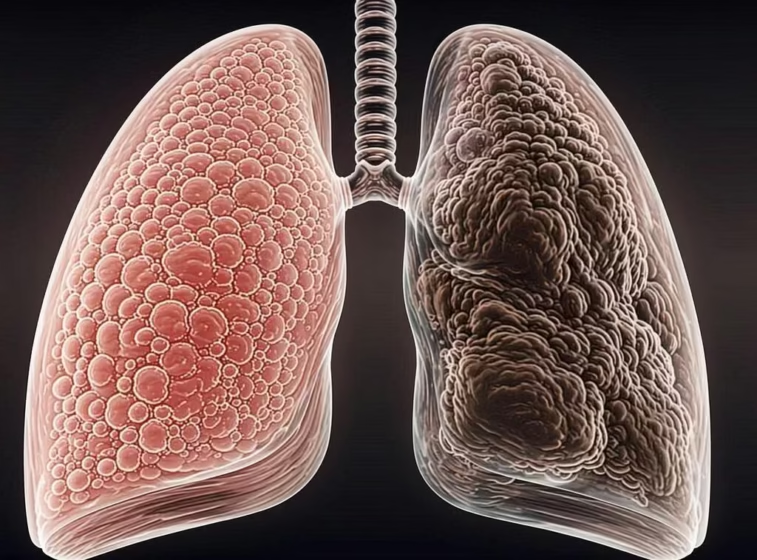
Mesothelioma vs Lung Cancer: These two cancers are often confused. Learn the critical difference between mesothelioma and lung cancer. Understand medical differences and whether asbestos exposure gives you legal compensation rights.
Mesothelioma vs Lung Cancer: Symptoms, Causes & Legal Rights
📋 Here’s a clear, 2026-ready breakdown.
Main takeaways (quick)
- Mesothelioma is not lung cancer. It starts in the lining around the lungs (pleura) or other linings; lung cancer starts inside the lung itself.
- Both can be caused by asbestos, but mesothelioma is very strongly tied to asbestos, whereas lung cancer is commonly tied to smoking and also has many other causes.
- Smoking multiplies lung cancer risk when combined with asbestos exposure (synergy), but smoking does not appear to increase mesothelioma risk.
- Because symptoms overlap and imaging alone can’t tell them apart, accurate diagnosis usually requires a biopsy with specialized pathology.
- If you have (or had) significant asbestos exposure and later develop mesothelioma or lung cancer, you may have legal rights to compensation through lawsuits, asbestos trust funds, and (for veterans) VA benefits. Timing and evidence matter a lot.
High-level decision guide

1. What is mesothelioma? How is it different from lung cancer?
- Where they start (anatomy)
- Lung cancer: a malignant tumor that begins in the lung tissue—usually in cells lining the airways or air sacs.
- Mesothelioma: a cancer of the mesothelium—the thin lining around the lungs (pleura), abdomen (peritoneum), heart (pericardium), or testes. The most common form is pleural mesothelioma in the chest.
- How common they are
- Lung cancer: one of the most common cancers in adults and the leading cause of cancer death in men and women.
- Mesothelioma: rare; about 2,000–3,000 new cases per year in the U.S.
- How tumors look/grow
- Mesothelioma: often starts as small nodules that can grow into a sheath-like rind around the lung.
- Lung cancer: typically forms distinct, individual masses with defined borders within the lung.
- Typical causes
- Mesothelioma: the main risk factor for pleural mesothelioma is asbestos exposure; most pleural mesotheliomas are linked to high levels of exposure, usually in the workplace.
- Lung cancer: smoking is the dominant cause, but asbestos, radon, other carcinogens, and genetic factors also contribute. Asbestos is a known cause of lung cancer as well.
- Why the confusion?
- Both occur in the chest, can cause similar symptoms (chest pain, shortness of breath, cough), and can be linked to asbestos. This sometimes leads to mesothelioma being misdiagnosed as lung cancer initially.
2. Symptoms: similarities and differences
Mesothelioma vs Lung Cancer: Shared symptoms (both can cause these):
- Persistent cough or worsening cough
- Shortness of breath (dyspnea)
- Chest pain or discomfort
- Fatigue and unintended weight loss
- Pleural effusion (fluid around the lung)
More suggestive of mesothelioma (patterns seen more often, not proof):
- Chest pain and dyspnea that progress, often with pronounced pleural thickening (extensive scarring of the lining) and recurrent effusions.
- Late-onset symptoms decades after asbestos exposure (latency often 20–60 years).
More suggestive of lung cancer:
- Coughing up blood (hemoptysis)
- Symptoms related to airway obstruction such as wheezing or post-obstructive pneumonia
- Localized mass seen on imaging centered within the lung rather than rind-like pleural thickening
Important: You cannot tell which one it is from symptoms alone—both can present similarly. Imaging plus biopsy is required for a definitive diagnosis.
3. Causes and risk factors: how mesothelioma and lung cancer differ
Mesothelioma vs Lung Cancer: Mesothelioma key risk factors:
- Asbestos exposure: the main risk factor for pleural mesothelioma; most cases are linked to high-level exposure, usually occupational.
- Other/less common factors:
- Certain germline gene mutations (e.g., BAP1 tumor predisposition syndrome) that increase susceptibility when combined with asbestos.
- Radiation therapy to the chest (rare).
- Zeolite minerals (in some regions).
- Age and male sex (reflecting occupational exposures).
Lung cancer key risk factors:
- Tobacco smoking (most common single cause; most cases are attributed to smoking).
- Asbestos exposure (established cause; asbestos-related lung cancer is recognized and can occur even in nonsmokers).
- Radon, second-hand smoke, air pollution, occupational carcinogens, and family history.
How asbestos and smoking interact:
- Smoking + asbestos together: the risk of lung cancer is greater than the risks from smoking and asbestos added together (a multiplicative/synergistic effect). Quitting reduces risk among asbestos-exposed workers.
- Smoking + asbestos and mesothelioma: smoking does not appear to increase mesothelioma risk. The main driver remains asbestos exposure.
Latency (time from exposure to disease):
- Asbestos-related diseases may not become apparent for decades—often 10–40 years or more for symptoms to appear.
- Mesothelioma especially can have very long latency (often 20–60 years).
4. Diagnosis: how doctors tell them apart
Mesothelioma vs Lung Cancer: Typical steps for both:
- History and physical: important to mention any known or possible asbestos exposure (occupational, military, home renovation, secondary exposure from family members).
- Imaging:
- Chest X-ray (often first test).
- CT scan; often shows mass/nodules (lung cancer) vs pleural thickening/effusion (mesothelioma).
- PET scan to assess metabolic activity and spread.
- Biopsy (required to confirm):
- Scans alone cannot reliably distinguish mesothelioma from lung cancer.
- Doctors obtain tissue samples via:
- Needle biopsy (CT- or ultrasound-guided),
- Bronchoscopy (for central lung tumors),
- Thoracoscopic surgery (VATS) to biopsy pleura or lung and to sample/ drain fluid.
- Pathology and special stains:
- Mesothelioma vs lung adenocarcinoma can look similar under the microscope.
- Pathologists use immunohistochemical stains (markers) to differentiate mesothelioma from lung cancer.
Why getting the right diagnosis matters:
- Treatment approaches and surgical options differ.
- Prognosis and clinical trial eligibility differ.
- For legal purposes, the specific diagnosis can affect compensation (trusts often assign different scheduled values by disease).
5. Treatment outlook: general patterns
- Lung cancer:
- Depends on type (NSCLC vs SCLC) and stage.
- Options may include surgery, radiation, chemotherapy, immunotherapy, and targeted therapies based on tumor molecular markers.
- Early detection (e.g., low-dose CT screening in eligible high-risk smokers) can improve outcomes.
- Mesothelioma:
- Often diagnosed at an advanced stage.
- Treatment commonly involves chemotherapy; some patients are candidates for surgery and/or radiation as part of multimodal therapy.
- Emerging options include immunotherapy and clinical trials.
- Survival (broadly):
- One study summary notes approximately 1-year survival rates are similar (~55% lung cancer; ~53% mesothelioma), while 5-year survival tends to be lower for mesothelioma (~12%) than lung cancer (~28%), but individual outlook varies widely based on stage, histology, and treatment.
6. Legal rights: when asbestos exposure may entitle you to compensation
Mesothelioma vs Lung Cancer: If you have significant asbestos exposure and later develop mesothelioma or lung cancer, you may be able to seek compensation. Key points:
- Types of compensation:
- Lawsuits (tort claims) against manufacturers/suppliers of asbestos-containing products.
- Asbestos bankruptcy trust funds (no lawsuit required against that company).
- VA benefits for veterans (disability compensation, health care).
- Workers’ compensation in some cases (state-specific; usually no-fault but benefits are often more limited).
- Social Security Disability for those who qualify based on health.
7. Asbestos trust funds
- What they are:
- Trusts created under U.S. Bankruptcy Code § 524(g) when asbestos companies faced bankruptcy due to litigation. They are set aside to pay current and future claimants.
- Collectively, more than $30 billion remains available across 60+ active trust funds.
- Who may qualify (typical criteria):
- A qualifying diagnosis: mesothelioma, asbestos-related lung cancer, asbestosis, or other asbestos-related diseases.
- Proof of exposure to products/companies linked to a specific trust (employment records, military records, witness statements, product identification).
- Showing causation (link between exposure and disease) and timely filing (each trust has deadlines, often around 2–3 years from diagnosis or death).
- Typical compensation levels (broad ranges; individual results vary):
- Trusts assign different “scheduled values” by disease. Mesothelioma claims generally receive higher values than lung cancer or asbestosis.
- A commonly cited typical per-trust “scheduled value” is around $180,000, but the actual paid amount depends on the trust’s payment percentage (often 10–30%).
- One source notes the average total trust payout for a mesothelioma patient (across all trusts) is estimated around $300,000–$400,000, with per-trust payouts ranging widely from about $7,000 to $1.2 million depending on the trust’s value and payment percentage.
- For lung cancer, another source summarizes typical per-trust ranges roughly $50,000–$150,000, often with lower payment percentages applied.
- Timing:
- Many trust claims are processed within 3–6 months; expedited claims can be paid in under 90 days with strong documentation.
8. Lawsuits and settlements
- Mesothelioma lawsuits:
- Average reported settlements are about $1–$1.4 million; trial verdicts average around $2.4 million, with some reaching much higher.
- Compensation can cover medical costs, lost income, pain and suffering, and other damages.
- Suits are against companies that made/sold asbestos-containing products, not against the government or military.
- Asbestos-related lung cancer lawsuits:
- Settlements reported to average about $100,000–$400,000; trial verdicts from 2015–2023 ranged from roughly $250,000 to $38 million depending on case facts and jurisdiction.
- Another firm’s overview notes asbestos lung cancer lawsuits pay “several hundred thousand dollars on average,” with many cases reaching $1 million or more.
- Smoking does not bar you:
- Even if you smoked, you may still qualify for compensation if asbestos was a substantial contributing cause. Mesothelioma vs Lung Cancer: Your legal team will evaluate the role of asbestos versus smoking.
9. VA benefits (for U.S. veterans)
- Veterans with mesothelioma or asbestos-related lung cancer may be eligible for VA benefits, including:
- Disability compensation (one 2026 source notes over $4,000/month for certain ratings as of 2026).
- VA health care coverage.
- Survivor benefits and funeral expense compensation.
- You can pursue VA benefits even if you also receive compensation from a lawsuit or trust; lawsuits are not filed against the military or government.
10. Workers’ compensation (briefly)
- If you were exposed to asbestos at work, you may be able to file a state workers’ compensation claim for an occupational disease. Mesothelioma vs Lung Cancer: This is a no-fault system that does not require proving negligence, but benefits are often more limited than tort lawsuits.
- Lawsuits and workers’ comp claims have different rules and trade-offs; many asbestos patients explore both.
11. Deadlines and practical next steps
- Time limits matter:
- Trusts typically have their own filing deadlines, often 2–3 years from diagnosis or death.
- State statutes of limitation for lawsuits vary and can be as short as one year from diagnosis (or from discovery that it was asbestos-related), so acting promptly is important.
- In some states, the clock can also start from when you should have discovered the link between your disease and asbestos exposure.
- Practical steps:
- Gather medical records: pathology reports confirming mesothelioma or lung cancer, imaging, and staging.
- Reconstruct exposure history: jobs, years, duties, employers; military service; home renovation or proximity to asbestos plants/shipyards; secondary exposure (e.g., family members who worked with asbestos).
- Keep paperwork: employment records, old work badges, union records, invoices, photos of products or worksites, witness names.
- Consult an attorney experienced in asbestos claims: they can evaluate your options (trusts, lawsuits, VA, workers’ comp), preserve evidence, and file before deadlines.
12. Bottom line for you
- If you’ve been diagnosed with mesothelioma or lung cancer and you have (or had) significant asbestos exposure, there is a real chance you have legal rights to compensation—but those rights are subject to deadlines and require proof.
- Mesothelioma and lung cancer are distinct diseases with different origins and typical causes, yet both can be caused by asbestos and often require legal and medical expertise tailored to asbestos-related illness.
- Focus first on your medical care with specialists who understand these diseases. Mesothelioma vs Lung Cancer: In parallel, consider an experienced asbestos attorney to evaluate your situation quickly; many offer free case reviews and work on contingency.
Note: Mesothelioma vs Lung Cancer: This is general information, not legal or medical advice. Laws and eligibility vary by state and country. Your personal situation (exposure details, diagnosis, timing) will determine what options you actually have.