
Publishers using header bidding earn 20–40% more ad revenue than those using waterfall. Header Bidding vs Waterfall Advertising; This technical guide explains how both work, the latency trade-offs, and why most enterprise publishers now use hybrid approaches.
Header Bidding vs Waterfall Advertising in 2026: Which Ad Technology Earns Publishers More Revenue?
Header bidding delivers 20–50% higher revenue than waterfall auctions, and by 2026 most enterprise publishers have moved to hybrid architectures that combine both approaches to balance yield with page speed.
Ad technology has been completely reshaped over the past few years. The waterfall method, once the industry standard, is now seen as an outdated relic by most digital publishers. But pure client‑side header bidding isn’t without its own serious problems. Header Bidding vs Waterfall Advertising; Heading into 2026, the most successful publishers have stopped treating this as an either/or decision and have moved to sophisticated hybrid models.
This guide walks through how each technology really works, what the revenue and latency trade‑offs actually look like, and why the industry consensus in 2026 is that a hybrid approach gives you the best of both worlds.
Quick Answer: Which Earns More Revenue?
If you take away one number, it’s this: publishers who switch from waterfall to header bidding consistently see CPM increases of 20–50%.
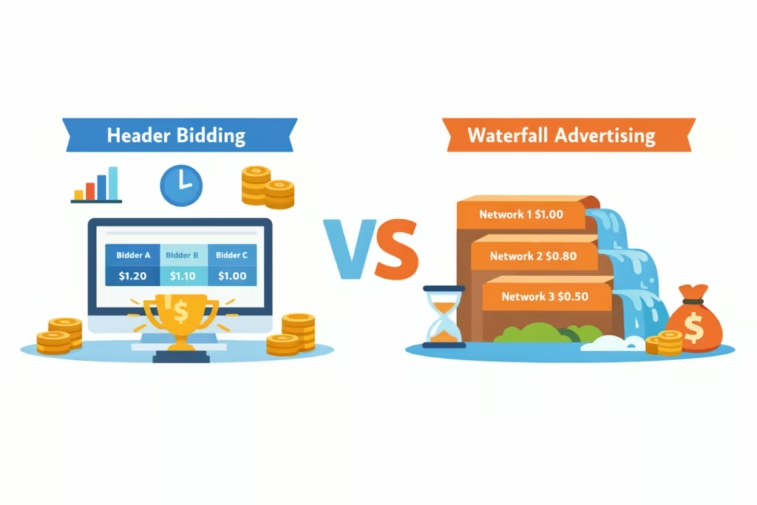
More conservative estimates still put the uplift at 20–40%. Header Bidding vs Waterfall Advertising; That difference comes down to a simple structural change: waterfall asks one buyer at a time, while header bidding asks everyone at once and takes the highest price. When a gaming app switched from waterfall to hybrid header bidding, its CPM jumped 35% and fill rate improved 22%.
But here’s the nuance that matters for 2026: those revenue gains come with trade‑offs, and the gap between client‑side and server‑side header bidding has narrowed significantly as third‑party cookies fade.
How Waterfall Bidding Works (and Why It Leaves Money on the Table)
Waterfall, also called daisy‑chaining, is the traditional method of selling ad inventory. Header Bidding vs Waterfall Advertising; The publisher sets a fixed priority order for demand partners—typically ranking them by historical average CPM. The ad server calls partners one at a time, and the first partner that meets the price floor wins the impression.
The mechanics in simple terms:
Imagine you have three demand partners: Partner A, Partner B, and Partner C. Partner A historically pays the highest CPM, so it gets first look. If Partner A passes or bids below your floor price, the impression “waterfalls” down to Partner B. If Partner B also passes, it goes to Partner C. The first partner to say yes wins—even if a lower‑ranked partner would have paid significantly more for that specific impression.
Why this is a problem:
- No real competition: Partners at the top of the waterfall have a first‑look advantage regardless of what lower partners might bid.
- Stale price floors: Priorities are based on historical averages, not real‑time demand. A partner might be willing to pay a premium for a specific user right now, but they never get the chance because they’re lower in the queue.
- Lost revenue: If the first‑priority partner fills at a low price, higher bids from lower‑priority partners are never even solicited.
- Slow iteration: Reorganizing waterfall priorities requires manual intervention and is always backward‑looking.
In practice, the waterfall model consistently sells impressions below their true market value. Header Bidding vs Waterfall Advertising; A partner ranked third might have bid $5 for an impression, but the impression was already sold to partner #1 for $2 simply because they had a higher historical average.
That said, waterfall still has a role in 2026—specifically in hybrid setups where it captures long‑tail demand that real‑time bidding channels miss.
How Header Bidding Works (The Modern Alternative)
Header Bidding vs Waterfall Advertising; Header bidding—also called advance bidding or pre‑bidding—is a programmatic technique that lets publishers offer ad inventory to multiple demand sources simultaneously before the ad server makes a final decision. The name comes from the JavaScript code originally placed in the <head> section of a webpage, though modern implementations are more flexible.
The step‑by‑step flow:
- Page loads: A user visits a publisher’s website. The header bidding wrapper (commonly Prebid.js) loads in the page’s header.
- Bid requests sent: The wrapper simultaneously sends bid requests to all configured demand partners (SSPs, exchanges, ad networks).
- Bids received: Each demand partner evaluates the impression opportunity and returns a bid (or declines). A timeout—typically 1,000–1,500ms—ensures the auction doesn’t wait indefinitely for slow responders.
- Bids passed to ad server: The wrapper collects all bids and passes them as key‑value pairs to the publisher’s primary ad server (usually Google Ad Manager).
- Final auction: The ad server runs its own auction, comparing header bidding bids against its own demand (e.g., Google AdX) and any direct‑sold campaigns. The highest bid wins.
- Ad renders: The winning ad creative renders in the ad slot on the page.
Why it’s more effective:
- Simultaneous competition: Every demand source bids on every impression at the same time, forcing buyers to offer their true maximum value.
- Real‑time pricing: The winner is determined by the highest real‑time bid, not historical averages.
- Full transparency: Publishers gain insight into exactly who is bidding and at what price.
- Higher CPMs: More competition per impression drives higher prices. Publishers typically see CPM increases of 20–50% when switching from waterfall to header bidding.
But there’s a catch: Header bidding requires advanced technical configuration and continuous optimization to reach its full potential. And as you’ll see, the latency cost can be significant.
The Latency Trade‑Off: What Header Bidding Costs in Page Speed
Header Bidding vs Waterfall Advertising; This is where things get real. While header bidding delivers higher revenue, it adds measurable latency that directly impacts user experience and, ultimately, SEO and ad performance.
Client‑Side Header Bidding: The Transparency Tax
Client‑side header bidding runs auctions directly in the user’s browser. Every bidder adds JavaScript execution, network requests, and processing time. A typical setup with 8–10 demand partners can add 500KB–1MB of JavaScript and generate 50–100 additional network requests per page load.
Real‑world impact:
Header Bidding vs Waterfall Advertising; A publisher who implemented client‑side header bidding with 6‑8 SSPs saw CPMs increase 60% compared to pure AdSense, but page load time increased by 800ms. Largest Contentful Paint (LCP) degraded from 2.1 seconds to 3.4 seconds—moving from “good” to “needs improvement” in Google PageSpeed Insights. Organic traffic dropped 8% over three months, likely due to Google penalizing poor performance.
The Core Web Vitals trap:
Google uses Core Web Vitals as direct ranking signals. Poor scores mean lower organic search visibility and, in some cases, higher cost‑per‑click for ads. Google’s research shows that a one‑second delay in page load reduces mobile impressions by 1.1% and desktop impressions by 1.9%. As page load time increases from one to three seconds, the probability of bounce increases by 32%.
So here’s the painful irony: you implement header bidding to earn more revenue, but the latency it adds hurts your SEO and traffic, which eventually eats into that revenue.
Server‑Side Header Bidding: Speed at a Cost
Server‑side header bidding (also called S2S) moves the auction orchestration away from the browser and onto an external server. The page makes one call, the server handles the auction, and the result comes back clean—adding essentially zero latency perceptible to the user.
The problem with server‑side:
Server‑side comes with its own serious trade‑offs. It typically delivers:
- 20–40% lower match rates (fewer advertisers can identify users)
- 15–25% higher discrepancy between reported impressions
- 15–30% lower average CPMs because advertisers pay less for impressions where they can’t do precise targeting or measure conversions properly
This is why, despite the latency advantages, only 15–20% of publishers globally use pure server‑side header bidding, while 70–75% still prefer client‑side despite the latency. The match rate penalty is simply too high for many publishers.
The Timeout Trap
Header Bidding vs Waterfall Advertising; Every header bidding auction has a timeout—the window within which all demand partners must return their bids before the auction closes. A higher timeout collects more bids but increases page load time. A lower timeout protects user experience but risks missing premium bids.
Static timeouts are failing in 2026. A fixed 1,000ms timeout works fine for normal traffic but collapses during traffic spikes. When your server load increases during a viral moment, network latency rises across demand partners’ infrastructure simultaneously. High‑CPM bidders—typically running more complex decisioning logic—take longer to respond under load. Your static 1,000ms window closes, those premium bids arrive late and are excluded, and you fill the impression with a lower‑CPM fallback.
The result? Publishers are losing 15–20% of CPMs precisely when demand is highest. This is why dynamic timeout optimization—where the auction window adapts based on real‑time signals like concurrent session volume and bidder response latency—has become a critical optimization in 2026.
The 2026 Industry Standard: Hybrid Architectures
The debate over header bidding versus waterfall has largely been settled in 2026. Most enterprise publishers now use hybrid approaches that combine elements of both, along with client‑side and server‑side header bidding.
What a Hybrid Looks Like
In a hybrid setup, the ad decision logic follows a three‑phase flow:
- Parallel bidding phase: The system sends requests to all bidding channels (Meta, AppLovin, Google AdMob Bidding, etc.) and collects their real‑time offers.
- Waterfall evaluation: The system also evaluates traditional waterfall demand sources based on historical eCPM data.
- Final selection: The system compares the highest bid from the bidding phase against the waterfall’s tiered price floors. The higher value wins.
This structure solves the core problem: real‑time bidding captures premium demand efficiently, while waterfall backstops long‑tail inventory that bidding channels might otherwise miss.
Three Hybrid Models in Practice
1. In‑app hybrid mediation (Google AdMob model): Waterfall isn’t obsolete in 2026; it’s just been demoted to a supporting role. In hybrid mediation, publishers place a small number of extremely high floor prices at the top of the waterfall (2–3x typical bidding eCPM) to capture rare premium deals. Even with fill rates as low as 1%, this pulls up overall eCPM ceilings. Below that, bidding channels compete freely. Publishers then segment mediation groups by geography (Tier 1 countries get higher floors and complex waterfalls; Tier 3 focuses on bidding to reduce latency) and by ad unit type (rewarded video vs. interstitial vs. banner).
2. Prebid.js + Prebid Server (web hybrid): A growing number of web publishers now run a dual‑layer auction. Client‑side Prebid.js runs for high‑value demand partners that need full cookie access and precise targeting. Server‑side Prebid Server handles the rest, reducing overall page latency without sacrificing match rates on premium inventory. This hybrid approach is quickly becoming the standard recommendation for mature publishers.
3. Cross‑channel unified demand stack: The most sophisticated publishers in 2026 treat web, app, and CTV inventory as a single unified demand stack rather than separate channels. They combine server‑side demand orchestration with first‑party data activation to create a consistent audience profile across platforms. Advertisers value this unified audience and bid accordingly.
Why 2026 Is the Tipping Point for Hybrid
Several converging forces have made hybrid architectures the default choice in 2026:
- Cookie deprecation is eroding the client‑side advantage. For years, cookies made client‑side targeting richer. As third‑party cookies fade, that advantage goes with it, making server‑side comparatively more attractive.
- Privacy regulations add another layer. Server‑side gives publishers more control over what data moves, where it goes, and how it’s handled—making it not just a compliance advantage but a strategic one.
- The performance math has shifted. The latency cost of running auctions client‑side is no longer an acceptable tradeoff when faster pages improve viewability, user experience, and monetization directly.
- The revenue gap has narrowed. Client‑side header bidding’s match rate premium over server‑side has shrunk significantly, making the performance‑focused architecture much easier to justify.
Header Bidding vs Waterfall Advertising; Side‑by‑Side Comparison
| Factor | Waterfall (Daisy‑Chain) | Client‑Side Header Bidding | Server‑Side Header Bidding | Hybrid (2026 Standard) |
|---|---|---|---|---|
| Auction type | Sequential (one at a time) | Simultaneous (browser) | Simultaneous (server) | Bidding + waterfall tiers |
| Winner determined by | Position in chain | Highest real‑time bid | Highest real‑time bid (with match rate penalty) | Max(real‑time bids, waterfall floor) |
| Revenue impact | Leaves money on table | +20–50% CPM | +10–30% CPM (lower match rates) | +30–60% (optimized) |
| Page latency | Low (but sequential) | High (+200–800ms) | Negligible (near zero) | Moderate (balanced) |
| Match rate / targeting | Poor | Excellent (full cookie access) | Poor‑moderate (20–40% lower) | High (client‑side for premium) |
| Technical complexity | Low | Moderate | High | Very high |
| Best for | Small publishers, long‑tail | High‑value inventory, transparency | Performance‑sensitive sites | Enterprise publishers, cross‑channel |
Actionable Recommendations for 2026
If you’re a small publisher with limited technical resources: Start with client‑side header bidding using a managed wrapper like Prebid.js. The 20–50% CPM uplift is worth the latency trade‑off, and you can optimize gradually.
If you’re a mid‑sized publisher: Move to a hybrid model immediately. Run client‑side for your top 3–5 demand partners that need full targeting fidelity. Route the rest through server‑side. Segment your timeout settings by geography and device type—for example, 800–900ms for US and Tier 1 markets, 1,100–1,400ms for international traffic.
If you’re an enterprise publisher: Unified demand stack across web, app, and CTV. Implement dynamic timeout optimization that adjusts auction windows based on real‑time traffic signals. Use A/B testing through platforms like Google Ad Manager’s Experiments feature to continuously refine floor prices and partner mix. Invest in first‑party data activation to maintain targeting precision as third‑party cookies disappear.
Bottom line for 2026: The old “Header Bidding vs Waterfall Advertising” debate is obsolete. Hybrid architectures that combine simultaneous bidding with waterfall backstops—alongside balanced client‑side and server‑side execution—consistently deliver the highest revenue while maintaining acceptable page speed. The publishers who win in 2026 aren’t choosing one technology over another. They’re building integrated yield stacks that use each approach exactly where it belongs.