
Payment gateway instant payout, Get paid instantly. Access your funds the moment a payment clears. Boost cash flow & grow your business. No more waiting.
📋 Payment gateway instant payout: 2026 Complete Guide
Payment gateway instant payout; Get instant payouts with our secure payment gateway—fast, reliable transactions in minutes. Boost cash flow today!
Here’s a complete 2026 guide to “instant payout” capabilities through payment gateways and PSPs: how they work, who offers what, what they cost, and how to choose and implement them.
Quick answer / TL;DR
- “Instant payout” means money moves from your payment gateway/PSP to your bank account (or your users’ accounts) in seconds/minutes instead of days.
- It’s usually:
- 1–3 business days by default for cards (standard settlement)
- 10 seconds via SEPA Instant in the EUecb.
- 24/7/365 over real-time rails like FedNow, RTP, SEPA Instant, UPI, PIX, etc.
- Major options:
- Card‑network instant payouts (Stripe, Adyen, PayPal, Square, etc.)
- Real‑time bank transfers (account‑to‑account via FedNow, RTP, SEPA Instant, Pay‑by‑Bank, UPI, PIX)
- Payout‑API platforms (Wise Platform, Airwallex, Dots, Trolley, Tipalti, Brite, Noda, etc.)
- Typical pricing: around 1–1.5% of the payout amount for card‑based instant payouts (e.g., Stripe 1.5% minimum 50¢; Square 1.5%; PayPal ~1.5%).
- Best fit if: you run a marketplace, gig platform, or any business where sellers/drivers/contractors expect to be paid immediately.
High‑level flow: what “instant payout” actually does
Payment gateway instant payout; This is the lifecycle when a customer pays and you (or your sellers) get paid instantly.
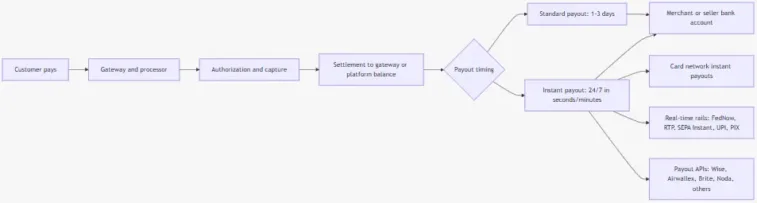
1. Concepts: settlement vs payouts vs instant payouts
Settlement vs payout vs instant payout
- Settlement:
- The gateway/processor moves funds from the customer’s bank/card issuer to your merchant balance.
- For cards, this is usually 1–3 business days after the transaction.
- Payout:
- Funds move from your merchant/platform balance to your (or your users’) bank account or card.
- Traditionally runs on batch schedules (e.g., daily T+2 or T+3).
- Instant payout:
- You trigger a payout that settles in seconds/minutes, 24/7/365, using:
- Card‑network instant rails (to a debit card), or
- Real‑time payment networks (e.g., FedNow, RTP, SEPA Instant, UPI, PIX).
- Example: Stripe Instant Payouts to an eligible debit card/bank “usually appear… within 30 minutes,” available weekends/holidays.
- You trigger a payout that settles in seconds/minutes, 24/7/365, using:
Real‑time payment rails that make instant payouts possible
- US:
- The Clearing House RTP network
- Federal Reserve FedNow Service (both launched and now broadly used for real‑time payments).
- EU/EEA:
- SEPA Instant Credit Transfer (SCT Inst): funds available in the payee’s account within 10 seconds, 24/7/365.
- New EU Instant Payments Regulation (IPR) is mandating broader availability and payee verification by 2025–2026.
- Other countries:
- UPI (India), PIX (Brazil), FPS (UK), NPP (Australia), etc., many with sub‑10 second settlement times.
- Real‑time APIs and orchestration layers (e.g., Lightspark Grid) route across these rails globally.
Payment gateway instant payout; Your gateway/PSP doesn’t always expose these directly, but instant payout products are usually built on top of them.
2. Typical use cases for instant payouts
Payment gateway instant payout; Instant payouts are most valuable when cash flow timing is a competitive or UX lever:
- Marketplaces & two‑sided platforms
- Pay sellers instantly after each order to attract and retain them (FedNow specifically highlights this use case).
- Gig & on‑demand platforms
- Ride‑sharing, delivery, task services — pay drivers/couriers instantly after shifts or individual jobs.
- Creator economy
- Pay creators/streamers instantly after tips or sales; improve loyalty and reduce churn.
- B2B supplier payments
- Enable suppliers to get paid on delivery instead of waiting weeks.
- Insurance claims & refunds
- Instant claim payouts or refund settlements improve customer satisfaction.
- SaaS with embedded finance
- Platforms embed instant payouts as a value‑added feature for their users (e.g., “get paid instantly” toggles).
Payment gateway instant payout; If your users don’t care strongly about same‑day access, standard payouts are usually cheaper and simpler.
3. How instant payout implementations usually work
Payment gateway instant payout; Two main patterns:
A) Merchant‑centric instant payout (you get paid faster)
- You accept payments via a gateway (Stripe, Adyen, Square, PayPal, etc.).
- Instead of waiting T+2/T+3 for standard settlement, you enable “Instant Payouts” or “Instant Transfers”:
- Funds go from your gateway balance to your bank account or debit card in minutes.
- You pay a fee (often ~1–1.5%) and there can be caps/limits.
B) Platform/payout‑API instant payout (you pay your users faster)
- You run a marketplace or gig platform.
- You use:
- Payout‑oriented products (Stripe Connect Instant Payouts, Adyen for Platforms, Wise Platform, Airwallex, Dots, Trolley, Brite, Noda, etc.).
- You call an API to trigger an instant payout to a user’s:
- Debit card (Visa/Mastercard), or
- Bank account via real‑time rails (FedNow, RTP, SEPA Instant, etc.).
- The PSP handles:
- Compliance and screening
- FX (if cross‑currency)
- Tracking and webhooks
- Reconciliation
Most “instant payout gateways” for platforms are really PSPs exposing a payout API + real‑time rails.
4. Major instant payout options (gateway/PSP level)
Payment gateway instant payout; Below is a practical, non‑exhaustive list as of 2025–2026.
1) Stripe Instant Payouts
- What it is:
- Move funds from your Stripe balance to an eligible debit card or bank account in minutes.
- Key facts:
- Funds “usually appear… within 30 minutes”; can request anytime, including weekends/holidays.
- Pricing (standard Stripe account): 1.5% of Instant Payouts volume, minimum fee 50¢.
- New users aren’t immediately eligible; eligibility is shown in the Dashboard.
- Different pricing/eligibility may apply under Stripe Connect for platforms.
- Best for:
- Online businesses in supported countries wanting fast access to operating cash.
- Platforms using Connect to offer instant payouts to sub‑merchants/users (where supported).
2) PayPal Instant Transfer
- What it is:
- Move your PayPal balance to a bank account or eligible card instantly instead of waiting days.
- Key facts:
- Instant transfers typically cost about 1.5% of the transferred amount, with minimum fees based on currency.
- Standard bank withdrawals can be free but slower.
- Best for:
- Sellers and freelancers who already use PayPal and want faster access to their balance.
3) Square Instant Transfers
- What it is:
- Move your Square balance to a linked bank account 24/7/365.
- Key facts:
- Fee: 1.5% per instant transfers.
- New sellers may have a daily instant transfer limit (e.g., up to $500/day, growing up to $5,000/day).
- Square also offers next‑day payouts for free and instant access via the Square Cards.
- Best for:
- Small merchants, cafes, retail, and service businesses using Square’s POS.
4) Adyen Instant Card Payouts
- What it is:
- Pay out to Mastercard and Visa cards instantly via a single API call.
- Key facts:
- Funds typically available on the card within 30 minutes, often within ~2 minutes.
- Designed for use cases like:
- Seller payouts, marketplace disbursements, gaming winnings, refunds/claims.
- Part of Adyen’s broader “online payouts” and “on‑demand payouts” platform products.
- Best for:
- Larger platforms and marketplaces that need strong global coverage and card‑based instant payouts.
5) Real‑time bank / Pay‑by‑Bank gateways
- Revolut Gateway (Pay by Bank):
- Revolut has integrated Pay by Bank into its gateway, enabling instant bank‑to‑bank payments for merchants, with faster settlement and stronger security via Open Banking.
- Pay‑by‑Bank / open‑banking providers (Noda, etc.):
- Noda offers instant payout APIs sending money instantly via bank or card.
- Often marketed as “instant bank payments” or “pay‑by‑bank checkout + payout.”
- SEPA Instant–enabled bank APIs:
- Some banks and PSPs (e.g., Nordea’s Multi‑Payout Instant API) expose SEPA Instant payouts directly for automated bulk instant euro payments.
- Best for:
- Europe‑focused platforms that want account‑to‑account instant payouts without card rails.
- Reducing card fees and chargebacks while still providing instant settlement.
6) Payout‑API platforms and global payout providers
Payment gateway instant payout; These aren’t classic “gateways” for accepting payments, but they’re critical for instant payouts to your users:
- Wise Platform:
- Provides global mass payouts and multi‑currency accounts; 74% of transfers were instant as of late 2025.
- Good for low‑cost cross‑border payouts but not always “instant” in every corridor.
- Airwallex:
- Offers global business accounts, local payouts, and FX; often same‑day or faster depending on corridor and rail.
- Brite Payments:
- Focuses on instant bank‑to‑bank payments in Europe; claims payouts delivered in seconds over its proprietary network.
- Noda:
- Instant payout APIs via bank or card; emphasizes instant bank payments with open banking rails.
- Others:
- Dots, Trolley, Tipalti, Pinelabs, Aeropay, etc., specialize in payout automation and, in some cases, real‑time rails or same‑day capabilities.
- Best for:
- Marketplaces, gig platforms, and SaaS that need global payouts, FX, and increasingly instant/real‑time options.
7) Crypto/USDC instant payout gateways (niche)
- Some solutions (e.g., WHMCS “Instant Payment Gateway” modules) offer instant crypto/USDC payouts directly to your own wallet with finality and no chargebacks.
- Best for:
- High‑risk or crypto‑native businesses and users comfortable with volatility and wallet management.
5. What does instant payout typically cost?
Payment gateway instant payout; Cost structures vary by provider and rail. Common patterns:
- Card‑based instant payouts (to debit card):
- ~1–1.5% of the payout amount:
- Stripe: 1.5%, minimum 50¢ per Instant Payout.
- Square: 1.5% per Instant Transfers.
- PayPal: ~1.5% for an instant bank/card transfer.
- You also pay the standard card processing fee on the original payment (e.g., Stripe ~2.9% + 30¢ in the US).
- ~1–1.5% of the payout amount:
- Real‑time bank payout (account‑to‑account):
- Fee models can be:
- Percentage only (e.g., 0.5–1%),
- Fixed per transaction (e.g., a few cents per instant payment),
- Subscription + per‑transaction (some payout‑API platforms like Dots use this model).
- Some banks/PSPs charge for instant payments on top of scheme fees (e.g., SEPA Instant fees may apply at the bank level).
- Fee models can be:
- International instant payouts:
- Often include FX spreads (e.g., Wise’s mid‑market rate plus a small percentage; Wise reports average fees around 0.53% and 74% instant by late 2025).
- Cross‑border rails like UPI/PIX/SEPA Instant can still be fast but FX and corridor availability matter.
Rule of thumb:
- Card instant payouts = fast and easy, but relatively expensive at scale.
- Bank‑based instant payouts = can be cheaper, especially domestically, but depend on rail availability and provider integrations.
6. Geographic differences: where instant payouts work well
- United States:
- Real‑time rails: FedNow and RTP are now widely available for instant bank‑to‑bank payments.
- Many gateways still rely on card‑network instant payouts (Stripe, Square, Adyen) because they’re broadly supported.
- Europe (SEPA zone):
- SEPA Instant Credit Transfer: funds available within 10 seconds, 24/7.
- EU Instant Payments Regulation is driving all PSPs to support instant payments by 2025–2026.
- Gateways and PSPs like Brite, Revolut (Pay by Bank), and some local banks expose instant payouts via SEPA Instant.
- United Kingdom:
- Faster Payments is already near‑real‑time; Pay by Bank (open banking) is increasingly used for both checkout and payouts.
- India, Brazil, others:
- UPI and PIX are instant/24/7 and used heavily by local gateways and fintechs.
For a global platform, you’ll often combine multiple providers:
- Card instant payouts in the US/elsewhere.
- Bank instant payouts in SEPA/UK/India/Brazil.
- A payout‑API layer to orchestrate.
7. Implementation patterns for instant payouts
A) If you just want faster access to your own funds
- Step 1: Choose a gateway with instant payouts:
- Stripe, Square, PayPal, Adyen, or a local acquirer that supports instant payouts in your country.
- Step 2: Link an eligible payout destination:
- Business debit card that supports instant payouts, or
- Bank account in a supported country/rail.
- Step 3: Enable and configure:
- Turn on Instant Payouts/Instant Transfers in the dashboard or via API.
- Understand:
- Fees (e.g., 1.5%).
- Limits (daily/transaction caps).
- Cut‑off times (if any).
- Step 4: Decide when to trigger payouts:
- Automatically after every payment?
- At a threshold (e.g., balance > $500)?
- Manually on demand?
- Step 5: Monitor:
- Payout status, fees, and bank reconciliation.
B) If you’re building instant payouts for your users (platform/marketplace)
Payment gateway instant payout; Architecturally, you’ll typically:
- Underwrite and KYC your users
- Collect identity and banking details.
- Run KYC/AML checks (often via the PSP’s onboarding tools).
- Accept and split payments
- Use Connect/for‑Platforms products (Stripe Connect, Adyen for Platforms, etc.) so payments are split and each user has a sub‑balance.
- Choose payout rails per user/country
- Card: where fast access is critical and users accept ~1% fee.
- Bank (real‑time): where cheaper rails exist and users’ banks support SEPA Instant, Faster Payments, FedNow, UPI, PIX, etc.
- Call the payout API
- Example flows:
- Stripe Connect Instant Payouts for eligible users.
- Adyen Instant Card Payouts / On‑demand Payouts.
- Wise Platform / Airwallex / Brite / Noda for bank‑based instant or same‑day payouts.
- Handle statuses and errors
- Use webhooks to track:
- Payout created, in_transit, paid, failed.
- Implement retry logic and user notifications.
Payment gateway instant payout; Many platforms start with card‑based instant payouts (easier, more universal) and then add real‑time bank rails by region as they scale.
8. Pros and cons of instant payouts
Pros
- Better cash flow:
- You or your users get funds within minutes instead of days.
- Competitive advantage:
- Marketplaces and gig platforms can attract and retain sellers/workers by paying instantly.
- Improved UX:
- “Get paid now” buttons and instant withdrawals reduce frustration.
- Lower working capital needs:
- For gig workers and small sellers, instant access reduces the need for credit.
Cons / trade‑offs
- Higher fees:
- 1–1.5% per payout on top of normal processing fees can add ups.
- Limits and eligibility:
- Daily caps, country/rail restrictions, and account history requirements (e.g., new Stripe users aren’t immediately eligible).
- Fraud & risk:
- Instant payouts increase risk; you must:
- Reserve funds.
- Use risk scoring and holds.
- Handle disputes and clawbacks.
- Instant payouts increase risk; you must:
- Operational complexity:
- More payout options mean more reconciliation, support, and error handling.
9. Compliance, risk, and operational considerations
- Regulatory:
- Ensure you comply with local rules when sending payouts (e.g., AML, sanctions screening, licensing).
- In the EU, instant payouts via SEPA Instant will increasingly require payee verification under the IPR and Verification of Payee schemes.
- Fraud & chargebacks:
- With instant card payouts, chargebacks can still come days later.
- Best practices:
- Use rolling reserves or per‑user limits.
- Delay or partially hold payouts for higher‑risk users.
- Combine with strong identity verification.
- Bank coverage and rail availability:
- Not every bank supports FedNow, RTP, SEPA Instant, or card instant payouts.
- PSP eligibility can vary by country and account type.
- Reconciliation:
- Instant payouts can make reconciliation trickier because they occur outside standard batch windows.
- Use PSP reports and webhooks, and map them to your internal ledger.
10. How to choose the right instant payout solution
Payment gateway instant payout; Start from your use case and region:
- For simple, small‑business instant access to your own funds:
- Check Stripe Instant Payouts, Square Instant Transfers, or PayPal Instant Transfer depending on where you operate and what you already uses.
- For US‑centric marketplaces/gig platforms:
- Stripe Connect Instant Payouts (card + some bank rails).
- Adyen for Platforms with instant card payouts and on‑demand payoutsdocs.
- Payout‑API providers that integrate FedNow/RTP for bank‑instant payouts.
- For Europe/UK:
- SEPA Instant–enabled providers:
- Brite (instant bank payouts).
- Revolut Gateway with Pay by Bank.
- Direct bank integrations like Nordea’s Multi‑Payout Instant APInordea .
- Wise Platform for low‑cost cross‑border instant/same‑day payouts where availablewise .
- SEPA Instant–enabled providers:
- For global platforms:
- Combine a global gateway (Stripe/Adyen) for payments with a payout‑API provider for global disbursements:
- Wise Platform, Airwallex, Dots, Trolley, etc..
- Use a real‑time orchestration layer (e.g., Lightspark Grid) if you need unified API access across multiple instant railslightspark .
- Combine a global gateway (Stripe/Adyen) for payments with a payout‑API provider for global disbursements:
Key selection criteria:
- Geography & rail coverage:
- Which countries and payout rails (card, FedNow, RTP, SEPA Instant, UPI, PIX) must you support?
- Cost structure:
- Percentage vs. flat fees, FX spreads, minimums, and monthly platform fees.
- API & integration quality:
- Webhooks, idempotency, bulk payout support, error codes.
- Compliance tooling:
- KYC/onboarding, sanctions screening, reporting.
- Limits & scaling:
- Throughput limits, payout size caps, and SLAs.
11. Quick checklist to get started
- Decide your scope:
- Instant payouts to your own business only?
- Instant payouts to your users (sellers, workers, creators)?
- Pick your primary gateway/PSP:
- Stripe, Square, PayPal, Adyen, local acquirer, or marketplace‑oriented provider?
- Enable instant payouts:
- Confirm supported payout methods (card, bank) and countries.
- Understand pricing and limits.
- Link eligible bank accounts/debit cards.
- Configure policies:
- Auto vs. manual payouts.
- Minimum/maximum amounts and frequency.
- Risk settings (limits, holds, reserves).
- Integrate & test:
- Use test accounts and test card/bank numbers to simulate instant payouts.
- Implement webhooks and reconciliation.
- Monitor and iterate:
- Track payout success rates, fees, and user feedback.
- Expand to additional rails (e.g., real‑time bank transfers) as volume grows.
If you share:
- Your country/regions,
- Whether you need payouts just for yourself or for thousands of users,
- Your typical volume and average ticket size,
Payment gateway instant payout; I can narrow this down to a shortlist of 2–3 providers and a concrete integration pattern for 2026.