
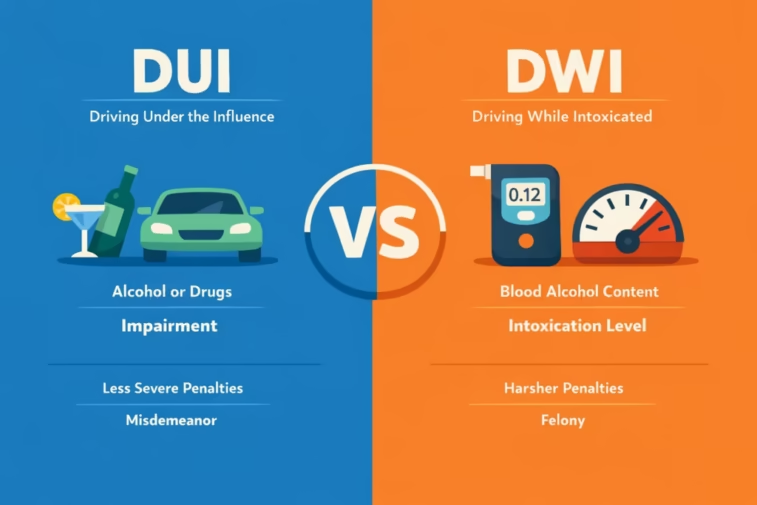
Difference between DUI and DWI carry different penalties by state. DUI vs DWI Legal Difference & Which Is Worse? A lawyer breaks down exact legal distinctions, fines, and license consequences.
DUI vs DWI Legal Difference & Which Is Worse? 2026 Complete Guide
Short answer (lawyer-view):
- In most states, “DUI” and “DWI” are just different labels for the same basic impaired-driving offense; neither is legally “worse” across the board. What makes a charge worse is BAC level, prior offenses, and aggravators (child passenger, injury/death, high BAC), not the acronym.
- A handful of states do draw a legal distinction. For example:
- Texas: DWI is the standard “intoxicated” offense (0.08% BAC or impairment) and carries jail, higher fines, and longer license suspensions. DUI is a lesser, zero-tolerance offense usually applied to drivers under 21 with any detectable alcohol. In Texas, DWI is the more serious charge.
- New York: DWI is the more serious “intoxicated” charge (0.08%+ BAC). DWAI (Driving While Ability Impaired) is a lesser, often noncriminal violation for lower BACs; DWI penalties are higher.
- South Carolina: DUAC (Driving with Unlawful Alcohol Content) is a lesser-included offense for BAC 0.08%–0.10%; DUI applies to impairment and any BAC above 0.08% and is the more serious charge.
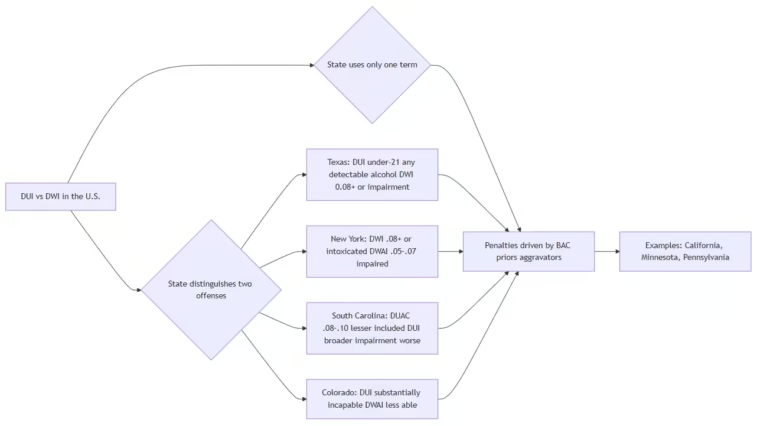
High-level map: DUI/DWI across the U.S.
DUI vs DWI Legal Difference; This diagram summarizes how different states treat DUI vs. DWI and which tends to be “worse” where a distinction exists.
1. What do DUI and DWI mean?
- DUI = Driving Under the Influence.
- DWI = Driving While Intoxicated or Driving While Impaired.
DUI vs DWI Legal Difference; Both refer to operating a vehicle while impaired by alcohol, drugs, or other substances. The label often reflects how a state names the offense rather than a different crime.
2. The key legal difference: it depends on the state
Most states: one term, one offense
- Many states pick one acronym and stick with it (for example, California, Minnesota, Pennsylvania mainly use “DUI”). In those states, “DUI” and “DWI” are essentially synonyms for the same impaired-driving crime.
- A few states use entirely different terms, such as:
- OUI (Operating Under the Influence) — e.g., Maine, Massachusetts.
- OWI (Operating While Intoxicated) — e.g., Wisconsin, Indiana, Iowa.
States that legally distinguish DUI vs. DWI (or similar paired offenses)
Texas
- DUI: Generally applies to drivers under 21 with any detectable alcohol (zero-tolerance). Prosecutors don’t need to prove 0.08% intoxication. Penalties typically involve fines, community service, and alcohol education; it’s treated as a lesser charge.
- DWI: Applies when a driver is “intoxicated” (BAC 0.08% or higher, or impairment of normal mental/physical faculties) while operating a vehicle in a public place. This is a Class B misdemeanor for a first offense and can carry jail time, higher fines, and license suspension. In Texas, DWI is generally the more serious charge.
New York
- DWI (Driving While Intoxicated): BAC 0.08% or higher, or other evidence of intoxication. This is the more serious charge with higher fines and longer license consequences.
- DWAI (Driving While Ability Impaired by Alcohol): BAC >0.05% but <0.07%, or other evidence of impairment. Treated as a less serious violation (often noncriminal for first offenses), with shorter license suspension (e.g., 90 days versus 6 months for DWI).
South Carolina
- DUAC (Driving with an Unlawful Alcohol Concentration): BAC 0.08% to 0.10%. This is a “lesser-included” offense with its own penalty range; first offense up to ~30 days jail, up to $400 fine, and a 6-month license suspension.
- DUI (Driving Under the Influence): Applies when alcohol or drugs “materially and appreciably impair” driving ability; can be charged even below 0.08% if impairment is shown. Penalties can exceed DUAC and increase with aggravators and priors. DUI is the more serious charge.
Colorado
- DUI: Driver is “substantially incapable” of safe driving due to alcohol or drugs; also a per se offense at BAC ≥0.08%. This is the more serious charge.
- DWAI (Driving While Ability Impaired): Driver is “less able” than normal to drive safely (a lower standard of impairment), often charged when BAC is below 0.08% or impairment is minor. This is treated as a less serious offense.
Others (examples)
- New Mexico: Uses “DWI” almost exclusively, and prosecutes both DUI and DWI under the same set of laws; there’s no practical difference in penalties.
- Maryland: Defines “DUI per se” at 0.08% and a separate “driving while impaired by alcohol” (0.07% BAC) with distinct penalty ranges; the higher-BAC, per-se offense is treated more harshly.
3. Which is worse: DUI or DWI?
General rule (most states)
- In states that only use one term, the question doesn’t apply; DUI and DWI refer to the same crime. The severity is determined by:
- BAC at the time of driving
- Number and recency of prior offenses
- Aggravating factors (child passenger, crash with injury/death, extremely high BAC, speeding, wrong-way driving, etc.)
- Whether a injury or death occurred.
In states that draw a legal distinction
- Texas: DWI is generally worse than DUI. DWI involves legal intoxication (0.08% BAC or impairment) and can bring jail, higher fines, and license suspension; DUI is a lesser, usually under-21 zero-tolerance offense with lighter penalties.
- New York: DWI is worse than DWAI. DWI (0.08% or intoxicated) is a crime with higher fines and at least a 6‑month license suspension; DWAI is typically a traffic infraction or noncriminal violation for lower BACs with a 90‑day suspension for alcohol DWAI.
- South Carolina: DUI is worse than DUAC. DUAC is a lesser-included offense for BAC 0.08%–0.10%; DUI applies to impairment and higher BACs, with higher maximum jail and fines.
- Colorado: DUI is worse than DWAI. DUI (substantial incapacity/0.08%+ per se) carries the standard DUI penalties; DWAI (less able than normal) carries lighter penalties.
Key point from legal commentary
- Best Lawyers (2026) emphasizes that the label “DUI” vs. “DWI” itself doesn’t determine severity; instead, severity is driven by BAC level, priors, and aggravators. Many people mistakenly assume one acronym is always worse, but that’s not true in most jurisdictions.
4. Typical penalties: what actually hurts?
DUI vs DWI Legal Difference; Across the U.S., a first‑time impaired‑driving conviction in 2026 commonly involves:
- Fines: often several hundred to a few thousand dollars.
- Jail or probation: many states allow up to 6–12 months for a first offense; some require minimum jail for higher BACs.
- License loss: 90 days to 1 year suspension is typical for a first offense in many states; extended suspensions or revocations for repeats or high BAC.
- Additional requirements: substance abuse assessment/treatment, community service, victim impact panels, and ignition interlock devices (IIDs) after reinstatement in many states.
These consequences increase sharply for:
- Repeat offenses (second, third within a “lookback” period—often 5–10 years, though some states are extending that; e.g., Washington moved from a 10‑year to a 15‑year lookback for felony enhancement in 2026).
- High BAC (commonly 0.15%–0.20% triggers enhanced penalties in many states).
- Child passengers, injury, or death.
5. License consequences and test refusal
Implied consent
- Every state has an implied consent law: by driving, you consent to chemical testing (breath, blood, urine) if lawfully arrested for DUI/DWI. Refusing a legally required test usually triggers separate administrative license penalties (often longer suspensions) and can be used as evidence in court.
License loss in practice
- First offense: suspension is commonly around 90 days to 1 year in many states; some states treat higher-BAC or refusal cases with longer suspensions.
- Repeat offenses: suspensions of 1–2 years are common, and some states may impose multi‑year revocations or even lifetime revocations in extreme cases.
Ignition interlocks (2026 trends)
- Many states require ignition interlock devices (IIDs) for repeat or high‑BAC offenders; research shows interlock laws for all convicted offenders reduce alcohol‑involved crashes.
- As of May 2026, most states require IIDs for some or all offenders post‑conviction, though specifics (first vs. repeat; required vs. incentivized) vary.
6. A few concrete examples (to show the range)
- Texas (DUI vs. DWI): DUI vs DWI Legal Difference; DWI generally worse because it’s defined as intoxication (0.08% or impairment) and brings jail exposure and license suspension; DUI is usually an underage, any‑detectable‑alcohol offense with lesser penalties.
- New York (DWI vs DWAI): DWI (0.08%+ or intoxicated) is worse (criminal, higher fines, at least 6‑month suspension); DWAI is lower-BAC/“ability impaired” and usually noncriminal with a 90‑day suspension.
- South Carolina (DUI vs DUAC): DUAC (0.08%–0.10% BAC) is a lesser-included offense; DUI (impairment at any BAC or above 0.08%) is the primary, more serious impaired‑driving charge.
- Colorado (DUI vs DWAI): DUI (substantial incapacity/0.08%+ per se) is the more serious offense; DWAI (less able than normal) is a lesser offense with lower penalties.
7. Why this matters in practice
- The label on your ticket (DUI vs. DWI) is far less important than:
- Your BAC level
- Whether anyone was hurt or killed
- Whether you have priors
- Whether you refused a chemical test
- Whether a child was in the car
- In states that distinguish DUI from DWI (or DWAI, DUAC), prosecutors sometimes agree to resolve a case under the lesser charge as part of a plea bargain—but that is strategic and highly fact‑specific.
8. 2026 legal trends to watch
- Extended look‑back periods: some states are lengthening the window for prior offenses that can upgrade a new charge to a felony (e.g., Washington extending from 10 to 15 years for felony escalation in 2026).
- Expanded ignition interlock requirements: more states mandating IIDs for all convicted offenders, with tightened reinstatement procedures.
- Continued emphasis on drugged driving: DUI vs DWI Legal Difference; laws covering any detectable amount of certain controlled substances or THC thresholds (e.g., Washington’s 5.00 ng/mL THC limit; New York, Illinois, Montana provisions).
Bottom line:
- Most states treat “DUI” and “DWI” as the same crime; DUI vs DWI Legal Difference; what hurts you is BAC, prior offenses, and aggravators.
- In states that distinguish them (Texas, New York, South Carolina, Colorado, etc.), the more serious label is typically the one tied to higher BAC or a higher standard of impairment (often DWI/DUI), while the lesser label (DUI in Texas; DWAI in NY; DUAC in SC) carries lighter penalties.
- If you’re facing a DUI or DWI, your best move is to consult a local criminal defense lawyer who can explain how your state defines the charges, what the exact penalties are, and whether a plea to a lesser offense is realistic in your situation.
DUI vs DWI Legal Difference; This is general information, not legal advice. Laws differ significantly by state, and outcomes depend heavily on the facts of each case.