
CDPs that unify online and offline data improve ad targeting efficiency by 30%. Best Customer Data Platform for Advertising; Compare Salesforce CDP, Adobe RTCDP, and Segment on identity resolution, audience activation, and compliance with GDPR and CCPA.
Best Customer Data Platform for Advertising in 2026: Unify Your Data & Activate Audiences at Scale
Best Customer Data Platform for Advertising; Here’s a 2026, ad-centric comparison of Salesforce CDP (Data Cloud), Adobe Real-Time CDP (RTCDP), and Segment (Twilio Segment), with a focus on identity resolution, audience activation, and GDPR/CCPA compliance.
Quick verdict
- Heavy Salesforce stack + want ad audiences pushed to Google/Meta/Amazon/LinkedIn with minimal IT? Choose Salesforce Data Cloud (CDP). Strong ad activation and AI-assisted segment building are highlights.
- Deep Adobe Experience Cloud (Analytics, Journey Optimizer, Marketo) + need strict, policy-enforced governance and real-time profile activation? Choose Adobe RTCDP. Very strong identity and governance framework.
- Best-of-breed martech, data warehouses, and developer-friendly pipelines with broad ad destination syncs? Choose Segment. Its identity graph and warehouse-native model excel for unifying online/offline data and activating to ad platforms.
Visual landscape: where each CDP shines for advertising
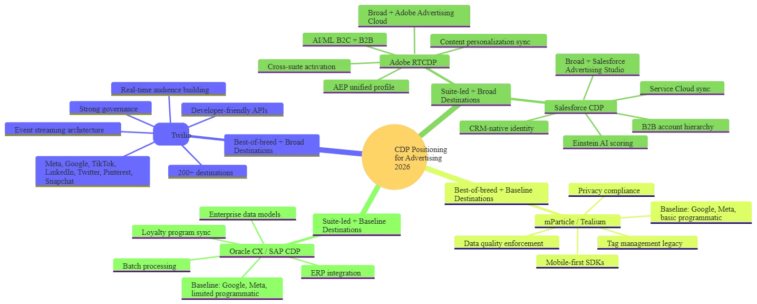
High-level comparison snapshot
| Capability | Salesforce CDP (Data Cloud) | Adobe Real-Time CDP | Segment (Twilio Segment) |
|---|---|---|---|
| Identity resolution | Identity resolution across online/offline sources; merges identifiers into unified profiles for marketing and AI use. | Identity Service bridges identities across devices and systems into a unified, real-time profile with a tenant-specific identity graph. | Identity Resolution merges traits across devices/channels into single “golden” profiles; anonymous stitching and user:account relationships supported. |
| Online + offline unification | Ingests marketing, sales, service, commerce, and data warehouse/POS data; builds unified profiles used across the business. | Identity Service explicitly calls out linking online (web/mobile) with offline interactions such as in-store purchases, loyalty, and call center into a single view. | Unify collects from all sources, including data warehouses, matches/merges to create always-up-to-date profiles; supports warehouse interoperability to enrich and sync profiles. |
| Audience activation to ads | Native activation to Google Ads, Meta, Amazon, and LinkedIn; supports AI-powered lookalikes and segment-level insights from ad partners. | Destinations framework for real-time sync to ad and social platforms; GenStudio for Performance Marketing references activating RTCDP audiences to Meta, Google, and LinkedIn. | Audiences sync continuously to marketing automation, ads platforms (e.g., Facebook/Google), analytics, and data warehouses; batch or real-time sync as users qualify. |
| GDPR/CCPA compliance | Salesforce’s cloud is designed to help customers comply with privacy laws globally; resources and tools support GDPR and CCPA obligations. | Privacy Service processes access, delete, and opt-out-of-sale requests aligned with GDPR/CCPA; real-time opt-out enforcement in segmentation; IAB TCF 2.0 support for consent integration. | Privacy Portal enables automated deletion/suppression and consent enforcement across Segment and connected tools to support GDPR/CCPA Right to be Forgotten and consent requirements. |
Why the 30% efficiency gain claim makes sense
Best Customer Data Platform for Advertising; Organizations that unify online and offline data in a CDP typically see higher ad targeting efficiency because they can:
- suppress recent buyers from acquisition ads,
- create high-propensity segments (e.g., churn risk, cross-sell),
- build better lookalikes off resolved profiles, and
- coordinate frequency across channels.
While exact percentages vary by maturity and use case, industry analyses consistently show paid media optimization (suppression + first-party activation) is among the highest-ROI CDP use cases. Best Customer Data Platform for Advertising; If your KPIs are CPA/ROAS, a 20–30% efficiency improvement is a reasonable planning target once activation workflows are running well.
Now, let’s go platform by platform.
1) Salesforce CDP (Salesforce Data Cloud)
Identity resolution
- Data Cloud runs identity resolution to link identifiers across sources and create persistent, unified profiles used for marketing and AI/Agentforce.
- Supports reconciling online touchpoints (web, email, mobile, ads) with offline data such as POS, loyalty, service interactions, and data warehouse records, enabling a 360 view for marketing, service, and sales.
- Salesforce’s identity resolution is designed to feed segmentation and AI use cases (e.g., propensity, churn) that are then activated across channels.
Audience activation for advertising
- Native activation to walled gardens: Salesforce documents the ability to “seamlessly and securely activate new audiences to walled garden platforms like Google Ads, Meta, Amazon, and LinkedIn” for personalized ads on each channel.
- AI-assisted audience building: With Agentforce + Data Cloud, marketers can describe target audiences in natural language; AI translates prompts into segments and can power lookalike modeling through ad platforms like Google and Meta.
- Feedback loops from ad partners: Segment-level insights from Google and Amazon can be brought back into Data Cloud to refine future segmentation and personalization.
GDPR and CCPA compliance
- Salesforce’s cloud services are “designed to help customers comply with privacy laws around the world,” including GDPR and CCPA, with controls, DPAs, and transfer mechanisms.
- Salesforce provides a dedicated Regional Privacy Laws resource that covers GDPR and CCPA, plus mechanisms like Standard Contractual Clauses and BCRs for transfers.
- Product-level privacy and governance capabilities (consent management, field-level security, sharing rules) are available across the Salesforce clouds that Data Cloud connects to, enabling privacy-aware segmentation and activation.
When Salesforce CDP is a strong choice
- You’re already heavy on Sales, Service, and/or Marketing Cloud and want unified profiles that feed not just ads, but also sales, service, and commerce.
- You value native activation to Google, Meta, Amazon, and LinkedIn, plus AI-generated segments and lookalikes.
- Your privacy program already leverages Salesforce’s compliance resources and you want to stay within that ecosystem.
Gotchas and considerations
- Deepest identity and activation value comes when other Salesforce clouds are in play; if Salesforce isn’t a primary system of record, you may still need significant data integration.
- For advanced data governance and labeling at the field level, Adobe’s policy-enforcement model is more granular out of the box (see below).
2) Adobe Real-Time CDP (RTCDP)
Identity resolution
- Identity Service (underlying RTCDP) bridges identities across devices and systems, so a single customer’s web browsing, in-store purchase, loyalty activity, and support calls are reflected as one profile.
- Uses identity namespaces (e.g., email, ECID, custom IDs) and maintains an organization-specific identity graph that is updated as new identity links are discovered.
- Identity graphs power Real-Time Customer Profile, which unifies data for real-time segmentation and activation.
Audience activation for advertising
- Destinations framework: RTCDP documentation lists Destinations for B2C and B2B editions, enabling segment sync to ad platforms and other destinations.
- GenStudio for Performance Marketing (Adobe’s performance marketing solution) describes activating RTCDP audiences to platforms like Meta, Google, and LinkedIn, with audiences staying dynamically updated from RTCDP.
- Because RTCDP is built on Adobe Experience Platform, Best Customer Data Platform for Advertising; segments can be reused across Journey Optimizer, Adobe Analytics, and other Adobe apps, ensuring consistent segmentation for on-site personalization and off-site media.
GDPR and CCPA compliance
- Privacy Service in Experience Platform processes customer requests to access, opt out of sale, or delete personal data in accordance with GDPR and CCPA; Best Customer Data Platform for Advertising; this applies to Real-Time Customer Profile and related data stores.
- RTCDP allows customers to opt out of segmentation use cases; opt-out preferences are stored and enforced via boolean logic in segment predicates (e.g., “AND NOT opted_out”).
- Data governance & labeling: RTCDP provides data usage labels and automated policy enforcement to prevent activation of sensitive data and to honor consent, with an emphasis on “marketing responsibly.”
- IAB TCF 2.0 support: Platform can ingest and use TCF consent signals in segmentation and audience export, which is critical for EU digital advertising.
When Adobe RTCDP is a strong choice
- You’re invested in the Adobe Experience Cloud (Analytics, Journey Optimizer, Marketo, AEM) and want consistent segments across web/app/email and paid media.
- You need sophisticated, enforceable data governance and labeling (e.g., preventing export of sensitive data to certain destinations).
- Your teams rely on Adobe for content and personalization, and you want closed-loop measurement between paid media and on-site experiences.
Gotchas and considerations
- RTCDP is a robust enterprise CDP, but implementation complexity is higher than some alternatives; plan for schema design, identity strategy, and governance configuration.
- If you don’t use other Adobe products, you may not fully realize the value of RTCDP’s deep integration with the rest of the Experience Cloud.
3) Segment (Twilio Segment)
Identity resolution
- Segment Unify includes Identity Resolution that “merges customer traits and interactions across devices and channels into a single profile for each customer in real time.”
- Identity Resolution “stitches together user behavior across platforms, anonymous or known state and devices… into a single golden profile,” critical in a cookie-reduced world.
- Supports anonymous-to-known stitching, user: account relationships for B2B, and multiple identifier types (cookie IDs, device IDs, emails, custom external IDs).
Online + offline unification and warehouse-native activation
- Unify collects data from all sources, including your data warehouse, matches and merges it to create always-up-to-date customer profiles, and supports warehouse interoperability (enriching profiles from the warehouse and sending unified profiles back).
- This pattern is ideal for loading id-resolved profiles into your warehouse and then using partners like LiveRamp for compliant onboarding to ad platforms for cookie-free targeting; Twilio’s own recipe explicitly walks through joining online + offline first-party data and loading profiles to Snowflake and LiveRamp.
Audience activation for advertising
- Engage Audiences can be synced to “marketing automation tools, ads platforms, analytics tools, or data warehouses,” with sync occurring in batch or in real time as users qualify.
- Segment docs show use cases like re-targeting customers with the same ad using Audiences, and Journeys can send users to Destinations at designated points for more complex flows.
- The extensive catalog of Destinations (400+), Best Customer Data Platform for Advertising; including Facebook/Meta, Google, TikTok, LinkedIn, and others, plus “Destination Actions” to customize payloads, gives you flexible activation options.
GDPR and CCPA compliance
- Twilio Privacy Portal provides “subject rights management,” enabling automated deletion and suppression across Twilio Segment and your connected stack, and integrates with consent management platforms for consent enforcement.
- Data retention and compliance: Twilio notes Segment offers tools to help with GDPR and CCPA, including features for managing consent and automatically executing deletion and suppression across the ecosystem.
- Capabilities include blocking data collection for specific users via suppression lists, which is important for honoring opt-outs and deletion requests.
When Segment is a strong choice
- Your stack is best-of-breed across analytics, email, ads, and data warehouses; Best Customer Data Platform for Advertising; you want a single pipeline to normalize and route events plus create audiences.
- You care deeply about warehouse-native workflows (e.g., modeling in Snowflake/BigQuery and syncing segments back to ad tools).
- You want developer-friendly setup and broad destination coverage, with privacy tools that work across many downstream tools.
Gotchas and considerations
- For very large, offline-first enterprises with complex data lakes, additional engineering may be required to model and feed offline data effectively.
- Segment is strongest as a unification/activation layer; if you need deep native marketing orchestration (e.g., journey orchestration, heavy content personalization), pairing with another tool or using Twilio Engage is often the pattern.
Which CDP should you pick for advertising in 2026?
Best Customer Data Platform for Advertising; Choose Salesforce CDP if:
- Your customer data and workflows are heavily in Salesforce (CRM, Service, Marketing/Commerce Clouds).
- You want native, low-friction activation to Google Ads, Meta, Amazon, and LinkedIn with AI-assisted segment creation and lookalikes.
- You prefer to rely on Salesforce’s established privacy and compliance resources for GDPR/CCPA.
Choose Adobe RTCDP if:
- You run on Adobe Experience Cloud and need consistent segmentation and activation across Analytics, Journey Optimizer, Marketo, and paid media.
- You require best-in-class governance—data labeling, policy enforcement, and IAB TCF 2.0 consent integration built into the platform.
- You want to unify online and offline data into a single profile and then activate it in real time across channels, with rigorous privacy controls.
Choose Segment if:
- You have a heterogeneous martech stack and a data warehouse you want to treat as a first-class citizen in your CDP architecture.
- You need flexible identity resolution that stitches anonymous and known interactions and then syncs audiences to many ad platforms and analytics tools.
- You want privacy controls (deletion, suppression, consent enforcement) that propagate across many downstream tools from a single control plane.
Practical activation patterns for advertisers
Best Customer Data Platform for Advertising; Regardless of platform, prioritize these advertising workflows in 2026:
- Suppress existing customers/recent purchasers from acquisition ads to reduce CPA and improve customer experience.
- Create high-propensity segments (churn risk, cross-sell, LTV tiers) using unified profiles and sync them to major ad platforms.
- Use first-party audiences to build platform lookalikes in Google/Meta/TikTok/LinkedIn for scalable acquisition.
- Integrate consent signals so segments exclude users who have opted out, ensuring GDPR/CCPA-compliant targeting.
Best Customer Data Platform for Advertising; If you share your current stack (CRM, warehouse, key ad platforms) and primary region (EU vs. US), I can sketch a concrete activation architecture and recommend which of these three CDPs fits best—and what to implement first to capture that ~30% efficiency gain quickly.