
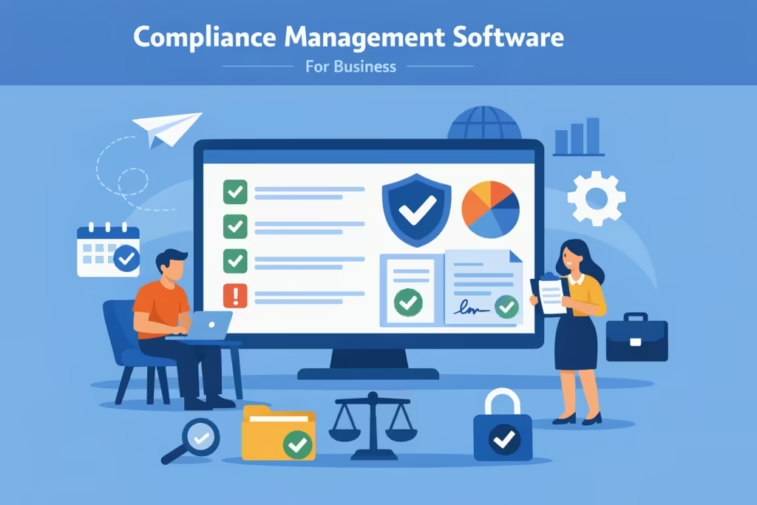
Non-compliance costs businesses an average of $14.82M per incident. Compare the best compliance management software for business in GDPR, SOC 2, ISO 27001, and industry-specific regulations in 2026.
Best Compliance Management Software for Business in 2026: How to Stay Audit-Ready Without the Stress
Here’s a straight, practical 2026 guide to the Best Compliance Management Software for Business and how to stay audit-ready without the stress.
Quick take (TL;DR)
- For fast-growing and mid-market tech companies (SOC 2, ISO 27001, HIPAA, PCI, AI risk): Vanta, Drata, Secureframe, Sprinto, and Hyperproof are the leading choices, with strong automation, continuous monitoring, and evidence handling. Best Compliance Management Software for Business; Vanta’s 2026 enterprise guide lists Vanta, Drata, OneTrust, Secureframe, and Sprinto as top GRC solutions for enterprise teams. Cynomi’s 2026 comparison highlights Cynomi, Drata, Vanta, Secureframe, Tugboat Logic (now OneTrust Certification Automation), Hyperproof, Ostendio, and LogicGate.
- For larger/complex enterprises and audit-heavy environments (SOX, internal audit, multi-risk programs): AuditBoard (named a Leader in the 2025 Gartner Magic Quadrant for GRC Tools), MetricStream, LogicGate Risk Cloud, RSA Archer, and ServiceNow GRC are frequently cited. MetricStream’s “Top 5 compliance tools for 2026” list includes MetricStream, LogicGate, OneTrust, RSA Archer, and ServiceNow GRC.
- Staying audit-ready in 2026 means three things: continuous monitoring instead of point‑in‑time checks, automated evidence collection tied directly to controls, and a single place for policies, risks, issues, and auditor requests.
Best Compliance Management Software for Business; To make this concrete, here’s a simple “always audit‑ready” loop.
Mermaid overview: The always audit‑ready loop

Below explore the Best Compliance Management Software for Business;
1. What “compliance management software” really does
Best Compliance Management Software for Business; A modern compliance management system should centralize and automate:
- Policies and documents (versioning, approval workflows, access)
- Requirements and control mappings (frameworks like SOC 2, ISO 27001, HIPAA, PCI DSS, GDPR, NIST, DORA, etc.)
- Evidence collection and testing (from cloud, HR, identity, and other systems)
- Issues, risks, and remediation tracking
- Audits and questionnaires (workspaces, evidence packs, auditor collaboration, trust centers)
Best Compliance Management Software for Business; Quickbase’s 2026 guide frames this as centralizing policies and procedures, automating regulatory workflows, tracking audits, and maintaining real-time visibility across the business—so you’re not constantly chasing spreadsheets.
2. Top compliance management platforms in 2026
Best Compliance Management Software for Business; Think in three buckets: (a) continuous compliance for tech/SaaS/ MSPs, (b) enterprise GRC and audit, and (c) operational/field compliance. Most businesses needing “audit‑ready without the stress” overlap (a) and (b).
A. Continuous compliance (tech/SaaS, high automation)
Best Compliance Management Software for Business; These platforms emphasize continuous monitoring of controls, automated evidence, and fast audit paths.
- Vanta
- What it is: An AI‑powered trust and compliance platform that unifies compliance, risk, and “proof” (trust center, questionnaires) in one system. Recognized as a Leader in the IDC MarketScape 2025 and used by 15,000+ organizations globally.
- Why it’s good for audit readiness:
- Connects to 400+ tools and runs 1,400+ automated tests hourly across cloud, IdP, HR, and on‑prem to detect control failures fast.
- Supports 35+ frameworks (SOC 2, ISO 27001, HIPAA, HITRUST, PCI DSS, DORA, EU AI Act, etc.) with cross‑mapped controls—test once, apply everywhere.
- Dedicated auditor portal with API access, immutable evidence trails, and collaborative workflows make auditors’ lives easier.
- Trust center and questionnaire automation can deflect most security questionnaires, with high answer acceptance rates.
- Best for: Mid‑market and enterprise teams managing multiple frameworks, business units, and geographies who want strong AI automation and continuous monitoring. Note pricing and planning for enterprise configurability (RBAC, adaptive scoping).
- Drata
- What it is: A compliance automation platform focused on continuous evidence collection and control testing for common frameworks (SOC 2, ISO 27001, HIPAA, etc.). Vanta’s 2026 review positions Drata as a strong option, especially for mid‑market organizations with standard compliance needs.
- Why it’s good for audit readiness:
- Automated evidence collection and daily control testing with dashboards to track progress toward certification.
- Trust Center capabilities (via the SafeBase acquisition) to share compliance status with customers.
- Straightforward user interface and support for custom control mapping.
- Considerations: Tests run daily rather than hourly, so there can be up to a 24‑hour window to detect control failures; enterprise‑grade multi‑entity features are less developed compared to some peers.
- Secureframe
- What it is: A compliance automation and GRC platform with modules for compliance, risk, vendor management, trust center, and federal/defense requirements. Secureframe was included in Forrester’s GRC Platforms Landscape, Q4 2025.
- Why it’s good for audit readiness:
- Automated evidence collection and controls management, plus policy management and user access reviews.
- “Secureframe Workspaces” to centralize and automate compliance across multiple business units and frameworks, cutting duplicate audits and manual work.
- “Secureframe Custom Integrations” lets you connect cloud, on‑prem, and legacy systems for continuous control testing and a more complete, real‑time view of compliance.
- Federal/defense capabilities: Secureframe Federal supports CMMC and FedRAMP readiness with live SPRS scoring and continuous control monitoring for defense contractors.
- Best for: Mid‑market to enterprises, particularly in highly regulated sectors or those needing federal/CMMC support, who want strong automation and multi‑BU management.
- Sprinto
- What it is: A continuous compliance and GRC platform with heavy automation, multi‑framework support, and an emphasis on fast audits (audit‑ready reports, trust center, questionnaires). Sprinto appears as a top alternative to Hyperproof in 2026 comparison lists.
- Why it’s good for audit readiness:
- Supports 200+ frameworks with strong automated evidence collection and always‑on monitoring (e.g., SOC 2, ISO 27001, PCI DSS, HIPAA, GDPR, NIST CSF, ISO 42001, FedRAMP, TISAX, etc.).
- Trust Center and AI security questionnaire features to speed up customer reviews.
- Policy management, access control workflows, security training, and “audit‑ready” reports packaged for auditors.
- Best for: Startups and mid‑market companies (SaaS, fintech, healthtech) who want to move fast and automate most compliance evidence and controls work.
- Hyperproof
- What it is: A GRC and compliance workspace used to map controls, collect and test evidence, manage audits, and keep stakeholders aligned across multiple frameworks. Sprinto’s 2026 comparison notes its strength in cross‑framework control reuse and reducing last‑minute scrambles.
- Why it’s good for audit readiness:
- Centralized controls mapped to frameworks, evidence collection via integrations, and evidence testing/validation steps to ensure quality before auditors see it.
- Audit management to track requests, evidence status, and provide auditor access from one place.
- Issue and remediation tracking that can integrate into Jira/ServiceNow‑style workflows.
- Best for: Growing compliance and GRC teams that need cross‑framework reuse and collaboration; some teams look for alternatives when UI friction or reporting overhead becomes an issue.
- Others in this cluster (worth a look)
- Thoropass, Scytale: strong for SOC 2/ISO automation for smaller and mid‑market teams.
- Cynomi: focused on vCISO and MSP‑style compliance automation with workflows and tooling; appears in 2026 “top compliance tools” lists.
B. Enterprise GRC and audit (SOX, internal audit, multi‑risk)
Best Compliance Management Software for Business; These are for larger, more complex programs spanning IT, operational risk, privacy, and internal audit.
- AuditBoard
- What it is: An AI‑powered connected risk platform that ties together compliance, risk, and audit. AuditBoard was named a Leader in the 2025 Gartner Magic Quadrant for GRC Tools, recognized for its modern interface, relatively fast implementation, and strong user satisfaction.
- Why it’s good for audit readiness:
- Purpose‑built workflows for SOX, internal audit, and compliance, with strong issue tracking, control testing, and reporting.
- Connected risk model integrates controls, risks, and audits—critical when multiple teams rely on the same controls.
- AI innovations to help with risk intelligence and audit workflows (e.g., summarizing evidence, spotting anomalies).
- Best for: Audit‑heavy organizations, larger companies with SOX/internal audit needs, and teams wanting a modern alternative to legacy GRC suites.
- MetricStream
- What it is: An enterprise‑grade, AI‑first connected GRC platform used by many Fortune 500 firms. MetricStream’s own “Top 5 compliance tools for 2026” positions it as a solution for large‑scale, highly regulated environments.
- Why it’s good for audit readiness:
- AI‑first compliance: ingests regulatory updates, maps them to your compliance profile, and automates policy and control updates and testing.
- Huge pre‑built content libraries (GDPR, HIPAA, SOX, PCI‑DSS) and a federated data model integrated with the Unified Compliance Framework (UCF)—9,300+ control statements mapped to 1,200+ regulations.
- Automated control testing and evidence collection for continuous monitoring, plus real‑time dashboards and reporting.
- Best for: Large enterprises (banking, healthcare, energy, insurance) that need deep integration of risk, compliance, and audit at scale.
- LogicGate Risk Cloud
- What it is: A modular GRC platform with a drag‑and‑drop workflow builder, highlighted by MetricStream as a top tool for 2026.
- Why it’s good for audit readiness:
- Highly configurable compliance workflows; you can mirror how your business actually operates rather than forcing a rigid process.
- Centralized library for policies, obligations, and audit documentation, with strong permissioning.
- Integrations with major cloud platforms (AWS, Azure, Google Workspace).
- Best for: Organizations that need to customize and scale workflows across risk, compliance, and audit—especially when your processes are unique or industry‑specific.
- OneTrust
- What it is: A broad privacy and GRC platform; appears in multiple 2026 lists as a top choice for privacy and third‑party risk management.
- Why it’s good for audit readiness:
- Strong global privacy tools for GDPR, CCPA, LGPD, etc., plus consent and cookie management aligned to international standards.
- Third‑party risk assessments and dashboards, and incident response workflows for breach reporting and regulatory tracking.
- Best for: Multinational organizations with complex privacy and vendor risk requirements; often paired with more IT/security‑focused tools for full coverage.
- RSA Archer
- What it is: A long‑standing enterprise GRC platform known for deep regulatory and internal compliance structures; named as a top compliance tool for 2026.
- Why it’s good for audit readiness:
- Centralized risk and compliance tracking for internal audits, policies, and regulatory controls, with strong pre‑built content.
- Regulatory change management that can trigger automated workflows, plus audit‑ready control testing and complete audit trails.
- Deep integrations with large enterprise platforms like SAP and Oracle.
- Best for: Large enterprises with complex, multi‑domain GRC programs who need deep configurability and ERP integration.
- ServiceNow GRC
- What it is: GRC embedded in the ServiceNow platform, tightly integrated with ITSM and SecOps; highlighted in 2026 compliance tool overviews.
- Why it’s good for audit readiness:
- Real‑time compliance monitoring integrated directly into IT workflows (incidents, changes, policies, audits).
- Unified dashboards that pull together incidents, changes, policies, and audits—useful when your compliance program sits within the IT organization.
- Policy management and exception handling automated within your existing ServiceNow environment.
- Best for: Organizations already standardized on ServiceNow that want to leverage their existing investment for GRC; implementation can be heavy but pays off when integrated tightly with IT processes.
- Other enterprise/compliance GRC tools to know
- Diligent, IBM OpenPages, SAI360, Workiva, Onspring, Resolver/Riskonnect: these appear in Gartner’s 2025 Magic Quadrant for GRC Tools and other 2026 comparisons, often chosen for board‑level risk, financial reporting, and integrated risk reporting.gartner
C. Operational and field compliance (safety, quality, EHS, frontline)
Best Compliance Management Software for Business; If your compliance stress comes from safety inspections, OSHA, environmental permits, site audits, and quality standards (ISO 9001, 21 CFR, etc.), you may need operational compliance software, not just GRC. Quickbase’s 2026 guide calls out this distinction: GRC for corporate/IT risk, operational compliance for day‑to‑day field safety and quality execution.
Examples (for context; not a ranking):
- Quickbase: no‑code/low‑code platform used to build operational compliance apps (permits to work, site safety audits, contractor certifications, incident reporting).
- ComplianceQuest, Intelex, ETQ, Procore: typical choices for quality, EHS, and safety‑heavy industries.
3. How to stay audit‑ready without the stress (playbook)
Best Compliance Management Software for Business; Regardless of which platform you choose, the playbook to stay audit‑ready looks roughly the same.
Step 1 – Define scope and frameworks (once, clearly)
- Decide which frameworks you actually need (e.g., SOC 2 + ISO 27001 + HIPAA; or SOX + DORA + privacy). Don’t chase everything.
- Identify in‑scope systems: cloud accounts, SaaS tools, production environments, key internal systems, identity providers, HRIS, ticketing, etc.
- Document business units, entities, and product lines—you’ll need this for multi‑entity or multi‑BU programs.
Step 2 – Build a single control library and map to frameworks
- Create one “master” set of controls. Map controls to all applicable frameworks so each control serves multiple obligations. Vanta and Secureframe explicitly emphasize cross‑framework mapping to reduce duplicate work.
- For each control, specify:
- What the control actually is (policy + procedure + technical setting)
- Owner(s) and evidence source (e.g., AWS Config, IdP logs, ticketing system)
- Test frequency and automation approach (API, integration, or manual)
Step 3 – Automate evidence collection and continuous monitoring
- Connect your compliance tool to the systems that already generate evidence:
- Cloud: AWS/Azure/GCP configuration and activity logs
- Identity: Okta/Azure AD/Google Workspace for access reviews and provisioning
- HRIS: joiners/leavers/moves
- Repos and CI/CD: code review and deployment practices
- Ticketing: change management, incident tracking
- Use scheduled tests and continuous checks rather than manual snapshots. Most top tools (Vanta, Drata, Secureframe, Sprinto, Hyperproof) automate control testing with configurable cadence—often daily or hourly.
Step 4 – Make evidence “auditor‑grade” by design
For every piece of evidence, ensure:
- Traceability: clear link from control → test → evidence sample → timestamp.
- Immutability: evidence isn’t editable after collection (or edits are logged), so auditors trust it.
- Completeness: the evidence covers the full in‑scope period, not a single day.
Aim for an “audit pack” feature (AuditBoard, Vanta, Secureframe, Sprinto, Hyperproof) that lets you:
- Filter by framework, period, or auditor request
- Export or share via a secure portal
- Include policies, process docs, and risk ratings alongside evidence
Step 5 – Run a continuous cadence of reviews and tasks
Instead of “audit crunch time,” make this routine:
- Weekly:
- Review failed tests and high‑severity issues
- Assign and track remediation
- Monthly:
- Access reviews for critical systems and apps
- Policy and procedural updates (e.g., after incidents or process changes)
- Quarterly:
- Internal risk and compliance reviews
- Update risk registers and control performance scores
Step 6 – Give auditors and customers self‑service access (but under control)
- Use Trust Center or secure portals (Vanta, Drata, Secureframe, Sprinto, and others offer this) to share:
- Current certifications and attestations
- Frameworks and in‑scope descriptions
- Summary control status and recent penetration tests
- Policies and summaries (redacted if needed)
- Provide auditors with direct, time‑bounded access to a portal or workspace so they can pull what they need without you emailing files constantly.
4. How to pick the right platform for your business
Best Compliance Management Software for Business; Use this checklist to shortlist:
- Framework and scope fit
- Must haves: Which frameworks (SOC 2, ISO 27001, HIPAA, PCI DSS, GDPR, DORA, NIST, AI risk, CMMC, FedRAMP, etc.) do you need now and in the next 12–18 months?
- Multi‑entity/multi‑BU: If you have multiple entities, large number of BUs, or M&A activity, prioritize platforms with strong multi‑entity or adaptive scoping (Vanta, Secureframe Workspaces, MetricStream, AuditBoard).
- Automation and integrations
- Check:
- Number and quality of integrations with your actual stack (cloud, IdP, HRIS, ticketing, code repos, etc.).
- Whether tests run frequently enough (hourly vs daily), and whether you can build custom tests for non‑standard systems. Vanta emphasizes hourly tests; Drata runs daily, for example.
- Evidence and audit workflow
- Ask vendors:
- Show me an end‑to‑end audit workflow: control mapping → test → evidence → issue → remediation → audit export.
- How do you handle custom evidence uploads and manual controls?
- Do you provide a dedicated auditor portal and trust center? (Vanta, Secureframe, Sprinto, Drata, Hyperproof, AuditBoard all do).
- Risk and third‑party management
- If vendor/TPRM is a big part of your compliance stress, prioritize tools with built‑in third‑party risk and questionnaire automation (Vanta, OneTrust, Secureframe, MetricStream, LogicGate).
- Usability and time‑to‑value
- Look for:
- Clean, role‑based dashboards for different stakeholders (CISO, compliance, auditors, executives).
- Pre‑built content libraries and templates for your frameworks to get started quickly.
- Implementation references (time to first audit, typical onboarding duration). Vanta’s and Sprinto’s materials emphasize fast time‑to‑value; enterprise GRC tools like MetricStream, ServiceNow, and RSA Archer typically need longer implementations.
- Cost vs. features
- Be explicit about:
- Must‑have modules (compliance, risk, TPRM, trust center, federal, etc.).
- Nice‑to‑have (AI copilots, advanced analytics, multi‑entity, custom reporting).
- Total cost over 3 years (implementation, annual subscriptions, internal effort).
- Proof points and external validation
- Check for:
- Recognition in analyst reports (Gartner, Forrester, IDC) — e.g., AuditBoard (2025 Gartner Leader), Secureframe (Forrester GRC Platforms Landscape Q4 2025), Vanta (IDC MarketScape 2025 Leader).
- Case studies from companies like yours (size, industry, frameworks).
5. Recommended “shortlists” by scenario
- If you’re a startup or mid‑market tech company needing SOC 2 + ISO 27001 quickly
- Shortlist: Vanta, Drata, Secureframe, Sprinto
- Prioritize: integrations with your stack, ease of onboarding, and built‑in trust center/questionnaire automation.
- If you’re scaling across multiple BUs, geographies, and frameworks
- Shortlist: Vanta, Secureframe, MetricStream, AuditBoard, LogicGate
- Prioritize: multi‑BU or multi‑entity support, cross‑framework mapping, and configurable reporting.
- If you’re audit‑heavy with SOX/internal audit plus IT compliance
- Shortlist: AuditBoard, MetricStream, RSA Archer, ServiceNow GRC, LogicGate
- Prioritize: internal audit workflows, SOX content, integration with ERP/ITSM, and reporting for executives and auditors.
- If privacy and vendor risk are your biggest compliance headaches
- Shortlist: OneTrust, MetricStream, Vanta, Secureframe
- Prioritize: data mapping and consent management, vendor assessment libraries, and regulatory change updates for privacy laws.
- If you’re in defense/federal and need CMMC/FedRAMP
- Shortlist: Secureframe Federal, plus specialized GRC offerings aligned to NIST 800‑171/CMMC and FedRAMP. Secureframe’s federal module explicitly targets these with CMMC and FedRAMP readiness features.
6. Common mistakes to avoid
- Buying before you map your controls and frameworks: You’ll end up implementing the vendor’s template instead of your actual program.
- Underestimating integrations and data quality: If your underlying systems are messy (inconsistent logging, missing tags), even the best tool won’t fix audit readiness.
- Ignoring change management: Compliance tools fail when only one person understands them. Plan for training, documentation, and handovers.
- Choosing “feature overload” over usability: A tool you don’t use consistently is worse than a simpler one you run daily.
Best Compliance Management Software for Business; If you share a few details (size, industry, main frameworks, and whether you’re already using ServiceNow/Atlassian/another big platform), I can narrow this to a 2–3 product shortlist tailored to you and outline an implementation roadmap (from kickoff to first audit) with timelines and owners.