
Best OTT Advertising Platforms; OTT advertising reaches 282 million US viewers in 2026 — and unlike traditional TV, it offers household-level targeting. Compare programmatic OTT (Magnite CTV, SpotX), direct publisher deals, and self-serve platforms on CPM and reach.: also rank in table 2026 Complete Guide
Best OTT Advertising Platforms in 2026: Programmatic vs Direct vs Self-Serve for Every Budget
Short answer
- For most advertisers in 2026, the best OTT/CTV buying model is a mix: use self-serve platforms to start fast and test; layer in programmatic for scale and cross-publisher reach; and reserve direct publisher deals for high-impact or contextually sensitive buys.
- Programmatic CTV (via Magnite’s CTV/OTT infrastructure, accessed through DSPs and ClearLine-type integrations) offers the broadest reach and sophisticated targeting but generally commands mid‑to‑high CPMs.
- Self‑serve platforms (Roku Ads Manager, Paramount Ads Manager, others) deliver competitive CPMs and low minimums for hands‑on advertisers, with transparent pricing and fast launch.
- Direct publisher deals unlock premium inventory and guaranteed placements—ideal for brand safety and big tentpole moments—but typically require higher minimums and earlier commitments.
OTT/CTV reach snapshot in 2026
- CTV/OTT now reaches the vast majority of US households. EMARKETER projects US CTV viewers at 243.6 million in 2026, with roughly 119.8 million CTV households, underlining that streaming is the default viewing behavior for most audiences.
- Publishers and trade sources note CTV device penetration around 9 in 10 US households, giving advertisers national scale plus household‑level targeting.
- Magnite’s proprietary research across US audiences shows streaming is the most-watched form of TV (81% of respondents), compared with 48% watching paid traditional TV and 30% broadcast TV—reinforcing why budgets are shifting to OTT.
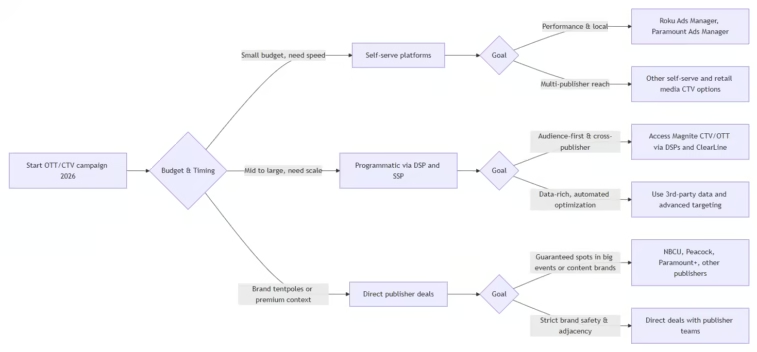
Decision map (programmatic vs direct vs self‑serve)
Best OTT Advertising Platforms; This flow shows how to choose a buying path based on budget, speed, and goals:
1) Programmatic OTT/CTV (Magnite/SpotX ecosystem)
- What it is: Buying connected TV/OTT inventory via DSPs that connect to sell‑side platforms like Magnite (which now incorporates SpotX’s CTV/OTT tech as Magnite Streaming). Best OTT Advertising Platforms; Magnite counts major publishers among its CTV/OTT clients (AMC, DISH Media, Disney Advertising, FOX, FuboTV, LG Ads Solutions, VIZIO, Warner Bros. Discovery, etc.), giving advertisers broad access to premium inventory across live and VOD.
- How you buy: Demand‑side platforms (The Trade Desk, Xandr, Google Display & Video 360, etc.) connect to Magnite Streaming/ClearLine to buy CTV/OTT programmatically. Magnite also has partnerships (e.g., with Mediaocean’s Prisma) to streamline buying for linear/digital blends.
- Targeting: Audience‑first buying using first‑party data, third‑party segments, seller‑defined audiences, and secure data matching. Magnite Streaming emphasizes advanced audience activation and real‑time reporting, supporting household‑ and device‑level targeting.
- Typical CPM range (2026): Across general programmatic CTV inventory, CPMs commonly land in the $25–$65 range, depending on targeting, content type, and inventory quality (premium/live sports command higher rates).
- Pros:
- Scale: Access to many publishers and devices from a single buy.
- Cross‑publisher reach and frequency management.
- Data‑driven audience buying and optimization in real time.
- Cons:
- Less certainty about exact placements unless you use private market deals/publisher‑specific deals.
- DSP fees and tech stack costs add on top of media CPM.
- Requires some expertise to set up pixels, measurement, and creative correctly.
2) Direct publisher deals
- What it is: Buying OTT/CTV directly from major publishers or broadcaster groups—e.g., NBCUniversal (Peacock, Bravo, USA, etc.), Paramount+ (CBS, Pluto TV, MTV), others—via their sales teams. Best OTT Advertising Platforms; These buys can be programmatic (private marketplace/p guaranteed deals) or traditional guaranteed.
- Example: NBCUniversal’s ONE Platform is designed as a unified buying system across its linear and digital properties, aiming to simplify planning and delivery across all screens with tools like ONE Optimizer, ONE Plan, ONE Delivery, and ONE Measurement.
- Targeting: Publisher first‑party data (viewership, sign‑ins, addressable IDs) + clean rooms and data partnerships; strong household‑level capabilities on logged‑in inventory.
- Typical CPM range (2026): Premium direct and programmatic deals often sit in the upper half of the $25–$65 band, and can exceed it for tentpole sports/events or highly coveted content. These are negotiated and vary significantly.
- Pros:
- Brand safety and adjacency: You know exactly which shows/channels/placements you’re buying.
- High impact: Great for launches, sponsorships, and event tie‑ins.
- Package benefits: Often include integrations, sponsorships, or custom creative opportunities.
- Cons:
- Higher minimums and longer lead times (upfronts, scatter).
- More manual workflow unless you use publisher self‑serve or programmatic guaranteed.
- Harder to compare performance across publishers without neutral measurement.
3) Self‑serve OTT/CTV platforms (hands‑on, lower minimums)
- What they are: Publisher‑ or platform‑specific self‑serve interfaces where you can upload creatives, set budgets, target audiences, and launch campaigns without big agency minimums.
- Paramount Ads Manager:
- Reach: Access to Paramount+ and Pluto TV/CBS/MTV inventory; positioned as “premium streaming” with massive monthly viewers.
- Minimums and CPM: Campaigns can start at $500 (self‑serve); the platform advertises “incredibly competitive CPMs,” with a pricing page that explains dynamic CPM as you adjust targeting.
- Ads are unskippable 30‑second spots on the big screen—strong for brand and mid‑funnel impact.
- Roku Ads Manager:
- Reach: Access to Roku’s ad‑supported ecosystem; Roku claims 125M people reached daily by the Roku Home Screen and that 47% of US TV streaming time is on Roku.
- Minimums and CPM: Roku positions Ads Manager as a self‑serve performance solution; they emphasize “efficiency and competitive pricing” via direct inventory and note “lower CPMs” in advertiser testimonials, though exact rate cards are dynamic and not publicly fixed.
- Features: Built‑for‑CTV optimization, Action Ads (interactive overlays), and Shopify Checkout integration for shoppable CTV ads.
- Other self‑serve: Many publishers and retail media networks (e.g., Amazon Freevee/Prime Video, Walmart Connect, MNTN Performance TV) offer CTV/OTT self‑serve options; these can be layered on top of Roku/Paramount.
Self-serve CTV, as described above in a publisher-specific form, also exists in a cross-publisher form built for performance marketers. Vibe is a streaming TV ad platform where brands launch in about five minutes at $50 a day, with no contracts and no five-figure minimums, and buy across 500+ premium channels including Roku, Hulu, Disney+, and ESPN from a single account.
The targeting layer is where it diverges from single-publisher self-serve. Vibe’s Identity Intelligence lets advertisers upload first-party CRM data from Salesforce, HubSpot, or a warehouse via Fivetran, then layer lookalikes, intent, and keyword audiences against a 120M+ household ID graph. Measurement runs through native integrations with Triple Whale, Northbeam, Haus, and 40+ other tools, with incrementality testing built in.
For a performance team already running Meta and Google, the practical effect is that CTV becomes another channel in the same stack: testable at low spend, measurable against downstream outcomes, and scalable without handing a brief to a managed service.
4) CPM and reach by buying model (2026 benchmarks)
Note: CPMs vary heavily by audience, daypart, content (live sports vs library), and deal type—Best OTT Advertising Platforms; use these as directional ranges:
| Buying model | Typical CPM range (US, 2026) | Reach characteristics | Minimum budget & complexity |
|---|---|---|---|
| Programmatic via DSP (Magnite/SpotX ecosystem) | $25–65+; higher for premium/live sports or sophisticated targeting; lower for remnant or broad bundles. | Very broad cross‑publisher and cross‑device; can reach most CTV households via apps that use Magnite Streaming and other SSPs. | Requires DSP access and some technical setup; managed or trading desk‑supported for mid‑large budgets. |
| Direct publisher (guaranteed; e.g., NBCU ONE Platform, major premium AVOD) | Typically mid‑to‑high $30s–$60s+; spikes for sports/live events; negotiated in upfronts/scatter. | Deep reach on specific publisher ecosystems (e.g., NBCU, Paramount+, others); good for brand safety and tentpole moments. | Higher minimums; longer lead times; often done through publisher reps or agency teams. |
| Self‑serve (Roku Ads Manager) | Competitive to low‑mid CPMs; Roku emphasizes direct premium inventory without third‑party fees and advertisers mention “lower CPMs” in testimonials; exact rates are dynamic. | Strong reach within Roku’s ecosystem (125M people reached daily by Roku Home Screen). | Self‑serve interface; low/no formal minimums; good for growth marketers and performance‑oriented buyers. |
| Self‑serve (Paramount Ads Manager) | “Incredibly competitive CPMs” per customer case study; dynamic pricing shown in‑platform as you adjust targeting. | Access to Paramount+ and Pluto TV/CBS/MTV; premium unskippable 30‑second spots. | Campaigns start at $500; 24‑hour activation, no agency required. |
5) How Magnite CTV and SpotX fit into the picture (2026)
- SpotX is now part of Magnite. Magnite announced Magnite Streaming as a unified CTV/OTT monetization platform that merges the Magnite CTV and SpotX platforms, and Magnite closed the SpotX acquisition previously—creating the largest independent CTV and video advertising platform in the programmatic marketplace.
- For advertisers, that means:
- Access to a very wide set of CTV/OTT publishers via DSPs that connect to Magnite Streaming (and ClearLine for certain buying platforms).
- More advanced deal types (e.g., programmatic guaranteed, private marketplaces, advanced podding, frequency capping) to improve control and performance.
6) Which model fits your budget? (quick recommendations)
- Very small or test budgets (a few hundred to a few thousand per month):
- Start with self‑serve: Roku Ads Manager and Paramount Ads Manager let you launch fast with low minimums. Use them to test creative, message, and basic targeting before expanding.
- Mid‑size budgets ($5k–$30k/month):
- Combine self‑serve (for specific publisher audiences and performance) with light programmatic via an accessible DSP to broaden reach beyond a single publisher. Use household‑level segments where available.
- Large budgets ($30k+/month) or national campaigns:
- Use programmatic for the core, buying through a DSP connected to Magnite/SpotX and other SSPs to maximize reach and frequency control.
- Layer direct publisher deals (e.g., NBCU ONE Platform, Paramount+) for tentpole moments and guaranteed premium environments.
- Use self‑serve to test incremental inventory, new creative, or performance‑oriented placements quickly.
7) Ranking table: best OTT advertising platforms/approaches by use case (2026)
Best OTT Advertising Platforms; “Rankings” here are practical, not absolute: Best OTT Advertising Platforms; each row shows where a platform/model shines, so you can pick the best starting point for your situation.
| Rank / Approach | Best for | Why (2026) | Example platforms / entry points |
|---|---|---|---|
| #1 (Self‑serve entry) | Testing CTV with small budget; performance marketers | Low minimums, fast launch, transparent pricing; Roku Ads Manager emphasizes “lower CPMs” and direct performance; Paramount Ads Manager starts at $500 with unskippable 30‑second spots and competitive CPMs. | Roku Ads Manager; Paramount Ads Manager |
| #1 (Programmatic scale) | Scaling audience‑first campaigns across many publishers | Magnite Streaming (including SpotX) gives DSPs unified access to a wide range of CTV/OTT inventory (AMC, DISH, Disney, FOX, FuboTV, LG Ads, VIZIO, WBD, etc.), with audience targeting and real‑time reporting. | Buy via major DSPs connected to Magnite/SpotX; Magnite ClearLine integrations. |
| #1 (Direct premium) | Brand tentpoles, strict brand safety, guaranteed placements | Direct deals with major publishers (NBCU ONE Platform, Paramount+, etc.) provide guaranteed spots in premium content and advanced measurement—ideal for big launches and live sports. | NBCUniversal ONE Platform; Paramount direct sales; other major broadcaster/publisher avails. |
| #2 (Self‑serve complement) | Extending beyond Roku/Paramount to more publishers | Other self‑serve CTV options and retail media networks (e.g., Amazon Freevee/Prime, Walmart Connect, MNTN) give additional access and creative formats. | Amazon Ads CTV; Walmart Connect CTV; MNTN Performance TV; others. |
| #2 (Programmatic mid‑market) | Mid‑size accounts wanting data‑rich targeting but smaller teams | Use smaller or more DSPs with managed service; programmatic still provides broader reach than self‑serve alone, with better frequency management. | Mid‑market DSPs or agency‑managed DSP seats. |
| #2 (Direct mid‑tier) | Regional or vertical‑specific premium content | Local or niche streaming publishers often sell direct or via programmatic private deals, giving strong adjacency to specific audiences at negotiable CPMs. | Regional streaming news; niche AVOD services; category‑specific apps. |
8) Practical 2026 setup tips
- Measurement: Set up CTV‑specific pixels and conversions where available (e.g., Paramount Ads Manager Pixel; Roku’s measurement integrations) Best OTT Advertising Platforms; so you can optimize beyond impressions—track site visits, signups, and purchases influenced by CTV.
- Creative: Use 15‑ and 30‑second cuts that work without sound (text overlays), clear CTAs, and early branding. Consider interactive formats (Roku Action Ads) or shoppable CTV if you’re in ecommerce.
- Frequency management: Programmatic via Magnite/SpotX‑connected DSPs supports frequency caps and pod control; direct deals also allow caps. Set household‑level frequency targets to avoid waste.
- Privacy and data: Expect reliance on publisher first‑party data, clean rooms, and cohort‑based signals. Targeting options that don’t depend on third‑party cookies are increasingly standard.
Bottom line
- Start with self‑serve (Roku, Paramount) for speed and low CPMs.
- Add programmatic via DSPs connected to Magnite/SpotX for scale and audience‑first buying.
- Reserve direct publisher deals for brand‑defining moments and premium environments.