
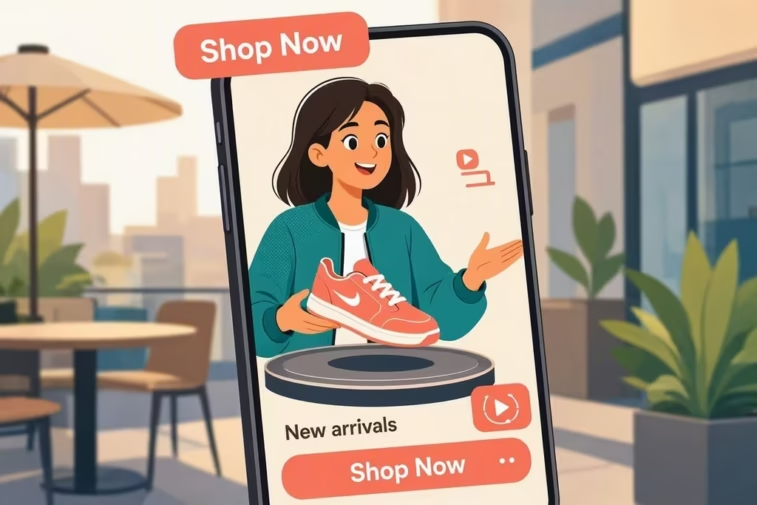
U.S. social video advertising spend is set to hit $31.9 billion in 2026, overtaking connected TV for the first time — a milestone that signals exactly where advertiser attention has shifted. This guide breaks down what social video advertising actually is, the platform-by-platform data behind the shift, the ad formats and lengths performing best right now, and how to build a social video strategy grounded in 2026’s actual numbers rather than outdated best practices.
What Social Video Advertising Actually Is
Social video advertising is the practice of running paid video content on social platforms — Instagram, TikTok, YouTube, Facebook, and LinkedIn among others — rather than through traditional broadcast, cable, or standalone display advertising. It spans a range of formats: in-feed video ads that appear as users scroll, short-form vertical ads on Reels, TikTok, and YouTube Shorts, pre-roll and mid-roll ads on longer YouTube content, shoppable video ads with embedded purchase links, and influencer-led or creator-produced sponsored content.
What separates it from generic “digital video advertising” is the native, feed-based delivery: social video advertising live inside the same scrolling environment as organic content, competing directly with what a user’s friends, favorite creators, and interests are already showing them — which is exactly why creative quality and format-native production matter more here than in almost any other advertising channel.
The Numbers That Explain Why Budgets Are Shifting
A handful of 2026 figures capture the scale of this shift better than any single trend explanation could:
- U.S. social video ad spend will reach $31.9 billion in 2026, overtaking connected TV (CTV) ad spend for the first time, growing 13% year-over-year against CTV’s 11% growth.
- U.S. businesses now spend more on digital video ads ($85 billion) than traditional TV ($59 billion) — a genuine changing of the guard in national advertising budgets.
- Global digital video ad spend is projected to reach $223.5 billion in 2026, up 7.7% from the prior year, with short-form video alone accounting for an estimated $122.5 billion of that total, a 10.2% year-over-year increase.
- Mobile video accounts for 75% of all digital video ad spending globally, underscoring that “social video” is functionally synonymous with mobile-first, vertical-format video for the large majority of advertisers.
- Social platforms — TikTok, Instagram, and YouTube combined — now account for over 60% of product discovery, surpassing Google search for the first time and signaling a genuine shift in how people find products to buy.
Behind these numbers is a straightforward audience reality: 94.6% of online adults watched some form of online video in the past 30 days, and streaming now accounts for more than half of all internet users’ total TV watch time globally. Video isn’t a channel advertisers are testing anymore — it’s where the audience already is.
Platform-by-Platform: Where Social Video Actually Performs
TikTok — Highest Engagement Rate
TikTok posts the highest average engagement rate of any major platform, at roughly 3.7% per follower — about eight times Instagram’s rate and 25 times Facebook’s. On TikTok specifically, humorous content drives the strongest engagement among marketers (30.12%), ahead of brand and product-focused content (24.90%) and educational content (13.05%). Commerce intent runs deep here too: 1 in 3 Gen Z TikTok users say they’re interested in buying directly through TikTok Live, and 74% of weekly users seek more product information after seeing an ad on the platform.
Instagram — Strongest Private Sharing and Discovery Data
Instagram passed 3 billion monthly active users, with much of that growth attributed directly to short-form video and private messaging. Reels get reshared more than 4.5 billion times per day across Meta’s platforms — critically, much of that spread happens through direct messages and group chats rather than visible public engagement, meaning a Reel’s real reach is often larger than its like and comment counts suggest. A Meta-commissioned study found Reels delivered 81% stronger product discovery and 47% greater influence on purchase decisions compared to other short-form platforms and television formats tested.
YouTube — Strongest Long-Term ROI and Trust
YouTube Shorts ads deliver 2.3x higher long-term ROAS than paid social overall, and creator-led video promoted through YouTube Shorts specifically drove an average 30% increase in conversion lift for advertisers. Trust plays a bigger role on YouTube than most platforms: 98% of users say they’re more likely to trust YouTube creators’ reviews and recommendations than equivalent content elsewhere. YouTube’s connected TV reach is also unusually strong in the U.S., with 84.6% of its ad audience reachable on an actual television screen, more than double the global average.
Facebook — Still Effective Despite Declining Organic Reach
Despite widely discussed organic reach decline, 71% of marketers still find Facebook video effective for reaching broad audiences and driving social commerce conversions. Facebook remains the number one platform for both product discovery (39% of users) and social customer service (45% seeking support there), and short-form video is now the most-engaged content format on the platform at 48%, ahead of text posts (32%) and live video (22%).
LinkedIn — The B2B Default
For B2B specifically, social platforms have become the default distribution channel for video, ahead of email, owned websites, and even other paid channels. Mid-form video has emerged as the leading B2B content format, and testimonial videos have grown sharply as a category — from just 17% of B2B video content in 2023 to 47% in 2026, making customer testimonials the fastest-growing video format tracked in current industry research.
What Length and Format Actually Work in 2026
The data on video length is unusually consistent across independent sources: short-form video delivers roughly 2.5x more engagement than long-form video, and 85% of marketers say short-form is the most effective social content format overall. Within short-form specifically, videos between 30 and 60 seconds are considered most effective by 71% of marketers — and the broader trend is toward even tighter content: average marketing video length has fallen 75% since 2016, from 168 seconds down to a projected 39 seconds in 2026.
That said, “shorter is always better” oversimplifies the picture. Nearly 54% of YouTube marketers say long-form video actually delivers their highest engagement on that specific platform, even as YouTube trails TikTok on short-form growth — a reminder that optimal length is platform-dependent, not a single universal rule. The honest takeaway: short-form dominates discovery and top-of-funnel reach almost everywhere, but longer-form content still earns its place on platforms where audiences arrive specifically to watch, learn, or be entertained at length, like YouTube.
The Hook Matters More Than Almost Anything Else
One statistic should shape every social video advertising brief written in 2026: 25% of adults will close a video after just 10 seconds if it doesn’t hook them immediately. That single number explains why so much of current social video strategy revolves around front-loading the strongest visual or message in the opening seconds rather than building toward a payoff — in a feed-based environment where the next video is one swipe away, there often isn’t a “build-up” phase to earn.
Creative Quality vs. Targeting: Which Actually Drives Results
A commonly cited and increasingly influential data point across the industry: creative quality accounts for a majority of the sales lift generated by digital video campaigns, outweighing targeting and placement decisions that used to dominate media-buying strategy. That shift has real practical consequences — it’s part of why 94% of organizations report influencer marketing outperforming traditional digital advertising, often delivering 2x to 3x returns, since creator-led content tends to feel native to the platform rather than obviously manufactured advertising.
Budget Trends Going Into the Rest of 2026
Advertiser intent data backs up the spending shift already underway: over 50% of marketers plan to grow their streaming and social video advertising investments in 2026, and a late-2025 survey found 82% of marketers expecting connected TV budgets to rise, with digital video (68%) and retail media (78%) close behind. At the same time, budget allocation remains conservative for a meaningful share of the market — 46% of marketers still allocate a third or less of their total marketing budget to video, suggesting there’s real room for continued reallocation as the ROI data becomes harder to ignore.
How to Build a Social Video Advertising Strategy Around This Data
A few practical takeaways translate directly from the numbers above into strategy:
- Default to short-form (30–60 seconds) for discovery and top-of-funnel goals, and reserve longer-form video specifically for YouTube or platforms where your audience arrives with intent to watch at length.
- Front-load your hook. With a quarter of viewers gone by the 10-second mark, treat the opening seconds as the most important creative real estate in the entire ad, not a warm-up.
- Prioritize creative testing volume over perfect targeting. Given how much of sales lift traces back to creative quality rather than audience selection, testing multiple creative variations tends to outperform obsessively refining audience segments on a single ad.
- Match platform to funnel stage. TikTok and Instagram Reels for high-engagement discovery and impulse-driven purchase intent; YouTube for trust-building, longer explanation, and measurable long-term ROAS; LinkedIn for B2B, especially testimonial and mid-form content.
- Don’t underweight private sharing metrics. Platforms like Instagram show meaningful reach happening through DMs and group shares that never appear in public engagement numbers — factor that into how you judge a campaign’s real performance, not just its visible likes and comments.
- Treat creator and influencer partnerships as a core channel, not an experiment. With reported 2x–3x ROI over traditional digital ads, influencer-led video has moved well past the “emerging tactic” stage for most consumer categories.
The Bottom Line
Social video advertising isn’t a growing channel anymore — for U.S. advertisers specifically, it’s now outspending connected TV, and globally it’s absorbing a rapidly growing share of the $223.5 billion projected in digital video ad spend for 2026. The platforms reward genuinely different strategies: TikTok and Reels for engagement and discovery, YouTube for trust and long-term return, and LinkedIn for B2B credibility through testimonial and mid-form content.
The advertisers pulling ahead in this environment aren’t necessarily spending the most — they’re the ones treating the first ten seconds of every video as non-negotiable, testing creative variation aggressively, and matching format and length to the specific platform and funnel stage rather than running one video everywhere and hoping it performs the same way twice.