
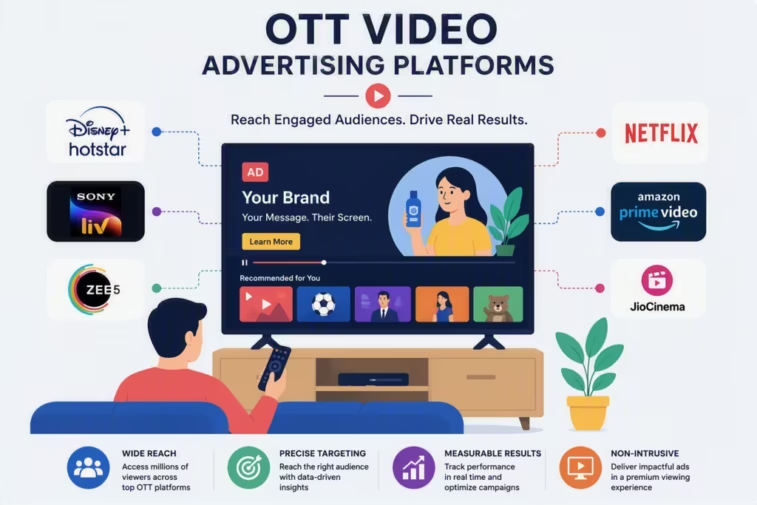
OTT Video Advertising Platforms; OTT ad spend has surged past $30 billion globally in 2026, with connected TV now capturing 45% of total video ad spend — but picking the right platform depends heavily on your budget, audience, and whether you need self-serve control or managed enterprise reach. This guide breaks down the best OTT video advertising platforms, how OTT actually differs from CTV, and which platform fits which kind of advertiser.
What OTT Video Advertising Actually Means
OTT — “over-the-top” — describes video content delivered directly over the internet, bypassing traditional cable or satellite infrastructure entirely. OTT Video Advertising Platforms; OTT advertising, then, is the practice of buying video ad placements inside that streaming content: pre-roll and mid-roll spots on services like Hulu, Peacock, Tubi, or Amazon’s streaming inventory, rather than traditional linear TV commercial breaks.
It’s worth clarifying a term that gets used almost interchangeably: CTV, or connected TV, refers specifically to the device — a smart TV, streaming stick, or console — while OTT technically also covers mobile and desktop streaming. In practice, most OTT ad spend runs on CTV devices, which is why the two terms blur together in most industry conversation. The distinction matters for one practical reason: premium CTV ads on a living-room-sized screen tend to deliver meaningfully higher completion rates and stronger brand recall than the same ad watched on a phone.
Why OTT Advertising Is Growing So Fast
The numbers explain the urgency behind this category. OTT Video Advertising Platforms; OTT platforms now capture 45% of total video ad spend, with CTV ad revenue growing roughly 25% year-over-year, and global OTT ad spend has surged past $30 billion in 2026 — some projections put the broader OTT video market on pace to reach $476 billion by 2027. OTT Video Advertising Platforms; The driver is simple: cord-cutting has made streaming the default way most households watch video, and advertisers have followed the audience. Layered on top of that shift is a genuine technology upgrade — cookieless, contextual, and first-party-data-driven targeting has matured enough that OTT campaigns can now approach the addressability advertisers used to get only from digital display and social.
The Best OTT Advertising Platforms, by Use Case
Amazon DSP — Best for Attribution and Premium Shopper Data
Amazon’s demand-side platform gives advertisers access to premium streaming inventory across Freevee, Fire TV, and Amazon’s live content, including major live sports rights. Its standout advantage is attribution: because Amazon can connect ad exposure directly to purchase behavior on its own retail platform, it offers a level of closed-loop measurement most competitors simply can’t match. Pricing runs CPM-based, typically with a minimum spend around $15,000, offered through both managed and self-serve options.
Best for: brands that sell on Amazon and want ad exposure tied directly to purchase data.
Roku Ads Manager — Best for U.S.-Centric Local Targeting
Roku’s advertising platform leans into strong local and U.S.-focused targeting, drawing on its position as one of the most widely used streaming devices in American households. It’s a strong fit for advertisers whose audience is concentrated domestically rather than needing international reach.
Best for: U.S.-focused brands prioritizing local and regional targeting precision.
The Trade Desk — Best for Omnichannel OTT Management
The Trade Desk is built for advertisers who want to manage OTT alongside other channels — display, audio, mobile — inside one programmatic buying platform, rather than running streaming campaigns in isolation. Alongside FreeWheel, it’s frequently cited as a leader specifically in omnichannel OTT ad management for larger, more complex media plans.
Best for: agencies and larger advertisers running OTT as one piece of a broader cross-channel media strategy.
Vibe — Best Self-Serve Option for SMBs
Vibe combines direct publisher deals across 500+ premium channels with a fully self-serve platform, giving smaller advertisers meaningful transparency into delivery without needing an agency relationship or a massive minimum spend — pricing starts around $50/day. It’s specifically positioned to make OTT genuinely accessible to advertisers who’d otherwise be priced out of the category’s larger platforms.
Best for: small and mid-sized businesses running their first OTT campaigns without a big media budget.
tvScientific — Best for Built-In Incrementality Testing
tvScientific differentiates on measurement rigor, offering incrementality testing baked directly into the platform rather than as a bolted-on add-on. Its publisher footprint runs smaller than the largest platforms, making it a better fit for performance-focused campaigns than broad brand-awareness plays.
Best for: performance marketers who need to prove OTT’s actual causal lift, not just track impressions.
Simpli.fi — Best for Hyperlocal Targeting
Simpli.fi specializes in geofencing and neighborhood-level targeting precision, covering OTT and CTV placements down to the ZIP code. For regional businesses and franchise networks, that level of geographic precision is difficult to match on broader national platforms.
Best for: local businesses, franchises, and regional brands where geography is the core targeting strategy.
AdRoll — Best for Full-Funnel Retargeting
AdRoll pairs connected TV advertising with its established retargeting and cross-channel advertising tools, aimed at advertisers who want to connect a streaming awareness campaign to measurable downstream conversion, rather than treating OTT as a standalone brand-awareness spend.
Best for: brands that want OTT awareness campaigns tied directly into an existing retargeting funnel.
Basis Technologies — Best for Agency Workflow Management
Basis Technologies is less a single ad-buying platform and more a programmatic workflow and media management system built for agencies and larger advertising teams juggling multiple campaigns and clients simultaneously.
Best for: agencies managing OTT campaigns at scale across many clients.
Hulu Ads and Tubi — Best Direct Publisher Buys for Proven Completion Rates
Buying directly through major ad-supported streaming publishers remains a strong option alongside programmatic platforms. Case data cited across the industry shows Hulu campaigns helping a streaming service achieve a 40% subscription uplift through demographically tailored promos, while Tubi campaigns for quick-service restaurant chains have hit 90% video completion rates with relatively low-cost contextual placements.
Best for: advertisers who want direct access to premium, ad-supported streaming inventory without a third-party DSP layer.
Programmatic vs. Direct Buys: How to Decide
The self-serve versus managed-service split is the obvious tradeoff in OTT, but the quieter shift is how performance marketers now expect streaming TV to behave. The same team running CRM-powered audiences on Meta and tracking incrementality in Northbeam wants that same workflow on the living-room screen. Vibe is built for that expectation: a self-serve streaming TV platform with Meta-style targeting, measurement, and iteration speed, without annual contracts or managed-service overhead.
Identity Intelligence is the piece that makes this work. Vibe layers first-party CRM data from Salesforce, HubSpot, 6sense, and warehouse pipes via Fivetran onto a 120M+ household ID graph, alongside lookalikes, intent signals, and keyword audiences. That gets closer to Meta or Google precision than to age and gender demos. Inventory sits across 500+ direct-supply premium channels including Roku, Hulu, Disney+, and ESPN, with full placement transparency.
Measurement runs through native integrations with Triple Whale, Northbeam, Haus, and 40+ partners, plus built-in incrementality testing. The practical effect for performance teams is that TV stops being a separate planning cycle and starts behaving like another line in the paid media dashboard.
Most OTT advertisers end up choosing between two buying models, and understanding the tradeoff matters more than picking a specific platform name:
- Programmatic OTT buying dominates the market, letting advertisers bid in real time on premium inventory across services like Hulu, Roku, and Tubi through a DSP. This model favors advertisers who want data-driven optimization, cross-platform reach, and the flexibility of self-serve control.
- Direct publisher deals — buying inventory straight from a specific streaming service — trade some flexibility for stronger brand-safety guarantees and, often, better negotiated rates at scale.
What to Evaluate Before Choosing a Platform
OTT Video Advertising Platforms; A few consistent factors separate a well-chosen OTT platform from a mismatched one:
- Minimum spend requirements. Enterprise-grade platforms like Amazon DSP often carry five-figure minimums, while self-serve platforms like Vibe are built specifically to be accessible at a much smaller daily budget.
- Self-serve vs. managed service. Smaller teams without dedicated media-buying staff often do better with a managed or heavily guided self-serve platform rather than a fully open programmatic environment.
- Attribution and measurement depth. If proving ROI matters as much as reach, prioritize platforms with strong first-party attribution (Amazon DSP) or built-in incrementality testing (tvScientific) over platforms that only report impressions and completion rates.
- Geographic targeting needs. National brand campaigns and hyperlocal franchise campaigns need fundamentally different targeting infrastructure — Simpli.fi’s geofencing precision solves a different problem than The Trade Desk’s omnichannel scale.
- Anti-fraud and transparent reporting. As programmatic OTT spend grows, platforms with robust fraud protection and transparent delivery reporting matter more, not less — verify this before committing significant budget.
The Bottom Line
The best OTT video advertising platform in 2026 depends far more on your budget and measurement needs than on any single platform’s overall market reputation. Amazon DSP wins on attribution for retail brands, Vibe wins on accessibility for advertisers testing OTT for the first time, The Trade Desk wins on omnichannel scale for agencies, and Simpli.fi wins when hyperlocal precision is the whole strategy. With OTT now capturing nearly half of all video ad spend and growing at roughly 25% year-over-year, the real risk for most advertisers isn’t choosing the “wrong” platform from this list — it’s continuing to sit out a channel that’s rapidly becoming where the television audience actually is.