
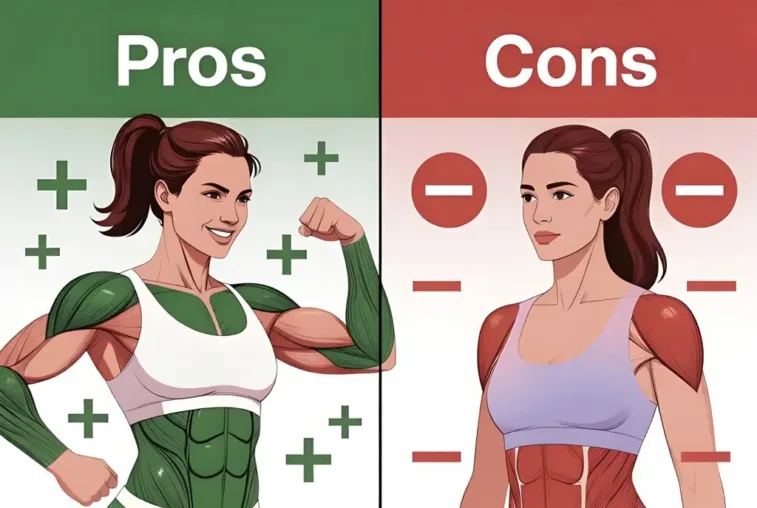
Discover the best pros and cons of creatine for females in 2026. Is it right for you? Boost strength, recovery & performance—learn the facts now!
2026 Complete Guide: Pros and Cons of Creatine for Females
Discover the best pros and cons of creatine for females in 2026—boost energy and strength safely. Learn if it’s right for you.
Best Pros and Cons of Creatine for Females; As of January 2026, creatine supplementation for females is supported by a robust and expanding body of research, with over 500 peer-reviewed studies confirming its safety and efficacy. Women exhibit 70-80% lower endogenous creatine stores than men, making supplementation potentially more impactful for muscle, cognitive, and mood health.
The benefits—spanning strength preservation, improved cognition, reduced depression risk, and post-menopausal bone health—appear to outweigh the mild, temporary side effects for the vast majority of healthy women. However, water retention, gastrointestinal discomfort, and persistent myths remain considerations. Best Pros and Cons of Creatine for Females; This guide synthesizes the latest 2025-2026 clinical data and expert consensus to provide a definitive analysis.
1. 2026 Science & Market Overview: Why Women Respond Differently
The Female Creatine Deficiency Gap
- Women naturally have 70-80% lower creatine stores than men due to smaller muscle mass and lower dietary intake (less meat consumption)
- Brain creatine concentrations are 10% lower in women, particularly in the frontal lobe (controls mood, memory, emotion)
- Hormonal influence: Estrogen fluctuations across menstrual cycle, pregnancy, and menopause affect creatine metabolism and may alter supplementation needs
- Better responsiveness: Because women start from a greater deficiency, supplementation often yields more pronounced benefits relative to baseline
2026 Research Breakthroughs
- Lifespan approach: New NIH-funded studies (2025) examine creatine across menstruation, pregnancy, postpartum, and menopause—previously understudied
- Depression & mood: Multiple clinical trials show 56% reduction in depressive symptoms when combined with antidepressants in female adolescents and adults
- Brain health: Creatine shown to blunt cognitive impairment from sleep deprivation—critical for women who experience more sleep disruption
- Post-menopausal benefits: High-dose creatine (0.3g/kg/day) + resistance training increases muscle size, bone mineral density, and functional strength in post-menopausal women
The following Best Pros and Cons of Creatine for Females explore below are;
2. Pros & Benefits for Females (2026 Evidence)
A. Muscle & Performance Benefits
| Benefit | Evidence Level | Details |
|---|---|---|
| Strength & Power | Strong (Multiple RCTs) | Increases strength/power during high-intensity exercise; no significant weight gain when dosed properly |
| Muscle Preservation | Strong (Aging studies) | Particularly effective for perimenopausal/menopausal women to combat age-related muscle loss (sarcopenia) |
| Recovery | Moderate | Reduces post-workout inflammation and soreness; supports faster return to training |
| Body Composition | Moderate | When combined with resistance training, may increase lean mass without fat gain (weight change is water, not fat) |
Key Insight: Unlike men, women typically don’t experience rapid weight gain from creatine unless using loading doses with high carbs
B. Cognitive & Mental Health Benefits
| Benefit | Evidence Level | Details |
|---|---|---|
| Depression Reduction | Strong (Clinical trials) | 56% decrease in CDRS-R scores in female adolescents; improved HAM-D scores in adults when combined with antidepressants |
| Brain Fog & Mental Fatigue | Moderate-Strong | Improves cognitive performance during stress and sleep deprivation; supports frontal lobe energy metabolism |
| Mood Enhancement | Moderate | Restores brain energy homeostasis; inverse relationship between creatine intake and depression incidence (31% lower risk in highest quartile) |
| Sleep Deprivation Protection | Moderate | Blunts negative effects of sleep loss on reaction time, executive function, and mood—critical for mothers and shift workers |
Mechanism: Creatine supports ATP resynthesis in the brain during high mental stress; women have lower baseline brain creatine, making supplementation more impactful
C. Lifespan & Hormonal Health Benefits
| Life Stage | Potential Benefit | Evidence |
|---|---|---|
| Menstrual Cycle | May buffer cognitive/performance dips during low-estrogen phases | Emerging; creatine kinase lowest during follicular phase |
| Pregnancy | Limited research; potential fetal brain development support (preclinical) | Animal studies promising; human trials ongoing. Not universally recommended due to limited data |
| Postpartum | May support recovery, mood stability, and energy levels | Emerging evidence; safe but consult physician |
| Perimenopause /Menopause | Strong evidence for muscle preservation, bone density, mood | High-dose (0.3g/kg/day) + resistance training increases bone mineral density, lean mass, and functional strength |
| PCOS & Metabolic Health | May improve glucose uptake and insulin sensitivity (theoretical) | Preliminary; more research needed |
Key Insight: Creatine appears beneficial across the female lifespan, with the strongest evidence for post-menopausal women (muscle, bone, mood) and depression management (adolescents and adults)
3. Cons & Side Effects for Females (2026 Evidence)
A. Gastrointestinal Distress
- Incidence: 5-10% of users, primarily with loading phases (20g/day split into 4 doses)
- Mechanism: Undissolved creatine draws water into intestines, causing bloating, cramping, diarrhea
- Female-Specific: Women may be more sensitive due to smaller GI tracts and hormonal fluctuations affecting digestion
- Mitigation:
- Skip loading phase; take 3-5g daily instead (achieves same saturation in 3-4 weeks)
- Mix with warm water or tea to improve dissolution
- Take with food to slow absorption
- Split dose into 2-3 smaller servings if symptoms occur
B. Water Retention & Weight Gain
- Reality Check: Not fat gain—creatine increases intracellular water in muscles, not subcutaneous fat
- Female Experience: Women typically gain 1-3 lbs (0.5-1.5 kg) of water weight, much less than men due to lower muscle mass
- Hormonal Timing: Water retention may be more noticeable during luteal phase (high progesterone) when women already experience bloating
- Mitigation:
- Skip loading phase (reduces acute water retention)
- Stay adequately hydrated (counterintuitive but helps body regulate fluid balance)
- Monitor body composition (DEXA, bioimpedance) to confirm it’s water, not fat
- Patience: Water weight stabilizes after 2-3 weeks of consistent use
C. Long-Term Safety Concerns (Myths vs. Facts)
| Concern | 2026 Evidence | Reality Check |
|---|---|---|
| Kidney Damage | No evidence in healthy individuals; may worsen pre-existing kidney disease | Safe in healthy women; 5-year studies show no kidney strain |
| Hair Loss | No direct link; one old study in rugby players (confounded by genetics) | No credible evidence; hair loss not reported in any female RCT |
| Dehydration | Only with insufficient water intake; creatine increases intracellular water | Myth: actually improves heat tolerance when hydrated |
| Hormonal Disruption | No impact on estrogen, progesterone, testosterone in female studies | No effect on menstrual cycle or fertility |
| Cancer Risk | No evidence; some studies suggest creatine may have protective effects | No association found in long-term human studies |
Bottom Line: All major safety concerns are myths in healthy females; 500+ studies support safety
D. Drug & Condition Interactions
- Kidney Disease: Avoid if you have chronic kidney disease or reduced kidney function
- Diabetes Medications: May enhance glucose uptake—monitor blood sugar if on insulin or sulfonylureas (theoretical)
- NSAIDs: Possible additive kidney stress at high doses; moderate use is fine
- Caffeine: May blunt creatine’s effects if taken simultaneously; space doses by 1-2 hours
4. Dosage Guidelines for Females (2026 Consensus)
Dosage Guidelines in Best Pros and Cons of Creatine for Females
Standard Maintenance Protocol (Recommended for Most Women)
- Dose: 3-5 grams per day (no loading phase needed)
- Timing: Post-workout with protein/carbs for muscle benefits; any time of day for cognitive benefits
- Form: Creatine monohydrate (most studied, cheapest, equally effective as other forms)
- Brand: Look for Creapure (German-manufactured, highest purity) or third-party tested (NSF, Informed Choice)
- Mixing: Dissolve in warm water, tea, or coffee for better solubility; avoid acidic juices (may degrade)
Loading Protocol (Optional, Not Recommended for Most Women)
- Dose: 20 grams per day (4 × 5g doses) for 5-7 days, then 3-5g maintenance
- Pros: Achieves muscle saturation 3 weeks faster (3-4 days vs. 3-4 weeks)
- Cons: Higher GI distress risk; more water retention; no long-term advantage over daily 3-5g
- Female Recommendation: Skip loading unless you’re an elite athlete with urgent competition timeline
Cycling (Not Necessary)
- 2026 Consensus: No need to cycle creatine; continuous use maintains benefits without tolerance
- If You Stop: Muscle creatine returns to baseline in 4-6 weeks; benefits gradually fade
Special Populations
Post-Menopausal Women:
- Dose: 0.3 g/kg/day (e.g., 21g for 70kg woman) + resistance training for bone density and muscle mass benefits
- Note: This is the only scenario where higher doses are evidence-based
Pregnant/Breastfeeding Women:
- Recommendation: Insufficient data; consult physician
- Theoretical Safety: Animal studies show no harm; human data limited
- Practical Advice: Many clinicians err on side of avoiding during pregnancy due to lack of robust human trials
Adolescents:
- Safety: Generally considered safe for female athletes >16 years; strong evidence for depression management
- Dose: 3-5g/day (no loading); parental consent and physician oversight recommended
5. Safety Considerations & Contraindications
Best Pros and Cons of Creatine for Females – Safety Considerations & Contraindications;
Who SHOULD Use Creatine
- ✅ Healthy females aged 16-70+
- ✅ Athletes (strength, power, endurance)
- ✅ Post-menopausal women (muscle, bone, mood support)
- ✅ Women with depression (adjunct to therapy/antidepressants)
- ✅ Vegetarians/vegans (naturally lower stores)
- ✅ Pregnant/postpartum (with physician approval)
Who Should AVOID or Use with Caution
- ❌ Pre-existing kidney disease (creatinine clearance <60 mL/min)
- ❌ Pregnant women (insufficient data; consult OB)
- ⚠️ Diabetes (monitor blood sugar; may enhance glucose uptake)
- ⚠️ History of kidney stones (ensure adequate hydration)
Monitoring
- Healthy women: No routine labs needed; 5-year studies show no kidney stress
- If Concerned: Check serum creatinine and eGFR at baseline and after 3 months; any rise >0.3 mg/dL warrants discontinuation
- Hydration: Drink 2-3 liters of water daily to support kidney function and minimize GI distress
6. Myths vs Evidence-Based Facts (2026)
Best Pros and Cons of Creatine for Females – Myths vs Evidence explore;
| Myth | 2026 Evidence | Reality |
|---|---|---|
| “Creatine causes hair loss in women” | Zero studies show link; one debunked rugby study (confounded by genetics) | Completely false; not a single female RCT reports hair loss |
| “It’s a steroid/doping” | Not on WADA banned list; naturally occurs in food | False; legal, safe, not a steroid |
| “It’ll make you bulky” | Women gain 1-3 lbs water, not muscle mass, without training | False; muscle requires resistance training + calories |
| “You must load and cycle” | Loading speeds saturation by 3 weeks but increases side effects | Unnecessary; 3-5g/day achieves same result with fewer side effects |
| “It’s only for bodybuilders” | Strong evidence for cognitive function, depression, bone health in general population | False; benefits extend far beyond muscle |
| “It damages kidneys” | 5-year studies show no kidney strain in healthy individuals | False in healthy women; safe unless pre-existing kidney disease |
| “Causes dehydration/cramps” | Actually improves heat tolerance when hydrated; no cramping data | Myth; may reduce cramping in some contexts |
| “Interferes with menstrual cycle” | No impact on estrogen, progesterone, cycle length in studies | False; no hormonal disruption |
| “Not safe during pregnancy” | Limited human data; animal studies show no harm; position: “insufficient evidence” | Inconclusive; clinicians recommend avoidance due to lack of data |
7. Comparison: Creatine for Females vs Males (2026)
Best Pros and Cons of Creatine for Females – Comparison table with males;
| Factor | Females | Males | Implication for Women |
|---|---|---|---|
| Baseline Muscle Creatine | 70-80% lower | Higher | Greater relative benefit from supplementation |
| Baseline Brain Creatine | 10% lower | Higher | Potentially greater cognitive/mood benefit |
| Water Weight Gain | 1-3 lbs (minimal) | 5-10 lbs (significant) | Less bloating concern for women |
| Strength Response | Modest increase (~5-10%) | Larger increase (~10-15%) | Still beneficial, especially for preservation |
| Depression Response | Strong evidence (56% reduction) | Weaker evidence | Major female-specific advantage |
| Bone Density Response | Significant increase (post-menopause) | Minimal | Critical for aging women |
| Loading Phase Need | Not recommended (GI risk) | Common practice | Skip loading for better tolerance |
| Optimal Dose | 3-5g/day (standard) | 5g/day (standard) | Same dose, better results relative to baseline |
| Hormonal Impact | None observed | None observed | No interference with menstrual cycle, fertility |
Bottom Line: Women may experience greater relative benefits than men due to lower baseline stores, with fewer side effects (less water weight) and unique advantages in mood and bone health
8. Expert Recommendations by Goal (2026)
Tips and Recommendations for Best Pros and Cons of Creatine for Females
Goal: Muscle & Athletic Performance
- Dose: 3-5g/day creatine monohydrate
- Timing: Post-workout with protein/carbs
- Duration: Continuous, no cycling needed
- Expected: 5-10% strength increase over 4-8 weeks; faster recovery
- Best Form: Creapure or NSF-certified monohydrate
Goal: Cognitive Function & Mental Fatigue
- Dose: 3g/day (can take any time)
- Timing: Morning or with coffee (avoid caffeine interference)
- Duration: Long-term (benefits accrue over months)
- Expected: Improved focus, faster mental processing, protection against sleep deprivation
- Note: Works best with adequate sleep and stress management
Goal: Depression Management (Adjunct)
- Dose: 3-5g/day (under physician supervision)
- Timing: Consistent daily dose
- Duration: 12+ weeks (clinical trials show benefits at 8 weeks, optimal at 12+)
- Expected: 30-56% reduction in symptoms when combined with therapy/antidepressants
- Critical: Do not replace prescribed treatment; discuss with psychiatrist first
Goal: Post-Menopausal Health
- Dose: 0.3g/kg/day (e.g., 21g for 70kg woman) + resistance training
- Timing: Split into 3 doses post-workout
- Duration: Long-term (1+ years)
- Expected: Increased bone mineral density, lean mass, functional strength
- Note: Requires high-dose protocol specific to this population
Goal: PCOS or Metabolic Health
- Dose: 3-5g/day (experimental)
- Timing: With meals
- Duration: Ongoing
- Expected: Potential improvement in glucose uptake (preliminary)
- Caution: Monitor blood sugar if on insulin/sulfonylureas
Goal: Preventive Brain Health (Aging)
- Dose: 3g/day
- Timing: Anytime, consistency matters
- Duration: Lifelong
- Expected: Protection from cognitive decline, better mood stability, reduced depression risk
- Evidence: Strongest for females due to lower baseline brain creatine
9. Frequently Asked Questions (2026)
Questions and answers at Best Pros and Cons of Creatine for Females
Q1: Will creatine make me gain weight?
A: 1-3 lbs of water weight (not fat) that stabilizes after 2-3 weeks. Women gain much less than men. Skip loading to minimize.
Q2: Is creatine safe during pregnancy?
A: Insufficient human data. Animal studies show no harm, but most clinicians recommend avoiding during pregnancy until robust trials complete. Consult OB/GYN.
Q3: Will it affect my menstrual cycle?
A: No. Multiple studies show no impact on cycle length, estrogen, progesterone, or fertility.
Q4: How long until I see benefits?
A: Muscle: 2-4 weeks. Cognitive/mood: 4-8 weeks. Depression: 8-12 weeks minimum.
Q5: Do I need to cycle it?
A: No. Continuous use maintains benefits without tolerance. Cycling offers no advantage.
Q6: What brand should I buy?
A: Look for Creapure (German manufacturing) or NSF/Informed Choice certified for purity and contaminant testing.
Q7: Can vegetarians/vegans take it?
A: Yes, especially recommended. Plant-based diets provide negligible creatine; supplementation yields greater relative gains.
Q8: Will it help me lose fat?
A: Indirectly. Preserves lean muscle during calorie deficit, increasing metabolic rate. Does not directly burn fat.
Q9: Is hair loss a real risk?
A: No credible evidence. Myth persists from one debunked study. Zero female RCTs report hair loss.
Q10: Can my teenage daughter take it?
A: Generally safe for athletes 16+ with parental consent and physician oversight; strong evidence for depression management in adolescents.
10. Final Verdict: Should You Take Creatine? (2026)
Final things in Best Pros and Cons of Creatine for Females
For Healthy Females: YES, Strong Recommendation
The benefits clearly outweigh the minimal risks for the vast majority of healthy women.
Key Reasons:
- Greater relative benefit due to lower baseline stores (muscle, brain, mood)
- Unique female advantages: Depression reduction (56%), post-menopausal bone health, PCOS support
- Fewer side effects: Less water weight, minimal GI distress without loading
- Safety: 500+ studies, 5-year safety data, no hormonal disruption
- Versatility: Benefits span muscle, cognition, mood, aging—one supplement, multiple outcomes
Who Should Start Immediately
- ✅ Healthy women aged 16-70+
- ✅ Athletes (strength, endurance, team sports)
- ✅ Post-menopausal women (muscle, bone, mood)
- ✅ Women with depression (adjunct to treatment)
- ✅ Vegetarians/vegans (naturally deficient)
- ✅ Shift workers & mothers (sleep deprivation protection)
Who Should Wait or Avoid
- ❌ Pregnant/breastfeeding (insufficient data; consult OB)
- ❌ Pre-existing kidney disease (creatinine clearance <60)
- ⚠️ On diabetes medications (monitor blood sugar)
- ⚠️ History of kidney stones (ensure hydration)
Optimal Protocol for Most Women
- Dose: 3-5g/day creatine monohydrate
- Form: Creapure or NSF-certified
- Timing: Post-workout (if training) or anytime (for cognitive benefits)
- Duration: Continuous, lifelong (no cycling)
- Hydration: 2-3 liters water daily
- Loading: Skip to avoid GI distress and water retention
11. Bottom Line & 2026 Outlook
Best Pros and Cons of Creatine for Females; Creatine is one of the most well-researched, safe, and effective supplements for females, with benefits that extend far beyond muscle into cognitive health, mood, and aging.
The female-specific advantages are compelling:
- Lower baseline stores mean greater relative gains
- Strong depression evidence (56% reduction) is unique to women
- Post-menopausal bone health benefit is a game-changer for aging
- Fewer side effects than men experience
2026 Research Gaps Being Addressed:
- Pregnancy safety: NIH trials underway; preliminary data expected 2027
- Optimal dosing across menstrual cycle: Emerging evidence on follicular vs. luteal phase needs
- Long-term cognitive protection: 10-year studies tracking dementia risk reduction
- PCOS metabolic effects: Clinical trials examining insulin sensitivity
Final Advice: Best Pros and Cons of Creatine for Females; If you’re a healthy female, start with 3-5g/day of creatine monohydrate, skip the loading phase, and give it 8-12 weeks to notice full benefits. The science is unequivocal: this is one of the safest and most versatile supplements for women’s health across the lifespan.
Note: The health information provided is for general knowledge and should never replace the professional medical advice of your physician or another healthcare expert. Consult your local healthcare provider for any health concerns.