
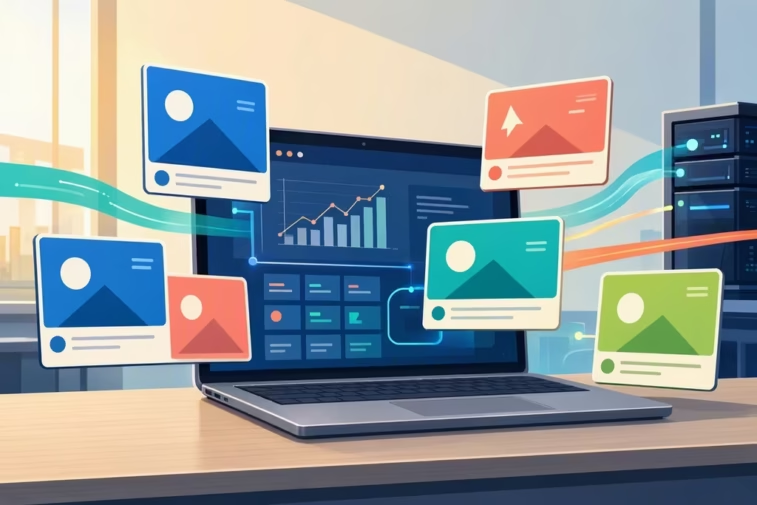
Programmatic advertising meaning: how automated ad auctions work in milliseconds, deal types, costs, and what changed in 2026.
Programmatic advertising is the automated buying and selling of digital ad space using software, data, and real-time auctions. Instead of a person negotiating a placement with a publisher weeks in advance, software decides in a split second which ad to show to which person, and how much to pay for it. That’s the whole idea. Programmatic Advertising Meaning: The rest of this guide explains how it works, the different ways to buy, what it costs, where it goes wrong, and the terms people mix up with it.
Programmatic Advertising Meaning; Why It’s Called “Programmatic”
The word describes how the buying is done, not what the ad looks like. Rules and algorithms, a “program,” execute the purchase, so the transaction doesn’t need a human to negotiate each placement. Programmatic Advertising Meaning: This is why programmatic is a buying method and not a channel or a strategy. A display ad, a streaming TV ad, a podcast ad, and a digital billboard can all be bought programmatically, and each can also be bought the old-fashioned way.
A Simple Way to Think About It
Think of a stock exchange, but for ad impressions. Every time someone loads a page or opens an app with an ad slot, that slot becomes a tiny item for sale. Advertisers, represented by software, bid on it. The highest eligible bid wins and their ad appears. The same thing happens billions of times a day. Real-time bidding, the technology that made this possible, launched around 2009 and 2010.
What Happens in One Auction
Here’s a walk-through of a single ad impression. Programmatic Advertising Meaning: The whole sequence typically finishes in under 100 milliseconds, faster than a blink, while the page is still loading.
- A person opens a page. Say it’s a news site on their phone in the morning.
- The publisher’s system flags an open ad slot. Its ad server and sell-side platform package the opportunity with details such as the page topic, device, and general location.
- The opportunity goes to an ad exchange, which broadcasts a bid request to many potential buyers.
- Demand-side platforms evaluate it for their advertisers. Each one checks whether this person and this page fit its campaigns’ targeting, and calculates a bid.
- Bids come back and the exchange picks a winner. Most exchanges now run first-price auctions, meaning the winner pays what it bid.
- The winning ad loads on the page. Verification tools can check whether it was viewable and appeared in a safe environment.
- Data flows back so the advertiser can measure what happened and the system can adjust future bids.
To the reader, none of this is visible. They just see a page with an ad.
The Players
| Term | What it means |
|---|---|
| DSP (demand-side platform) | The advertiser’s buying software |
| SSP (supply-side platform) | The publisher’s selling software |
| Ad exchange | The marketplace where DSPs and SSPs meet |
| Ad server | Delivers the ad and tracks what happens |
| DMP or CDP | Systems that organize audience data |
| Verification vendors | Check viewability, fraud, and brand safety |
The Four Ways to Buy
Programmatic isn’t just open auctions. Sources commonly describe four deal types, trading off scale against control:
| Deal type | How it works | Good for |
|---|---|---|
| Open auction (RTB) | Any eligible advertiser can bid on available impressions, and prices move in real time | Reach, scale, and testing |
| Private marketplace (PMP) | An invite-only auction on inventory a publisher has set aside | Premium placements and brand safety |
| Preferred deal | A publisher offers a buyer first access at a negotiated price before the open auction | Priority access without a commitment |
| Programmatic guaranteed | A reservation with an agreed price and volume, executed through automated systems, with no auction | Reserved premium inventory and sponsorships |
So RTB is one method of programmatic buying, not a synonym for it.
Where Programmatic Ads Appear
- Display: banner and image ads on websites and apps
- Video: online video and in-stream ads
- Connected TV (CTV): ads in streaming TV apps
- Audio: streaming music and podcast ads
- Native: ads that match the look of the surrounding content
- Digital out-of-home (DOOH): digital billboards and screens in public places
What Programmatic Is Not (Common Mix-Ups)
| Often confused with | The difference |
|---|---|
| Display advertising | Display is a format. Programmatic is a buying method that can buy display, video, audio, CTV, and more |
| PPC or search ads | Search ads run in Google’s and Microsoft’s own auctions based on keywords someone searched. Programmatic mostly covers inventory across the rest of the internet |
| Paid social | Platforms like Meta and TikTok run self-contained auctions inside their own walled gardens |
| Real-time bidding | RTB is the auction mechanism, one part of programmatic |
| Retargeting | Retargeting is a targeting strategy that is often executed programmatically |
What It Costs
Programmatic Advertising Meaning: Programmatic is usually priced in CPM, the cost per thousand impressions. For example, a $5 CPM means $5 for every 1,000 ads shown, so $5,000 buys about a million impressions. Benchmark figures vary widely by format and quality. One 2026 roundup puts display on the Google Display Network around $3 per thousand, private marketplace inventory around $8, and CTV display around $25. In-stream video is often cited at $12 to $25. These are rough orientation, not quotes.
On top of media costs, buyers typically pay fees to platforms, data providers, and verification vendors, and agencies charge their own fees. Platform fees are reported at roughly 12% to 20% of spend, though terms are negotiated. Asking for an itemized breakdown is one of the most useful things a buyer can do.
Why Advertisers Use It
- Reach at scale across many sites, apps, and screens through one platform
- Targeting using first-party data, context, location, and audience signals
- Real-time optimization, with software shifting budget toward what’s working
- Efficiency, since automation replaces much of the manual negotiation
- Granular data on what ran and where
The Downsides
- Complexity. The ecosystem has many layers, and mistakes are costly.
- Opaque fees. Money passes through several companies, and not every dollar reaches the publisher.
- Ad fraud and low-quality inventory, including made-for-advertising sites built to harvest ad dollars.
- Brand safety. Ads can appear next to content you wouldn’t choose.
- Measurement problems. Platforms can claim credit for sales that would have happened anyway.
- Privacy rules. Data practices face growing regulation.
Programmatic in 2026: What’s Changed
- Cookies didn’t disappear the way people expected. Google decided in April 2025 not to deprecate third-party cookies in Chrome and then retired about ten Privacy Sandbox technologies in October 2025. But Safari and Firefox already block third-party cookies, and privacy regulation continues, so the industry still leans on alternatives such as first-party data, contextual targeting, and identity solutions like Unified ID 2.0 and RampID.
- Connected TV keeps growing, and a large share of the buying conversation has shifted to it.
- AI is built into bidding and optimization. Ask vendors how it works and what evidence supports their claims.
- The platform landscape shifted. Microsoft closed its DSP, Microsoft Invest, on February 28, 2026, and fee competition among DSPs has intensified.
- Scale is enormous. One 2026 roundup estimates global programmatic spend above $200 billion, with the large majority of US digital display bought programmatically.
Is Programmatic Right for You?
Programmatic Advertising Meaning: It tends to make sense when you:
- Want reach beyond search and social, such as awareness or consideration
- Have creative in several formats
- Can track results and have a clear goal beyond clicks
- Have enough budget to give the system room to learn, which sources suggest is often around $5,000 to $10,000 a month
It’s probably not the right first step when your budget is tiny, you lack tracking, or you mainly want to capture people already searching for what you sell, which search ads often do better.
How to Get Started
- Set one clear goal, such as new customers or qualified leads.
- Choose how you’ll access it: self-serve, a managed service, or an agency.
- Start with a focused test on one or two channels instead of everything at once.
- Check the basics: tracking, placement reports, viewability, and brand safety settings.
- Measure real impact, ideally with an incrementality test, not only last-click results.
- Review fees and inventory quality before scaling.
Quick Glossary
- Impression: one showing of an ad
- CPM: cost per thousand impressions
- First-party data: data you collect directly from your own customers
- Contextual targeting: matching ads to the content of the page
- Frequency cap: a limit on how often one person sees your ad
- Viewability: whether an ad was actually in view
- Made-for-advertising (MFA) site: a site built mainly to sell ads
- Supply path optimization: choosing shorter, cleaner routes between you and publishers
- CTV: connected TV
- DOOH: digital out-of-home
Frequently Asked Questions
- What does programmatic advertising meaning? It means buying and selling digital ad space automatically with software, data, and real-time auctions, instead of negotiating each placement by hand.
- Is programmatic advertising the same as real-time bidding? No. RTB is the auction method used for open-auction buying. Programmatic also includes private marketplaces, preferred deals, and programmatic guaranteed deals.
- What’s the difference between programmatic and display advertising? Display is an ad format. Programmatic is a buying method that can buy display and many other formats.
- Is programmatic advertising the same as PPC? No. PPC or search ads are triggered by keywords someone searches for on a search engine. Programmatic buys ad space across the wider internet using audience, context, and other signals.
- Does programmatic advertising meaning still work without third-party cookies? Yes. Advertisers use first-party data, contextual targeting, and identity solutions, and Chrome still supports third-party cookies even though other browsers don’t.
- How much does programmatic advertising cost? Media is priced per thousand impressions, with benchmark figures from a few dollars to $25 or more depending on format, plus platform, data, and verification fees. Ask for an itemized quote.