
Learn how to budget for a wedding without stress! Smart tips, cost breakdowns & savings hacks. Start planning your dream day today!
2026 Complete Guide: How to Budget for a Wedding
How to Budget for a Wedding? Marriage budgeting made easy! Get step-by-step guides, cost trackers & real examples for a stress-free plan. Save smarter now!
Great question — and congrats if this is for you! How to Budget for a Wedding? Planning a wedding budget isn’t glamorous, but it’s what makes the rest (and your post-wedding life) much less stressful.
I’ll walk you through:
- How much weddings actually cost in 2026
- A simple wedding budget framework with category breakdowns
- Step‑by‑step process to build your budget
- How to track it (spreadsheet or app)
- Who pays for what (contributions guide)
- Ways to stay under budget and still have the day you want
How to Budget for a Wedding? I’ll keep it practical and numbers-focused.
1. Quick reality check: what a wedding really costs in 2026
How to Budget for a Wedding? Recent data from major wedding platforms (The Knot’s 2026 Real Weddings Study, Zola’s 2025–2026 averages, SoFi, etc.) shows:
- U.S. “average” wedding cost (2025–2026):
- Around $33,000–$36,000 is commonly cited as an overall national average.
- The Knot’s 2026 study: average about $34,200 based on 10,474 U.S. couples married in 2025.
- Zola (wedding registry platform): about $36,000 average in 2025, with median around $10,000 (median is often more “typical” than the average because a few huge weddings skew the mean up).
- Fidelity (citing Zola): reports ~$36,000 in 2025.fidelity
- Big variation by location:
- Most expensive state (in one recent Zola analysis): New Jersey ≈ $47,000
- Cheapest state: Utah ≈ $17,000
- Example: New York City ≈ $47,000, Utah ≈ $17,000.
- Spending is rising:
- 2024 average (Zola): ~$33,000
- 2025 average: ~$36,000 So inflation is very real in weddings, just like everywhere else.
Takeaway for you:
- Use these numbers as a reference, not a rule. You can absolutely spend more or less than the “average.”
- Decide early: “We’ll aim around $25k,” “around $35k,” or “around $50k” — then build your budget around that target.
2. A simple wedding budget framework (overview)
How to Budget for a Wedding? Here’s the basic structure most wedding budgets follow:
- Reception & venue
- Food & drink / catering
- Photography & video
- Attire & beauty (rings, dresses, suits, hair/makeup)
- Flowers & decor
- Invitations & paper goods
- Music & entertainment
- Transportation & accommodation
- Gifts / registry
- Officiant / legal stuff
- Planner / coordination / service fees
- Contingency fund
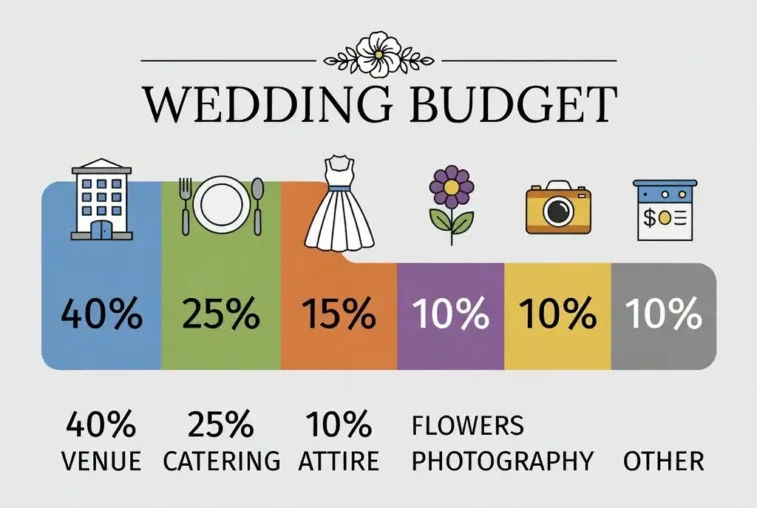
How to Budget for a Wedding? Industry data (The Knot, Here Comes The Guide, etc.) suggests typical “big bucket” percentages of a total wedding budget:
- Reception & venue: ~40–50%
- Food & drink (catering): ~15–20%
- Photography & video: ~10–15%
- Attire, beauty, rings: ~5–10%
- Flowers & decor: ~5–10%
- Music & entertainment: ~5–10%
- Invitations & paper: ~2–5%
- Transportation & accommodation: ~2–5%
- Gifts / registry: ~2–5% (often funded separately by guests, but couples sometimes cover some items themselves)
- Officiant, legal, favors: ~2–5%
- Planner, coordination, misc.: ~3–5%
These ranges vary a lot by style, location, and priorities (e.g., a backyard wedding will have much lower “venue” share than a ballroom), but they’re a good starting point when you design your own numbers.
3. Wedding budget workflow (visual overview)
How to Budget for a Wedding? Here’s the basic process from idea to locked‑in budget:
- Set total target
- Pick date & guest count
- Research costs per category
- Build initial budget with percentages
- Compare target vs savings & contributions
- Adjust & lock budget
- Track expenses & pay vendors
- Hold contingency for last‑minute costs
Now let’s go step‑by‑step.
4. Step 1 – Choose your total budget target
Before you open any spreadsheets, anchor on a number that feels realistic but slightly uncomfortable.
Questions to ask:
- Where are we getting married (city/region)?
- How many guests (roughly)?
- What style? (backyard, restaurant, ballroom, destination)
- What are our “must‑haves” vs “nice‑to‑haves”?
Using the 2026 averages:
- If you want near the U.S. average:
- $30,000–$35,000 for a “normal” wedding in many areas.
- If you want high‑end / big city / fancy venue:
- $40,000–$60,000 is very common.
- If you want intentionally lean:
- $15,000–$25,000 is totally doable with careful choices (smaller guest list, simpler venue, less elaborate decor).
Example: You live in a medium‑cost city and want a nice but not crazy wedding.
- Set target: $35,000
- Later, you’ll allocate 50% to reception & venue ($17,500), 18% to food, etc.
Write down your target number; that’s your North Star for all other decisions.
5. Step 2 – Lock in your non‑negotiables (guest count & date)
Two things massively drive cost:
- Guest count
- Date/day of week
- Guest count:
- Each extra guest = extra plates, extra chairs, more invitations, more cake, possibly bigger venue.
- Rough math: if catering + venue per‑guest costs are $200, adding 10 guests = $2,000 more.
- Date/day:
- Prime dates (Saturday nights, June–October “peak season”) often cost more than:
- Fridays, Sundays, weekdays, or off‑peak months.zola+1
- Prime dates (Saturday nights, June–October “peak season”) often cost more than:
Quick move:
- Agree on a target guest range early (e.g., 100–130 guests).
- Choose a date or at least a season (e.g., “late April”) before locking venues.
6. Step 3 – Build your category budget (with percentages)
Once you have a total budget target, assign percentages to each category. Use the big‑bucket ranges above and tweak to your style.
Example: $35,000 target (U.S., medium‑formal, not ultra‑luxury):
- Reception & venue (45%) = $15,750
- Food & drink (18%) = $6,300
- Photography & video (12%) = $4,200
- Attire, beauty, rings (9%) = $3,150
- Flowers & decor (6%) = $2,100
- Music & entertainment (5%) = $1,750
- Invitations & paper (3%) = $1,050
- Transportation & accommodation (3%) = $1,050
- Gifts / registry (3%) = $1,050
- Officiant, legal, favors (3%) = $1,050
- Planner / coordination / misc. (3%) = $1,050
You’d then break each category into line items (venue rental, food cost per head, dress, suit, etc.). This matches the type of breakdown you see in wedding budget breakdown guides, which group expenses by vendor type.
How to adapt for different styles:
- Backyard / low‑key:
- Reduce reception & venue: e.g., 30–35% of total.
- Increase decor rentals: 8–10%.
- High‑end / luxury:
- Reception & venue: 50%+ of total.
- Photography & video: 15%+.
- Attire & jewelry: 10%+.
- Minimalist / courthouse:
- Venue + food may be much smaller share; officiant/legal might be your biggest share.
7. Step 4 – Build your vendor list with cost ranges
For each major category, list typical vendors and research rough price ranges. Wedding budget guides strongly recommend starting vendor search before falling in love with venues — vendors book up fast.
Typical vendor types:
- Venue:
- Hotel ballroom, barn, restaurant, vineyard, community center, religious venue, backyard, etc.
- Costs: site fee, rental, food/beverage minimums, service charge, taxes, gratuity.
- Catering / bar:
- Per‑head cost for plated dinner, buffet stations, bar packages, service staff, rentals, cake.
- Photography:
- Engagement shoot, wedding day coverage (hours), albums, prints, raw files, second shooter.
- Videography:
- Highlight film, full edit, drone, same‑day edit.
- Attire & beauty:
- Dress/es, suit/es, alterations, shoes, accessories, jewelry (rings, bands), hair & makeup trials, day‑of styling.
- Flowers & decor:
- Bridal bouquet, boutonnieres, centerpieces, aisle decor, welcome sign, guestbook favors, table decor.
- Music / DJ / band:
- Ceremony musicians, reception DJ or live band, MC, lighting.
- Invitations & paper:
- Save‑the‑dates, wedding invitations, RSVP cards, thank‑you cards, wedding website.
- Transportation & accommodation:
- Shuttles/rides for guests, accommodation block for out‑of‑town guests, your own pre‑wedding stay.
- Officiant & legal:
- Officiant fee, marriage license, day‑of coordinator tips.
- Planner / coordinator:
- Flat fee or % of budget; sometimes month‑of coordination packages.
For each vendor, put:
- Low estimate
- High estimate
- Preferred estimate (what you’d like)
Keep notes on what’s included (e.g., “album included,” “8 hours of coverage”).
8. Step 5 – Who pays for what? (contributions and funding)
2025–2026 data shows couples fund weddings in a few main ways:
Common funding sources:
- Couples’ own savings:
- Roughly 47% of couples rely primarily on their savings to pay for the wedding.
- Credit cards:
- Around 31% of couples optimize credit card rewards or use cards for cash flow and points.
- Personal loans:
- Some couples take out personal loans to cover part of the wedding cost.
- Contributions from family:
- Many couples receive financial help from parents or relatives.
From Zola’s 2026 First Look report (U.S.):
- 59% of couples say family is contributing; of those:
- 29% say family is fully paying.
- 30% say family is partially paying.
How to handle contributions constructively:
- Ask clearly:
- “Would you like to contribute to the wedding as a gift, or are you thinking of a fixed amount?”
- If it’s a fixed amount:
- Decide whether it:
- Reduces your target (you still plan the full spend, but your out‑of‑pocket is smaller), or
- Adds on top of your target (you plan a smaller wedding and their gift lets you “buy up” to your ideal wedding).
- Decide whether it:
- If it’s “we’ll pay for X”:
- Treat that as a committed line item in your budget (e.g., “parents’ $10,000 towards venue & catering”).
- Be transparent early:
- If you know family wants to help, talk numbers before you sign contracts so you avoid last‑minute “we thought you were handling this” awkwardness.
9. Step 6 – Build and/or choose a tracking tool
You can budget in:
- A spreadsheet (Google Sheets, Excel, Numbers, etc.)
- A wedding budgeting app
- A printable PDF/planner
Spreadsheet pros:
- Full control
- Easy to customize
- Great for side‑by‑side vendor comparisonsvowconnection+1
Apps or digital templates pros:
- Pre‑built wedding categories
- Sometimes vendor lists, payment tracking, and dashboardsrockmywedding+1
Free spreadsheet options:
- Google Sheets / Excel:
- Many free wedding budget templates (e.g., The Knot’s wedding planning spreadsheet, Google Sheets wedding templates curated by personal finance sites).
- Free wedding budget PDF planners:
- Some sites offer downloadable PDF/Excel planners designed for 2026 with built‑in category lists and average costs for line items.
Minimum your tool should support:
- Columns for:
- Category
- Vendor name
- Estimated cost
- Actual cost (once booked)
- Deposit paid
- Balance due
- Payment date
- Paid? (checkbox)
10. Step 7 – Research and fill in realistic numbers by category
How to Budget for a Wedding? Use your vendor research + percentages to populate your budget. I’ll go category by category with realistic ranges and tips.
10.1 Reception & venue (typically 40–50% of budget)
What’s usually included:
- Site rental fee
- Room rental (if separate)
- Food & beverage minimum spend
- Service charge or admin fee
- Taxes and gratuity (often 18–26% on top in the U.S.)
Rough 2026 ranges (U.S., not ultra‑luxury):
- 100 guests, $35k total budget (example):
- Reception + venue ~ $15,750 (45% of budget)
- You might see:
- $10k–$25k+ for venue + catering alone depending on city and venue type.
Money‑saving tips:
- Consider off‑peak dates:
- Friday or Sunday vs Saturday; winter vs early summer; many venues offer lower pricing on off‑peak days.
- Ask about inclusive vs “plus” packages:
- Inclusive bar (beer, wine, basic mix) vs a consumption bar (everything charged by consumption) can massively change your final number.
- Reduce rental hours:
- A 4‑hour reception instead of 6 can cut rental, overtime staff, and some bar costs.
- Look for “all‑inclusive” venues:
- Some venues include tables, chairs, linens, basic decor in the base price, reducing your rentals/decor spend.
10.2 Food & drink / catering (typically 15–20%)
What’s included:
- Plated dinner or buffet
- Cocktail hour or welcome drinks
- Wine/beer/table service
- Wedding cake
- Late‑night snack or after‑party bar
Rough cost math:
- If total budget is $35k and food share is 18%:
- Food & drink budget = $6,300
- At 100 guests with $80/head average:
- $8,000 for food; remaining $3,300 for drinks, cake, service, etc.
Money‑saving tips:
- Lower guest count:
- Cutting from 150 to 100 guests can save huge money, not just on food but on venue size too.
- Reduce bar package:
- Wine & beer only vs full open bar; signature cocktails vs premium spirits.
- Brunch or lunch instead of dinner:
- Often cheaper per person while still feeling plenty fancy.
- Skip passed hors d’oeuvres and heavy stations:
- Focus on a really good dinner and cake instead of many starters that guests barely touch. Many planners recommend skipping or lightening passed items to save without sacrificing guest experience.
10.3 Photography & video (typically 10–15%)
What’s typically included:
- Engagement shoot
- Wedding day coverage (preparation to dance floor)
- Digital gallery or online gallery
- Prints, albums, or RAW files
Rough ranges:
- Solo photographer:
- $2,000–$6,000 is common for 8 hours of coverage in many markets.
- Two photographers / second shooter:
- $3,000–$10,000+ depending on experience, market, and album choices.
- Videography:
- $1,500–$5,000+ depending on hours and edits.
If your total budget is $35k and you allocate 12%:
- Photo + video budget = $4,200
- Example split:
- Photographer: $3,500
- Videographer: $2,500
- Album/print upgrades: included
Money‑saving tips:
- Prioritize coverage hours over extra bells and whistles:
- Choose the most important window (ceremony + portraits + key party moments) and buy fewer extra hours.
- Skip raw files:
- If you’re okay with a basic online gallery and some prints, you can often save by not buying all RAW footage.
- Consider one strong photographer instead of two marginal ones:
- A top‑tier shooter with great gallery may be better value than two mid‑tier photographers.
10.4 Attire, beauty, rings (typically 5–10%)
What’s included:
- Wedding dress/es and alterations
- Suit/suit rental or purchase
- Shoes, accessories
- Jewelry (engagement ring + wedding bands)
- Hair & makeup (trial + day‑of)
- Groom/groomsmen gifts
Rough ranges:
- Dress(es): $1,000–$3,000+ (depending on designer, fabric, embellishments).
- Suit: $200–$1,500 (rental or purchase).
- Jewelry: extremely variable; many couples spend anywhere from $1,000–$10,000+ on both rings.
- Beauty (hair/makeup): $300–$800 for bride + maybe $150–$500 for groom.
If your total budget is $35k and you allocate 9%:
- Attire, beauty, rings budget = $3,150
- Example:
- Dresses & alterations: $1,500
- Suit: $700
- Rings: $500
- Hair & makeup (both): $450
Money‑saving tips:
- Sample sales and second‑hand:
- For dresses, suits, and accessories.
- Rent instead of buy:
- Especially tuxedos and formal wear.
- Limit professional beauty:
- Maybe you pay for hair/makeup for one person and DIY the other.
- Be realistic but disciplined on jewelry:
- Decide a combined ring budget early and stick to it; it’s very easy for emotions + marketing to push this number way up.
10.5 Flowers & decor (typically 5–10%)
What’s included:
- Bridal bouquet, boutonnieres, corsages
- Centerpieces and altar flowers
- Aisle and welcome signage
- Table numbers, menu cards, lounge decor
Rough ranges:
- Floral design: $500–$3,000+ depending on complexity and choice of blooms.
- Miscellaneous decor: $200–$1,000+.
If your total budget is $35k and you allocate 6%:
- Flowers & decor budget = $2,100
Money‑saving tips:
- Focus spend on a few high‑impact areas:
- A gorgeous altar arrangement and welcome sign can do more heavy lifting than scattered small vases everywhere.
- Use in‑season blooms:
- Local, seasonal flowers are much cheaper than imported or out‑of‑season exotics.
- Mix high/low:
- Use cheaper greenery/foliage to fill space around premium statement flowers.
10.6 Music, entertainment & MC (typically 5–10%)
What’s included:
- Ceremony musicians (string quartet, singer, etc.)
- Reception DJ or live band
- MC / host
- Lighting / dance floor effects
Rough ranges:
- DJ + MC: $1,000–$3,000
- Live band + musicians: $2,000–$5,000+ for longer sets/larger groups.
If total budget is $35k and you allocate 7%:
- Music & entertainment budget = $2,450
Money‑saving tips:
- Prioritize a good DJ/band over add‑ons:
- A great DJ with a strong song list often beats extra musicians and dancers.
- Keep the party shorter:
- 4 hours of dancing instead of 6 can reduce band/DJ cost without losing energy.
- Skip extras:
- Cold sparks, dancers, photo booths are fun, but they add up.
10.7 Invitations & paper goods (typically 2–5%)
What’s included:
- Save‑the‑dates
- Wedding invitations
- RSVP cards or website
- Wedding website (sometimes bundled)
- Thank‑you cards
- Day‑of stationery (programs, menus, place cards)
Rough ranges:
- Invites suite: $300–$1,500+ depending on customization, printing method, and quantity.
- Day‑of stationery: $100–$500.
If total budget is $35k and you allocate 3%:
- Invitations & paper budget = $1,050
Money‑saving tips:
- Go paperless where possible:
- Digital save‑the‑dates and wedding website are standard now and can cut stationery costs.
- Simplify:
- One high‑quality invitation card instead of multiple enclosures.
- Print in bulk:
- Order all items from one vendor for better pricing and consistent quality.
10.8 Transportation & accommodation (typically 2–5%)
What’s included:
- Shuttle or bus for guests
- Accommodation blocks (room blocks for out‑of‑town family/wedding party)
- Your own pre‑wedding stay or travel
Rough ranges:
- Shuttle/transport:
- $500–$2,000 depending on distance and group size.
- Accommodation:
- Highly variable by location (e.g., $150–$300/night at a modest hotel vs $400–$800+ in a city).
If total budget is $35k and you allocate 3%:
- Transportation & accommodation budget = $1,050
Money-saving tips:
- Group blocks:
- Negotiate a small group rate at a hotel near your venue.
- Limit shuttles:
- Encourage guests to carpool or use rideshares instead of individual shuttles for everyone.
- Choose walkable venues:
- If many guests are local, you may reduce transportation/accommodation spend significantly.
10.9 Gifts / registry (typically 2–5%)
From a budgeting standpoint, this is “soft” because guests usually pay for gifts, but:
- Many couples buy some items themselves:
- Welcome bags, welcome baskets, gifts for parents/attendants.
- Some couples pre‑buy items from their own registry:
- e.g., upgrading luggage, buying appliances with gift funds they know are coming.
If total budget is $35k and you allocate 3%:
- Gifts / registry (out‑of‑pocket) = $1,050
Money‑saving tips:
- Build a focused registry:
- Fewer, more meaningful items instead of a giant random list.
- Be realistic about cash gifts:
- Assume a portion of intended gift money may end up as cash or gift cards; you can use that to replenish contingency or cover emergencies.
- Don’t over‑commit:
- Don’t promise to buy big gifts for others from your own wedding budget; that’s a common source of overspend.
10.10 Officiant, legal, favors, planner, misc. (typically 2–5%)
How to Budget for a Wedding? What’s included:
- Officiant fee or donation
- Marriage license
- Day‑of coordination tips
- Favors for guests
- Wedding planner fee (if any)
- Miscellaneous vendors (e.g., restroom trailers, lounge furniture, lounge attendants)
Rough ranges:
- Officiant: $200–$1,000 depending on denomination and whether it’s your own house of worship.
- Marriage license: $20–$150 depending on location.
- Planner:
- 10–20% of total budget is common for full‑service planners; some charge a flat fee instead.
- Favors:
- $1–$10 per guest; $200–$1,000+ total.
If total budget is $35k and you allocate 4%:
- Officiant, legal, favors, planner, misc. = $1,400
Money-saving tips:
- Use a partial planner:
- Day‑of coordination only (lower flat fee) instead of full‑service design and management.
- Limit favors:
- Simple, low‑cost favors (e.g., a small treat or donated item) instead of expensive boxes for everyone.
- Check what’s legally required:
- In some places, the marriage license is a small administrative fee; in others, it’s bundled or not required at all.
11. Step 8 – Add a contingency fund (this is not optional)
How to Budget for a Wedding? Almost every wedding has surprises:
- Last‑minute guests
- Overtime charges
- Forgotten items (rentals, tips)
- Weather contingencies (tent, heaters, rain plan)
Many planners and budgeting guides recommend setting aside around 5–10% of your total budget for contingency, especially if your wedding is:
- Outdoors
- In a volatile climate season
- Complex logistics (lots of moving parts, multiple locations)brides
Example:
- $35,000 target budget
- 5% contingency = $1,750
You can choose:
- Fixed contingency fund:
- Set aside actual cash in a separate savings account.
- “Hidden buffer” in categories:
- Add small buffers within categories (e.g., venue +15% instead of 12%) and don’t list them all as a line item.
12. Step 9 – Track and update as you book vendors
How to Budget for a Wedding? Once your budget is set, discipline = tracking reality.
Good habits:
- Record every deposit and final payment:
- Immediately note them in your sheet/app.
- Update “estimate vs. actual”:
- Each time you sign a contract or pay a deposit, update your forecast.
- Use color coding:
- Green = on/under budget, yellow = close, red = over.
- This helps you see where to cut before it’s too late.
Sample line item in a spreadsheet:
- Category: Venue
- Vendor: Example Barn at Hill
- Est. total: $15,000
- Actual total: $16,500
- Deposit: $4,000 (paid)
- Balance due: $12,500 (due March 15)
- Paid? checkbox
13. Example: sample $35,000 wedding budget (summary)
How to Budget for a Wedding? Here’s a concrete, example budget using the 45/18/12/9/3/3/3/4 split we discussed (U.S., medium‑formal, 100 guests):
- Reception & venue (45%) — $15,750
- Food & drink (18%) — $6,300
- Photography & video (12%) — $4,200
- Attire, beauty, rings (9%) — $3,150
- Flowers & decor (6%) — $2,100
- Music & entertainment (7%) — $2,450
- Invitations & paper (3%) — $1,050
- Transportation & accommodation (3%) — $1,050
- Gifts / registry (3%) — $1,050
- Officiant, legal, favors, planner, misc. (4%) — $1,400
Total: $35,000
If you want a leaner $25,000 or a higher $50,000 wedding, you’d keep similar percentages but scale the absolute numbers down or up.
14. Red‑flag warnings: how budgets get broken (and how to avoid them)
How to Budget for a Wedding? From recent budgeting guides and real-couple data, here’s what actually goes wrong most often:greenvelope+1
- Guest creep:
- “We’ll just invite 10 more people,” repeated 4 times, suddenly adds dozens of guests and thousands in cost.
- Not tracking extras:
- Service charges (often ~18–22% on top of catering/venue), overtime, delivery fees, extra hours, trial sessions, etc. accumulate invisibly.
- Underestimating big categories:
- Especially venue + catering, photography, and decor.
- No contingency:
- Surprise expenses (weather rentals, last‑minute guest rooms) go straight to credit card or family loans.
- Changing vision mid‑planning:
- Adding “just this one extra thing” across multiple categories without adjusting elsewhere.
How to avoid:
- Hard cap on guest count:
- Agree a range and treat it as almost sacred.
- Require written quotes with “all‑in”:
- Ask vendors for a single price that includes all major line items (service, tax, gratuity) to compare apples to apples.
- Build in 5–10% contingency:
- And resist the urge to spend “just a little more” unless you’re adjusting elsewhere.
- Freeze categories once booked:
- Once venue + catering + photo are locked, use remaining budget to prioritize the rest, not to keep increasing already‑booked categories.
15. Who should do what (roles that work)
How to Budget for a Wedding? Budgeting goes much smoother when you agree on:
- Who owns the spreadsheet:
- Usually one partner (often the one more excited by spreadsheets) maintains the master file.
- Who talks to vendors:
- Both of you should agree on a “budget check” before either of you reaches out to a vendor beyond pre‑approved numbers.
- Who handles payments:
- Assign who physically pays deposits and final invoices so nothing gets lost.
Agree on simple rules:
- No contracts above your pre‑approved category total without a conversation.
- If one of you wants to overspend in one category, decide together where to cut back in another.
16. Quick sanity check: are we on track?
How to Budget for a Wedding? Once your budget is built, pause and ask:
- Does our total target still match our combined savings + contributions + any we’re willing to borrow?
- What’s our per‑guest cost?
- If total budget / guest count is far above your area average (e.g., you’re at $500+/guest while local friends are around $200–$300), is that realistic or do we need to adjust guest list or style?
- Have we left room in the big categories for the things that matter most to us?
- For example, if photography is your top priority, keep your photo budget strong and trim decor or favors.
17. 2026 pro tips: what’s new or different now
How to Budget for a Wedding? Based on 2025–2026 planning advice and data, a few key trends:
- Couples are more cautious about taking on debt:
- Many planners explicitly advise against financing your entire wedding with debt; they recommend using savings and gifts where possible and only borrowing sparingly.
- More off‑peak and non‑traditional dates:
- Fridays, Sundays, and winter/weekday weddings are increasingly popular because they’re cheaper and still lovely.
- Higher cost of “social media tax”:
- Many planners note that certain decor and floral choices are heavily influenced by Instagram/TikTok trends and can massively inflate the flowers + decor share of your budget. Couples trying to stay grounded are being more selective here.
- Use budget breakdowns as a communication tool:
- Planners and venues appreciate when you show up with a rough category breakdown; it helps them quickly see what’s realistic and what’s not.
18. Free and low‑cost tools to help
How to Budget for a Wedding? Useful free/low‑cost resources to get organized:
- Free wedding budget spreadsheet templates (Google Sheets/Excel/PDF planners):
- Several 2026 guides offer free downloads, including The Knot’s wedding planning spreadsheet and budget templates from wedding sites.
- Budget calculators & average-cost breakdowns:
- Tools like Zola, The Knot, and SoFi publish current averages by category and sometimes calculators to help you benchmark your numbers.
These are great for sanity‑checking your numbers against what other people in your region are spending.
If you tell me:
- Your country/city
- Your rough guest count
- Your target budget range
How to Budget for a Wedding? I can sketch a tailored example budget with likely local per‑guest costs and category splits that feel appropriate for your market.