
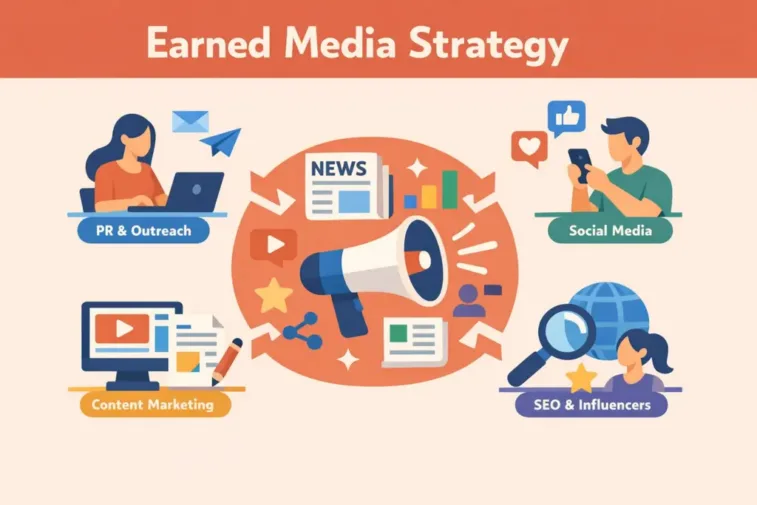
Boost your brand’s visibility with a powerful earned media strategy. Leverage PR, social shares, and word-of-mouth to drive credibility and maximize reach.
Earned Media Strategy: 2026 Complete Guide
Here’s a 2026-complete guide to building and running an earned media strategy that actually drives business results.
Quick take / main idea
- Earned media = when others talk about you voluntarily (press coverage, social mentions, reviews, UGC, peer recommendations). You trigger and influence it, but you don’t own or pay for the placement.
- The best strategies today are:
- Audience-first (not pitch-first)
- Anchored in real relationships with journalists/influencers
- Deeply integrated with paid/owned (PESO)
- Measured on business outcomes (leads, conversions, trust), not vanity metrics like impressions
Earned Media Strategy: Below is a visual of the full cycle, then we’ll go step by step.
- Define objectives & KPIs
- Audience & narrative research
- Build targeted media & creator lists
- Create earned-first content & assets
- Outreach: personalize & follow up
- Amplify: social, SEO, partners, paid
- Monitor: listening & coverage capture
- Measure: outputs, outcomes, impact
- Optimize: adjust stories, targets, tactics
- Audience & narrative research
1. What earned media is (and isn’t) in 2026
- Definition:
- Earned media is public exposure through word of mouth, customer reviews, social media mentions, or media coverage resulting from your content or services’ quality and relevancy. Unlike paid and owned, it originates organically outside the company.
- Classic examples:
- News and trade press articles about you
- Podcast/radio/TV appearances
- Social mentions, shares, and comments
- Reviews and ratings (Google, Trustpilot, G2, app stores, etc.)
- UGC (unboxing videos, how-to posts from users)
- Non-paid influencer/creator posts and mentions
- What it isn’t:
- Your blog, website, email, or branded social posts (those are owned media)
- Ads, sponsored posts, or paid placements (those are paid media)
- Influencer posts you pay for as a pure media buy (gray area — often treated as paid, but can spark organic follow-on earned coverage).
Why it matters now
- Trust in advertising continues to decline, while personal recommendations and peer reviews are highly trusted — Nielsen’s Trust in Advertising survey found 88% of respondents most trust recommendations from people they know.
- Earned media has disproportionate impact at the bottom of the funnel: personal recommendations often decide purchases.
2. Context: earned vs. owned vs. paid (PESO) in 2026
Earned Media Strategy: Most modern teams use a PESO model (Paid, Earned, Shared, Owned) to integrate media types:
- Paid:
- Ads on social, search, display, sponsored content, sponsored podcasts/segments.
- Owned:
- Website, blog, email, brand social profiles, podcast you host, white papers, reports.
- Earned:
- Press coverage, reviews, social mentions, word-of-mouth, non-paid creator posts, expert commentary.
- Shared:
- Sometimes used to describe social sharing and community-driven amplification (often overlaps with earned).
For 2026 planning, assume:
- Paid = scale and targeting
- Owned = SEO, nurture, and conversion
- Earned = trust and proof at the decision stage
- The magic is in how you combine them: e.g., a piece of earned coverage (press/creator) repurposed into ads and email content.
Earned media vs. paid media vs. owned media EXPLAINED
3. 6-step earned media strategy framework (adapted for 2026)
Earned Media Strategy: This adapts a proven 6-step framework and adds 2026 specifics.
Step 1: Know your audience (better than your competitors do)
- Get specific about “who”:
- Build audience personas: job titles, industries, demographics, psychographics, where they hang out (Reddit, LinkedIn, niche podcasts, trade press, etc.).
- Map questions they ask and problems they care about.
- Identify trusted sources for each persona:
- Which journalists, newsletters, Substacks, podcasters, and creators do they trust?
- Which communities (subreddits, Discords, LinkedIn Groups, niche forums) influence them?
- Use data to refine:
- Check your referral traffic to see which media/send you real visitors.
- Talk to Sales and Customer Success to hear what prospects/customers actually read and reference.
- 2026 twist:
- Factor in AI search (LLMs) and social platforms as discovery channels. LinkedIn is growing as a source within AI-driven answers, and Reddit remains heavily cited. Being mentioned in these places can feed AI-search reputation.
Step 2: Tighten your story — nobody cares about your boilerplate
Earned Media Strategy: Your story must be newsworthy, useful, and unique — not just “we hired someone” or “we launched X version.” Pressure-test each angle:
- Is it timely? (Tied to current news, trend, or seasonal urgency)
- Is it unique? (Something only you can say or show)
- Is it useful? (Readers learn something or get value)
Good 2026 story types:
- Proprietary data or surveys with strong charts/infographics
- Contrarian, evidence-backed point of view on a hot industry topic
- Real-world case studies with verifiable results
- Original research or frameworks that simplify complex problems
Step 3: Build your media and creator lists (lean and relevant)
- Don’t spray and pray. Bigger lists ≠ better results.
- Segment by:
- Beat/topic (e.g., AI in healthcare, climate tech, B2B SaaS pricing)
- Region/language
- Outlet type (national, trade, newsletters, podcasts, creators)
- Keep it current:
- Use media relationship platforms (e.g., Muck Rack, Presspage) to manage lists and track outreach.
- 2026 add:
- Include niche newsletters, Substackers, and trusted community leaders (e.g., active Redditors or Discord admins) alongside traditional journalists.
- Look at creators on TikTok, YouTube, and LinkedIn who regularly post about your domain.
Step 4: Personalize outreach — or don’t bother
Earned Media Strategy: Every pitch should feel written for that person:
- Use their name and reference their recent work with specifics.
- Show you understand their audience and why the story matters to them.
- Keep it short and respect their time.
- Offer something that makes their job easier:
- Data visualizations they can use
- Expert quotes or Q&A
- High-res images or short video clips
2026 tactics:
- Short video (15–60s) from your expert can help busy journalists quickly understand the angle.
- Provide sharable visual snippets that work well on social (social posts often amplify coverage).
Step 5: Pitch value, not your brand
Lead with what’s in it for their audience:
- Proprietary data or trends not yet public
- Early access under embargo
- A fresh angle on a hot story (explain why now)
- Access to customers or experts who can speak to real impact
Think like an editor: what headline would they want to write from your pitch? If it sounds like an ad, rework it.
Step 6: Build relationships, not just hit-and-run pitches
Relationships turn one-off hits into recurring coverage:
- Follow up courteously and respond quickly to requests.
- Say thank you and share their articles (even when they’re not about you).
- Periodically check in without an ask: send a relevant insight, data point, or kudos.
- Treat creators and influencers the same way: long-term trust outperforms one-off transactions.
4. Integrating with owned and paid (PESO in practice)
Earned Media Strategy: To maximize earned media in 2026, tightly weave it with owned and paid:
- Owned → Earned:
- Publish high-quality owned content (blog posts, reports, videos) that serve as pitching assets.
- Make it easy for journalists and creators to find and reuse your data, charts, and visuals.
- Earned → Paid:
- Turn strong coverage into:
- Social ads (“As seen in…”)
- Retargeting creatives
- Sales enablement decks and one-pagers
- Use quotes and logos in landing pages and email nurturing.
- Turn strong coverage into:
- Earned + Social & SEO:
- Ask for links where appropriate (many stories will link naturally), which supports SEO.
- Monitor which earned pieces drive referral traffic and conversion, and double down on similar angles/outlets.
- Amplify via employee advocacy:
- Encourage employees to share and comment on coverage — humanizes your brand and extends reach.
5. Measurement: from vanity to outcomes (2026 edition)
Earned Media Strategy: The big shift in 2024–2026: PR is held to the same outcome-based standards as marketing. Impressions alone no longer prove value.
Use frameworks like AMEC’s Integrated Evaluation Framework and PESO to structure measurement:
- Align objectives and benchmarks upfront.
- Track outputs (coverage), out-takes (audience comprehension), outcomes (attitude/behavior change), and impact (business results).
Recommended metrics stack for 2026:
Output metrics (coverage volume)
- Media mentions (by outlet type, region, beat)
- Share of voice vs. competitors
- Pieces including key messages and/or spokespeople
Quality and attention metrics
- Message pull-through: % of mentions that include your key messages
- Prominence: headline vs. in-passing mention
- Use of visuals (coverage with visuals often sees higher engagement)
- Domain authority / audience quality of outlets
Engagement metrics
- Social engagement on coverage (shares, comments, saves, sends — new LinkedIn metrics for depth of engagement)
- Referral traffic from earned pieces (using UTM parameters)
- Time on site and conversion from referral traffic
Sentiment and trust
- Sentiment distribution (positive/neutral/negative)
- Review scores and trends over time (G2, Google, App Store, etc.)
- Crisis spikes: sharp increases in negative mention volume or sentiment
Business outcome metrics (the north star)
- Leads/opportunities attributed to earned media (tracking via UTMs or promo codes)
- Pipeline influence: deals where earned media was a touchpoint
- Conversion rate from referral traffic
- Searches for brand + brand terms following coverage spikes
- Lift in brand trust or consideration (via survey research)
Practical 2026 measurement habits:
- Real-time dashboards over static decks (stakeholders expect live access).
- Attribution models that connect media coverage to website behavior and conversions.
- Quarterly reviews that tie top-performing stories and outlets to leads/revenue.
6. 2026 trends shaping earned media tactics
Earned Media Strategy: Tie your strategy to how media and attention are evolving:
- Search & discovery are now multi-modal and social-first:
- Social content must work as “searchable” assets (captions, transcripts, keywords) because people use TikTok, YouTube, and Reddit as search engines.
- AI and reputation in LLMs:
- AI search pulls heavily from social platforms like Reddit and LinkedIn; being covered and cited there supports your reputation in AI-generated answers.
- Long-form and TV-integrated formats:
- Instagram and others are pushing long-form, lean-back content (e.g., Instagram on TV); think about longer-form storytelling that can be clipped and quoted.
- Reddit’s resurgence:
- Reddit is a top platform in some regions and is growing in importance; people seek peer-led, trusted content. Strategies include participating authentically in relevant communities (not spamming) and monitoring for reputation risks/opportunities.
- Authenticity vs. AI:
- Audiences value human-made authenticity, but AI tools are table stakes for content workflows. Use AI for research, monitoring, and draft support; keep voice and stories human.
- Performance-driven creator partnerships:
- Creator relationships are increasingly ROI-focused. Measure beyond reach to engagement, clicks, and conversions when partnering.
7. Choosing channels and tactics for 2026
Mix these channels based on your audience:
- Media relations:
- National/business press, trade publications, local outlets
- Tech and industry blogs and newsletters
- Podcasts and broadcast:
- Guest appearances on niche and industry shows
- Regular expert segments (e.g., monthly “Ask the Expert” slot)
- Creators & influencers:
- Niche experts on YouTube, TikTok, LinkedIn, Instagram
- Micro-influencers with highly engaged communities
- Reviews & UGC:
- Actively request and nurture reviews from happy customers.
- Encourage and showcase UGC (with consent).
- Community platforms:
- Meaningful participation in relevant subreddits, Discords, Slack/Discord communities, and LinkedIn Groups.
- Events and experiences:
- Webinars, roundtables, and live events that press/creators attend or cover.
- Thought leadership:
- Bylines and op-eds
- Original reports and data studies
- Speaking at conferences and industry events
8. Building your 12-month earned media roadmap
Here’s a simple 12-month plan you can adapt:
- Q1: Foundation & Research
- Audit past coverage and competitor presence.
- Define objectives and KPIs using a framework like AMEC.
- Build/segment media and creator lists.
- Develop 2–3 core narrative pillars (e.g., data, customer impact, POV).
- Q2: Content Engine & Early Wins
- Create and publish a flagship piece of owned content (report, survey, framework).
- Run an outreach series tied to the flagship.
- Begin a regular cadence of expert commentary on timely news.
- Q3: Relationships & Scale
- Deepen relationships with top 10–20 journalists/creators (no-pitch check-ins, value-add).
- Launch a small event or webinar series designed to generate coverage.
- Launch an employee advocacy program around earned content.
- Q4: Optimization & Outcome Reporting
- Review which outlets and story types drove the best outcomes (not just volume).
- Create case studies from your best earned wins.
- Set next year’s targets based on real conversion and trust data.
9. Common pitfalls and how to avoid them
- Only counting impressions:
- Fix: Set at least a few outcome-based KPIs (leads, conversions, consideration surveys).
- Spray-and-pray pitches:
- Fix: Smaller, highly targeted lists with tailored pitches.
- Ignoring negative or neutral coverage:
- Fix: Monitor sentiment, respond professionally, and use feedback to improve.
- One-off campaigns instead of always-on:
- Fix: Maintain an always-on newsroom, regular content, and ongoing relationship touches.
- Not tying earned back to owned/paid:
- Fix: Build simple workflows to amplify coverage across ads, email, and social.
10. How to start this week
If you want immediate momentum, do this:
- Define 1–2 clear outcomes (e.g., “Increase demo requests from press referrals by 20% in 6 months”).
- Audit your last 6–12 months of coverage: which outlets and stories actually drove traffic and conversions?
- List your top 10 “dream” journalists/creators plus 20–30 “realistic but relevant” ones.
- Develop one strong, data-backed story with:
- A clear headline
- Simple visual
- Short expert quotes
- Send 10–20 highly personalized pitches (no blasts), follow up once helpfully.
- Set up a simple dashboard (even a spreadsheet to start) tracking:
- Mentions, sentiment, referral traffic, and leads from those mentions.
- After 30–60 days, review what worked and iterate.
Earned Media Strategy: If you tell me your industry, company stage, and primary goal (e.g., brand awareness, lead gen, trust-building in a specific market), I can turn this into a concrete, customized earned media plan and calendar for 2026.
[…] The remaining Beatles must convince this naïve country boy to join the biggest band in the world and help them save music forever 🎵✨. A hilarious “what if” take on the infamous “Paul is dead” conspiracy theory that has entertained music fans since 1966! 🎤🔍Also read, Boost your brand’s visibility with a powerful earned media strategy. […]