
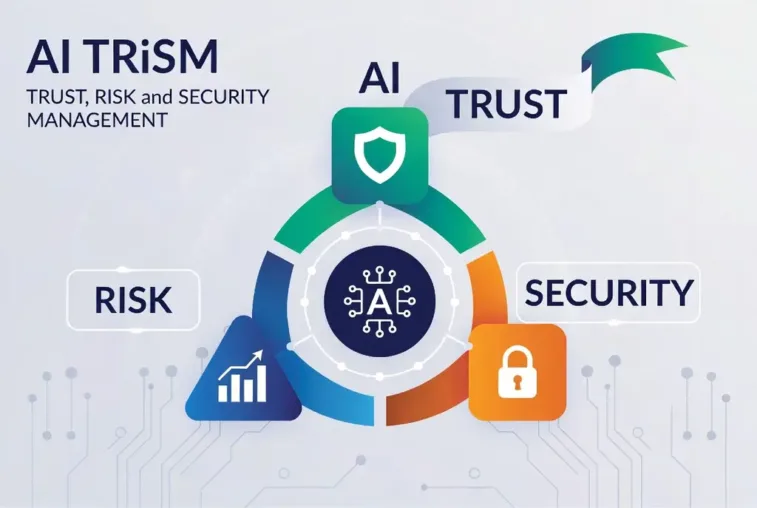
Explore AI TRiSM (Trust, Risk & Security Management) solutions for 2026. Boost compliance & mitigate AI risks. Learn more now!
2026 Complete Guide: AI TRiSM Trust Risk And Security Management
Here’s a practical, 2026-ready guide to AI trust, risk, and security management (AI TRiSM). I’ll cover concepts, leading frameworks (NIST, ISO/IEC 42001, EU AI Act, COBIT/DPO), and a step‑by‑step implementation plan.
High‑level takeaway (what “AI TRiSM” really means in 2026)
- AI TRiSM = AI Trust, Risk, and Security Management: a governance and control framework so you can:
- Use AI in a controlled, trustworthy way.
- Understand and manage its risks (security, privacy, compliance, ethics, performance).
- Show regulators, partners, and customers that your AI is safe and fair.
- Leading reference points in 2025–2026:
- NIST AI Risk Management Framework (AI RMF) – U.S. federal framework for identifying and managing AI risks across the lifecycle.nist+1
- ISO/IEC 42001 – new international standard for AI Management Systems, focused on governance, risk, and quality.hicomply+1
- Gartner’s AI TRiSM concept and related governance platforms; emphasizes governance, trustworthiness, fairness, reliability, and data protection.ibm+1
- EU AI Act – risk‑based regulation with specific obligations and documentation requirements for high‑risk AI systems.artificialintelligenceact+2
- COBIT/DPO for AI – widely used to integrate AI risk into IT governance and overall risk management.
Best practice in 2026: combine a risk framework (NIST or ISO 42001) with IT governance (COBIT/DPO) and, if in the EU, explicit EU AI Act compliance.
1. Core concepts: trust, risk, security, and “TRiSM”
These four pillars are the building blocks.
- AI Trust:
- Confidence that AI behaves as expected:
- Reliable outputs (stable, accurate enough for the use case).
- Transparent decisions (explainable, auditable).
- Ethical behavior (fair, non‑discriminatory).
- Built via: governance, testing, monitoring, and transparency.
- Gartner describes AI TRiSM explicitly as “ensuring AI model governance, trustworthiness, fairness, reliability, robustness, and data protection.”ibm
- Confidence that AI behaves as expected:
- AI Risk:
- Possible negative impacts from using AI:
- Strategic: wrong decisions, reputational damage, failed AI projects.
- Compliance: violating laws (GDPR, EU AI Act, sector rules).
- Security: data breaches, model poisoning, adversarial attacks.
- Ethics: bias, discrimination, lack of fairness.
- Modern frameworks (NIST AI RMF, ISO 42001, EU AI Act) all focus on risk identification, assessment, and treatment across the AI lifecycle.nist+2
- Possible negative impacts from using AI:
- AI Security:
- Protecting:
- Data (training data, prompts, outputs).
- Models (reverse‑engineering, theft, tampering).
- Infrastructure (APIs, deployment environments).
- Humans (prompt injection, leaked data via users).
- NIST’s AI RMF includes security‑focused functions such as threat modeling, attack resistance, and incident response specific to AI systems.nist
- Protecting:
- TRiSM:
- TRiSM is basically “Technology Risk Management” applied to AI.
- Classic standards like ISO 31000 and NIST 800‑37 already support technology risk; AI TRiSM extends those ideas to AI‑specific contexts (model risk, data risk, automation risk).
- ISO/IEC 42001 is sometimes described as an “AI Management System” standard—i.e., a TRiSM-style overlay for AI governance, risk, and quality.scrut
2. Leading frameworks you should know in 2026
You don’t have to use all of them, but you should choose one as your “anchor” and align the rest.
2.1 NIST AI Risk Management Framework (AI RMF)
- What it is:
- A voluntary framework from the U.S. National Institute of Standards and Technology (NIST) to manage risks to individuals, organizations, and society from AI.nist
- Very risk‑centric and practical; widely referenced in 2025–2026 guidance and by consultancies and tool vendors.ispartnersllc
- Key characteristics:
- Covers the full AI lifecycle:
- Design and development
- Deployment and operation
- Monitoring and maintenance
- Disposal
- Risk categories:
- Technical (e.g., model failure, drift)
- Statistical/nontechnical (e.g., mis‑aligned metrics, poor data quality)
- Security (e.g., adversarial attacks, data exfiltration)
- Governance, ethics, and human factors
- Strong on mapping risks to controls and documenting risk treatments.nist
- Covers the full AI lifecycle:
- When to choose NIST AI RMF:
- You operate mainly in the U.S. or want a neutral, detailed risk methodology.
- You already use NIST standards (e.g., NIST SP 800‑53 for security).
- You want something that can be plugged into existing risk/ governance processes.
2.2 ISO/IEC 42001 (AI Management System)
- What it is:
- An international standard from ISO/IEC for an AI Management System (AIMS). Focus is on governance, risk management, and quality of AI systems across the lifecycle.scrut
- Often seen as the TRiSM counterpart for AI: certifiable, structured, and audit‑friendly.hicomply
- Key characteristics:
- Defines requirements for:
- AI governance structures, roles, and responsibilities.
- Risk identification, assessment, and treatment across AI use.
- Lifecycle controls (from design to decommissioning).
- Quality and performance monitoring for AI systems.
- Strong emphasis on:
- Transparency and documentation.
- Continuous improvement of the AI management system.
- Can be certified by a third party; many organizations use certification to signal trust to customers and partners.hicomply
- Defines requirements for:
- When to choose ISO 42001:
- You operate internationally and want a recognized, certifiable standard.
- Customers or regulators explicitly mention ISO 42001.
- You want clear criteria for audits and third‑party assessments.
2.3 AI TRiSM (Gartner concept + governance platforms)
- What it is:
- AI TRiSM, as coined by Gartner, stands for Artificial Intelligence Trust, Risk and Security Management.ibm
- It’s more a conceptual approach and market category than a single standard:
- Emphasizes AI model governance and trustworthiness: reliability, robustness, safety, fairness, data protection.
- Many “AI governance platforms” (e.g., ModelOp, others) explicitly say they “operationalize AI TRiSM,” i.e., they provide tools to enforce AI TRiSM principles: inventories, approvals, monitoring, and risk validation.modelop
- Key practices:
- Central inventory of AI models, datasets, and use cases.
- Model and data lineage (where did the model/data come from?).
- Risk and compliance rules tied to AI models (e.g., “this model can’t be used for credit decisions without extra review”).
- Dashboards for risk, trust KPIs (model performance, drift alerts, incident tracking).modelop
- When to lean on AI TRiSM concepts:
- You want a governance‑first, business‑driven view of AI (not just security/IT).
- You buy or build an AI governance platform and want a mental model to align it with.
2.4 EU AI Act (risk‑based, regulation‑driven)
- What it is:
- The EU AI Act is a broad regulation for AI systems in the EU, with rules tiered by risk (unacceptable, high, limited, minimal risk).digital-strategy.ec.europa+1
- It explicitly covers:
- Safety, fundamental rights, and transparency.
- Data quality and governance.
- Human oversight.
- Technical documentation and conformity assessments.
- For “high‑risk” AI (e.g., critical infrastructure, employment), obligations include:
- Fundamental rights impact assessments.
- Data governance and high‑quality training data.
- Robust testing and evaluation.
- Certain forms of documentation and logging.
- Human oversight and training.
- Post‑deployment monitoring and incident reporting.artificialintelligenceact+1
- Overlap with AI TRiSM:
- Many “AI governance” and “risk management” practices you’d implement under NIST or ISO are exactly what the EU AI Act expects for high‑risk systems.
- Companies like Deloitte explicitly frame EU AI Act readiness as a risk management and documentation exercise.deloitte
- When to prioritize EU AI Act:
- You operate in or serve the EU.
- Your AI systems fall into high‑risk or limited‑risk categories (especially for sensitive sectors).
- You sell or provide AI systems as products into the EU market.
2.5 COBIT and DPO for AI (IT governance + risk)
- What they are:
- COBIT: a leading IT governance and management framework used to align IT with business goals, manage risk, and improve performance.metricstream
- DPO (Data Processing Officer) frameworks: focused on data protection and privacy risk (e.g., extensions of COBIT for GDPR/privacy).
- ISACA and others have written practical guides for using COBIT specifically for AI governance, treating AI as another critical IT layer to govern.isaca
- How they fit with AI TRiSM:
- COBIT gives you:
- Governance structure (policies, processes, organizational roles).
- Risk management practices (identification, control design, monitoring).
- AI‑specific guidance recommends:
- Treat AI as a strategic asset.
- Include AI risk in enterprise risk register.
- Map AI controls to COBIT domains and processes.isaca
- DPO/privacy frameworks add:
- Strong protection for personal data.
- Alignment with GDPR/other privacy laws.
- Data protection by design and by default for AI systems.
- COBIT gives you:
- When to choose COBIT/DPO:
- You already use COBIT for IT or audit.
- You need to harmonize AI risk with existing IT risk and reporting.
- You must show strong data protection and privacy governance (especially under GDPR or EU AI Act).
3. Comparative snapshot of main frameworks
Think about which combo fits your context:
- NIST AI RMF:
- Best for: detailed risk identification and treatment; strong on technical/security aspects.
- Origin: U.S. government; voluntary but widely adopted.
- Certification: No formal NIST certification, but many vendors claim “NIST‑aligned.”nist+1
- ISO/IEC 42001:
- Best for: an auditable, international, management system standard for AI.
- Origin: ISO/IEC; international, certifiable.
- Certification: Yes, via accredited certification bodies.hicomply+1
- AI TRiSM concept / governance platforms:
- Best for: cross‑functional governance (trust + risk + security) and operationalizing model governance.
- Origin: Gartner and various vendors; not a standard, but a market approach.ibm+1
- EU AI Act:
- Best for: legal compliance and market access in the EU; risk‑tiered obligations for AI systems.
- Origin: EU regulation; mandatory for in‑scope systems.
- Certification: Conformity assessments, some codes of practice, but not “ISO‑style” certification.artificialintelligenceact+1
- COBIT/DPO:
- Best for: integrating AI into existing IT governance, risk, and privacy processes.
- Origin: ISACA, DPO frameworks; widely used in audit and compliance.
- Certification: No “COBIT certificate,” but many firms implement COBIT‑based controls that can be audited.isaca+1
Practically, many large organizations in 2026 run:
- NIST AI RMF or ISO 42001 as their risk/base,
- EU AI Act controls where mandatory,
- COBIT/DPO as the governance backbone,
- An AI governance platform to operationalize AI TRiSM day‑to‑day.modelop+1
4. A practical AI TRiSM implementation roadmap (2026‑style)
Here’s a realistic, step‑by‑step plan you can follow.
Step 1 – Set the context: strategy and risk appetite
- Define why you’re using AI and what “trustworthy AI” means for your organization:
- Business goals: efficiency, new products, personalization, fraud detection, etc.
- Risk appetite:
- Are you OK with “black‑box” models in some areas, or do you require explainability everywhere?
- How much bias risk is acceptable before mitigation (none vs. minimal vs. managed)?
- Obtain executive sponsorship:
- AI TRiSM affects everyone (IT, legal, HR, risk, compliance).
- You need leadership to define and sign off on your AI risk appetite and principles.
Step 2 – Discover your AI landscape
You can’t manage what you don’t see.
- Build an AI inventory:
- List all AI use cases:
- Internal tools (co‑pilot coding, email drafting, knowledge assistants).
- Customer‑facing (chatbots, recommendation engines, dynamic pricing).
- Embedded models in products (classifiers, generators, decision engines).
- For each item, capture:
- Purpose, owner, data used, third‑party providers.
- Deployment environment (cloud/on‑prem, SaaS).
- Users and exposure (internal only vs. external customers).
- List all AI use cases:
- Classify by risk and regulatory scope:
- Use NIST’s risk categories and/or EU risk categories to tag each use case:
- High‑risk vs. limited‑risk vs. minimal (EU AI Act).digital-strategy.ec.europa+1
- Safety‑critical vs. non‑critical.
- Whether personal data is heavily involved.
- Use NIST’s risk categories and/or EU risk categories to tag each use case:
Step 3 – Choose and adapt your primary framework(s)
- Choose your “anchor” framework:
- In the U.S. or global, but EU exposure:
- Use NIST AI RMF as your core risk methodology.
- Map EU AI Act requirements onto that (e.g., treat EU “high‑risk” rules as mandatory controls).
- Operating mainly in Europe or seeking certification:
- Use ISO/IEC 42001 as your AI management system, and interpret EU AI Act obligations through that lens.
- In the U.S. or global, but EU exposure:
- Integrate with IT governance:
- Embed AI in COBIT:
- Define AI‑specific control objectives and processes inside existing COBIT domains.isaca
- Extend DPO/privacy processes to cover AI data processing.
- Embed AI in COBIT:
- Use an AI governance platform if:
- You have many models and vendors.
- You need ongoing monitoring, approvals, and lineage beyond spreadsheets.
- Make sure the platform can be mapped to your chosen framework (NIST/ISO/COBIT).modelop
Step 4 – Design your AI TRiSM controls (map risks → controls)
Using your chosen framework, work through each AI use case and design controls.
- Risk identification:
- Start with framework categories:
- Security: data breaches, prompt injection, model theft, infrastructure attacks.nist
- Privacy: unlawful processing, lack of consent, insufficient anonymization.
- Performance/model: drift, poor accuracy, lack of robustness.
- Fairness/ethics: bias against protected groups, opaque decisions.
- Compliance: conflict with GDPR, EU AI Act, sectoral rules.
- Start with framework categories:
- Control mapping:
- For each risk, assign people, process, and technology controls:
- People: training, approvals, separation of duties.
- Process: model documentation, change management, incident response.
- Technology: encryption, access controls, logging, MLOps monitoring.
- For each risk, assign people, process, and technology controls:
- Treat it like any other risk framework:
- Risk ID → assessment → control design → implementation → monitoring.
Step 5 – Build security around the AI lifecycle
Security and trust go hand‑in‑hand; AI adds a few twists.
- Data security:
- Classify training data and prompts per sensitivity (personal, health, financial, confidential).
- Apply strong controls to high‑sensitivity data:
- Encryption in transit and at rest.
- Strict access control and logging.
- Data minimization: use only what you really need.
- Model security:
- Protect models from:
- Theft: model artifact files, weight repositories.
- Tampering: unauthorized model changes.
- Reverse‑engineering: especially for proprietary or high‑value models.
- Techniques:
- Model and artifact signing (hashing, integrity checks).
- Strict access in model registries and MLOps pipelines.
- Rate limiting and abuse detection for AI APIs.
- Protect models from:
- Usage security:
- Prevent prompt injection and jailbreaking:
- Validate and sanitize user inputs.
- Use guardrails and policy‑as‑code layers around models.
- Monitor for abusive usage:
- Anomalous usage patterns (excessive queries, probing).
- Automated detection of policy violations (hate, harassment, illegal content).
- Prevent prompt injection and jailbreaking:
NIST AI RMF and many ISO 42001 implementations explicitly include these AI‑specific security considerations in their risk categories and control catalogs.nist+1
Step 6 – Implement model and data governance (trust from the inside)
Trust isn’t just about security; it’s also about how the model is built and behaved.
- Data governance:
- Catalog datasets:
- Sources, provenance, purpose, consent status.
- Data quality rules:
- Representativeness, completeness, bias checks.
- Retention and deletion:
- How long you keep different types of data.
- Processes to honor deletion/withdrawal of consent.
- Catalog datasets:
- Model governance:
- Model cards:
- Short description of what each model does, its limitations, and approved uses.
- Lineage:
- Which version, trained on which data, by whom, approved when.
- Approval process:
- Who can approve a model for production?
- What testing and documentation is required?
- Model cards:
- Transparency and explainability:
- Provide:
- Model cards and documentation to users/oversight bodies (especially under EU AI Act).artificialintelligenceact+1
- Explanation interfaces or summary for automated decisions.
- Provide:
Step 7 – Monitoring, metrics, and incident response
To make AI TRiSM work continuously, you need ongoing visibility.
- KPIs and metrics:
- Trust and risk indicators:
- Model performance: accuracy, precision, recall, F1, etc.
- Fairness metrics: disparate impact, false positive/negative rates across groups.
- Security incidents: number of AI‑related breaches or attempts.
- Compliance gaps: failed audits or checks against ISO 42001/EU AI Act.
- Trust and risk indicators:
- Dashboards and reporting:
- Aggregate metrics at:
- Enterprise level (for board/risk committee).
- System level (for model owners and AI product teams).
- Aggregate metrics at:
- Incident response:
- Define:
- What counts as an “AI incident” (e.g., discriminatory outcome, model leak, data breach using AI).
- Roles and playbooks: security, legal, PR, communications.
- Integration with existing incident management processes (NIST CSF, ISO 27001, etc.).
- Define:
Step 8 – Independent assurance and certification
- Third‑party audits:
- For ISO 42001:
- Engage an accredited certification body to audit your AI Management System.
- Use audits both for marketing (“we’re ISO 42001 certified”) and for internal improvement.hicomply+1
- For EU AI Act:
- Prepare required technical documentation:
- Risk and fundamental rights impact assessments.
- Data governance statements.
- Quality and testing results.
- Post‑monitoring plans.edps.europa+1
- Be prepared for conformity assessments by notified bodies or future EU oversight.
- Prepare required technical documentation:
- For ISO 42001:
- Internal audit:
- Extend your existing IT/internal audit scope to include AI TRiSM controls.
- Use COBIT‑style control self‑assessments to ensure AI controls are operating effectively.metricstream
5. Organizational roles and culture
AI TRiSM will fail without clear ownership and culture.
- Key roles:
- Executive sponsor: accountable for AI trust and risk at the top.
- AI governance council or committee:
- Cross‑functional (IT, legal, compliance, risk, business, HR).
- Prioritizes use cases and resolves conflicts.
- AI risk owners:
- Accountable for risk assessments and treatments in specific AI systems.
- Data protection / privacy office (DPO):
- Ensures AI use aligns with privacy law.
- Security / MLOps:
- Implements technical controls around models and infrastructure.
- Culture and training:
- Regular training for:
- Developers (secure coding, adversarial AI awareness, data protection).
- Business users (prompting risks, data hygiene, approved tools only).
- Management (understanding their AI risk responsibilities).
- Encourage a “speak up” culture:
- Reward reporting of issues, early detection of failures, and good AI hygiene.
- Regular training for:
6. Tooling and automation in 2026
You won’t run AI TRiSM manually at scale.
- AI governance platforms:
- Tools that operationalize AI TRiSM by providing:
- AI inventories and catalogs.
- Model and data lineage.
- Policy checks at use time (e.g., “this model can’t be used for credit in EU without additional human review”).
- Monitoring dashboards for model drift, fairness, and compliance.modelop
- Many of these explicitly say they “support AI TRiSM,” COBIT, and NIST/ISO frameworks.modelop+1
- Tools that operationalize AI TRiSM by providing:
- Security tooling:
- MLOps platforms:
- Track model versions, data lineage, and deployment pipelines.
- Integrate with vulnerability scanning and secret management.
- AI‑specific security:
- Tools to detect prompt injection and jailbreaks.
- Rate limiting and anomaly detection on AI APIs.
- Data security:
- CASB/DLP tools tailored to training data and prompts.
- Encryption and key management for model storage.
- MLOps platforms:
- GRC (Governance, Risk, Compliance) tools:
- Extend your existing GRC to cover AI:
- AI risk register and libraries.
- Links from AI systems to regulatory obligations (EU AI Act, sectoral rules).
- Control testing and evidence collection for audits.
- Extend your existing GRC to cover AI:
7. Example: minimal AI TRiSM control set (for a single AI system)
For a typical internal AI use case (e.g., a support co‑pilot), your controls could look like:
- Governance:
- Model card approved by Legal/Risk and documented.
- Allowed use cases clearly defined and communicated.
- Risk:
- Annual risk assessment using NIST AI RMF categories.
- Risys logged in corporate risk system.
- Security:
- Only pre‑approved models and connectors used.
- Access control and MFA for model repo and deployment environments.
- Prompt logging and anomaly detection on usage.
- Privacy:
- No personal customer data sent to external models without legal review.
- Data retention policy respected; prompts and outputs not stored longer than necessary.
- Quality and fairness:
- Quarterly performance and bias testing.
- Incident process for if bias is detected.
- Monitoring:
- Dashboard of model performance, drift, and usage.
- Monthly AI TRiSM report to governance committee.
You’d then map these controls into your chosen framework (e.g., NIST AI RMF categories and/or ISO 42001 clauses) and keep evidence for audits.
8. Common pitfalls and how to avoid them
- Treating AI TRiSM as “just an IT security project”:
- AI brings strategic, ethical, and compliance risk, not just malware.
- Involve legal, HR, risk, and business leaders from day one.ibm
- Over‑focusing on one framework and ignoring regulation:
- ISO 42001 or NIST alone won’t save you if you ignore EU AI Act or other local laws.
- Map your compliance obligations into your framework; don’t treat them as separate.deloitte
- Starting too big:
- Pick 1–2 critical AI systems as pilots.
- Design and refine your AI TRiSM processes there before scaling.
- No visibility into shadow AI:
- Monitor and approve AI tools, not just sanctioned ones.
- Shadow AI bypasses your TRiSM controls and is a major source of real-world incidents.splunk
- Poor documentation:
- Regulators and auditors increasingly expect detailed AI technical documentation (per EU AI Act Article 11).artificialintelligenceact
- Maintain records of:
- Data sources and preprocessing.
- Model testing and validation results.
- Risk assessments and mitigation decisions.
9. Quick tailoring by organization type
- Enterprise with global operations and EU exposure:
- Anchor: ISO/IEC 42001 + EU AI Act conformity.
- Use NIST AI RMF as underlying risk methodology.
- Overlay COBIT/DPO for IT governance and privacy.
- AI governance platform for scale and monitoring.
- SME with limited AI use:
- Start with NIST AI RMF (or a simplified version) for risk identification.
- Integrate AI risk into existing risk register.
- Focus on:
- Buying from reputable AI vendors.
- Basic data security and privacy.
- Simple documentation and approvals.
- Public sector / highly regulated:
- Likely mandatory adherence to specific AI guidelines (e.g., EU AI Act for public sector use).
- Emphasize:
- Fundamental rights impact assessments.
- Human oversight and transparency.
- Strong security and data protection.
- AI product vendors / SaaS providers:
- Your own AI TRiSM becomes part of your product story:
- Show how your development lifecycle aligns with NIST/ISO.
- Provide model cards, transparency, and logging.
- Offer EU AI Act‑compliant options where relevant.
- Your own AI TRiSM becomes part of your product story:
10. Short checklist: “Are we doing AI TRiSM right in 2026?”
- Strategy and governance:
- We have a documented AI strategy and risk appetite.
- Roles (executive sponsor, AI risk owners, DPO, security) are assigned.
- Framework:
- We’ve chosen an anchor framework (NIST AI RMF or ISO/IEC 42001).
- EU AI Act and other legal obligations are mapped into it.
- Inventory and risk:
- We maintain an inventory of AI use cases and models.
- Risk assessments are performed using framework categories.
- Controls and security:
- Key controls are documented for each AI system (security, privacy, quality, fairness).
- MLOps and security tools cover model deployment and usage.
- Monitoring and improvement:
- We track AI‑specific KPIs (performance, drift, fairness, incidents).
- There is a process to review and improve controls regularly.
- Assurance:
- Internal or external audits cover AI TRiSM.
- We can explain to a regulator or customer how our AI is trustworthy and under control.
If you tell me a bit about your context (country/region, sector, how mature your AI use is today, and whether you already use COBIT/NIST/ISO), I can turn this into a very concrete, tailored AI TRiSM program with phases, priorities, and sample controls.