
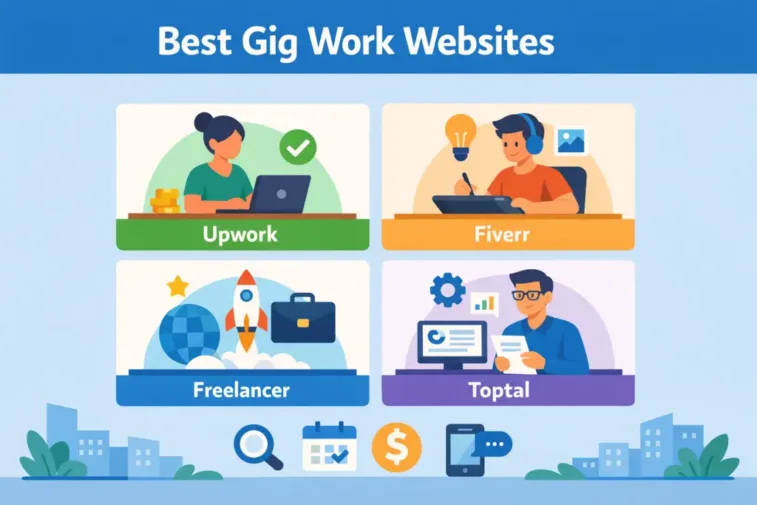
Discover the best gig work websites in 2026. Top-rated Gig platform for freelancers & side hustles—maximize earnings with the #1 gig economy jobs.
Gig platform: 2026 Complete Guide
Main takeaway:
A gig platform in 2026 is a digital marketplace that matches independent workers with on-demand tasks or services—ride-hailing, delivery, freelance work, home services, and more. Success comes from balancing great user/worker experience, smart pricing and unit economics, strong trust and safety, and increasingly strict regulations (especially in the EU).
The market is large and growing fast—platform-based labor generated about $556.7B in 2024 and is projected to grow at ~16% CAGR, while the wider “gig economy tech platforms” market is forecast to rise from $485B in 2025 to ~$1.39T by 2035 (11.1% CAGR).
Gig platform: Below is a comprehensive, 2026-ready guide covering business models, operations, payments, regulation, and tech.
High-level lifecycle of a gig platform
Here’s what happens end-to-end on a typical gig platform:
- Customer places request
- Platform matches worker
- Worker performs service
- Platform confirms completion
- Customer pays
- Platform deducts fees and taxes
- Worker receives net payout
- Rating and review
- Trust score updates for worker and customer
Gig platform: Keep this flow in mind as we dive into each part.
1. What is a gig platform in 2026?
- Definition:
- A digital platform that:
- Organizes work performed by individuals in return for payment
- Uses a website or app as the primary interface
- Relies heavily on automated systems for matching, monitoring, and decision-making.
- A digital platform that:
- Common examples:
- Location-based: Uber, Bolt, Grab, DiDi, DoorDash, Deliveroo, Glovo, TaskRabbit.
- Online services: Fiverr, Upwork, Freelancer.com, Toptal.
- Asset-sharing: Airbnb (more “platform work” for hosts than classic gig, but same dynamics).
- Workers:
- Typically classified as independent contractors (though this is under intense regulatory scrutiny in many regions).
- Value proposition:
- For customers: instant access to services, transparent pricing, ratings/reviews.
- For workers: flexibility, quick earnings, low barrier to entry.
- For you (the platform): a scalable business with light fixed assets (you don’t employ the workforce directly in most models).
Gig Economy;
2. Market size and outlook (2025–2035)
- Platform-based labor:
- Generated an estimated $556.7B in 2024, with projected CAGR around 16.18% from 2025 onward.
- Gig economy tech platforms market:
- Valued at about $485B in 2025, projected to reach $1.39T by 2035 (11.1% CAGR).
- Expected to nearly triple (2.9x) over the decade, driven by demand for flexible work and on-demand services, plus continued investment in mobile and worker-engagement tech.
- Leading regions:
- North America, Europe, and Asia-Pacific are key growth regions.
- Leading players:
- Uber, Lyft, DoorDash, Airbnb, TaskRabbit, Fiverr, Upwork, Freelancer.com, Grab, DiDi Chuxing, among others.
Implication: The market isn’t a fad—it’s structural and still growing, but competition is intense and regulatory pressure is rising.
3. Core business models for gig platforms
Most successful gig platforms fall into a few well-defined models.
A) Transaction commission (marketplace) model
- How it works:
- Customer pays the platform via the app.
- Platform keeps a commission (e.g., 10–30%) and passes the rest to the worker.
- Used by:
- Ride-hailing (Uber, Grab, Bolt)
- Delivery (DoorDash, Wolt, Glovo)
- Services marketplaces (TaskRabbit, Fiverr, Upwork).
- Pros:
- Simple and transparent to customers.
- Scales with transaction volume.
- Cons:
- Need enough volume to cover fixed costs.
- Sensitive to worker and customer price sensitivity.
B) Lead-fee / membership model
- How it works:
- Workers pay a fee per lead or a monthly subscription to access jobs or appear in search results.
- Used by:
- Some home-services marketplaces (Thumbtack, TaskRabbit variants), B2B professional services platforms.
- Pros:
- More predictable revenue from workers.
- Can align platform incentives with worker success.
- Cons:
- Can reduce job accessibility for workers who can’t afford fees.
- Risk of “pay-to-play” perception if not managed well.
C) Subscription / SaaS model (for worker tools)
- How it works:
- Platform offers free basic matching, but sells tools to workers (scheduling, analytics, promoted placement, financing).
- Used by:
- Freelance platforms (Upwork, Fiverr with “Plus”/promotions), some management tools for couriers/drivers.
- Pros:
- Diversifies revenue; can increase worker LTV.
- Cons:
- Requires a large worker base to monetize.
- Must keep add-ons truly valuable to avoid churn.
D) Hybrid “managed service” model
- How it works:
- Platform employs or directly manages workers in some markets (or for certain services), while using pure contractors elsewhere.
- Used by:
- Some on-demand home services and specialized care platforms, where quality and compliance risks are high.
- Pros:
- Stronger control over quality and compliance.
- Cons:
- Higher operational complexity, costs, and regulatory burden.
Gig platform: Most modern platforms blend multiple revenue streams: commissions plus SaaS, plus lead fees or promoted listings for workers.
4. How gig platforms make money (revenue mechanics)
Typical revenue streams:
- Commissions:
- Take a percentage of each transaction (e.g., 20–30% of fare, 10–25% of service fee).
- Service fees:
- Add a booking, service, or “platform fee” on top of the worker’s price.
- Subscriptions:
- Charge workers or businesses a monthly fee for premium placement, analytics, or tools.
- Advertising:
- Charge for “boosted” visibility in search, featured placements, or co-marketing campaigns.
- Financial services:
- Earn from instant payouts, earned-wage access, cash advances, or integrated cards.
- Bundles:
- Offer “Pro” or “Business” plans to power users (e.g., high-volume restaurants, professional freelancers).
Gig platform: From a Shipturtle analysis of service marketplaces, common monetization patterns are commission, subscription, and add-ons—mirroring what works across gig platforms overall.
5. Key building blocks of a gig platform
Think of a gig platform as a stack of capabilities:
A) Customer and worker apps
- Customer app:
- Request service, track provider, communicate, pay, rate.
- Worker app:
- Accept/reject jobs, navigate, chat, track earnings, manage availability.
- Cross-device:
- Optimized for mobile-first usage in most categories.
B) Matching and dispatch engine
- Core logic:
- Matches supply (workers) to demand (customers) based on:
- Location, time, skill/rating, price, platform goals.
- Matches supply (workers) to demand (customers) based on:
- Techniques:
- Simple heuristics → rule-based matching → ML-based prediction for ETA, acceptance probability, and quality.
C) Pricing and dynamic pricing
- Fixed pricing:
- Common for flat-fee services (e.g., “assembly for $50”).
- Dynamic pricing:
- Surge/multiplier during high-demand periods (ride-hailing, delivery).
- Algorithmic quote based on time/distance/complexity for home services.
D) Trust, safety, and quality system
- Identity and onboarding:
- KYC, ID verification, background checks where legally required.
- Ratings & reviews:
- Two-way feedback loop (worker and customer).
- Insurance:
- Liability, injury, or property damage insurance for certain verticals.
- Content moderation:
- Review messages, photos, and listings for prohibited items or behavior.
E) Payments and payouts
- Customer payments:
- In-app payments via cards, wallets, and local methods (Pix, UPI, iDEAL, etc.).
- Worker payouts:
- Standard bank transfers (slower, cheaper) and real-time/instant payouts (RTP, FedNow, SEPA Instant, UPI, etc.).
- Instant payouts are increasingly expected by gig workers; 90% of individuals say they’d prefer to receive disbursements instantly if given a choice, and satisfaction is significantly higher with instant payments.
F) Algorithmic management (ops and performance)
- Automated systems:
- Real-time monitoring and evaluation of work performance (e.g., location tracking, speed, cancellations, acceptance rates).
- Impactful decisions:
- Task allocation, pay per task, account deactivation, and access to work can be driven by automated decision-making systems.
G) Data, analytics, and experimentation
- Data:
- Demand patterns, supply capacity, churn, LTV, marketplace balance.
- Experimentation:
- A/B testing pricing, bonuses, UI changes, and matching algorithms.
6. Operations and supply management
A) Supply acquisition and activation
- Channels:
- Performance marketing, referrals, bonus campaigns, partnerships.
- Onboarding:
- Simple sign-up, document upload, verification, and first “job” guidance to activate workers quickly.
B) Incentive design
- Earnings certainty:
- Clear per-task or per-hour pay and transparent incentives.
- Bonuses:
- Surge bonuses, completion streaks, hourly guarantees during peak times.
- Gamification:
- Levels, badges, leaderboards to encourage desired behaviors.
C) Retention and lifecycle management
- Segmentation:
- Casual vs. full-time workers; high performers vs. at-risk churn.
- Interventions:
- Targeted bonuses, personalized messaging, re-engagement campaigns.
D) Marketplace health (supply–demand balance)
- Metrics:
- Wait time for customers, acceptance rate, cancellation rate, utilization rate.
- Actions:
- Adjust pricing, incentize supply in specific areas/times, and invest in marketing where supply is thin.
7. Payments and instant payouts (2026 view)
A) Why instant payouts matter
- Worker expectations:
- Gig workers often rely on same-day or instant pay to manage cash flow; platforms that pay faster can attract and retain better workers.
- Competition:
- As instant payments become standard in many markets, not offering them can be a competitive disadvantage.
B) Instant payment rails to leverage
- US:
- RTP (The Clearing House) and FedNow (Federal Reserve) enable 24/7/365 real-time payments in seconds, and most US banks now support both rails.
- Europe:
- SEPA Instant Credit Transfer: funds available within 10 seconds, 24/7/365.
- Other markets:
- UPI (India), PIX (Brazil), FPS (UK), NPP (Australia), etc., provide fast or instant rails.
C) Implementation patterns
- Use a payout provider or gateway that:
- Exposes instant payouts via cards (debit networks) and/or bank rails (RTP, FedNow, SEPA Instant, UPI).
- Handles KYC, compliance, and webhooks.
- Design your payout policy:
- Standard vs. instant payout speeds, fees, and minimum amounts.
- Per-worker limits based on risk and tenure.
8. Regulation and worker classification (critical in 2026)
Regulation is one of the biggest shifts affecting gig platforms right now.
A) European Union – Platform Work Directive
- Timeline:
- EU adopted the Platform Work Directive to improve working conditions and data protection in platform work.
- Member States must transpose it into national law by 2 December 2026.
- Key concepts:
- “Digital labour platform”: a service that organizes work via an app/website, using automated monitoring or decision-making, and pays individuals for that work.
- “Platform work”: work organised through such a platform in the EU.
- Rebuttable presumption of employment:
- If indicators of direction and control are present (e.g., remuneration rules, conduct/appearance rules, supervision by electronic means, limited choice of hours, restricted ability to work for others), there is a presumption of an employment relationship.
- The burden is on the platform to prove the worker is genuinely independent.
- Algorithmic management and data rules:
- Strong limits on automated monitoring and decision-making systems that significantly affect working conditions.
- Prohibited automated processing of sensitive data (emotional state, private communications, biometric data for ID, data predicting union activity, etc.).
- Data Protection Impact Assessments (DPIAs) are required before deploying high-risk automated systems, with worker consultation.
- Transparency:
- Platforms must inform workers and authorities about the use of automated systems: what data is monitored, how decisions are made, and how they affect working conditions.
What this means for your gig platform in the EU:
- You must audit your control criteria, algorithms, and data practices now.
- Consider whether some worker segments should be reclassified as employees (with all that implies).
- Build processes for transparency, human oversight of algorithms, and DPIAs.
B) US, UK, and other regions
- US:
- Worker classification (employee vs. independent contractor) is determined by federal/state law and tests (e.g., ABC test in California, economic realities tests elsewhere).
- Ongoing legal challenges and regulatory proposals at federal/state level continue to scrutinize classification.
- UK:
- Recent cases and policy developments have increased scrutiny of employment status in the gig economy; expect further evolution post-2026.
- Global trend:
- Regulators worldwide are focused on:
- Correct classification,
- Minimum earnings and benefits,
- Transparency in algorithmic management,
- Data protection.
- Regulators worldwide are focused on:
Practical tip:
- Treat worker classification and algorithmic transparency as core design issues, not afterthoughts.
- Maintain flexible operating models so you can adapt as local rules evolve.
9. Technology stack and architecture (2026)
Modern gig platform typically include:
A) Mobile/web front-end
- Customer and worker apps built as:
- Native mobile apps (iOS/Android) for performance and UX.
- Web apps (often PWA) for broader reach and easier updates.
B) Backend services
- Core APIs:
- Matching, pricing, payments, user management, notifications.
- Event-driven architecture:
- Use message queues and events (e.g., job created, accepted, completed, cancelled) to decouple services and scale.
C) Data and ML infrastructure
- Data stores:
- Relational databases for transactions, user profiles.
- NoSQL or event stores for activity logs and telemetry.
- ML models:
- ETA prediction, dynamic pricing, fraud detection, recommendation, churn prediction.
D) Integrations
- Payments and payouts:
- Payment gateways, instant payout providers, card issuers, and local payment methods.
- Mapping and location:
- Google Maps, Mapbox, etc.
- Communication:
- SMS, push notifications, email providers.
- Compliance:
- KYC/identity verification, background checks, AML screening.
E) Marketplace builders vs. custom
- Marketplace builders (e.g., Shipturtle, no-code tools) can help launch quickly, but may limit deep customization and multi-region complexity.
- Custom engineering:
- Provides full control but requires larger upfront investment and ongoing maintenance.
10. Unit economics and how to think about profitability
Key metrics to understand whether your gig platform can be healthy:
- Contribution per transaction (rough formula):
- Revenue from customer (fare/fee) minus:
- Payment processing fees
- Worker payout (net of any withholding)
- Direct variable costs (insurance per trip, bonuses, incentives)
- Revenue from customer (fare/fee) minus:
- Gross margin:
- Aggregate contribution margin across transactions.
- CAC vs. LTV:
- Customer acquisition cost vs. lifetime value (on both customer and worker side).
- Marketplace balance:
- Ensure you’re not over-supplying or over-demanding in a way that destroys economics (e.g., overspending on bonuses when demand is weak).
Common pitfalls:
- Underpricing services relative to true cost (including insurance, support, incentives).
- Overpaying for acquisition without measuring retention.
- Ignoring the cost of instant payouts and premium support.
11. Trust, safety, and brand
Trust is a moat for gig platform. Core components:
- Identity and verification:
- ID verification, phone/email verification, document scanning.
- Screening:
- Background checks (criminal, driving, etc.) where relevant.
- Reviews and reputation:
- Two-way rating system, detailed feedback, and mechanisms to detect gaming.
- Safety features:
- In-app emergency buttons, ride tracking, SOS features, photo evidence of delivery.
- Content policies and moderation:
- Clear acceptable-use policies; proactive moderation of listings and messages.
- Insurance:
- Commercial liability, auto, workers’ comp, or statutory coverage as required locally.
12. A step-by-step roadmap to launch a gig platform in 2026
Phase 1 – Strategy and design (0–3 months)
- Choose your vertical and geography.
- Decide your business model:
- Commission-only vs. hybrid with subscriptions/fees.
- Design the user journey for customers and workers.
- Map regulatory requirements:
- Worker classification, licensing (e.g., transport, food), data protection, local labor rules.
Phase 2 – MVP build (3–9 months)
- Build:
- Customer and worker apps (start with one platform each if necessary).
- Core backend: matching, payments, basic ratings.
- Integrate:
- Payments gateway and at least one payout option.
- Maps (if location-based), notifications, analytics.
- Launch:
- In a single city or region to keep operations manageable.
Phase 3 – Scale and optimize (9–24 months)
- Expand:
- To more cities/regions, following demand density.
- Enhance:
- Algorithmic pricing and matching.
- Worker tiering and incentives.
- Instant payouts where worker expectations and economics justify it.
- Strengthen:
- Trust & safety (insurance, verification, moderation).
- Local compliance teams and processes.
Phase 4 – Maturity and ecosystem (24+ months)
- Diversify revenue:
- Subscriptions, financial products, B2B services.
- Deepen tech:
- More advanced ML for predictions, automation, and personalization.
- Engage with regulators:
- Participate in consultations; adapt models as new laws (like the EU Platform Work Directive) are implemented.
13. Key trends shaping gig platform in 2026
- Regulatory tightening and worker protections:
- EU Platform Work Directive adoption by December 2026; increasing focus on employment status and algorithmic transparency.
- AI and algorithmic management:
- More sophisticated matching, pricing, and fraud detection—but also more scrutiny and requirements for human oversight and DPIAs in some jurisdictions.
- Instant payments and financial services:
- Real-time rails (FedNow, RTP, SEPA Instant, UPI, PIX) and instant payouts becoming table stakes for worker satisfaction and retention.
- Niche and verticalized platforms:
- Growth of specialized gig platforms in healthcare, home services, B2B, and professional services, not just ride-hailing and generic freelancing.
- Hybrid work and “gig + traditional” blends:
- Platforms increasingly integrating with traditional employment, offering workers options like benefits or portable benefits programs.
14. Checklist: Is your gig platform built for 2026?
Use this as a quick diagnostic:
- Strategy:
- Clear vertical and geography.
- Defined unit economics and a path to positive contribution margin.
- Regulatory:
- Worker classification analysis documented for key markets.
- Plan in place for EU Platform Work Directive compliance (if operating in the EU).
- Product:
- Solid matching and pricing algorithms.
- Easy onboarding for workers and customers.
- Ratings, reviews, and trust features live and actively used.
- Operations:
- Supply acquisition and retention strategy.
- Incentive programs aligned with desired behaviors.
- Payments:
- Multiple payment methods for customers.
- At least one instant or same-day payout option for workers in key markets.
- Technology:
- Scalable backend and event-driven architecture.
- Basic analytics and experimentation framework.
- Trust:
- Identity verification and screening.
- Safety tools and insurance where needed.
- Content moderation and incident response processes.
If you share:
- The vertical you’re targeting (ride-hailing, delivery, freelance, home services, B2B, etc.),
- Your primary geography/region,
- Whether you’re starting from zero or optimizing an existing platform,
Gig platform: I can turn this into a tailored playbook: prioritized feature roadmap, regulatory risk map, and a phased launch plan specific to your gig platform.