
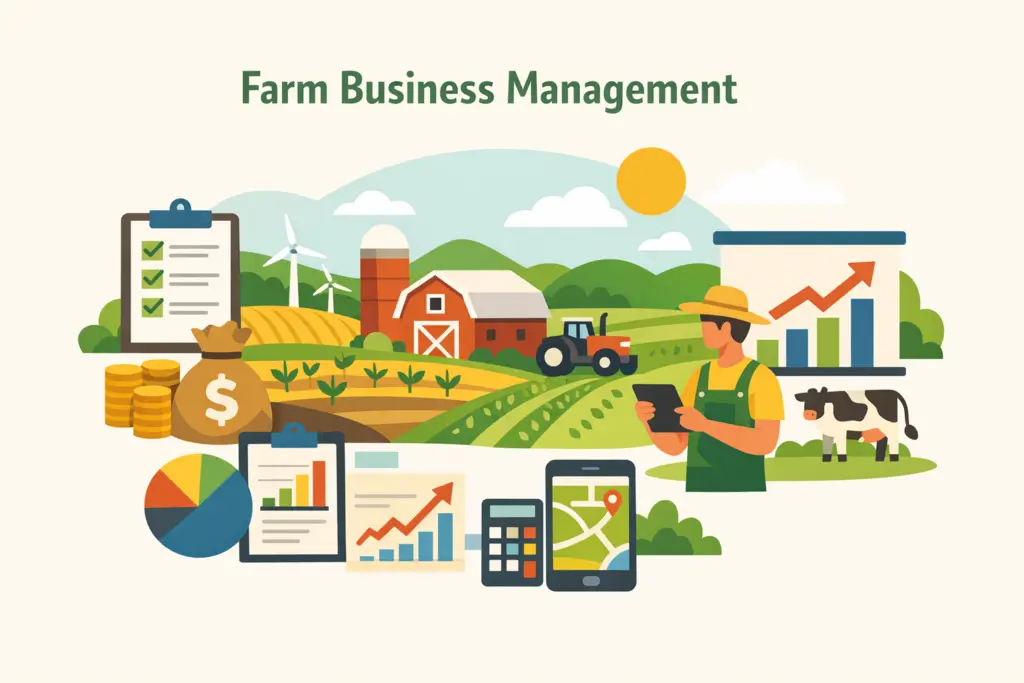
Boost best farm business management, profits & streamline operations. Get your free, personalized plan today. Unlock your farm’s full potential, Start for free.
2026 Complete Guide: Best Farm Business Management
Maximize best farm business management potential with proven business management strategies. Boost profits, streamline operations, and grow sustainably. Start optimizing today!
Main takeaway (short version):
- The “best” farm business management in 2026 means:
- A clear business plan and goals,
- Strong financial management and benchmarking,
- Structured risk management (production, market, financial, legal, HR),
- Smart use of digital tools and data,
- Efficient operations and sustainable practices,
- A marketing and sales strategy that matches your enterprises,
- Ongoing learning and adjusting.
Additional knowledge from Video;
Best Farm Business Management; Below is a structured framework you can adapt to your farm.
1. Strategy and business planning
1.1 Start with your vision and goals
- Define why you’re in farming:
- Lifestyle, family legacy, profit, community, environmental stewardship, or a mix.
- Set 3–5 year goals:
- Financial (e.g., target net profit, debt-to-asset ratio),
- Operational (e.g., yield, quality, efficiency),
- Personal (e.g., work hours, quality of life).
- Involve family and key partners so everyone is aligned.
1.2 Write a simple, practical business plan
A good business plan doesn’t need to be long; it should be a living document you actually use. Key elements (adapted from SARE’s farm business planning basics and USDA Farmers.gov guidance) include:
- Executive summary:
- What your farm does, where it is, and main goals.
- Description of the operation:
- Enterprises (crops, livestock, value-added, agritourism),
- Scale, location, resources (land, water, labor).
- Marketing plan:
- Who you sell to, how, and why they buy.
- Operational plan:
- Production practices, infrastructure, equipment, labor, key workflows.
- Management and organization:
- Who does what, roles, decision-making.
- Financial plan:
- Balance sheet, income statement, cash flow budget, and scenario analysis.
Use free/low-cost planning templates from:
- SARE – “The Basics of Farm Business Planning,”
- USDA Farmers.gov – “Plan Your New Farm Operation” page.
1.3 Choose and size your enterprises carefully
- Analyze:
- Market demand and prices,
- Your strengths and resources,
- Capital requirements and risk profile.
- Use enterprise budgets (from extension agencies or regional commodity groups) to estimate:
- Gross margins per acre/head,
- Break-even yields and prices.
- Consider diversification vs. focus:
- Diversification can spread risk but also dilute management attention,
- Focus can improve efficiency and quality in specific areas.
1.4 Think early about succession and transition
- Even if succession is years away, start the conversation:
- Who wants to be involved?
- What are ownership, management, and financing transition paths?
- Use legal and financial advisors early to avoid last-minute crises.
2. Financial management (the foundation)
Best Farm Business Management; Strong financial management is what separates “farming as a hobby” from a resilient business.
2.1 Keep clean, up-to-date records
You need accurate data to make good decisions. At minimum:
- Production records:
- Yields, planting/harvest dates, input use, livestock performance.
- Financial records:
- Income (sales, government payments, insurance),
- Expenses (inputs, labor, repairs, rent/lease, interest, taxes),
- Assets and liabilities.
- Separate personal and business finances:
- Dedicated business bank account and credit card.
2.2 Master the three core financial statements
- Balance sheet (net worth statement):
- Assets (current: cash, inventory; intermediate: machinery, breeding livestock; long-term: land),
- Liabilities (current: accounts payable, short-term loans; long-term: mortgages),
- Owner’s equity.
- Income statement (profit & loss):
- Revenue, cost of goods sold, gross margin, operating expenses, net profit.
- Cash flow statement:
- Cash inflows and outflows over time,
- Critical for liquidity, especially with seasonal cycles.
Purdue’s Center for Commercial Agriculture provides excellent, practical guides on balance sheets, profitability analysis, and benchmarking that apply broadly beyond the U.S.
2.3 Budgeting and cash flow management
- Annual operating budget:
- Projected income and expenses for the year,
- Updated as actuals come in.
- Cash flow budget:
- Month-by-month (or week-by-week in peak seasons),
- Helps you anticipate shortfalls and plan credit lines.
- Capital budget:
- Plans for major purchases (equipment, buildings, land),
- Includes financing options and expected returns.
2.4 Enterprise analysis and benchmarking
- Track profit by enterprise:
- Crop vs. crop,
- Livestock vs. crops,
- Value-added vs. commodities.
- Use benchmarking tools where available:
- AHDB’s Farmbench (UK) helps compare your farm’s performance against similar farms using standardized cost and output data.
- USDA ERS farm sector income forecasts provide context on broader income and cost trends (e.g., expected changes in crop and livestock receipts through 2026).
- Focus on key ratios:
- Operating profit margin,
- Return on assets (ROA),
- Debt-to-asset and debt-to-equity,
- Asset turnover.
2.5 Financing and capital management
- Match term to use:
- Short-term credit for operating inputs and cash flow gaps,
- Intermediate/long-term for equipment and land.
- Understand your cost of capital:
- Interest rates, fees, opportunity cost of equity.
- Maintain relationships with lenders:
- Share your business plan and budgets proactively,
- Communicate problems early.
3. Risk management
Best Farm Business Management; Agriculture is inherently risky; good businesses manage risk rather than just hoping for the best. Extension resources emphasize a structured risk management process: identify, assess, reduce, and monitor risks.
3.1 Types of farm risk
- Production risk:
- Weather, pests, diseases, equipment failure.
- Market/price risk:
- Commodity price swings, input cost volatility.
- Financial risk:
- Interest rates, credit availability, cash flow shortfalls.
- Legal/regulatory risk:
- Compliance with environmental, labor, food safety, and land-use rules.
- Human risk:
- Health, safety, labor availability, management succession.
3.2 Tools and strategies
- Production risk:
- Diversify crops and enterprises,
- Use resilient varieties/breeds,
- Irrigation where feasible,
- Good agronomy and animal husbandry,
- Crop insurance and livestock insurance programs.
- Market/price risk:
- Forward contracts, futures/options (if available and you’re comfortable),
- Marketing contracts with buyers,
- Vertical integration or closer coordination with supply chains,
- Spreading sales across the season/year instead of selling all at once.
- Financial risk:
- Maintain adequate working capital and liquidity,
- Use debt conservatively and understand covenants,
- Fix interest rates where appropriate,
- Stress-test your cash flow against price drops or yield shortfalls.
- Legal and regulatory:
- Keep up with environmental, food safety, labor, and zoning regulations,
- Maintain good records and documentation,
- Use written agreements (leases, contracts, employment).
- Human risk:
- Safety programs and training,
- Clear roles and backup decision-makers,
- Adequate insurance (health, disability, life, business interruption).
University of Missouri Extension has a practical risk management planning guide with templates you can adapt to your farm.
4. Operations and production management
4.1 Align production with business goals
- Choose production systems that:
- Fit your land and climate,
- Match your skills and risk tolerance,
- Meet market requirements and targeted margins.
- Standard operating procedures (SOPs):
- For critical tasks (planting, spraying, harvest, animal health protocols),
- Improves consistency, quality, and training.
4.2 Soil health, nutrient management, and sustainability
- Nutrient management planning:
- Guides fertilizer and manure use to improve efficiency and reduce environmental impact.
- AHDB’s Nutrient Management Guide (RB209) explains how to balance the benefits of fertilizers against economic and environmental costs and support regulatory compliance.
- Soil health practices:
- Cover crops, reduced tillage, crop rotations, organic amendments.
- Good Agricultural Practices (GAP) for sustainable farming:
- Can reduce chemical use, improve soil biodiversity, and support food safety and market access. Recent guidance highlights economic benefits and price stability for farms adopting GAP, including premium markets and reduced input costs.
4.3 Machinery and infrastructure
- Right-size your fleet:
- Balance ownership cost vs. custom hiring,
- Consider shared machinery arrangements where appropriate.
- Preventive maintenance:
- Schedule to avoid breakdowns at critical times.
- Infrastructure:
- Storage (grain, produce, inputs),
- Handling facilities,
- Livestock housing and handling.
5. Technology, data, and digital tools in 2026
Best Farm Business Management; Innovation in agriculture in 2026 is being driven by IoT, robotics, and AI-powered solutions that can improve efficiency and resilience. Digital platforms and farm management software are increasingly used to turn data into actionable insights.
5.1 Farm management software / ERP
Best Farm Business Management; Modern farm management systems help integrate:
- Planning and recording,
- Financials and inventory,
- Field and livestock operations,
- Compliance and traceability.
Recent reviews list agriculture ERP and farm management solutions that streamline operations and support compliance, including systems like:
- AgriERP, built on Microsoft Dynamics 365 for end-to-end farm management,b2saas
- Other agriculture-focused ERPs highlighted in 2025 comparison guides.
What to look for:
- Fits your farm size and enterprises (crop-only, livestock, mixed, or value-added),
- Integrates with your accounting system or has built-in financials,
- Supports mobile use in the field,
- Provides analytics and dashboards,
- Handles local regulatory and reporting needs.
5.2 Precision agriculture, IoT, and automation
Trends for 2026 highlight:
- IoT sensors for soil moisture, weather, and crop monitoring,
- Robotics for planting, weeding, and harvesting,
- AI-based decision support for input use and disease detection.
Adoption tips:
- Start with clear problems (e.g., reduce water use, improve spraying efficiency),
- Pilot on a portion of the farm,
- Measure economic returns (cost savings, yield gains, labor savings),
- Ensure connectivity and cybersecurity basics are in place.
5.3 Data-driven decision-making
- Combine data from:
- Financial records,
- Production and field records,
- Weather and market data.
- Use simple dashboards:
- Key metrics per enterprise (yield, margin, cost per unit),
- Cash flow vs. budget,
- Critical KPIs (e.g., feed conversion, input cost per bushel).
- Review regularly (monthly or quarterly) with your team/advisors.
6. Marketing and sales
Marketing transforms production into financial success; it’s a core risk and value driver.
6.1 Clarify your market position
- Who are your customers?
- Consumers (direct via farmers markets, CSA, online),
- Processors,
- Wholesalers and retailers,
- Export markets.
- What makes you different?
- Organic, regenerative, local, specialty variety, quality, reliability, certification.
6.2 Choose your channels and pricing strategy
Common channels:
- Spot markets (commodity),
- Contracts (forward or production),
- Direct-to-consumer,
- Cooperatives or marketing groups.
Pricing strategies:
- Cost-plus (ensure you cover costs and margin),
- Market-based (track prices, timing sales),
- Value-based (premium for attributes/brand).
6.3 Manage marketing risk
- Use a mix of:
- Contracts for guaranteed volumes,
- Spot sales for upside potential,
- Hedging tools if appropriate and available.
- Stay informed about:
- macro supply/demand trends, USDA forecasts, and global policy shifts, which influence prices and trade.
7. People, organization, and human resources
7.1 Roles and responsibilities
- Define who:
- Makes strategic decisions,
- Manages day-to-day operations,
- Handles finances,
- Oversees compliance and safety.
- Document roles so that:
- People know expectations,
- There’s backup in case of illness or absence.
7.2 Training and development
- Technical training:
- Agronomy, animal health, equipment operation, safety.
- Business training:
- Financial literacy, marketing, negotiation, digital tools.
- Use extension programs, online courses, and industry associations.
7.3 Labor management
- Clear hiring and onboarding processes,
- Standardized work procedures,
- Fair compensation and performance feedback,
- Compliance with labor laws and regulations.
8. Sustainability, regulations, and certifications
8.1 Environmental stewardship and regulation
- Nutrient management planning:
- As noted, guides like AHDB’s RB209 help optimize nutrient use and support regulatory compliance.
- Soil and water conservation:
- Practices to reduce erosion and improve water quality,
- May qualify for cost-share programs or payments.
- Pesticide and chemical use:
- Follow label requirements and integrated pest management (IPM),
- Keep records for traceability and compliance.
8.2 Food safety and traceability
- Good Agricultural Practices (GAP) support:
- Food safety,
- Traceability,
- Market access to buyers requiring certification.farmonaut
- Implement:
- Traceability systems (lot tracking, records),
- Standard operating procedures for harvesting, packing, storage,
- Regular training for all workers.
8.3 Certification and ecosystem service markets
- Organic, regenerative, fair trade, and other certifications can open premium markets but also require compliance and documentation.
- Emerging ecosystem service markets (carbon, biodiversity) may provide additional income but require careful evaluation of costs, contract terms, and long-term commitments.
9. Performance monitoring and continuous improvement
9.1 Choose and track key performance indicators (KPIs)
Examples:
- Financial:
- Net farm income,
- Operating profit margin,
- Return on assets and equity,
- Debt-to-asset.
- Operational:
- Yield per hectare/acre,
- Input cost per unit of output,
- Livestock performance (e.g., calving rate, feed conversion).
- Environmental/quality:
- Input use efficiency,
- Reject rates or quality defects,
- Soil health indicators.
9.2 Regular reviews
- Monthly:
- Cash flow vs. budget,
- Key operational metrics.
- Quarterly/seasonally:
- Enterprise performance,
- Marketing results.
- Annually:
- Full financial review,
- Update business plan and goals.
9.3 Learn from peers and advisors
- Join producer networks, discussion groups, and extension programs.
- Use benchmarking data (where available) to understand how you compare to similar farms.
10. Putting it all together: a practical roadmap
Best Farm Business Management; Here’s a simple 12–24 month roadmap to improve your farm business management:
- Step 1 – Clarify direction (0–2 months):
- Write or update your vision, goals, and business plan using SARE/USDA resources as a guide.
- Step 2 – Strengthen financials (2–6 months):
- Clean up records,
- Build current balance sheet and cash flow budget,
- Set up basic enterprise analysis,
- Compare your numbers to benchmarks where available.
- Step 3 – Tackle risks (3–9 months):
- Use a risk management planning template to identify and prioritize your top risks and choose mitigation actions.
- Step 4 – Upgrade operations and sustainability (6–18 months):
- Develop/improve nutrient management and soil health plans using guidance like RB209 and GAP resources.
- Standardize key SOPs.
- Step 5 – Deploy technology and data (6–24 months):
- Evaluate and select a farm management/ERP system that fits your needs
- Pilot precision ag or IoT tools where they can clearly add value.
- Step 6 – Refine marketing and sales (ongoing):
- Clarify your target markets and value proposition,
- Adjust mix of contracts, spot sales, and direct channels,
- Monitor and manage price risk.
- Step 7 – Build your team and organization (ongoing):
- Define roles and train people,
- Implement HR and safety practices,
- Plan for succession.
Best Farm Business Management; If you share a bit about your situation (country/region, farm size, enterprises like crops/livestock/value-added, and your main challenges), I can tailor this into a concrete action plan and KPI set for your farm.







[…] transforms into something strange, hilarious, and unexpectedly touching 💕. Read more; Boost best farm business management, profits & streamline […]