
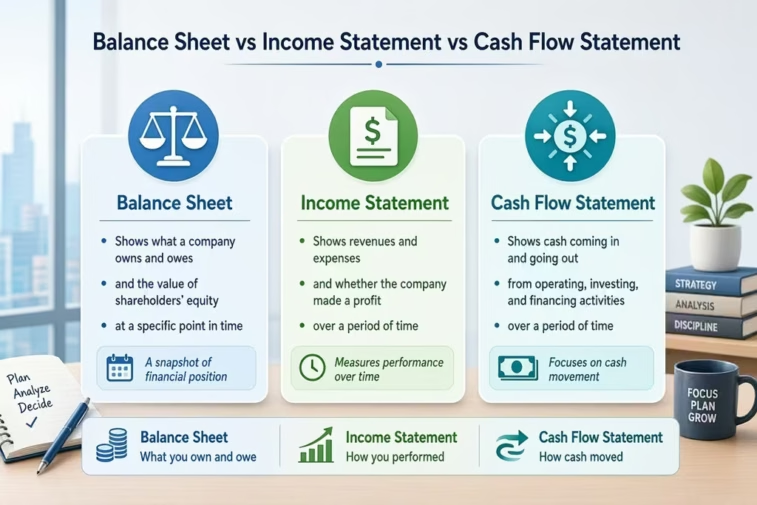
Learn the difference between the balance sheet vs income statement vs cash flow statement with formats, formulas, a worked example and how the three connect.
Balance Sheet vs Income Statement vs Cash Flow Statement: Differences, Formats, Examples and How They Connect
When you open a company’s annual report, three statements appear again and again: the balance sheet, the income statement and the cash flow statement. Together they tell the full financial story of a business, but each answers a different question.
- Balance sheet: What does the company own and owe right now?
- Income statement: Did the company make a profit or loss over a period?
- Cash flow statement: Where did the cash come from and go during that period?
Balance Sheet vs Income Statement vs Cash Flow Statement; This guide explains the difference between the three statements in plain language, shows their formats and formulas, walks through one connected example with numbers, and explains how to read them together like an analyst.
Quick Answer: Balance Sheet vs Income Statement vs Cash Flow Statement – The Difference at a Glance
| Basis | Balance sheet | Income statement | Cash flow statement |
|---|---|---|---|
| Also called | Statement of financial position | Profit and loss (P&L), statement of profit or loss, statement of operations | Statement of cash flows |
| Main question | What does the business own and owe? | Is the business profitable? | How did cash move? |
| Time frame | A single point in time (a date) | A period (month, quarter, year) | A period (month, quarter, year) |
| Main elements | Assets, liabilities, equity | Revenue, expenses, profit | Operating, investing and financing cash flows |
| Basis | Accrual accounting | Accrual accounting | Cash movements (adjusted from accrual profit) |
| Key equation | Assets = Liabilities + Equity | Revenue − Expenses = Net income | Opening cash + Net cash flow = Closing cash |
| Shows | Financial position and strength | Performance and profitability | Liquidity and cash generation |
| Used to judge | Solvency, liquidity, capital structure | Margins, growth, efficiency | Ability to pay bills, fund growth, repay debt |
Balance Sheet vs Income Statement vs Cash Flow Statement; In one line: the balance sheet is a snapshot, the income statement is a video of performance, and the cash flow statement is the video of cash.
What Is a Balance Sheet?
The balance sheet reports a company’s assets, liabilities and owners’ equity at a specific date, such as 31 March or 31 December. It is built on the accounting equation:
\text{Assets} = \text{Liabilities} + \text{Equity}Both sides must always balance, which is where the name comes from.
Assets: what the company owns
- Current assets (expected to turn into cash within a year): cash and bank balances, accounts receivable, inventory, prepaid expenses, short-term investments
- Non-current assets: property, plant and equipment, intangible assets such as patents and software, goodwill, long-term investments
Liabilities: what the company owes
- Current liabilities (due within a year): accounts payable, short-term loans, accrued expenses, taxes payable, current portion of long-term debt
- Non-current liabilities: long-term loans, bonds, lease obligations, deferred tax liabilities
Equity: the owners’ stake
- Share capital
- Retained earnings (accumulated profits not paid out as dividends)
- Reserves and other equity items
What the balance sheet tells you
- Whether the company can pay its short-term bills (liquidity)
- How much debt it carries compared with owners’ money (leverage)
- How its assets are funded
- How much value has built up in the business
What Is an Income Statement?
The income statement reports revenues, expenses and profit over a period. It shows whether the business earned more than it spent.
Typical structure
- Revenue (sales)
- Cost of goods sold (COGS)
- Gross profit = Revenue − COGS
- Operating expenses: salaries, rent, marketing, depreciation, administration
- Operating profit (EBIT) = Gross profit − Operating expenses
- Interest and other income or expenses
- Profit before tax
- Income tax
- Net profit (net income)
\text{Net income} = \text{Revenue} - \text{Expenses}What the income statement tells you
- Growth in sales
- Profit margins at each level
- Whether costs are under control
- How much profit remains for owners
It follows the accrual principle: revenue is recorded when earned and expenses when incurred, not necessarily when cash changes hands.
What Is a Cash Flow Statement?
The cash flow statement reports the cash that entered and left the business during a period, split into three activities. It explains why cash changed between two balance sheet dates, and why profit and cash are not the same thing.
The three sections
- Operating activities: cash from running the core business (customer receipts, payments to suppliers and employees, taxes)
- Investing activities: cash spent on or received from long-term assets (buying equipment, selling property, buying or selling investments)
- Financing activities: cash raised from or paid to owners and lenders (issuing shares, borrowing, repaying loans, paying dividends)
\text{Net change in cash} = \text{CFO} + \text{CFI} + \text{CFF}Direct vs indirect method
- Direct method: lists actual cash receipts and payments.
- Indirect method: starts with net income and adjusts for non-cash items (such as depreciation) and changes in working capital. Most companies use the indirect method.
What the cash flow statement tells you
- Whether the business generates real cash from operations
- How much it invests for growth
- How it funds itself and rewards owners
- Whether it can survive a cash crunch
Balance Sheet vs Income Statement: The Core Differences
- Time: A balance sheet is a photograph on one date. An income statement covers a whole period.
- Purpose: The balance sheet shows financial position. The income statement shows performance.
- Content: Assets, liabilities and equity versus revenue and expenses.
- Permanence: Balance sheet accounts carry forward from year to year. Income statement accounts are reset to zero at the start of each period, and the profit is moved into retained earnings.
- Questions answered: “How strong is the company?” versus “How well did it perform?”
Income Statement vs Cash Flow Statement: Why Profit Is Not Cash
A company can report a profit and still run out of cash, or report a loss and have plenty of cash. The reasons:
- Credit sales: Revenue is recorded when the sale is made, but the cash arrives later.
- Non-cash expenses: Depreciation reduces profit but no cash leaves the business.
- Inventory purchases: Cash goes out to buy stock, but the cost reaches the income statement only when the stock is sold.
- Capital spending: Buying equipment uses cash, but only the yearly depreciation appears as an expense.
- Loan repayments and dividends: These use cash but are not expenses.
This is why the cash flow statement is essential even for profitable companies.
Balance Sheet vs Cash Flow Statement
The balance sheet shows the cash balance at a date. The cash flow statement explains how that balance changed between two dates. The closing cash on the cash flow statement must match the cash line on the balance sheet.
How the Three Financial Statements Are Connected
Balance Sheet vs Income Statement vs Cash Flow Statement; The statements are not independent. They form one linked system.
- Net income from the income statement is the starting point of the indirect cash flow statement.
- Net income also flows into retained earnings on the balance sheet (after dividends).
- Closing cash on the cash flow statement becomes the cash balance on the balance sheet.
- Changes in balance sheet items (receivables, inventory, payables, equipment, debt) drive the adjustments in the cash flow statement.
- Depreciation appears as an expense on the income statement, reduces the asset value on the balance sheet, and is added back on the cash flow statement.
If any statement is wrong, at least one of the others will usually fail to tie, which is why accountants cross-check them.
Worked Example: ABC Traders
Balance Sheet vs Income Statement vs Cash Flow Statement; The figures below are illustrative. Amounts are in currency units.
Income statement for the year
| Item | Amount |
|---|---|
| Revenue | 1,000,000 |
| Cost of goods sold | (600,000) |
| Gross profit | 400,000 |
| Operating expenses (including depreciation of 30,000) | (200,000) |
| Operating profit (EBIT) | 200,000 |
| Interest expense | (20,000) |
| Profit before tax | 180,000 |
| Income tax at 30% | (54,000) |
| Net income | 126,000 |
Balance sheet at year end
| Assets | Amount | Liabilities and equity | Amount |
|---|---|---|---|
| Cash | 150,000 | Accounts payable | 100,000 |
| Accounts receivable | 120,000 | Long-term debt | 250,000 |
| Inventory | 130,000 | Total liabilities | 350,000 |
| Property and equipment (net) | 500,000 | Share capital | 300,000 |
| Retained earnings | 250,000 | ||
| Total equity | 550,000 | ||
| Total assets | 900,000 | Total liabilities and equity | 900,000 |
The balance sheet balances: assets of 900,000 equal liabilities of 350,000 plus equity of 550,000.
Additional information
- Opening cash: 85,000
- Opening retained earnings: 150,000
- During the year receivables rose by 20,000, inventory rose by 30,000 and payables rose by 15,000
- New equipment bought for 80,000
- New loan of 50,000 received
- Dividends paid: 26,000
Cash flow statement for the year (indirect method)
| Item | Amount |
|---|---|
| Net income | 126,000 |
| Add: depreciation | 30,000 |
| Less: increase in receivables | (20,000) |
| Less: increase in inventory | (30,000) |
| Add: increase in payables | 15,000 |
| Cash from operating activities | 121,000 |
| Purchase of equipment | (80,000) |
| Cash from investing activities | (80,000) |
| Loan received | 50,000 |
| Dividends paid | (26,000) |
| Cash from financing activities | 24,000 |
| Net increase in cash | 65,000 |
| Opening cash | 85,000 |
| Closing cash | 150,000 |
How they tie together
- Net income of 126,000 starts the cash flow statement.
- Retained earnings: 150,000 opening + 126,000 net income − 26,000 dividends = 250,000, which matches the balance sheet.
- Closing cash of 150,000 matches the cash on the balance sheet.
- Notice that net income (126,000) and operating cash flow (121,000) differ because of depreciation and working capital changes.
Balance Sheet vs Income Statement vs Cash Flow Statement; Key Ratios From Each Statement
From the income statement
\text{Gross margin} = \frac{\text{Gross profit}}{\text{Revenue}}, \qquad \text{Net margin} = \frac{\text{Net income}}{\text{Revenue}}For ABC Traders: gross margin = 400,000 ÷ 1,000,000 = 40%, net margin = 126,000 ÷ 1,000,000 = 12.6%.
From the balance sheet
\text{Current ratio} = \frac{\text{Current assets}}{\text{Current liabilities}}, \qquad \text{Liabilities to equity} = \frac{\text{Total liabilities}}{\text{Equity}}For ABC Traders: current assets are 400,000 (150,000 + 120,000 + 130,000) and current liabilities are 100,000, so the current ratio is 4.0. Total liabilities to equity is 350,000 ÷ 550,000, about 0.64.
From the cash flow statement
\text{Free cash flow} = \text{Cash from operations} - \text{Capital expenditure}For ABC Traders: 121,000 − 80,000 = 41,000. Cash from operations divided by net income is 121,000 ÷ 126,000, about 0.96, which shows that most profit turned into cash.
Combining statements
\text{Return on equity} = \frac{\text{Net income}}{\text{Equity}}For ABC Traders: 126,000 ÷ 550,000, about 22.9% (using year-end equity for simplicity; analysts often use average equity).
Which Statement Matters Most?
Balance Sheet vs Income Statement vs Cash Flow Statement; None alone is enough. Each shows a different angle:
- Lenders focus on the balance sheet and cash flow to judge repayment ability.
- Investors study the income statement for growth and profitability and cash flow for quality of earnings.
- Managers use all three for planning and control.
- Startups watch the cash flow statement most closely because running out of cash is the biggest risk.
- Tax authorities rely mainly on the income statement.
A healthy business typically shows steady profit, positive operating cash flow, manageable debt and growing equity.
What About the Statement of Changes in Equity?
Balance Sheet vs Income Statement vs Cash Flow Statement; A complete set of financial statements usually includes a fourth statement, the statement of changes in equity (or statement of retained earnings), which explains how equity moved during the period through profit, dividends, share issues and other items. Notes to the accounts supply accounting policies and details behind the numbers.
Terminology Across Standards and Countries
Balance Sheet vs Income Statement vs Cash Flow Statement; Names differ slightly between accounting frameworks.
| Common name | Alternative names |
|---|---|
| Balance sheet | Statement of financial position |
| Income statement | Profit and loss account, statement of profit or loss, statement of operations |
| Cash flow statement | Statement of cash flows |
Companies follow rules such as IFRS, US GAAP or their national standards (for example, Ind AS in India). The core ideas are the same, but presentation and some treatments differ.
Common Mistakes When Reading Financial Statements
- Looking at profit without checking cash flow
- Ignoring debt and short-term obligations on the balance sheet
- Comparing single years instead of trends
- Overlooking non-recurring or one-time items
- Confusing revenue with cash received
- Treating depreciation as a cash expense
- Ignoring working capital changes
- Comparing companies in different industries without context
- Forgetting that a balance sheet is only a snapshot, and can be managed around the reporting date
Tips for Students and Small Business Owners
- Learn the accounting equation first. Everything builds from it.
- Practise by building the three statements for a simple business.
- Check that closing cash and retained earnings tie across statements.
- Track cash weekly even if you prepare statements monthly.
- Compare your statements with previous periods and industry averages.
- Use accounting software, but understand what each line means.
- Ask a qualified accountant to review your numbers regularly.
Frequently Asked Questions (FAQs)
What is the main difference between a balance sheet and an income statement?
A balance sheet shows what a company owns and owes on a specific date. An income statement shows revenue, expenses and profit over a period.
What is the difference between an income statement and a cash flow statement?
The income statement uses accrual accounting and reports profit. The cash flow statement reports actual cash movements. Profit does not equal cash because of credit sales, non-cash expenses, inventory and capital spending.
Which financial statement is most important?
All three matter. The balance sheet shows strength, the income statement shows performance and the cash flow statement shows liquidity. The best analysis uses them together.
Are the Balance Sheet vs Income Statement vs Cash Flow Statement linked?
Yes. Net income flows into retained earnings and the cash flow statement. Closing cash on the cash flow statement equals the cash on the balance sheet.
Is the profit and loss statement the same as the income statement?
Yes. Profit and loss (P&L) statement is another name for the income statement.
Is a balance sheet the same as a statement of financial position?
Yes. They are two names for the same statement.
What are the three sections of the cash flow statement?
Operating, investing and financing activities.
Why is depreciation added back in the cash flow statement?
Depreciation reduces net income but does not use cash. Adding it back converts accrual profit toward actual cash generated.
Can a profitable company have negative cash flow?
Yes. If customers pay slowly, inventory builds up or large investments and loan repayments are made, a profitable company can still run short of cash.
Do all three statements cover the same period?
The income statement and cash flow statement cover a period such as a year. The balance sheet reports a single date at the end of that period (and usually shows the previous period for comparison).
Which statement shows a company’s debt?
The balance sheet shows debt as liabilities. The income statement shows interest expense, and the cash flow statement shows borrowings and repayments.
In what order are the statements prepared?
Commonly the income statement first (to find net income), then the statement of changes in equity or retained earnings, then the balance sheet, and finally the cash flow statement, which uses information from the first three.
Conclusion
The Balance Sheet vs Income Statement vs Cash Flow Statement are three views of the same business. The balance sheet shows where the company stands on a given date. The income statement shows how profitable it was over a period. The cash flow statement shows how cash moved and whether profit turned into real money.
Read them together, check how they connect, and look at trends over several periods. Balance Sheet vs Income Statement vs Cash Flow Statement; Once you can follow the links between them, you can judge the health of any business, whether you are studying for an exam, running a shop or analysing a listed company.
Disclaimer: Figures in the example are illustrative. Accounting rules and presentation vary by jurisdiction and standard. This article is for educational purposes and is not accounting, tax, legal or investment advice. Consult a qualified professional for your specific situation.