
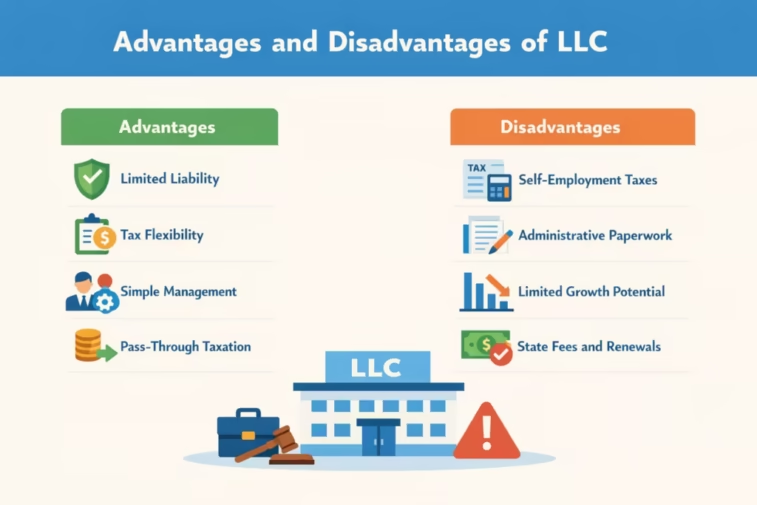
Wondering if an LLC is right for your business in 2026? Discover the key advantages and disadvantages of LLC formation, including tax benefits, liability protection, compliance costs, and critical drawbacks to make an informed decision.
Advantages and Disadvantages of LLC in 2026: Liability Protection, Taxes, and Setup Costs Compared
Here’s a clear, 2026‑oriented comparison of the advantages and disadvantages of LLC, with a focus on liability protection, taxes, and setup/maintenance costs.
Main takeaways (short version)
- Pros: Strong limited liability for business debts and claims (when you follow formalities), tax flexibility (pass‑through by default, with options like S‑corp election), and credibility with banks and clients.
- Cons: Ongoing state fees and compliance, extra self‑employment tax on net earnings (15.3% for Social Security and Medicare), and limited liability isn’t absolute (personal guarantees, fraud, or your own negligence/torts can still create personal exposure).
Quick decision overview: Is an LLC worth it for you?

What is an LLC?
- An LLC (Limited Liability Company) is a U.S. business structure that combines limited liability (like a corporation) with pass‑through taxation (like a partnership). nolo
- It can have one owner (“single‑member LLC”) or multiple owners (“multi‑member LLC”).
- Owners are called “members,” and the LLC can be managed by its members or by appointed managers.
The following Advantages and Disadvantages of LLC is explore below;
Advantages of forming an LLC
1) Limited liability protection (core benefit)
- In general, members aren’t personally on the hook for the LLC’s business debts and legal claims, protecting personal assets like your home, car, or bank accounts—provided the LLC is properly formed and maintained.
- This protection is similar to what corporations offer and is usually stronger than what you get as a sole proprietor or general partner.
- But limited liability is not absolute (more on this in “Disadvantages” below).
2) Tax flexibility: usually pass‑through, with options
- By default, the IRS treats a single‑member LLC as a “disregarded entity” (income on the owner’s Form 1040), and a multi‑member LLC as a partnership, unless you elect corporate treatment.
- Pass‑through means the LLC itself usually pays no federal income tax; profits and losses flow through to members, who report them on their personal tax returns.
- If it helps, LLCs can file Form 8832 to elect to be taxed as an S corporation or C corporation (timing rules apply for elections).
3) Self‑employment tax: what you actually pay
- Members who are active in the business generally pay self‑employment tax (SE tax) on their net earnings from self‑employment of $400 or more; this covers the employer and employee portions of Social Security and Medicare.
- The SE tax rate is 15.3% on net earnings (12.4% for Social Security + 2.9% for Medicare). There is an additional 0.9% Medicare tax on higher earnings.
4) Management and profit flexibility
- LLCs let you choose member‑managed or manager‑managed structures, and you can split profits however members agree (as long as it’s reflected in your operating agreement and complies with state law).
5) Credibility and access to financing
- Banks, landlords, and larger clients often prefer doing business with an LLC rather than a sole proprietor because it signals that the business is a separate legal entity. This can help with:
- Opening a business bank account
- Getting business credit cards or loans
- Signing commercial leases
The following Advantages and Disadvantages of LLC is explore below;
Disadvantages of forming an LLC
1) Ongoing state costs and compliance (setup + maintenance)
- One‑time filing fees vary widely by state:
- Many states range roughly from $40 to $200+; some states like Massachusetts and Tennessee are notably higher.
- Most states charge annual (or biennial) fees or report requirements just to keep the LLC in “good standing.” LLC University’s 2026 analysis puts the average annual LLC fee around $91 nationwide.
- If you ignore these fees or fail to file required reports, the state can administratively dissolve your LLC.
2) Extra self‑employment tax on profits
- Active members generally owe the 15.3% SE tax on their share of LLC net earnings (in addition to income tax at ordinary rates). That SE tax is effectively both the employer and employee shares of Social Security and Medicare.
- By contrast, S corporations can sometimes reduce the overall SE/FICA burden on salaries paid to owner‑employees who are also on payroll (subject to payroll thresholds and rules), which some businesses view as a potential tax advantage of S‑corp status.
3) Limited liability is not absolute (when protection fails)
Advantages and Disadvantages of LLC; Important exceptions where you can still be personally liable:
- Personal guarantees: If you personally guarantee a business loan, lease, or contract, and the LLC can’t pay, the creditor or landlord can come after your personal assets. This is very common with banks and landlords.
- Your own negligence or torts: If you personally cause harm (e.g., you drive negligently and injure someone while working, or you commit fraud), you can still be sued personally; the LLC doesn’t shield you from your own misconduct.
- Professional malpractice: Professionals (doctors, lawyers, accountants, architects, etc.) can often still be personally liable for their own malpractice regardless of LLC status.
- Failure to follow corporate formalities: If you don’t maintain separate bank accounts, mix personal and business funds, or miss state filings, courts may “pierce the veil,” making you personally liable for business debts.
4) More complexity than a sole proprietorship
- Compared with just operating under your own name, an LLC typically requires:
- Filing articles of organization with the state
- Creating an operating agreement
- Keeping separate records and bank accounts
- Annual/biennial reports and fees to the state
5) Potential tax downsides vs. alternatives (context‑specific)
- Not automatically better for all income levels:
- As a pass‑through, members pay ordinary income tax rates on their share of LLC profit; if you expect very high profits and plan to reinvest heavily, an S‑corp election might (or might not) reduce overall taxes, depending on your situation.
- State‑level taxes and fees can differ:
- Some states (e.g., California) impose franchise/annual fees based on gross receipts or a flat annual fee on top of income tax, which can significantly raise the total tax cost for an LLC. For example, California’s annual LLC tax is $800/year (as of 2026) plus filing fees, and other states have different structures.
- Investors may prefer C‑corporations:
- If you plan to raise significant outside capital from VCs or institutional investors, an LLC structure can be less familiar to them than a C‑corp; many venture funds prefer C‑corps with specific share classes.
Liability protection: how it works (and where it’s thin)
- What it protects:
- Typically shields members’ personal assets (house, personal bank accounts, cars not used 100% for business) from:
- Business contracts and debts
- Lawsuits against the LLC for business‑related matters (e.g., customer slip‑and‑fall on business premises, product liabilities, employee actions within the scope of employment, subject to workers’ comp rules).
- Typically shields members’ personal assets (house, personal bank accounts, cars not used 100% for business) from:
- What it does not protect:
- Personal guarantees you signed
- Your own torts or negligence while doing business (e.g., driving your own car for business; professional malpractice).
- Fraud or illegal acts committed by you
- Failure to maintain separation (e.g., paying business expenses from your personal pocket consistently; not keeping proper records; missing state filings). Courts may “pierce the veil” in these cases.
Bottom line: Advantages and Disadvantages of LLC; An LLC gives you strong—but not bulletproof—protection if you treat it like a real business, not as an alter ego.
Taxes: how an LLC is taxed (2026 framework)
Default federal tax treatment (pass‑through)
- Single‑member LLC: “Disregarded entity” → income on your Form 1040 (Schedule C/E as appropriate).
- Multi‑member LLC: Taxed as a partnership → files Form 1065; members get Schedule K‑1s.
- In both cases, the LLC itself generally does not pay federal income tax; profits/losses flow through to members.
Optional corporate elections (if beneficial)
- File Form 8832 to elect S‑corp treatment (or C‑corp).
- The election generally can’t take effect more than 75 days before the date filed, nor later than 12 months after that date. Late relief is possible in certain circumstances.
- Why elect S‑corp?
- For owner‑employees with salary, being taxed as an S‑corp can reduce overall SE/FICA taxes because part of the compensation becomes wages subject to employer payroll taxes instead of SE tax on all net earnings. It’s highly fact‑specific.
State and local taxes
- States and some cities impose:
- Income/franchise taxes on LLCs
- Gross receipts taxes (notably California on LLCs) or annual franchise/report fees that function like taxes.
- These are in addition to federal income tax and SE tax.
Taxes; The following Advantages and Disadvantages of LLC is explore above.
Setup and ongoing costs: what to expect (2026)
One‑time startup costs
- State filing fee:
- Often around $50–$200, with some states over $200–$300+ (e.g., Texas $310; Massachusetts $520).
- Optional but recommended:
- Registered agent (if you use a service or are required in states like Arizona/New York) — often around $100–$200 per year.
- Operating agreement drafted by a lawyer — highly recommended for multi‑member LLCs.
- Name reservation fee in some states.
- Publication requirements in a few states (legal notice in a newspaper).
Ongoing compliance costs
- Annual/biennial fees or reports:
- Most states require an annual or biennial statement/list of members and/or a small fee; LLC University estimates the average annual LLC fee at about $91 across states. These are mandatory even if your LLC earns nothing.
- State franchise or gross receipts taxes (in some states):
- For example, California’s $800 annual LLC tax is a well‑known case; other states have smaller franchise or fee structures.
- Foreign qualification:
- If your LLC does business physically in states other than its home state, you may need to register (foreign qualify) in those states, which adds fees and reporting.
- Tax prep and bookkeeping:
- Many LLCs benefit from professional help to handle Schedule C/E, Schedule K‑1, SE tax (Schedule SE), and state filings. This isn’t a fee charged by the LLC itself, but it’s a real, ongoing cost for many owners.
Setup and ongoing costs; The following Advantages and Disadvantages of LLC is explore above.
LLC vs. sole proprietorship vs. S corporation (quick comparison)
- vs. Sole proprietorship:
- LLC gives limited liability; sole prop gives none.
- Sole prop is simpler and cheaper to start; LLC has more formalities and likely higher ongoing compliance costs.
- Both are pass‑through by default for taxes (for single‑member vs. sole prop).
- vs. S corporation (tax election for an LLC):
- Default LLC: all net earnings subject to SE tax (15.3%) at member level.
- S‑corp election: salaries to owner‑employees are subject to payroll taxes; remaining profit can pass through and may be taxed at a lower overall rate in some scenarios, but it comes with payroll complexity and reasonable comp requirements.
- Many small businesses stay as a default LLC for simplicity, and only elect S‑corp if their tax advisor projections show a clear benefit.
Same comparison; The following Advantages and Disadvantages of LLC is explore above.
Practical tips if you choose an LLC
- Treat the LLC like a separate person:
- Separate bank accounts and credit cards
- Don’t pay business expenses routinely from personal funds
- Keep proper records and meeting minutes
- Comply with state requirements:
- File any required annual/biennial reports on time
- Pay required fees to maintain good standing
- Update registered agent information if it changes
- Consider an operating agreement:
- Even for single‑member LLCs, an agreement can clarify ownership, profit splits, and what happens if a member wants out, which reduces disputes and shows the business is separate.
- Watch for “veil‑piercing” risks:
- Avoid personally guaranteeing business debts unless you clearly accept the risk.
- Don’t use the LLC to commit fraud or clearly wrongful acts.
- Maintain adequate capital and insurance (general liability, professional liability, workers’ comp, etc.)—insurance complements the LLC’s legal protections.
When an LLC is usually a good choice
- You want limited liability protection for business debts and claims.
- You prefer pass‑through taxation (and maybe S‑corp election later if it helps).
- You’re ok with:
- Paying reasonable state fees and filing annual/biennial reports.
- Paying SE tax (15.3%) on your share of net earnings from the business.
- You want flexibility in management and profit splits.
When an LLC might NOT be ideal
- Your risk level is very low and simplicity is top priority (low‑risk consulting, solo freelancing with minimal contracts)—a sole proprietorship might suffice.
- You’re targeting VC or institutional investors who strongly prefer C‑corp structures.
- You want to minimize ongoing paperwork and state fees, and your liability exposure is already covered by strong insurance policies and a careful business model.
Bottom line
Advantages and Disadvantages of LLC; Forming an LLC is a powerful, flexible tool for many small businesses in 2026: it delivers real limited liability protection and tax flexibility in exchange for setup/ongoing costs and self‑employment tax on net earnings.
The “liability shield” is strong but not absolute; it works best when you respect corporate formalities, avoid personal guarantees, and back it with appropriate insurance. Always check your specific state’s rules and, if you’re near high income or multiple owners, run the numbers with a tax professional to compare default LLC taxation vs. S‑corp election for your situation.