
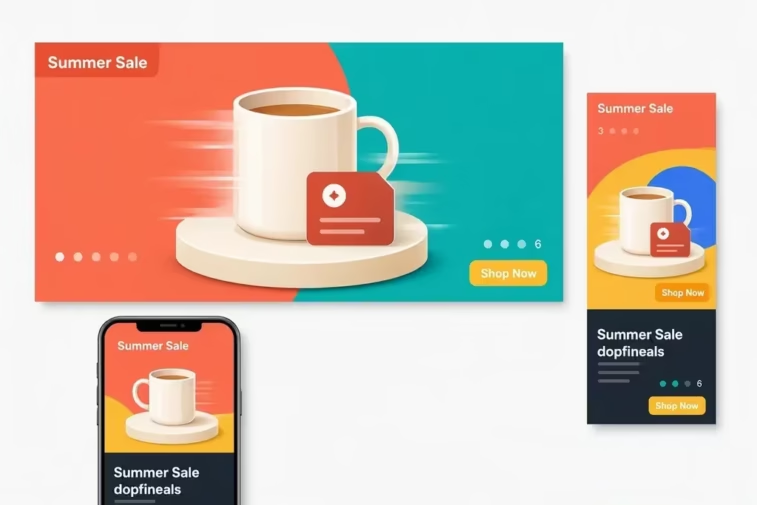
Banner ads explained: what they are, how programmatic buying works, standard IAB sizes, 2026 cost benchmarks, design best practices and an 8-question FAQ.
Banner Ads: The Complete Guide for Marketers
A banner ad is a rectangular display advertisement — an image, animation or HTML5 creative — served into a fixed slot on a website, app or network at a standard size, bought mainly on CPM, and clicked through to an advertiser’s landing page. The first banner ran in 1994; the format now trades in real-time programmatic auctions.
Banner ads are the oldest advertising format on the internet, and thirty years on they still quietly carry a very large share of it. US internet advertising took in a record 294.6 billion dollars in 2025, up 13.9 percent (IAB/PwC), and global digital ad spend is forecast to pass 950 billion dollars in 2026 (Statista) — a market still built around the rectangular unit the first banner introduced. Marketers simultaneously dismiss banners as background noise and keep buying them at scale, because the underlying economics remain genuinely hard to replace.
This guide covers the format end to end: what banner ads are and how they differ from display advertising as a category, how the buying mechanics work, the four creative types, the standard IAB sizes worth building, what banners cost with sourced 2025–2026 benchmarks, the banner-blindness research every planner should know, and the design and targeting practices that reflect how the channel works today. It closes with an eight-question FAQ built from the queries marketers actually search. Every statistic carries a named source and a year.
What Are Banner Ads?
A banner ad is a graphic advertisement placed into a designated space on a web page or app, linking to the advertiser’s site when clicked. The creative can be a static image, an animated GIF, an HTML5 file with motion and interaction, or a responsive unit assembled on the fly from supplied headlines and images. Sizes are standardized by the IAB — units such as the 300×250 medium rectangle and the 728×90 leaderboard — so one creative file can be planned, traded and measured across thousands of unrelated publishers.
The relationship between the terms is a common point of confusion: banner ads are a format within display advertising, not a synonym for it. Display advertising is the umbrella covering banners, native placements, interstitials and other visual units across websites and apps; a banner is the classic rectangular unit that defined the category. The distinction matters for planning, because banners compete on different inventory, attention patterns and pricing than the native or video formats sitting next to them in the same platform.
How Banner Ads Work: From Ad Server to Impression
Under the hood, a single banner impression is the output of a fast, automated supply chain. The flow below describes the standard programmatic path — now the dominant way banner inventory is bought; direct-sold placements skip the auction but follow the same logic:
- Creative upload and tagging. The advertiser builds creatives in each required size, uploads them to an ad server or DSP, and attaches click-through URLs, tracking pixels and frequency caps.
- Publisher ad call. When a user opens a page with an ad slot, the publisher’s ad server issues a bid request describing the user, placement, size and context — within milliseconds.
- Real-time auction. Demand-side platforms evaluate the request against targeting rules and budget, bid what the impression is worth, and the highest bid wins the slot.
- Delivery and render. The winning creative is served into the slot, typically via HTML5, and logged with viewability tracking attached.
- Measurement loop. Clicks, viewable impressions and conversions flow back into the platform, where algorithms adjust bids and the advertiser sees which placements earned the outcome.
Google’s Display Network alone spans more than two million websites and apps (Google), which is what makes the model scalable: one campaign and one set of creatives can reach a publisher base no direct sales team could contract with individually. Programmatic pipes now intermediate most of that inventory, with private marketplaces and programmatic guaranteed deals layered on top for premium placements.
A Short History of Banner Advertising
The first banner ad ran on October 27, 1994, on HotWired.com — a plain striped unit for AT&T asking, “Have you ever clicked your mouse right HERE? You will” (Wired). Industry histories report a 44 percent click-through rate, a number no placement will ever see again. Performance declined as supply exploded and users learned to ignore the format: click-through rates around 12 percent in the late 1990s fell to roughly 0.72 percent by 2016 (HubSpot) and about 0.05 percent across platforms in Google Doubleclick data cited by Outbrain.
The format survived its own decline by professionalizing. The IAB standardized sizes and file weights so creatives could scale; Media Rating Council viewability rules made “seen” the billing unit rather than “served”; real-time bidding replaced bulk remnant buying with per-impression auctions; and retargeting turned the banner into the cheapest performance reminder in the media mix. Google’s 2025 decision to keep third-party cookies in Chrome removed the near-term existential threat, leaving the format to compete — with thirty years of infrastructure behind it — on price and reach rather than novelty.
Types of Banner Ads
Creative capability has expanded far beyond the static GIF, but every variant still lives inside the same rectangular slot. Four families cover essentially everything in market:
Table 5 — The four banner ad types compared
| Type | What it is | Best for | Considerations |
|---|---|---|---|
| Static | A single fixed image (JPG or PNG) with headline, visual and CTA | Cheap reach, simple messages | Lightest file weight; nothing to catch the eye |
| Animated | GIF or HTML5 sequences cycling two to four frames | Storytelling in one slot; product angles and steps | Must respect publisher animation rules (usually 15–30 seconds) |
| Rich media / interactive | HTML5 units that expand, play video, host carousels or mini-games | Engagement campaigns, product showcases | Highest production cost; Google reports engagement up about 75 percent over standard display |
| Responsive display | Platform auto-assembles the unit from supplied headlines, images and logos | Scale across unknown placements | Less layout control; assets must survive cropping and reordering |
The strategic choice is less about novelty and more about the job. Static and light animated units remain the default for retargeting, where the audience knows the brand and the banner’s task is a cheap reminder with a clear next step. Rich media earns its production cost at the top of the funnel, where the interaction itself is the message — an expandable unit can host a product tour or video that a static frame cannot. Responsive display ads trade layout control for the platform’s ability to fit every placement automatically, which is why Google pushes them as the default creative type in Display campaigns.
Standard Banner Ad Sizes (IAB Units)
Standardization is the quiet innovation that made banner advertising an industry: because publishers, ad servers and exchanges agree on a fixed menu of dimensions, a creative built once can trade anywhere. The IAB-maintained units below account for the overwhelming majority of display volume:
Table 6 — Standard IAB banner sizes and where they run
| Size (px) | Name | Where it appears | Notes |
|---|---|---|---|
| 300×250 | Medium rectangle (MPU) | In-content and sidebar, desktop and mobile | The universal unit — highest demand and typically the first size to build |
| 728×90 | Leaderboard | Top of page, desktop | Header position; high viewability on desktop templates |
| 320×50 | Mobile leaderboard | Top or bottom of mobile screens | The mobile workhorse; compact copy required |
| 300×600 | Half page | Sidebar, desktop | Large canvas with strong viewability; premium CPMs |
| 160×600 | Wide skyscraper | Sidebar, desktop | Vertical unit for persistent side-rail placements |
| 336×280 | Large rectangle | In-content, desktop and mobile | Performs well embedded within article text |
| 970×250 | Billboard | Top of page, desktop | Premium large format on publisher homepages |
If budget only allows a handful of sizes, start with the 300×250, 728×90 and 320×50, adding the 300×600 half page where the plan includes premium desktop placements. File weight matters as much as dimensions: Google Ads caps display creatives at 150 kilobytes, and premium publishers typically require initial loads of 50 to 100 kilobytes for mobile units (Yahoo ad specs) — heavy creatives fail to serve on much of the quality inventory.
How Much Do Banner Ads Cost?
Banner pricing runs on four main models. CPM (cost per thousand impressions) is the default for awareness buys; viewable CPM (vCPM) bills only when the ad meets the MRC viewability threshold; CPC charges per click and is common on Google’s Display Network; and CPA deals, where the publisher carries conversion risk, appear mainly in retargeting and affiliate arrangements. Direct-sold premium placements are quoted as flat rates, which is why planners benchmark everything back to an effective CPM.
Benchmarks vary sharply by industry, so the most useful reference is the per-industry table below, from AdBacklog’s 2025 Google Ads benchmark study:
Table 7 — Display (banner) benchmarks by industry, AdBacklog 2025
| Industry | Avg. CTR | Avg. CPC | Avg. CPA |
|---|---|---|---|
| E-commerce | 0.51% | $0.45 | $65.80 |
| Finance & insurance | 0.52% | $0.86 | $56.80 |
| Automotive | 0.60% | $0.58 | $23.70 |
| Health & medical | 0.59% | $0.63 | $72.60 |
| Legal services | 0.59% | $0.72 | $39.50 |
| Travel & hospitality | 0.47% | $0.44 | $99.10 |
| Technology | 0.39% | $0.51 | $103.60 |
| Real estate | 1.08% | $0.75 | $74.80 |
Across all industries, WordStream’s long-running benchmark dataset puts average display CTR at 0.46 percent and average CPC at 0.63 dollars (Storegrowers, 2026). Search remains the contrast point: median search CPC is 5.42 dollars across 13,474 US campaigns (WordStream, May 2026), meaning a display click costs roughly one-ninth of a search click. That gap is the arithmetic behind display’s enduring role — banners are not a replacement for capturing existing demand, but they are by far the cheapest way to manufacture the impressions, familiarity and site visits that search later harvests. Cost is driven mainly by placement quality, targeting precision and viewability requirements, so identical creatives can see CPMs differ by a factor of five.
The Banner Blindness Problem — and What Actually Works
Banner blindness is the term — coined in 1998 — for the learned habit of ignoring anything that looks like an ad. The scale is well documented: an Infolinks study found 86 percent of consumers experience it, and only 14 percent can recall the last ad they saw. Nielsen Norman Group’s eye-tracking confirmed the phenomenon persists on desktop and mobile despite two decades of design evolution, and Jakob Nielsen’s scanning studies explain why: users read pages in an F-shaped pattern while the brain filters out banner-shaped regions as predictable noise.
Blindness is a rational response to volume, not a flaw in the audience — users see thousands of advertising exposures a day, so attention became the scarce resource. The research also points to the escape routes. Studies from the Higher School of Economics found that visually neutral banners, which adopt the typography and restraint of surrounding editorial content, outperform loud designs, because aggressive styling is precisely the signal the brain has learned to skip. Relevance is the other half: the same unit that dies in a generic right rail performs respectably in a contextually matched in-content position.
Measurement discipline helps too. Since 2014, the MRC viewability standard has required that at least 50 percent of a display ad’s pixels be on screen for one continuous second (30 percent for large units) before an impression counts as viewable, and industry measurement put global viewability at roughly 76 percent in 2024. Plan against viewable rather than served impressions, buy vCPM on premium inventory, and judge campaigns on assisted conversions rather than raw clicks. The uncomfortable summary: the click-through rate was never the point of most display spend, and campaigns that treat banners purely as direct response tend to conclude the format is dead.
Banner Ads Best Practices for 2026
The practices below are distilled from platform guidance, the eye-tracking literature and the benchmark data above. They assume a standard programmatic setup — a DSP or Google Ads account, standard IAB sizes, and separate prospecting and retargeting campaigns:
- One message per banner. Each unit should carry a single value proposition, one dominant visual and one call to action. In a one-second attention window, a second message is a distraction.
- Design like the page, not like an ad. Adopt the publisher context’s visual language — restrained palettes, real photography, editorial typography — because loud styling triggers the ignore reflex that neutral design avoids.
- Make the CTA unmistakable. A high-contrast button with a concrete verb outperforms clever ambiguity; the banner should answer where a click leads before the click happens.
- Keep files light. Build to the 150 kilobyte platform cap and the tighter 50–100 kilobyte initial loads premium publishers require; heavy creatives fail to render on exactly the inventory you paid extra to reach.
- Separate cold and retargeting campaigns. Mixing audiences in one ad group lets the algorithm chase the cheaper converting segment and starves top-of-funnel reach; run them as distinct campaigns.
- Refresh creative on a cycle. Frequency builds familiarity up to a point, then fatigue; cap exposures per user and rotate two to three variants per audience.
- Test the placement, not only the art. Placement reports routinely show a minority of apps consuming the budget with junk views; pruning placements often moves cost per outcome more than any bid change.
None of these are cosmetic. Each maps to a measured failure mode — blindness, fatigue, wasted delivery or silent low-quality inventory — and together they explain most of the gap between a disciplined display program and a set-and-forget campaign.
Targeting, Measurement and the First-Party Data Era
Targeting options have consolidated into three practical layers. Contextual targeting places banners next to relevant content — the oldest method, enjoying a privacy-driven revival because it needs no personal data. Audience targeting uses first-party customer lists, on-site behavior and modeled segments, with retargeting — showing ads to people who visited your site — still the most reliable performer in the channel. Platform automation now handles much of the bid and audience decisioning inside the architecture the marketer builds.
The privacy environment has reshuffled these layers rather than removed them. Google confirmed in 2025 that third-party cookies would remain in Chrome subject to user controls rather than face forced deprecation, which preserves the legacy machinery near term; even so, first-party data has become the primary optimization signal across platforms, because CRM lists and value-based conversion events are inputs algorithms can optimize against regardless of browser policy (the pattern Aimers’ 2026 display guide describes as the channel’s new reality). Marketers who export customer lists into their DSPs are insulating their programs from the next platform shift.
Measurement should be layered to match the channel’s actual job. Click-through rate and CPC describe the auction; viewability describes whether impressions qualified at all; conversions and CPA describe direct response; and view-through, assisted conversions and brand-lift studies describe the demand-shaping work that never appears in last-click reports. Banners run at roughly 0.46 percent CTR against search’s 3.17 percent (WordStream dataset), but their task differs — display accumulates influence earlier in the funnel and converts it later, which is why serious programs pair banner reporting with search-lift and incrementality tests rather than judging the format on clicks alone.
Banner Ads vs Native Ads vs Paid Social
Planners rarely choose between banners and everything else; they choose slots in a mix. The comparison below positions the three most common non-search options:
Table 8 — Banner ads, native ads and paid social compared
| Dimension | Banner ads | Native ads | Paid social |
|---|---|---|---|
| Format | Standard rectangular units in page slots | Units styled to match surrounding content feeds | In-feed units inside social platforms |
| Attention | Peripheral; exposed to banner blindness | In-stream; viewed 52 percent more than display (Outbrain) | Integrated into scrolling; strong video engagement |
| Cost profile | Cheapest impressions — average CPC around $0.63 (WordStream) | Higher CPMs in exchange for attention | Mid-range CPMs; $117.7B US category in 2025 (IAB/PwC) |
| Best funnel stage | Retargeting, demand creation, frequency | Consideration, content-led storytelling | Full funnel, especially discovery and video |
| Measurement | Viewability, assisted conversions | Engagement and brand lift | Platform-native conversion and attribution tools |
The practical reading is that these formats are complements with different unit economics. Banners win on cost per qualified impression and on retargeting mechanics; native wins on attention per impression when the story matters more than the reach; paid social wins on video engagement and conversion tooling. A sensible 2026 plan uses each for what it is cheapest at, and treats the banner line item as low-cost connective tissue that keeps the brand present between higher-cost moments.
Are Banner Ads Still Worth It in 2026?
The honest answer is that banners are worth exactly what you use them for. As direct response judged on last-click, the format looks weak: conversion rates around 0.59 percent and CPAs that often exceed search’s. As demand infrastructure, the case is strong — a click costing roughly one-ninth of a search click (0.63 dollars against 5.42 dollars median CPC per WordStream’s 2026 data), two million-plus publisher reach through one platform, and retargeting mechanics no other channel replicates at the same price.
For most brands the right posture is a supporting role with disciplined measurement: prospecting banners for cheap reach against contextual and first-party audiences, retargeting banners as the always-on reminder layer, and judgment on assisted conversions and branded-search lift rather than clicks. Concentrate the expensive creative investment where attention is actually sold — video, social and connected TV. If you are extending that video investment, the companion guides to this article cover what is CTV advertising and how to choose a CTV advertising platform, and the collaborative ads guide shows how retailers and brands split the same performance machinery. The banner is not the star of the modern media plan, but as connective tissue it still outperforms almost everything else per dollar.
Frequently Asked Questions About Banner Ads
What are banner ads in digital marketing?
Banner ads are rectangular graphic advertisements served into designated slots on websites and apps. They can be static images, animated GIFs, HTML5 rich media or responsive units, sold by CPM or CPC, and they click through to the advertiser’s landing page. They are the original display ad format, running since 1994.
Do banner ads still work?
Yes, for the right jobs. As direct response they look weak — average display CTR is 0.46 percent (WordStream data) — but they remain the cheapest way to buy reach and retarget site visitors, and their impact shows up in assisted conversions and branded-search lift rather than last-click reports.
What is the most common banner ad size?
The 300×250 medium rectangle is the most common and versatile unit, running in content and sidebars on desktop and mobile. The other core sizes are the 728×90 desktop leaderboard, the 320×50 mobile leaderboard and the 300×600 half page — those four cover most inventory.
How much do banner ads cost?
Pricing depends on industry and placement, but Google Display Network averages run about $0.63 per click at a 0.46 percent CTR (WordStream, 2026). AdBacklog’s 2025 data shows e-commerce CPC around $0.45 and finance around $0.86. Premium direct placements are quoted as flat rates.
What is banner blindness?
Banner blindness is the learned habit of visually ignoring anything that resembles an ad. An Infolinks study found 86 percent of consumers experience it, and Nielsen Norman Group’s eye-tracking confirmed it persists on desktop and mobile. Neutral, context-matched design and in-content placements are the standard countermeasures.
What is the difference between banner ads and display ads?
Display advertising is the category — all visual ad units across websites and apps, including native placements and interstitials. Banner ads are one format within it: the standard rectangular units like the 300×250. Every banner is a display ad, but display includes formats beyond banners.
What does CPM mean in banner advertising?
CPM stands for cost per mille — the price of one thousand ad impressions. A $5 CPM means five dollars per thousand banner deliveries. Its stricter variant, vCPM, bills only when the ad is viewable under the MRC standard: 50 percent of pixels on screen for one continuous second.
How do you measure banner ad success?
Layer the metrics to match the campaign’s job: viewability for delivery quality, CTR and CPC for engagement efficiency, conversions and CPA for direct response, and view-through conversions, assisted conversions and brand-lift studies for awareness. Judging banners on last-click alone systematically understates their contribution.
Final Word
Banner ads have outlived every prediction of their death by doing a specific job unusually well: cheap, measurable, ever-present reach across the open web, with a retargeting layer that converts attention earned elsewhere. The benchmarks frame the trade plainly — low click rates and low prices, high volume and real strategic leverage when the format feeds a funnel rather than trying to close it. Marketers who plan around blindness, buy viewable impressions and measure beyond the last click will find the format as useful in 2026 as it was in 1994; those who expect search-like intent from an interruption unit will keep concluding it is dead.
The practical next step is small: audit one display campaign against the seven best practices above, check the placement report for where the budget actually went, and rebuild the size set around the four core units. The format rewards that kind of unglamorous discipline — and has for three decades.