
Ask ten SEO professionals whether social signals affect search rankings, and you’ll get ten answers with varying degrees of confidence, several contradictions, and at least one heated tangent about a Google patent from 2013. Few topics in search marketing generate as much confused, contradictory advice as this one — partly because the honest answer is more nuanced than either “yes, absolutely” or “no, completely irrelevant,” and partly because Google’s own public statements on the subject have been carefully, deliberately vague for over a decade.
Here’s a genuinely clear answer, grounded in what’s actually documented, what’s reasonably inferred from indirect evidence, and what remains speculative — because conflating these categories is exactly what produces the bad advice littering this topic.
What Social Signals Actually Are
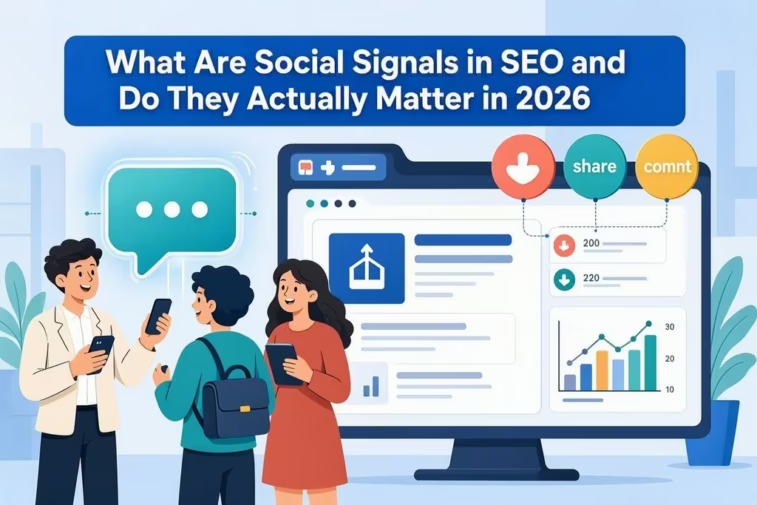
Social signals refer to the engagement metrics generated when content is shared, discussed, and interacted with on social media platforms — likes, shares, comments, retweets, and the resulting traffic that flows from social platforms to a website.
The core question in SEO circles isn’t whether these signals exist — they obviously do and are easily measured — but whether search engines directly use them as a ranking factor, the way they use backlinks, content relevance, and page experience signals.
What Google Has Actually Said
Google’s public position, stated by multiple Google representatives across many years including Google’s own Search Advocate, is that social signals — the raw counts of likes, shares, and follows — are not a direct ranking factor. Google has explained this partly through a practical technical constraint: much of the engagement data on major social platforms (particularly Facebook and increasingly other platforms restricting API access) isn’t fully crawlable or accessible to Google’s indexing systems in the same way that public web pages and their backlinks are. Google can’t reliably factor in data it can’t fully see and verify at scale.
This is a specific, narrow claim: raw social engagement counts aren’t a direct input to the ranking algorithm. It is not a claim that social media activity has zero relationship to search performance — and conflating these two different claims is where most of the bad advice on this topic originates.
The Indirect Relationship: Why Social Activity Correlates With Better Rankings
Even accepting that social signals aren’t a direct ranking factor, there’s a well-documented, logical, and empirically observable relationship between strong social media activity and strong search performance. Understanding the actual mechanism matters more than debating the semantics of “direct” versus “indirect” influence.
Social Content Drives Backlinks
Content that performs well on social media reaches a larger audience, including bloggers, journalists, and website owners who might link to it. A piece of content that goes viral on Twitter/X or gets extensively shared on LinkedIn is discovered by more people who have the ability to link to it from their own websites — and backlinks are unambiguously, extensively documented as one of the strongest direct ranking factors in Google’s algorithm.
The social signal itself isn’t the ranking factor. The backlinks that social visibility generates are the ranking factor. But without the social distribution, many of those backlinks would never have been created, because the content would never have reached the people capable of linking to it.
Social Profiles and Posts Rank in Search Results Directly
Social media profiles, posts, and especially video content from platforms like YouTube, TikTok, and increasingly LinkedIn and Twitter/X frequently rank directly in Google’s search results, particularly for branded searches and increasingly for informational queries where Google surfaces relevant social discussion alongside traditional web results. A brand with strong, active social presence across relevant platforms occupies more total search result space for searches related to that brand — a direct, measurable SEO benefit that has nothing to do with algorithmic ranking factor debates and everything to do with simply having more indexed, rankable content across more platforms.
Social Traffic Contributes to Engagement Metrics Google Does Consider
While Google has stated that social signals themselves aren’t a direct ranking factor, engagement metrics on your actual website — time on page, bounce rate, pages per session — are increasingly understood to factor into Google’s assessment of content quality and user satisfaction, particularly through systems like Google’s page experience signals and its broader emphasis on content that genuinely satisfies search intent. Social traffic that arrives, engages meaningfully with your content, and doesn’t immediately bounce contributes positively to these metrics — the same way organic search traffic or direct traffic would.
The distinction matters: it’s not that Google is measuring “this page got 500 Facebook likes” and rewarding it. It’s that visitors arriving from social media, if they engage genuinely with strong content, produce the same positive engagement signals as visitors from any other source — and those engagement signals are more clearly connected to ranking outcomes than raw social counts ever were.
Brand Search Volume Increases
Content that performs well on social media increases brand awareness, which measurably increases the volume of branded searches — people searching for your company or product name directly after encountering it on social media. Branded search volume is a signal Google’s algorithm does incorporate into its broader assessment of a site’s authority and relevance, distinct from and in addition to any specific keyword ranking consideration.
Social Platforms Function as Search Engines in Their Own Right
This is increasingly significant and often overlooked in the traditional “does social affect SEO” debate: a growing share of search behavior, particularly among younger demographics, happens directly on social platforms — TikTok, Instagram, and YouTube are used as primary discovery and search tools by a meaningful and growing portion of internet users, independent of Google entirely. Optimizing content for discoverability on these platforms is no longer a side activity supporting traditional SEO — for many businesses and audiences, it’s become a parallel, comparably important discovery channel in its own right, sometimes described in the industry as “social search” or treated under the broader umbrella of answer engine optimization as AI-driven search tools increasingly draw on social discussion as a source.
What the Correlational Research Actually Shows
Multiple large-scale studies over the years — most notably ongoing analyses from SEO tool providers like Ahrefs, Moz, and SEMrush examining correlations across millions of search results — have consistently found a positive correlation between social share counts and search ranking position. Pages ranking higher in Google search results tend to have higher social share counts than pages ranking lower for the same terms.
This finding gets consistently misinterpreted in both directions. Some marketers cite it as proof that social signals directly cause better rankings. Serious SEO researchers, including the researchers who ran these studies themselves, are consistently careful to note that correlation doesn’t establish causation here — and the far more likely explanation is that both social shares and search rankings are independently caused by the same underlying factor: genuinely strong, valuable content that both people and search algorithms respond to. Good content gets shared more. Good content also earns more backlinks, ranks better for relevance, and satisfies user intent more effectively — all separately, but simultaneously.
The practical takeaway from this body of research isn’t “get more social shares to improve rankings” as a direct mechanical lever. It’s “the kind of content that performs well on social media tends to be the same kind of content that performs well in search” — which is a genuinely useful strategic insight, just not the direct causal relationship that gets oversimplified in less careful SEO advice.
Where Social Signals Matter Most in Practice
Given this more precise understanding, here’s where investing in social media activity produces genuine, measurable SEO benefit:
New content distribution. For newly published content with no existing backlink profile or search ranking history, social sharing is often the fastest way to get the content in front of an audience capable of linking to it, referencing it, or otherwise contributing to the signals that do directly affect ranking.
Local SEO and brand search. For local businesses in particular, active, engaged social presence contributes to overall online visibility and branded search volume in ways that compound with traditional local SEO signals like Google Business Profile activity and reviews.
Video and visual content specifically. YouTube video SEO is a well-documented, direct discipline of its own — YouTube is the second-largest search engine by query volume, and video content optimized for YouTube search frequently also surfaces in traditional Google search results, creating a genuine dual-benefit content format.
E-A-T and brand authority signals. Google’s quality evaluation guidelines emphasize experience, expertise, authoritativeness, and trust — and a strong, active, engaged social media presence is one of many signals that contributes to an overall impression of a legitimate, established, trustworthy entity, both to Google’s systems (indirectly, through the backlinks and mentions strong social presence generates) and to human users evaluating whether to trust and engage with a brand they encounter in search results.
Building Social Signals as Part of a Broader SEO Strategy
Given the indirect-but-real relationship between social activity and search performance, treating social signal generation as a component of a broader content and SEO strategy — rather than either ignoring it entirely or treating it as a magic direct ranking lever — is the practically sound approach.
Prioritize content that’s designed to perform on both channels simultaneously. Content built with genuine social shareability in mind — a clear hook, an emotional or practical trigger for sharing, a format suited to the platform — while also being built with search intent and keyword relevance in mind, captures the compounding benefit of both channels reinforcing each other, rather than treating them as separate, disconnected efforts.
Seed new content’s social distribution deliberately. Since new content benefits disproportionately from social distribution — reaching an audience capable of generating the backlinks and engagement that genuinely do affect ranking — deliberately promoting new content across your owned social channels, relevant communities, and your engaged audience immediately upon publication is a foundational practice, not an afterthought.
Consider tools to build social signals for SEO for the specific challenge of new content and new sites with limited existing distribution. Crowdsourced engagement platforms — connecting content with real users who genuinely view, engage with, and share content — can help new or under-distributed content reach the audience threshold needed to generate the organic backlinks, brand searches, and engagement signals that constitute the actual, documented ranking benefit. This is meaningfully different from believing raw engagement counts are themselves a ranking factor; it’s a practical tool for solving the cold-start distribution problem that prevents genuinely good content from reaching the audience capable of generating the signals that do matter.
Track the right downstream metrics, not vanity social counts. Rather than obsessing over raw like and share counts as an end goal, track whether social distribution is actually producing the outcomes that matter for SEO: referring domains and backlinks generated, branded search volume trends, and engagement quality (time on page, bounce rate) for traffic arriving from social sources. These are the metrics that connect social activity to genuine search performance improvement.
The Honest Answer
Social signals, in the narrow sense of raw like and share counts as a direct algorithmic input, are not a confirmed direct ranking factor in Google’s search algorithm, based on Google’s own consistent public statements over more than a decade.
Social media activity, in the broader sense of building genuine audience engagement, distribution, and brand presence, has a real, well-documented, if indirect relationship with search performance — operating through backlink generation, brand search volume, direct social search behavior on other platforms, and the engagement quality of traffic that social channels send to your website.
The practical strategic implication for 2026: don’t invest in social media activity because you believe raw engagement metrics directly move your Google rankings. Invest in it because strong social distribution is one of the most reliable mechanisms for getting genuinely good content in front of the audience that generates the signals — backlinks, brand searches, engaged traffic — that unambiguously do.
That’s a more precise, more useful understanding than either extreme position in the debate — and it points toward a specific, actionable strategy rather than either dismissing social media as SEO-irrelevant or treating it as a shortcut around the harder work of earning genuine authority.