
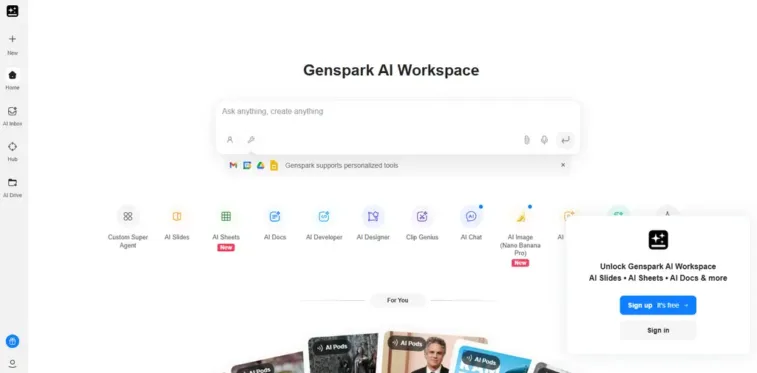
Discover the GenSpark AI Browser, Learn why the game-changing tool that summarizes pages, drafts content & finds answers instantly. See it in action, Upgrade your browsing experience!
In the evolving landscape of web browsing, where traditional search engines often fall short in delivering synthesized, actionable insights, GenSpark AI Browser stands as an innovative platform that redefines user interaction with online information. Developed as an AI-powered tool, GenSpark combines the functionality of a browser with advanced agentic capabilities, allowing users to automate research, content creation, and data analysis through specialized AI agents.
Launched in 2024 and refined by 2025, it caters to researchers, professionals, educators, and casual users who demand more than mere link lists—offering dynamic “Sparkpages” that compile and summarize data from multiple sources in real time. As an all-in-one AI workspace, GenSpark pivots from conventional browsing to proactive intelligence, integrating tools for multimedia generation and collaborative workflows, all while prioritizing privacy and unbiased results in a digital era dominated by information overload.
Overview: An Agent-Driven Gateway to Knowledge 🔍
GenSpark AI Browser operates as a hybrid search engine and productivity suite, leveraging a multi-agent framework to process queries and generate cohesive, fact-checked reports known as Sparkpages. Users input a search term or prompt, and the system deploys specialized AI agents to scour the web, distill findings, and present them in structured formats with citations and interactive elements. This extends beyond browsing to include content creation features like AI Slides, Sheets, and Docs, making it a versatile tool for tasks ranging from academic research to marketing campaigns.
Built on models from providers like OpenAI and Claude, GenSpark emphasizes real-time adaptability, offline model support, and an AI agent store for quick deployment of task-specific assistants. Its browser extension enhances everyday navigation with autonomous features such as ad blocking, content summarization, and personalized recommendations, positioning it as a “superpowered research assistant” that evolves with user needs in 2025’s AI-centric digital ecosystem.
Key Features: Empowering Tools for Seamless Exploration ⚙️
GenSpark AI Browser is equipped with a robust array of functionalities that blend browsing with AI orchestration, ensuring users can navigate, create, and analyze effortlessly:
- Multi-Agent Search Framework 🔗: Deploys specialized agents to handle complex queries, synthesizing data from diverse sources into interactive Sparkpages with summaries, comparisons, and cited references for comprehensive overviews.
- Custom Super Agent Builder 🎛️: Allows no-code creation of personalized AI agents for automating workflows, such as generating spreadsheets, websites, or multimedia content from simple prompts.
- Interactive AI Copilot 🎙️: Embedded chat functionality on Sparkpages for follow-up questions, clarifications, or deeper dives, enhancing real-time engagement.
- Content Generation Suite 📊: Includes AI Slides for presentations, AI Sheets for data analysis, AI Docs for report drafting, AI Image/Video for visuals, and AI Meeting Notes for transcription and summarization.
- Offline Model Support and Integrations 🔌: Downloads AI models for on-device use, with connectors to Google Workspace, Notion, Slack, and APIs for custom extensions, plus browser-specific tools like ad blocking and content downloading.
- Fact-Checking and Privacy Controls 🛡️: Built-in verification to flag outdated info, enterprise-grade encryption, user-controlled data retention, and GDPR compliance for secure, reliable operations.
These features collectively transform passive browsing into an active, intelligent process, adaptable to professional and educational demands.
Pros: Strategic Advantages in Efficiency and Innovation 📈
GenSpark AI Browser offers compelling benefits that address key pain points in information retrieval and content production, earning praise for its user-centric design:
- Unbiased and Comprehensive Insights 🌟: Filters out ad-driven content for impartial results, with multi-model comparisons (e.g., Claude, GPT) ensuring depth and accuracy in research.
- Workflow Automation Boost ⚡: Custom agents handle repetitive tasks like report generation or market analysis, saving hours and boosting productivity by up to 50% in beta tests.
- High Customization and Flexibility 🎨: No-code interface allows tailored agents and integrations, making it versatile for educators, marketers, and developers alike.
- Strong Security and Compliance 🛡️: User-focused privacy controls and encryption build trust, ideal for sensitive data handling in professional settings.
- Affordable Entry with Scalability 💡: Free tier provides substantial value, with paid plans offering ample credits for heavy users without vendor lock-in.
These strengths make GenSpark AI Browser a forward-thinking choice for those prioritizing intelligent, secure browsing.
Cons: Areas for Refinement in Specialized Use ⚠️
While powerful, GenSpark AI Browser has limitations that users should consider for optimal fit:
- Limited Historical Depth 📉: Struggles with archival or niche data, potentially overlooking older sources compared to traditional search engines.
- Adjustment Curve for Format 🔄: The Sparkpage structure may require adaptation from users accustomed to raw link lists, with occasional interface overload for complex queries.
- Credit-Based Constraints 📊: Free tier’s daily limits can restrict high-volume tasks, and pro plans are pricey for casual users.
- Domain-Specific Gaps ❓: Less effective for highly specialized fields like advanced sciences, where alternatives provide deeper databases.
- Speed and Browser Performance 🐢: As a full browser, it may feel slower than lightweight tools, with quirks in offline mode during beta.
These drawbacks suggest GenSpark AI Browser excels in general research but benefits from complementary tools for edge cases.
Pricing: Tiered Plans for Progressive Adoption 💰
GenSpark AI Browser employs a freemium model as of December 2025, balancing accessibility with premium capabilities through credit-based usage:
- Free Plan ($0/month): 100 daily credits for basic searches, agent access, and core features—ideal for casual browsing and light research.
- Plus Plan ($24.99/month): 10,000 monthly credits, advanced integrations, and priority processing—suited for regular professionals needing deeper automation.
- Pro Plan ($249.99/month): 125,000 monthly credits, custom workspaces, dedicated support, and unlimited agents—tailored for enterprises with high-volume demands.
Credits vary by task complexity (e.g., simple queries use fewer), with no overage fees but replenishment on renewal. Annual billing offers discounts, ensuring cost alignment with usage.
Alternatives: Viable Options in AI-Powered Browsing 🔄
For users exploring beyond GenSpark AI Browser, several platforms offer comparable agentic search and automation, each with unique emphases:
- Perplexity AI: A conversational search engine with cited answers and model comparisons; excels in real-time queries but lacks full browser integration—free tier with Pro at $20/month.
- ChatGPT (with Browsing): Versatile AI for dialogue-based research and drafting; strong in fluency but prone to hallucinations—free basic, Plus at $20/month for advanced features.
- Kompas AI: Focuses on iterative deep research with editable reports; ideal for comprehensive analysis but slower for simple tasks—$20/month plans.
- Elicit: Specialized for academic literature synthesis; robust for evidence-based insights but limited to scholarly sources—generous free tier, paid from $12/month.
- Bing Chat: Integrated AI search with GPT-4; accessible and up-to-date but conversation-limited—free with Microsoft account.
GenSpark AI Browser alternatives provide pathways for specialization, weighing GenSpark AI Browser multi-agent workspace against focused search or affordability.
Why GenSpark AI Browser is a Game Changer: A Balanced Analysis
GenSpark AI Browser represents a fundamental shift from traditional browsers to agentic, AI-native web experiences. Here’s why it’s generating significant buzz—and controversy—in 2025.
🚀 Core Innovations That Make It Disruptive
1. True On-Device AI (No Cloud Dependency)
The Game Changer: Runs 169 open-weight AI models (GPT, DeepSeek, Gemma families) entirely on your local hardware. This eliminates:
- Latency: Instant responses without server delays
- Privacy: Your data never leaves your device
- Costs: No metered API calls or subscription fees (completely free)
Impact: Unlike competitors that rely on cloud processing, GenSpark works offline anywhere, making AI assistance truly ubiquitous.
2. Super Agents Embedded in Every Webpage
The Game Changer: AI assistants that understand webpage context and perform autonomous actions:
- E-commerce: Automatically finds best deals and compares prices
- YouTube: Summarizes videos and extracts transcripts instantly
- Research: Pulls citations, fact-checks claims, generates reports
Impact: Transforms passive browsing into active task completion without switching tools.
The Game Changer: The browser can autonomously navigate websites, gather information, and complete multi-step tasks without user intervention.
Example Use Case: Research a topic across 50 sites while you sleep, compiling results into a structured report.
Impact: Moves beyond simple search to autonomous digital labor.
4. MCP Store: 700+ Tool Integrations
The Game Changer: Built-in Model Context Protocol store connecting to Discord, GitHub, Slack, and hundreds of other platforms.
Impact: Creates a unified workflow automation hub directly in the browser, eliminating the need for separate automation tools.
5. Ad-Free by Default
The Game Changer: Native ad-blocking without compromising UX or speed.
Impact: Cleaner experience and potentially faster page loads compared to ad-supported browsers.
📊 How It Compares to Competitors
vs Traditional Browsers (Chrome, Safari)
- Advantage: 100% AI-native vs. bolted-on AI features
- Advantage: Offline functionality
- Disadvantage: Learning curve for agentic workflows
vs AI-Enhanced Browsers (Arc, SigmaOS)
- Advantage: On-device processing (privacy) vs. cloud dependency
- Advantage: No subscription cost
- Disadvantage: Less mature ecosystem
vs Agentic Browsers (Comet by Perplexity, Dia)
| Feature | GenSpark | Comet (Perplexity) | Dia |
|---|---|---|---|
| On-Device AI | ✅ Yes (169 models) | ❌ No (cloud) | ⚠️ Mixed |
| Citation Quality | ⚠️ Concerns | ✅ Strong | ⚠️ Variable |
| Mobile Security | ⚠️ Reported bugs | ✅ More stable | ⚠️ Unknown |
| Cost | ✅ Free | $20/month | Unknown |
| User Control | ✅ High | ✅ High | ⚠️ Low |
Key Differentiator: GenSpark AI Browser is the only truly on-device, free agentic browser available.
⚠️ Critical Challenges & Controversies
1. Ethical & Legal Concerns
The Problem: AI-generated summaries raise copyright infringement questions and could cannibalize publisher ad revenue.
Risk: Publishers may sue or block GenSpark, limiting content access.
2. Accuracy & Trust Issues
The Problem: AI summaries can contain inaccuracies, omissions, or misinterpretations, especially for technical/legal/medical content.
Risk: Users making decisions based on flawed information.
3. Mobile Security Vulnerabilities
The Problem: Recent bug reports reveal major security and flow flaws in the Android app, particularly around permissions and notifications.
Risk: Data exposure on mobile devices.
4. User Control vs. Autonomy
The Problem: Autopilot features raise concerns about user agency—when does the AI act in your interest vs. its own agenda?.
Risk: Loss of control over browsing experience.
5. Hardware Dependency
The Problem: On-device AI performance scales directly with your CPU/GPU and memory.
Risk: Slower performance on older devices; limited model capability vs. cloud alternatives.
🎯 Why It’s Fundamentally Different
Philosophical Shift
Most browsers (even AI-enhanced ones) are “browsers with AI features.” GenSpark AI Browser is an “AI workspace that happens to browse”.
Business Model Disruption
- Competitors: Charge subscriptions ($20/month for Comet, $20/month for ChatGPT Plus)
- GenSpark: Completely free with no metered usage
Potential Impact: Could force industry-wide pricing pressure.
Privacy Revolution
By eliminating cloud dependency, GenSpark sidesteps the data collection and surveillance business model that funds most free browsers.
🏆 The Verdict: Is It Really a Game Changer?
GenSpark AI Browser; Yes, but with caveats.
Game-Changing Aspects:
- ✅ Democratizes AI: Premium agentic capabilities available to anyone, on any device, for free
- ✅ True Privacy: On-device processing eliminates data harvesting concerns
- ✅ Autonomous Browsing: First browser designed for AI-first workflows rather than human clicking
- ✅ Ecosystem Play: MCP integration positions it as a universal automation hub
Limitations to Watch:
- ⚠️ Legal Storm Brewing: Copyright challenges could limit content access
- ⚠️ Mobile Readiness: Android app stability issues need resolution
- ⚠️ Trust Gap: Accuracy concerns require users to verify critical information
- ⚠️ Hardware Barriers: Requires modern devices for optimal performance
💡 Who Should Use It?
✅ Ideal For:
- Privacy-conscious professionals
- Researchers needing offline AI
- Automation enthusiasts
- Budget-conscious users (it’s free)
❌ Not Yet For:
- Mobile-heavy users (wait for Android fixes)
- Critical decision-makers (verify AI outputs)
- Publishers (conflict of interest)
Bottom Line:
GenSpark AI Browser is revolutionary in its architecture and pricing, but faces growing pains typical of disruptive technology. Its on-device, agentic approach truly redefines what a browser can be—but success depends on navigating legal challenges and building user trust.