
Discover how long does it take to become a lawyer—from college to law school and passing the bar. Get the full timeline in under 2 minutes.
2026 Complete Guide: How long does it take to become a Lawyer?
Discover how long does it take to become a lawyer—from college to law school and passing the bar. Get the full timeline and start your legal career journey today!
📋 Short answer
- In most common-law jurisdictions, you’re looking at roughly:
- United States: about 7 years from high school to licensed lawyer (4-year bachelor’s + 3-year JD + bar exams). In practice, many people take 7–8+ years due to LSAT prep, bar review, and background checks.
- Canada: about 7–8 years from starting post-secondary education to licensure (bachelor’s + 3-year JD + articling/bar requirements).
- England & Wales (solicitor, SQE route): at least 5–6 years if you start with a degree (3-year law degree + 2 years of Qualifying Work Experience, or 3 years any degree + law conversion + SQE + 2 years QWE).
- Australia: at least 5 years of study and professional practice (law degree + Practical Legal Training), plus admission steps.
The exact time depends on the country, the type of lawyer, whether you study full-time or part-time, and whether you need to add bar exams, articling/training, or “character and fitness” checks.
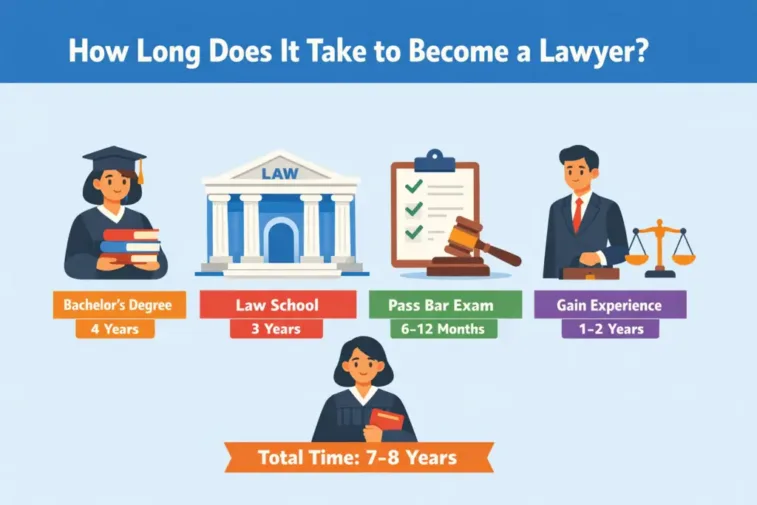
How long does it take to become a Lawyer? Below is a 2026-ready, jurisdiction-by-jurisdiction guide, plus a visual timeline and options to speed things up or slow them down.
High-level timeline (US-style path)
How long does it take to become a Lawyer? This is the classic path many people think of (4 years of college + 3 years of law school + bar):
- High school graduate
- Bachelor’s degree: 4 years
- Law school: 3 years JD
- Bar exam prep and exam: 2–6 months
- Character and fitness, swearing-in: a few months
- Practicing lawyer
Other things:
- If nothing goes wrong and you go full‑time: minimum ≈7 years from high school graduation.
- In real life, add LSAT prep, possible bar retakes, and waiting periods, and many people land around 7–8 years.
United States (JD + bar exam)
Typical path and duration
- Bachelor’s degree: 4 years (almost all ABA-approved law schools require a bachelor’s).
- Law school (JD): 3 years full-time; part-time/evening programs often take 4 years.
- Bar exam prep and exam: roughly 2–6 months after graduation.
- Character & fitness and swearing-in: several months more, depending on the state.
Typical total: minimum about 7 years from high school to licensed attorney; realistically often 7–8+ years due to LSAT prep, application cycles, bar prep, and possible retakes.
Key steps in order
- Undergraduate degree (4 years)
- Any major is fine; schools care more about GPA and skills than the specific major.
- LSAT and applications
- LSAT prep usually takes 3–6 months for most competitive applicants (150–300 hours of study).
- Law school (3 years full-time)
- Covers core subjects (contracts, torts, criminal law, constitutional law, etc.) plus electives and clinics.
- Bar exam
- Most states use the Uniform Bar Exam (UBE); some have their own exams.
- Study period: typically 2–6 months of intensive review after graduation.
- Character & fitness and swearing-in
- Background check, moral character application, and then admission to the state bar.
Ways to change the timeline in the US
- Faster: 3+3 BA/JD or similar accelerated programs where you start law school in your 4th undergraduate year; can reduce total post‑high‑school time to about 6 years.
- Slower: part-time JD programs (often 4 years), working during law school, gap years, or needing to retake the bar exam (about 1 in 5 don’t pass on the first try nationally, which can add time).
Canada
Typical path and duration (common law provinces)
- Bachelor’s degree: 3–4 years.
- Law school (JD): 3 years.
- Licensing requirements:
- Articling (or an approved Law Practice Program in some provinces): roughly 8–12 months.
- Bar exams/admission requirements: vary by province, often additional exams and coursework (e.g., PLTC in BC with a bar exam).
Typical total: about 7–8 years from the start of post-secondary education to being a licensed lawyer.
Notes
- Quebec (civil law) has a different structure (often BCL/LLB from a Quebec university followed by a notarial or bar stage).
- Internationally trained lawyers typically go through the National Committee on Accreditation (NCA) process, then some combination of exams and/or articling before admission.
England & Wales (solicitor via SQE – the main route from 2021 onward)
Core requirements (SQE system)
Under the Solicitors Qualifying Examination (SQE) route, to become a solicitor you must:
- Hold a degree (or equivalent) in any subject.
- Pass SQE1 (legal knowledge) and SQE2 (legal skills).
- Complete two years of Qualifying Work Experience (QWE).
- Meet the SRA’s character and suitability requirements.
Typical timelines
- Law graduate (LLB, 3 years):
- 3-year law degree.
- Prepare for and pass SQE1 and SQE2 (prep times vary; a typical full‑time push after graduation is around a year or slightly more).
- Two years of QWE (can be done before, during, or after exams, and does not have to be in a single block).
- Realistic range from starting university to qualification: often around 5–6 years of full‑time study and work, depending on how QWE is sequenced.
- Non‑law graduate (3‑year degree in another subject):
- 3-year non‑law degree.
- Law conversion (e.g., PGDL/SQE prep course) – often ~1 year full-time.
- SQE1 and SQE2.
- Two years of QWE.
- Realistic range: roughly 6–7 years from starting university to qualification if studying full-time.
Important notes
- The SQE route is flexible: QWE can be built from paralegal work, placements, pro bono, etc., and does not have to follow the old “training contract” model, but the total two‑year full‑time equivalent still applies.
- For barristers, the path is different (LLB/GDL + Bar course + pupillage), usually also taking several years after university.
Australia
Typical path and duration
- Law degree:
- Either an integrated LLB (often 4–5 years) or a 3‑year LLB/JD after another degree.
- Practical Legal Training (PLT):
- Usually about 6 months full-time (Graduate Diploma in Legal Practice) and includes supervised workplace experience (often around 15 weeks).
According to UNSW: “It takes at least five years of study and professional practice” to become a lawyer in Australia, depending on the route.
Typical full-time timeline examples:
- Integrated LLB (e.g., BA LLB) straight after high school: 4–5 years including PLT.
- Non‑law degree first + 3‑year LLB/JD + PLT: roughly 5.5–6.5 years total.
- After finishing your academic and PLT requirements, you apply for admission to the Supreme Court in your state/territory and then obtain a practising certificate.
India
Standard academic routes (Bar Council of India framework)
- After Class 12:
- 5‑year integrated LLB (e.g., BA LL.B, BBA LL.B) – these integrated double-degree courses are designed to be at least 5 years’ duration.
- After graduation (in any discipline):
- 3‑year LLB program – for graduates who already hold a bachelor’s degree.
After completing the LLB, you typically must:
- Enroll with a State Bar Council.
- Pass the All India Bar Examination (AIBE) to get a “Certificate of Practice” (required under the Bar Council of India rules to practice law).
Typical total time:
- From Class 12: about 5 years of study (integrated LLB) + bar exam and enrollment process.
- From completing a first bachelor’s: about 3 years (LLB) + bar exam and enrollment.
What can make the journey longer or shorter?
Factors that can add time
- Part‑time study while working.
- Gap years (work, travel, family).
- Repeating exams (LSAT, SQE, bar exams).
- Character and fitness or suitability investigations raising issues.
- Need for additional qualifications (e.g., LLM/Masters to improve employability or to meet foreign-qualification requirements).
Acceleration options
- 3+3 programs (US): combine the final year of a bachelor’s with the first year of law school, reducing total post‑high‑school time to around 6 years.
- Accelerated or intensive PLT/SQE prep courses that compress preparation into shorter windows.
- Starting law early (e.g., integrated 5-year LLB in India or Australia).
Practical tip
If you’re planning for 2026–2029 entry, check the specific rules of:
- The country/state/province where you want to study.
- The regulator (e.g., state bar in the US, SRA in England & Wales, Law Society in the relevant Canadian province, Legal Admission Board in Australian states, Bar Council of India for India).
How long does it take to become a Lawyer? Rules can and do change (e.g., SQE replacing the GDL/LPC in England & Wales, or updates to bar exam formats), so always confirm with the official regulator or your target law school’s admissions office.
How long does it take to become a Lawyer? If you tell me which country (and state/province, if relevant) you’re interested in, I can map out a detailed year‑by‑year timeline tailored to that path and include exam dates and decision points.