
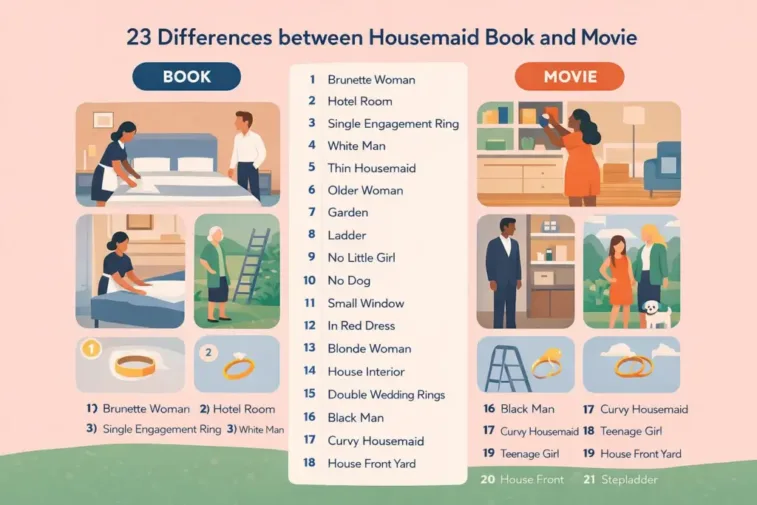
Discover the top 23 differences between Housemaid book and movie! Uncover key plot changes, character twists, and hidden details—click to explore now!
Differences between Housemaid Book and Movie – The 2026 Complete Guide
Discover 23 key differences between Housemaid book and movie. See how the novel and film contrast in plot, characters, and suspense.
The 2025-2026 film adaptation of Freida McFadden’s bestselling thriller The Housemaid brings significant changes to the source material, transforming the slow-burn psychological dread of the novel into a more visceral, action-oriented cinematic experience. Director Paul Feig’s adaptation, starring Sydney Sweeney, Amanda Seyfried, and Brandon Sklenar, maintains the central twist but alters key plot points, character arcs, and the climax to create what Feig calls a more “bloodthirsty” and “satisfying” ending for film audiences.
This guide details 23+ major and minor differences between Housemaid book and movie, organized by plot structure, character development, thematic elements, and visual storytelling choices. The most significant changes involve Enzo’s reduced role, the method of Andrew’s death, the attic torture sequences, and the omission of subtle psychological control tactics that defined the novel’s tension.
1. Plot & Ending: The Most Significant Changes
Plot & Ending for Differences between Housemaid Book and Movie
Andrew’s Death: Book vs. Film
Book Version:
- Method: Millie leaves Andrew locked in the attic without food or water for days. He eventually dies from dehydration and self-inflicted torture .
- Discovery: Nina returns to the house (encouraged by Enzo) believing Millie is trapped, only to find Andrew’s dead body in the attic .
- Tone: Psychological retribution; slow, patient punishment that mirrors the book’s themes .
Film Version:
- Method: Violent confrontation—Andrew escapes the attic and attacks both women on the staircase. Millie pushes him over the spiral staircase railing, causing a fatal fall .
- Director’s Reasoning: Paul Feig stated he wanted to “expand the ending” and make it more satisfying for a “bloodthirsty” movie audience. He felt the book’s ending wasn’t “harsh enough” for cinema .
- Additional Element: The film adds a lightbulb replacement ruse—Nina tells police Andrew fell while changing a lightbulb, explaining his presence in the attic .
Impact: The film trades psychological suspense for dramatic catharsis, giving audiences an active confrontation rather than passive neglect.
The Attic Torture Sequence
Millie’s Punishment:
- Book: Andrew forces Millie to balance three heavy books on her stomach for hours, monitoring her via camera. When she fails, he makes her restart .
- Film: After Millie accidentally breaks antique china (Andrew’s mother’s), he orders her to cut 21 deep slashes into her own stomach with a sharp shard.
Andrew’s Punishment:
- Book: Millie forces Andrew to balance books on his groin and pull out his own teeth with pliers.
- Film: Millie slits his throat with a hidden knife, locks him in the attic, and forces him to pull out one front tooth as symbolic punishment for his “perfect smile” .
Why the Change: The film amplifies violence to create more immediate visual horror, while the book’s punishments are more psychologically inventive and prolonged.
2. Character Arcs & Roles: Who Changed?
Character Arcs & Roles for Differences between Housemaid Book and Movie
Enzo: From Central to Peripheral
Book Enzo:
- Backstory: Deeply developed—his sister was murdered in Italy by her husband, giving him a clear motive to help Nina .
- Romance: He and Nina develop genuine romantic feelings; they have sex after she escapes .
- Language: Deliberately speaks Italian to discourage neighborhood women; teaches Italian to Cecilia while Nina rescues Millie .
- Agency: Actively devises plan with Nina to replace her with Millie; convinces Nina to return to save Millie .
- Rejection of Millie: Millie tries to seduce him, but he rejects her because of his feelings for Nina .
Film Enzo:
- Reduced Role: Mostly a “pretty face” with minimal screen time; his backstory is completely cut.
- No Romance: No sexual relationship with Nina; relationship is platonic and supportive .
- Language: One first interaction where he says “danger” in Italian, but this is not expanded .
- Passive Role: Nina’s daughter Cecilia (not Enzo) encourages Nina to return to the house to check on Millie .
- Removed Scenes: No Italian lessons with Cecilia; no active rescue planning .
Director’s Cut: Feig trimmed Enzo’s storyline for time, sacrificing character depth for pacing.
Nina Winchester: Physical Transformation Removed
Book Nina:
- Size: Described as U.S. size 14 (UK 18), having deliberately gained weight to make herself less attractive to Andrew .
- Appearance: Lets dark roots grow out, neglects her appearance as a control tactic against Andrew’s abuse .
- Psychology: Her physical transformation is a manifestation of psychological survival strategy.
Film Nina:
- Appearance: Amanda Seyfried is slim and conventionally attractive; no weight gain storyline .
- Roots: The dark roots detail is retained visually, but the deliberate weight gain motivation is never mentioned.
Analysis: The film’s casting choice removes a layer of Nina’s psychological complexity—her body as a site of resistance.
Millie: From Patient to Action-Ready
Book Millie:
- Transformation: Incremental awareness; her anger simmers slowly across pages .
- Method: Psychological precision; patient retribution that mirrors Andrew’s cruelty .
- Violence: More creative and prolonged torture methods (teeth pulling, starvation) .
Film Millie:
- Action-Oriented: Sydney Sweeney portrays her as more reactive, openly furious, and forceful.
- Catharsis: Film gives her immediate physical release rather than psychological warfare .
- Final Scene: The “hitwoman for hire” ending is streamlined; less emphasis on long-term planning .
Director’s Intent: Feig wanted Millie to be a more active protagonist for cinematic satisfaction.
3. Added, Removed & Altered Scenes
Added, Removed & Altered Scenes in Differences between Housemaid Book and Movie
Completely Removed from Film
1. The Peanut Butter Allergy Scene
- Book: Nina panics when Mill tries to feed Cecilia peanut butter (alleged allergy). Andrew denies the allergy exists, gaslighting Millie into thinking Nina and Cecilia are making it up. Later, Nina’s POV reveals Cecilia IS allergic, and Andrew keeping peanut butter in the house is psychological control tactic.
- Film: Cut entirely.
- Impact: Removes a key example of Andrew’s psychological manipulation and gaslighting .
2. The Chandelier Made of Hair
- Book: Nina was forced to pull out 100 strands of her hair for Andrew’s twisted trophy collection; chandelier made from his ex-fiancée Kathy’s hair .
- Film: Chandelier appears visually, but no explanation is given. Viewers who read the book recognized it; others were confused .
- Impact: Loses the physical manifestation of Andrew’s historical abuse .
3. Nina’s Pregnancy Lie
- Film Addition: Nina tells Millie she’s already pregnant during the job interview, explaining her mood swings .
- Book: No such lie; Nina’s instability is presented as genuine mental health crisis .
4. The Creepy Dollhouse
- Film Addition: Cecilia plays with a dollhouse that mirrors the Winchester home .
- Book: Not present .
- Purpose: Visual metaphor for the family’s “playing house” facade .
5. The Detective’s Identity
- Book: Detective investigating Andrew’s death is father of Andrew’s missing fiancée.
- Film: Detective is a young woman whose sister was engaged to Andrew.
- Impact: Maintains personal connection but genderswaps for thematic resonance (women reclaiming power) .
Altered Scenes
Andrew’s Mother at the Funeral:
- Book: After guests leave, Andrew’s parents approach Nina. His father rushes out distraught; mother mentions missing teeth, says “smiles are a privilege,” thanks Nina for “teaching him a lesson,” and dismisses Millie’s involvement .
- Film: Interaction happens during the funeral with guests present; more public and less intimate. Mother makes same comment about teeth, but guests are confused and quickly move on. Film ends with Nina approaching Millie and Cecilia .
Nina’s Confidant:
- Book: Nina initially confides in a friend about Andrew’s abuse; the friend betrays her by contacting Andrew, leading to Nina’s psychiatric commitment .
- Film: Nina goes directly to Enzo, bypassing the friend subplot entirely .
Nina’s Psychiatric Stay:
- Book: More detailed; friend betrayal leads to commitment .
- Film: Streamlined; Nina’s escape plan with Enzo is discovered, leading to commitment .
4. Thematic & Tone Differences
Thematic & Tone in Differences between Housemaid Book and Movie
Psychological vs. Physical Horror
Book:
- Slow-burn dread: Tension built through psychological manipulation, gaslighting, and unreliable narration (split POV) .
- Mental violence: Andrew’s control is primarily psychological; physical abuse is implied or secondary .
- Moral ambiguity: Millie’s retribution is equally cruel; readers question who is the real “villain” .
Film:
- Immediate visceral horror: Graphic violence (plate cuts, throat slitting, staircase fall) takes center stage .
- Action-thriller pacing: Director Paul Feig aimed for “shock and catharsis” over sustained unease .
- Clear heroes/villains: Millie and Nina are unequivocal protagonists; Andrew is pure monster .
Director’s Quote: “The book is unsettling, the movie is thrilling… I wanted to play with how much I could fool the audience for an hour, because what’s great about that story… she makes you root for everything that you should not be rooting for, and then she makes you pay the price. That’s where the fun comes in, retribution”.
Control & Power Dynamics
Book: Power shifts gradually; Andrew’s control is total, then Millie’s revenge is equally systematic. Film: Power shifts are abrupt and explosive; Andrew’s dominance is established quickly, and Millie’s rebellion is immediate.
5. Minor but Notable Changes
Minor Changes in Differences between Housemaid Book and Movie
| Element | Book | Film |
|---|---|---|
| Millie’s Room | Described as genuinely uncomfortable, sparse | Looks “too gorgeous”—visually appealing, undermining discomfort |
| Winchester Family China | Not a plot point | Replaces books as reason for attic punishment; china breaking triggers confinement |
| Season Setting | Summer; Enzo constantly sweating while working | Not explicitly stated; climate details minimized |
| Millie’s Advance on Enzo | Explicitly tries to seduce him; he rejects her | Cut entirely; no sexual tension shown |
| Nina’s Wait to Repulse Husband | Deliberately gains weight; neglects appearance | Weight gain storyline removed; roots growing out retained but motivation unclear |
| Detective’s Gender | Male (father of fiancée) | Female (sister of fiancée) |
| Cecilia’s Role in Return | Not involved in Nina’s decision to return | Encourages Nina to go back to save Millie |
6. Character Motivations: What Got Lost?
Character Motivations in Differences between Housemaid Book and Movie
Millie’s “Hitwoman” Ending
Book: More overt—Millie and Enzo explicitly form a group to help abused women;暗示 she becomes a professional killer. Film: Streamlined—final scene shows Millie interviewing for a new job at an abused woman’s house; ambiguity remains but less emphasis on organized vigilantism.
Why the Changes Were Made
Director Paul Feig’s Rationale:
- Pacing: Film requires faster plot movement; psychological nuance slows momentum .
- Visual Impact: Physical violence translates better to screen than psychological torture .
- Audience Satisfaction: Modern thriller audiences expect cathartic, definitive endings .
- Time Constraints: Enzo’s backstory and the friend’s betrayal subplot were cut for runtime .
Trade-offs: The film gains mainstream appeal but loses the book’s literary depth and moral complexity.
7. Critical Reception: Book vs. Film
Critical Reception for Differences between Housemaid Book and Movie
Book Reception
- Strengths: Unreliable narration, psychological depth, slow-burn tension, split POV structure .
- Praise: “Unsettling,” “masterclass in gaslighting,” “morally ambiguous” .
Film Reception (2025-2026)
- Strengths: Strong performances (Sweeney, Seyfried), visual style, cathartic ending .
- Criticism: “Loses book’s subtlety,” “Enzo underdeveloped,” “too focused on shock value” .
- Audience Split: Book readers notice omissions; new viewers enjoy thriller pace .
Meta Perspective: Many viewers who read the book felt the film was “not as good,” while those new to the story found it effective.
8. The 2026 Viewing Context
Why This Guide Matters Now
The film released December 2025 and is still in theaters in early 2026, making this a contemporaneous comparison. As audiences who read the novel in 2023-2024 see the adaptation, the differences are fresh discussion points.
Streaming vs. Theatrical Experience
As of 2026, the film is theatrical-only. A streaming release (likely Lionsgate+) is expected in March-April 2026, which will drive renewed interest in book-to-film comparisons.
9. Complete Difference Index
For quick reference, here’s every documented change:
MAJOR DIFFERENCES (7):
- Andrew’s death method (starvation vs. staircase fall)
- Attic torture methods (books vs. plate shards)
- Enzo’s role (central romance/planning vs. background support)
- Nina’s physical transformation (weight gain vs. none)
- Peanut butter allergy subplot (cut)
- Chandelier hair trophy (unexplained)
- Detective’s gender and relation to Andrew
MODERATE DIFFERENCES (6):
- Season setting (summer vs. unspecified)
- Millie’s room quality (horrible vs. gorgeous)
- Nina’s pregnancy lie (added in film)
- Creepy dollhouse (added in film)
- Family china significance (added in film)
- Nina’s confidant (friend vs. Enzo)
MINOR DIFFERENCES (10+):
- Millie’s advance on Enzo (cut)
- Italian lessons with Cecilia (cut)
- Nina’s psychiatric stay details (trimmed)
- Enzo’s sister backstory (cut)
- Andrew’s mother dialogue (public vs. private)
- Who prompts Nina’s return (Enzo vs. Cecilia)
- Hitwoman ending explicitness (reduced)
- Role of Winn family china (replaces books)
- Summer heat emphasis (minimized)
- Millie’s action orientation (patient vs. reactive)
10. Conclusion: Which Version Should You Experience?
Read the Book If You Want:
- Psychological depth and slow-burn tension
- Complex character motivations and backstories
- Moral ambiguity and unreliable narration
- Detailed world-building and subtle control tactics
- A more “literary” thriller experience
Watch the Film If You Want:
- Fast-paced, visceral horror
- Strong visual storytelling and production design
- Cathartic, definitive justice
- Excellent performances from Sweeney and Seyfried
- A mainstream thriller experience
2026 Recommendation: Do both. The book provides foundation; the film offers a different (but valid) interpretation. Understanding the differences enriches both experiences; in Differences between Housemaid Book and Movie.
11. Where to Watch & Read in 2026
Film: Theatrical release (Lionsgate); streaming expected March-April 2026 on Lionsgate+
Book: Available in paperback, ebook, and audiobook (Millions of copies sold; BookTok phenomenon)
Final Note: As the film enters streaming in 2026, expect renewed discussion of these differences. Director Paul Feig has expressed openness to an extended cut that might restore some of Enzo’s scenes—stay tuned for potential “director’s edition” announcements.