
Enterprise risk management software helps organizations identify, assess, and mitigate threats before they become crises. Compare the top ERM platforms on risk scoring, compliance reporting, and integration depth for 2026.
Best Enterprise Risk Management Software in 2026: Ranked for CISOs, CFOs & Compliance Teams
Here’s a 2026-ready, persona‑aware guide to the best Enterprise Risk Management (ERM) / GRC platforms, synthesized across recent analyst reports, expert reviews, and vendor comparisons.
2026 ERM/GRC — Top Picks at a Glance (CISO, CFO, Compliance)
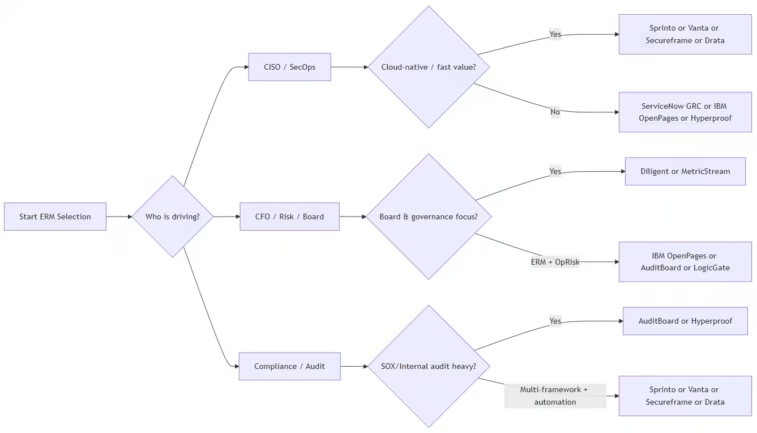
- CISO (cyber/IT risk + continuous controls): Sprinto, Vanta, ServiceNow GRC, Secureframe, IBM OpenPages
- CFO (board‑reporting + OpRisk + ESG): Diligent, MetricStream, IBM OpenPages, AuditBoard, LogicGate, OneTrust
- Compliance/Audit (SOX/ISO/SOC2 + evidence): AuditBoard, Sprinto, Vanta, Secureframe, Drata, Hyperproof, ZenGRC
Overall 2026 “Best of” List (consensus, not a single analyst ranking)
- Sprinto (automation & compliance‑first ERM)
- AuditBoard (audit‑ and SOX‑centric “connected risk”; named a Leader in the 2025 Gartner MQ for GRC Tools)
- IBM OpenPages (AI‑enabled, enterprise‑grade GRC; named a 2025 Gartner MQ Leader)
- Vanta (continuous monitoring + fast time‑to‑value GRC; strong for cloud‑native teams)
- MetricStream (large‑enterprise GRC with strong operational risk and regulatory change)
- ServiceNow GRC (leveraging ITSM for integrated risk workflow; powerful but heavy to configure)
- Secureframe (compliance automation & GRC; included in Forrester’s Q4 2025 GRC Platforms Landscape; early AI/ISO 42001 support)
- LogicGate Risk Cloud (no‑code configurability + risk quantification)
- Drata (continuous compliance automation for SOC 2/ISO 27001 and other frameworks)
- Hyperproof (enterprise GRC for evidence & third‑party risk at scale; 2026 AI‑native TPRM updates)
- OneTrust (privacy‑led GRC with strong vendor risk)
- Diligent One (board‑centric governance/ERM; recognized as a GRC leader in Forrester coverage)
- ZenGRC (compliance‑first GRC with pre‑built content and common controls)
- StandardFusion (mid‑market, ISO/SOC‑aligned ERM; good value)
- LogicManager, Archer, SAI360, Onspring, Protecht, Pathlock (strong for specific niches or heavy enterprise deployments)
Important: No single “official” 2026 ranking exists. Best Enterprise Risk Management Software; The list above reflects vendors that appear repeatedly across 2025–2026 comparison pieces, analyst announcements, and platform reviews, with an explicit slant toward CISOs, CFOs, and compliance teams.
ERM/GRC selection flow (who fits where)
How the 2026 market is shifting (quick context)
- From periodic to continuous: Platforms emphasize continuous control monitoring (CCM) rather than point‑in‑time audits (Cyber Sierra, Vanta, Secureframe, Hyperproof, Sprinto).
- AI everywhere: Risk pattern recognition, control mapping, and regulatory change intelligence are now table stakes (IBM OpenPages’ agentic AI, OneTrust, MetricStream, AuditBoard’s targeted AI).
- Integration is non‑optional: Best‑in‑class platforms integrate with cloud stacks, ITSM, and productivity tools; user complaints focus on poor integrations or endless configuration (ServiceNow, some legacy tools).
- Evidence formats matter: Auditors want screenshots and linked artifacts, not raw CSV exports; leading tools emphasize audit‑ready evidence (Cyber Sierra, Hyperproof, Secureframe).
Best Enterprise Risk Management Software; With that context, here’s the 2026 breakdown by persona.
CISOs: Best for cyber/IT risk, CCM, and continuous visibility
1) Sprinto
- Why it’s great for CISOs: Automation depth and multi‑framework continuous monitoring. Native integrations (200+) continuously collect evidence and flag control gaps with automated escalation. Built‑in risk register, NIST‑based controls library, and vendor risk dashboards give CISOs a single pane for infosec risk and compliance posture.
- 2026 edge: Strong AI‑assisted control mapping and risk scoring; board‑ready dashboards that keep executives aligned.
- Trade‑offs: Ideal for cloud‑first organizations; if you run heavy legacy/SAP/Oracle core systems, you may still need complementary coverage.
2) Vanta
- Why it’s great for CISOs: Continuous monitoring plus integrated risk registers and vendor risk. Connects to cloud tools (AWS, Okta, GitHub, etc.) and automatically checks configs, with alerts for misconfigs or risky accesscomplyjet . Vanta’s GRC product cross‑maps controls across many frameworks and centralizes risk visibility, with an “agentic trust” angle (questionnaires, trust centers, AI vendor reviews).
- 2026 edge: Very fast onboarding; new risk register structuring and AI‑assisted vendor reviews help CISOs scale programs without big headcount.
- Trade‑offs: Users note it’s maturing; very large, complex environments may need customization that Vanta’s current model doesn’t fully match.
3) ServiceNow GRC
- Why it’s great for CISOs: If you already use ServiceNow for ITSM and SecOps, GRC becomes part of the same workflow—incidents, vulnerabilities, changes, and risks are all connected. Strong for aligning cyber risk with IT operations and automating risk acceptance workflows.
- 2026 edge: Workflow engine is powerful; enterprises can model complex risk acceptance and exception processes.
- Trade‑offs: Users consistently report it “takes forever to configure”; time‑to‑value is long unless you have dedicated ServiceNow devs.
4) Secureframe
- Why it’s great for CISOs: Deep automation for common controls and frameworks (SOC 2, ISO 27001, HIPAA, PCI). 2025 enhancements include Secureframe Federal (CMMC/FedRAMP), AI Evidence Validation, and ISO 42001 support for AI risk—making it attractive for CISOs needing AI governance early.
- 2026 edge: Among the first to explicitly support NIST AI RMF and ISO 42001; recognized in Forrester’s Q4 2025 GRC Platforms Landscape.
- Trade‑offs: Best for cloud‑first environments; heavy onboarding for very complex, heterogeneous tech stacks can still be a project.
5) IBM OpenPages
- Why it’s great for CISOs: Enterprise‑scale, AI‑driven risk platform that unifies IT/cyber risk with other risk domains. IBM integrated AI into OpenPages early, and added agentic AI for compliance applicability recommendations and policy/evidence automation. Named a Leader in the 2025 Gartner Magic Quadrant for GRC Tools.
- 2026 edge: Supports AI governance via watsonx.governance plus traditional ERM; ideal for highly regulated industries that need a single system across cyber, operational, and compliance risks.
- Trade‑offs: Longer implementation (on the order of 6–9 months) and premium pricing; overkill for mid‑market or simple programs.
6) Hyperproof
- Why it’s great for CISOs: Built for managing controls at scale and automating evidence collection; integrates with Azure, AWS, Slack and more via Hypersyncs. Strong third‑party risk management and AI‑assisted vendor risk workflows added in 2026.
- 2026 edge: Enterprise GRC with a modern UX, high ratings (4.8/5 on Gartner Digital Markets), and features tailored to continuous compliance and audits.
- Trade‑offs: More powerful for mature programs; initial configuration and data modeling require effort.
CFOs / Enterprise Risk: Best for board reporting, OpRisk, and ESG
1) Diligent One Platform
- Why it’s great for CFOs: Governance‑first design with board dashboards and external risk data, giving boards a consolidated, decision‑ready view of enterprise risk. Integrates entity management, governance, and risk; strong for board packs and meeting prep.
- 2026 edge: Recognized as a GRC leader in Forrester coverage; strong emphasis on connecting operational risk to governance and board oversight.
- Trade‑offs: Less depth on operational risk day‑to‑day workflows compared to some OpRisk‑first platforms.
2) MetricStream
- Why it’s great for CFOs: Large‑enterprise GRC with deep operational risk, audit, and regulatory change modules; ranked highly in operational risk and audit categories. AI/ML for risk insights and regulatory change, plus low‑code customization to fit complex organizational structures.
- 2026 edge: Positioned for “Connected GRC,” enabling ERM, OpRisk, ESG, and cyber risk across multinational entities.
- Trade‑offs: Program complexity and implementation effort are significant—best suited for mature risk functions with dedicated GRC teams.
3) IBM OpenPages
- Why it’s great for CFOs: Proven, scalable ERM used by many large financial institutions and insurers; supports unlimited entities, processes, and hierarchies, and embeds AI for risk pattern detection and reporting. Strong alignment to COSO ERM, ISO 31000, and regulatory expectations in financial services.
- 2026 edge: Agentic AI and LLM features (e.g., applicability recommendations, automated policy and control documentation) accelerate CFO‑level reporting and scenario analysis.
- Trade‑offs: Heavyweight; requires a committed implementation and risk data model owners.
4) AuditBoard
- Why it’s great for CFOs: “Connected risk” approach unifying ERM, ORM/SOX, and internal audit with strong executive visualization and reporting. Best Enterprise Risk Management Software; Recognized as a Leader in the 2025 Gartner Magic Quadrant for GRC Tools.
- 2026 edge: Faster implementation than many traditional ERM suites; strong user satisfaction and targeted AI features for risk intelligence and audit workflows.
- Trade‑offs: Very audit‑centric; some CFO teams prefer a more finance‑/board‑first interface (Diligent/MetricStream may feel more natural).
5) LogicGate Risk Cloud
- Why it’s great for CFOs: No‑code configurability and risk quantification support communication of risk in financial terms—something CFOs care about deeply.
- 2026 edge: Strong workflow design and process automation, enabling finance/risk teams to tailor ERM to specific business processes and hierarchies.
- Trade‑offs: Steeper learning curve; modeling your own workflows takes design effort.
6) OneTrust
- Why it’s great for CFOs: Evolved from privacy to a broad GRC platform with strong vendor risk, ESG, and data protection capabilities—key for CFOs managing regulatory and reputation risk.
- 2026 edge: Comprehensive assessment library and regulatory intelligence are helpful for finance leaders navigating expanding privacy and ESG requirements.
- Trade‑offs: Users sometimes report rigidity in configuration and mixed experiences with flexibility for bespoke processes.
Compliance & Audit Teams: Best for SOX, ISO, SOC 2, and evidence management
1) AuditBoard
- Why it’s great for compliance/audit: Purpose‑built for internal audit and SOX with collaborative assessments, reporting, and action‑plan management. Best Enterprise Risk Management Software; Clean executive visualizations and granular reporting make it easy to walk auditors and leadership through control environments. Recognized as a 2025 Gartner MQ Leader in GRC Tools.
- 2026 edge: Strong alignment to how audit teams actually work; pre‑built templates and integrated AI for risk intelligence help maintain evidence readiness.
- Trade‑offs: Can feel audit‑first if your primary driver is enterprise risk rather than internal audit.
2) Sprinto
- Why it’s great for compliance/audit: Deeply automates evidence collection and control testing across 40+ frameworks simultaneously (SOC 2, ISO 27001, HIPAA, GDPR, PCI, NIST, ISO 42001, etc.), with 24/7 risk scoring and monitoring. Case studies show rapid multi‑framework rollouts and significant reductions in manual compliance work.
- 2026 edge: Broad framework coverage with native integrations; well‑suited to teams that want both ERM and compliance automation on one platform.
- Trade‑offs: Focus on cloud‑first; heavy legacy ERP/on‑prem estates may need supplementary integrations.
3) Vanta
- Why it’s great for compliance/audit: Continuous monitoring automates evidence collection for common controls; supports cross‑framework control mapping and integrates with widely used cloud and identity tools. Best Enterprise Risk Management Software; Good for fast‑growing, cloud‑native companies that need SOC 2, ISO 27001, HIPAA, etc.
- 2026 edge: AI‑driven vendor questionnaires and risk register enhancements; strong focus on audit readiness and trust centers.
- Trade‑offs: Rapid product evolution can mean UI changes and occasional immaturities reported by users.
4) Secureframe
- Why it’s great for compliance/audit: Continuous compliance automation with strong integrations; adds FedRAMP/CMMC and AI governance (ISO 42001, NIST AI RMF) in 2025. Best Enterprise Risk Management Software; Good evidence management and policy libraries; recognized in Forrester’s Q4 2025 GRC Platforms Landscape.
- 2026 edge: One of the earliest to mainstream AI‑risk framework support, ideal if AI governance is on your 2026 roadmap.
- Trade‑offs: Still more focused on compliance and security risk than broad, multi‑domain ERM.
5) Drata
- Why it’s great for compliance/audit: Maintains a strong position in continuous compliance automation for SOC 2, ISO 27001 and similar frameworks; extensive integration ecosystem and user‑friendly dashboards.
- 2026 edge: Strong audit readiness features and a solid risk management module; good for mid‑market to enterprise scaling compliance programs.
- Trade‑offs: Users have reported noticeable price increases at renewal, which complicates long‑term planning.
6) Hyperproof
- Why it’s great for compliance/audit: Centralized controls, risks, and evidence; Hypersync automates evidence ingestion from Azure, AWS, Slack, and others; Best Enterprise Risk Management Software; designed for mature GRC programs managing complex audits.
- 2026 edge: AI‑native third‑party risk management (2026) and strong object model allow multi‑BU, multi‑framework orchestration without exploding spreadsheets.
- Trade‑offs: More complexity to configure than lighter tools; best with dedicated GRC ops.
7) ZenGRC
- Why it’s great for compliance/audit: Compliance‑first GRC with pre‑loaded risk registers and content for 30+ standards, including continuous monitoring and common control management.
- 2026 edge: Good for organizations adding structured risk management to an existing compliance function.
- Trade‑offs: Some users report weak reporting features and complex integrations.
Strong Niche / Enterprise Options Worth Knowing
- StandardFusion: Mid‑market, ISO/SOC‑oriented ERM with Power BI, flexible risk models (ISO 27005, NIST, FAIR), and affordable pricing.
- LogicManager: Cross‑functional ERM hub with taxonomy‑driven linkages and Risk Ripple Analytics; good for organizations wanting a structured ERM taxonomy across functions.
- Archer: Established, deep GRC platform used by large enterprises; strong third‑party risk management and customizable dashboards.
- Onspring: No‑code GRC platform with quick time‑to‑value; strong for teams prioritizing configuration speed and broad GRC coverage.
- Pathlock: GRC with a focus on identity security, access governance, and continuous controls monitoring across SAP, Oracle, Workday, and other core systems.
- SAI360: Industry‑specific GRC for healthcare, financial services, manufacturing; integrated learning and operational risk management.
- Protecht ERM: Recognized ERM specialist with COSO ERM alignment (often chosen by pure ERM programs).
- Cyber Sierra: GRC platform with continuous control monitoring and integrated modules (TPRM, threat intel, security training, cyber insurance); Best Enterprise Risk Management Software; pitched as CISO‑oriented with strong automation.
2026 Selection Checklist (CISO, CFO, Compliance)
Best Enterprise Risk Management Software; Before you shortlist, validate against these fundamentals:
- Process before product: No tool fixes broken processes; clarify your risk taxonomy, control framework, and reporting rhythm first.
- Integration & data quality: Can it pull data from where risk lives (cloud, ITSM, HRIS, ERP, identity providers)? Are you okay with the integration effort?
- Evidence & audit readiness: Does it output audit‑ready evidence (not just raw exports), support audit requests, and streamline external audits?
- AI & automation scope: Are you using AI for superficial content generation or for real risk prioritization, control testing, and regulatory change?
- Scalability & performance: Will it handle your entities, controls, and third parties without becoming slow or unmanageable?
- Persona fit:
- CISO: Continuous monitoring + vendor risk + cloud integrations + AI‑driven prioritization.
- CFO: Board reporting + OpRisk/ERM + ESG + cross‑function taxonomy.
- Compliance/Audit: Framework coverage + evidence management + workflow + auditor‑friendly exports.
Best Enterprise Risk Management Software; If you share a bit more about your organization (size, industry, key frameworks, and whether you’re already on ServiceNow, IBM, or similar), I can narrow this into a precise shortlist and draft evaluation criteria/demo scripts for your team.