
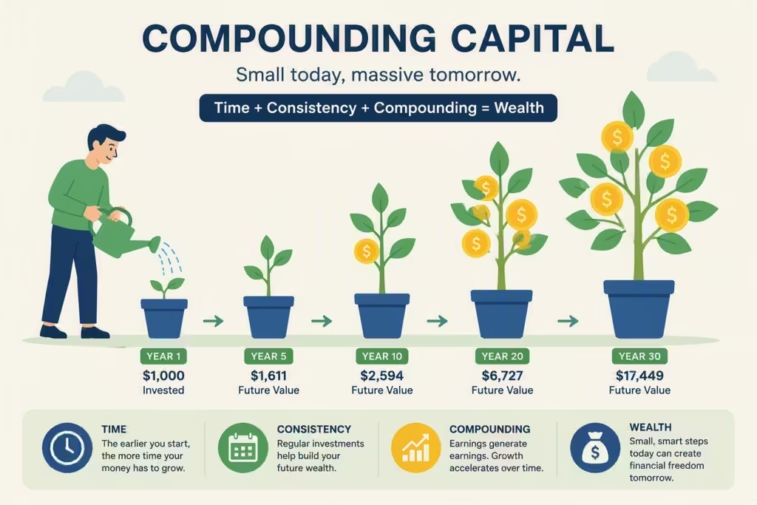
Compounding capital is the single most reliable force in building long-term wealth — and yet most people underestimate exactly how it works and how much time matters compared to how much money they start with. This guide breaks down what compounding capital actually means, the real math behind it, why 2026’s yield environment has changed the equation, and the specific mistakes that quietly destroy compounding for otherwise disciplined investors.
What Compounding Capital Actually Means
Compounding capital is the process of earning returns not just on your original investment, but on the accumulated returns that investment has already generated. Albert Einstein reportedly called compound interest the eighth wonder of the world, adding that those who understand it earn it, while those who don’t, pay it — a line that’s been repeated so often it risks sounding like a platitude, but the underlying math genuinely is that powerful.
The mechanism is simple once you see it laid out: in year one, you earn a return on your starting capital alone. In year two, you earn a return on both your original capital and on the gains from year one. In year three, you’re earning on your original capital plus two years of accumulated gains. Each year, the base your returns are calculated on grows — which is precisely why compounding accelerates over time rather than growing at a flat, steady rate.
The Math, Made Concrete
Abstract explanations of compounding rarely land the way a concrete number does. Consider a $10,000 investment earning 10% annually. In year one, that 10% return adds $1,000, bringing the balance to $11,000. In year two, that same 10% return is now calculated on $11,000, not $10,000 — producing $1,100 instead of $1,000. That extra $100 didn’t come from adding more money; it came purely from the previous year’s gains being put back to work.
A more dramatic illustration: offered a choice between $10,000 a day for 30 days, or a single penny that doubles in value every day for 30 days, most people instinctively take the flat $10,000 daily rate. But the doubling penny, despite looking trivial for the first two weeks, compounds to more than $5 million by day 30. The lesson isn’t that pennies are secretly valuable — it’s that exponential growth is deeply counterintuitive to how humans naturally estimate outcomes, and that gap in intuition is exactly why so many investors underestimate what disciplined, long-term compounding capital can actually deliver.
Why Time Matters More Than Almost Anything Else
The most consequential — and most consistently underestimated — variable in compounding isn’t your rate of return or even how much you invest. It’s time.
Consider two investors: a 25-year-old who invests $200 a month until age 65, versus a 45-year-old who invests $1,000 a month for 20 years. Despite contributing five times less per month, the 25-year-old will likely end up with more total wealth, purely because their capital has twice as long to compound. This is often summarized as a simple, uncomfortable truth: you can’t out-earn a late start. No later contribution size can fully substitute for lost compounding time, which is exactly why financial professionals so consistently emphasize starting as early as possible, even with small amounts, over waiting until you can invest a larger sum.
What “Compounding” Means Differently Across Asset Types
The word compounding gets used slightly differently depending on the type of investment, and understanding the distinction matters:
- Savings accounts and interest-bearing deposits compound in the most literal sense — a fixed interest rate is applied to a growing balance, with the interest itself starting to earn interest.
- Stock market investments compound less mechanically but arguably more powerfully over time: capital appreciation, reinvested dividends, and reinvested capital gains all combine to grow the base your future returns are calculated on, even though the year-to-year rate of return isn’t fixed or guaranteed the way a savings account’s is.
- Reinvested dividends specifically are one of the most underrated compounding levers available to equity investors — money that could be taken as cash income is instead used to purchase more shares, which then generate their own future dividends, accelerating the compounding cycle further.
Why 2026’s Environment Has Changed the Compounding Math
Compounding isn’t happening in a vacuum, and the broader rate environment genuinely affects how fast it works. With global yields running roughly in the 5% to 7% range in 2026, compounding capital is mechanically working faster than it did during the near-zero interest rate era of the previous decade — the same disciplined saving and reinvestment habits produce a meaningfully larger outcome purely because the underlying rate environment is more favorable than it’s been in years.
That said, the investing environment overall is also more selective than it was a few years ago. Major asset managers have pointed out that the period when nearly every investment seemed to pay off is behind us, with labor dynamics and AI-driven economic shifts now mattering more than inflation as the dominant forces shaping markets. The practical takeaway isn’t that compounding stopped working — it’s that the quality of what you’re compounding matters more now: durable income, strong balance sheets, and businesses with genuine staying power are increasingly what separates investors who benefit from a full market cycle of compounding from those who get knocked off track by volatility along the way.
The Mistakes That Quietly Destroy Compounding
Compounding is powerful specifically because it’s uninterrupted. A handful of common behaviors break that continuity, often without investors realizing how much long-term value they’re giving up:
Withdrawing Gains Along the Way
One of the most expensive financial decisions an investor can make is interrupting the compounding cycle by withdrawing accumulated gains partway through — cashing out returns for near-term spending rather than letting them continue compounding capital. The cost isn’t just the amount withdrawn; it’s every future year of growth that withdrawn amount would have generated had it stayed invested.
Letting Fees Quietly Erode the Base
A seemingly small difference in annual fees compounds negatively in exactly the same way returns compound positively. A 1% difference in annual fees can cost a long-term investor tens of thousands of dollars over a 30-year horizon — money that would otherwise have remained invested and continued compounding on itself.
Ignoring Taxes on Annual Gains
Taxes paid on dividends and capital gains each year act as a persistent brake on compounding, since taxed money is no longer part of the growing base. This is precisely why tax-advantaged accounts — IRAs, 401(k)s, and Health Savings Accounts among them — are considered foundational to a serious compounding strategy: in a tax-deferred account, gains aren’t taxed annually, meaning the full amount keeps compounding rather than being reduced each year.
Trying to Time the Market Instead of Staying in It
Compounding requires time in the market, not perfectly timed entries and exits. Automating consistent contributions — commonly through dollar-cost averaging — removes the temptation to guess at market timing, buying more shares when prices are low and fewer when prices are high, which smooths volatility while keeping the compounding process running continuously in the background.
How to Actually Put This Into Practice
A few concrete habits translate the theory of compounding into real results:
- Start now, regardless of amount. The math consistently favors an early, smaller start over a later, larger one — waiting to “invest more once you have more” is usually the more expensive choice in the end.
- Automate contributions. Removing manual decision-making from the process ensures consistency, which is what compounding depends on most.
- Reinvest everything you can. Dividends, interest, and capital gains left in the account — rather than withdrawn — are what keeps the compounding base growing.
- Minimize fees deliberately. Low-cost index funds and ETFs preserve far more of your long-term compounding potential than higher-fee actively managed alternatives, all else being equal.
- Use tax-advantaged accounts first. Sheltering gains from annual taxation lets compounding run uninterrupted for as long as legally possible.
- Resist withdrawing gains prematurely. Treat early withdrawals as a last resort, not a routine option, given how much future compounding each withdrawal quietly forfeits.
The Bottom Line
Compounding capital isn’t a clever trick or a niche strategy — it’s the basic mathematical engine behind nearly every significant long-term fortune, and it rewards exactly two behaviors: starting early and staying uninterrupted. The investors who benefit most from compounding aren’t necessarily the ones who pick the best individual stocks or time the market perfectly; they’re the ones who understand that time is the scarcest input in the equation, that fees and taxes quietly work against them every single year, and that the discipline to leave money invested — through volatility, through the temptation to withdraw gains, through market cycles that feel uncertain — is what ultimately separates modest returns from genuinely exponential wealth.