
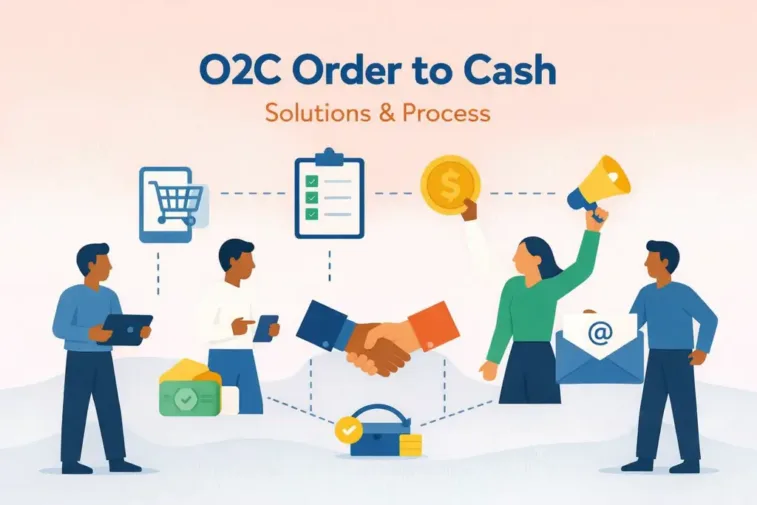
Boost efficiency with O2C Order to Cash solutions & Process for 2026. Streamline invoicing, payments & collections for higher CTR & revenue!
O2C Order to Cash Solutions & Process: 2026 Complete Guide
Streamline your O2C process in 2026 with end-to-end Order to Cash solutions. Boost efficiency, reduce delays & improve cash flow. Learn more now!
This comprehensive guide covers the entire O2C Order to Cash solutions & Process lifecycle, top automation platforms, AI innovations, and strategic best practices for 2026.
1. What is Order-to-Cash (O2C) in 2026?
Definition & Scope
Order-to-Cash (O2C) is the complete business cycle from customer order placement to payment collection and reconciliation. It encompasses every critical touchpoint in the revenue cycle, ensuring customer orders translate into actual cash flow.
The 2026 O2C Process Includes:
- Order Management: Capturing and validating purchase details
- Credit Management: Assessing customer creditworthiness and setting terms
- Order Fulfillment & Shipping: Picking, packing, and delivering products
- Invoicing: Generating and sending accurate bills
- Accounts Receivable: Monitoring payments and follow-ups
- Payment Collection: Processing payments and reminders
- Cash Reconciliation: Matching payments to invoices
- Revenue Recognition: Recording revenue upon delivery
- Customer Relationship Management: Feedback and issue resolution
- Data Analysis: KPI tracking and continuous improvement
Why O2C is Critical in 2026
Direct Business Impact:
- Cash Flow: Streamlined O2C accelerates payment collection by weeks; inefficient processes create costly delays
- Customer Satisfaction: Transparent, accurate billing and fulfillment strengthens relationships
- Operational Efficiency: Eliminates manual bottlenecks and reduces errors
- Competitive Advantage: Companies with efficient O2C processes outperform competitors on working capital metrics
The 2026 Imperative: With $3.1 trillion lost annually to manual process inefficiencies and 12 hours per week wasted on app-switching , O2C automation is no longer optional—it’s a strategic necessity.
2. Step-by-Step O2C Process Breakdown (2026)
Step 1: Order Management & Entry
Modern Channels: E-commerce platforms, direct sales, ERP integrations, EDI transactions (B2B), mobile apps.
Key Activities:
- Capture order details: Quantity, price, delivery date, specifications
- Validate information: Check customer data, product availability, pricing accuracy
- Route order: Automatically send to fulfillment team
- Credit check: Real-time credit approval for new and existing customers
2026 Automation: AI validates orders against historical patterns; flags anomalies (e.g., unusual quantities) before fulfillment.
Step 2: Credit Management
For New Customers:
- Credit bureau checks (Experian, Dun & Bradstreet)
- Financial statement analysis
- Trade reference verification
- Set credit limits and payment terms
For Existing Customers:
- Continuous monitoring of payment patterns
- Dynamic credit limit adjustments based on behavior
- Automated holds on accounts exceeding limits
2026 Innovation: AI-driven credit risk scoring that updates in real-time based on payment behavior and external data.
Step 3: Order Fulfillment & Shipping
Process Flow:
- Inventory allocation: Real-time reservation of stock
- Pick & pack: Warehouse management system (WMS) guided operations
- Quality control: Verify order accuracy before shipping
- Shipping coordination: Select optimal carrier, generate tracking
- Customer notification: Automated shipping confirmation with tracking
2026 Tech: IoT sensors track shipment conditions; blockchain verifies handoffs; autonomous vehicles for last-mile delivery.
Step 4: Invoicing
Best Practices:
- e-Invoicing: Electronic invoices delivered via email, portal, or EDI
- Accuracy: Automated validation against order and shipping data
- Timing: Invoice immediately upon shipment (or service completion)
- Clarity: Itemized charges, payment terms, due date, remittance instructions
2026 Mandate: Global e-invoicing compliance is critical—many countries now require electronic invoices with specific tax formats.
Step 5: Accounts Receivable & Collections
Collections Workflow:
- Payment monitoring: Track due dates and incoming payments
- Dunning: Automated reminders at 15, 30, 45 days past due
- Dispute handling: Flag and route invoice disputes for resolution
- Escalation: Legal action for extended non-payment
2026 Automation: AI-powered dunning cadences that optimize send times and personalize messages based on customer behavior.
Step 6: Payment Collection
Methods: ACH, virtual cards, checks, wires, PayPal, Stripe, BNPL (Buy Now, Pay Later).
Best Practices:
- Multiple options: Offer customers preferred payment methods
- Self-service portal: Branded portal for invoice access and payment
- Automated reminders: SMS, email, push notifications
- Early payment discounts: Dynamic discounting (e.g., 2/10 net 30)
Step 7: Cash Application & Reconciliation
Process:
- Payment receipt: Match incoming funds to invoices
- Auto-match: AI matches based on invoice number, amount, customer ID
- Exception handling: Investigate unmatched payments
- GL posting: Post to General Ledger in real-time
2026 AI: Autonomous cash application with 95-99% match rates; learns from historical patterns.
Step 8: Revenue Recognition
Criteria: Recognize revenue when performance obligation is satisfied (product delivered or service rendered).
Automation: ERP automatically triggers revenue recognition upon delivery confirmation, updating customer account and financial statements.
Step 9: Customer Relationship Management
Activities:
- Feedback collection: Post-order surveys
- Issue resolution: Address billing or delivery disputes promptly
- Account updates: Maintain accurate customer master data
2026 Focus: Customer portals provide transparency into order status, invoice history, and payment options—reducing inquiries by 70%.
Step 10: Data Analysis & Continuous Improvement
KPIs to Track:
- DSO (Days Sales Outstanding): Target <30 days
- Invoice accuracy: Target 99.5%+
- Collection period: Average days to payment
- First-pass yield: % of orders fulfilled without errors
- Customer satisfaction: NPS or CSAT scores
2026 Analytics: AI identifies bottlenecks (e.g., “shipping delays cause 5-day increase in DSO”) and suggests optimizations.
3. Top O2C Software Platforms: 2026 Rankings
1. Kolleno – AI-Powered O2C for Modern Finance Teams
Standout Feature: Unified AR and collections platform with AI agents and a branded customer payment portal.
Key Capabilities:
- End-to-end AR automation: Dunning workflows, task queues, dispute handling
- AI Agent & Copilot: Automates cash application, matches payments, reduces manual entry
- Branded payment portal: Multiple payment methods, statements, invoice access
- Credit risk management: Real-time credit checks and portfolio monitoring
- Native ERP integrations: NetSuite, QuickBooks, MS Dynamics, Xero, Sage (fast implementation)
G2 Rating: 4.9⭐
Ideal For: Businesses wanting to improve cash flow and cut DSO without hiring more collectors.
ROI: 71% reduction in overdue balance within 3-6 months (DNA Payments, 1Password, Deliverect case studies).
2. Esker – Unified O2C and Source-to-Pay
Standout Feature: Broad automation covering both O2C and procure-to-pay in one platform.
Key Capabilities:
- O2C suite: Digitizes orders, invoicing, collections, cash allocation
- AR automation: Strong OCR for invoice processing
- Integrated payments: Cash-flow management tools with visibility
- ERP connectors: Removes data silos, reduces manual rekeying
- Analytics: Collections performance and cash-flow trends
G2 Rating: 4.3⭐
Ideal For: Mid-market and larger organizations wanting one platform for AR, credit, collections, and order management across multiple entities.
3. HighRadius – Autonomous O2C for Complex AR
Standout Feature: “Autonomous Finance” platform with AI-driven O2C across credit, e-invoicing, collections, cash application, and deduction management.
Key Capabilities:
- AI-driven automation: Credit, invoicing, collections, cash application, deductions
- Autonomous cash application: High auto-match rates with exception management
- Cash forecasting: Uses transaction data for working capital visibility
- ERP integrations: 50+ ERPs (SAP, Oracle, Workday, Sage)
- Advanced analytics: Collections performance, dispute drivers, O2C KPIs
G2 Rating: 4.3⭐
Ideal For: Mid-market companies with enterprise-grade complexity needing deep automation and predictive analytics (longer implementation).
4. SAP Ariba – Network-Driven Invoicing & Payables
Standout Feature: Procure-to-pay and spend management with strong supplier network integration.
Key Capabilities:
- Buying & invoicing: Automates P2P workflows, reduces manual processing
- e-Invoicing: Global business network for electronic invoices (compliance-focused)
- Contract management: Controls supplier terms, monitors compliance
- ERP integrations: SAP and non-SAP systems; centralizes supplier, order, invoice data
- Audit trails: Strong compliance controls
G2 Rating: 4.1⭐
Ideal For: Businesses wanting tight control over the “cash out” side of O2C; strong for procurement integration.
5. Oracle Order Management Cloud – Core Order Orchestration
Standout Feature: Enterprise-grade order orchestration within the Oracle ecosystem.
Key Capabilities:
- Order orchestration: Manages complex order flows, configurations, fulfillment
- Global compliance: Multi-country, multi-currency, multi-language support
- Integration: Deep Oracle ERP, SCM, CRM connectivity
- Scalability: Handles millions of orders for global enterprises
Ideal For: Large enterprises already invested in Oracle Cloud (ERP, SCM, CX).
6. OpenText – B2B Integration & e-Invoicing
Standout Feature: Business Network Cloud connecting trading partners via secure EDI and APIs.
Key Capabilities:
- B2B integration: Exchanges O2C docs (POs, ASNs, invoices) across global supply chains
- e-Invoicing: Compliance with global mandates and tax regulations
- Customer integration: Seamless order processing, real-time communication, accelerated cycles
Ideal For: Companies with complex B2B trading partner networks requiring EDI/API connectivity.
4. Key Features to Look for in 2026 O2C Platforms
When evaluating O2C solutions, prioritize these capabilities:
- ✅ Strong ERP/Accounting Integrations: Native connectors for NetSuite, SAP, Sage, Xero, QuickBooks ensure clean data flows and accurate DSO tracking
- ✅ Automation Where Cash Moves: Automated invoice generation, payment reminders, cash application, and overdue routing
- ✅ Credit & Risk Controls: Real-time credit limits, exposure monitoring, customer risk scoring
- ✅ Dispute & Exception Handling: Capture and route disputes within O2C flow; track resolution to prevent stalls
- ✅ Customer-Friendly Payment Experience: Branded portals showing order status, invoices, and payment options
- ✅ Insight for Finance & Operations: Link O2C flow to inventory management and cash management for holistic visibility
- ✅ AI-Powered Collections: AI agents that optimize dunning cadences and personalize outreach
- ✅ Global e-Invoicing Compliance: Support for country-specific tax formats and mandates
5. Implementation Roadmap: 2026 Best Practices
Phase 1: Process Analysis (1-2 weeks)
Map Current State:
- Document each O2C step from order entry to payment reconciliation
- Identify bottlenecks (e.g., “invoices stuck in approval for 5 days”)
- Quantify errors (pricing mistakes, shipping delays)
- Survey stakeholders (sales, finance, customers) for pain points
Set Goals:
- Specific: “Reduce DSO from 45 to 30 days”
- Measurable: “Increase invoice accuracy to 99.5%”
- Time-bound: “Achieve within 6 months”
Phase 2: Platform Selection (2-3 weeks)
Vendor Evaluation:
- Demo with real scenarios (your orders, invoices, customers)
- Check references from similar-sized companies in your industry
- Assess AI capabilities (are they native or bolt-on?)
- Verify integration list (your ERP, banks, CRM)
Decision Matrix:
- Prioritize ERP compatibility and AI features
- Consider total cost: software + implementation + training
- Evaluate mobile capabilities for field sales/approvers
Phase 3: Configuration & Integration (4-8 weeks)
Technical Setup:
- Connect ERP: OAuth authentication; map order, invoice, customer fields
- Configure workflows: Credit approval rules, dunning cadences, payment terms
- Set up portals: Branded customer portal with payment methods
- Enable AI: Train models on 100+ historical orders/invoices
- Test end-to-end: Process 20-50 test orders through entire cycle
Change Management:
- Train sales on order entry automation (4 hours)
- Train finance on collections AI and workflows (8 hours)
- Train approvers on mobile/email approvals (2 hours)
- Document procedures for exceptions and disputes
Phase 4: Pilot & Go-Live (2-4 weeks)
Soft Launch:
- Start with one product line or customer segment
- Run parallel with old process for 2 weeks
- Monitor KPIs daily: DSO, invoice accuracy, match rate
Full Rollout:
- Phased rollout by region or business unit
- Maintain old system access for 30 days as backup
- Celebrate early wins (e.g., “DSO reduced by 10 days!”)
Phase 5: Optimization (Ongoing)
Continuous Improvement:
- Monthly: Review KPI dashboard; identify bottlenecks
- Quarterly: Retrain AI models; adjust credit limits
- Annually: Audit O2C compliance; update workflows
6. 2026 Best Practices for O2C Excellence
Embrace AI-First Automation
- Start with collections: AI dunning increases recovery rates by 25%
- Enable outlier detection: Flag unusual orders before fulfillment
- Use Copilot: Ask natural language questions (“Which customers are 30 days overdue?”)
- Measure AI ROI: Track time saved, error reduction, DSO improvement
Integrate End-to-End
- ERP sync: Real-time data flow prevents manual rekeying
- CRM connection: Sales sees payment status; finance sees order history
- Bank feeds: Automated payment matching reduces cash application time
- Inventory system: Prevents overselling and stockouts
Optimize Credit Management
- Real-time scoring: Update credit limits monthly based on payment behavior
- Dynamic terms: Offer 2/10 net 30 to high-risk customers to accelerate payment
- Automated holds: Flag orders when account exceeds credit limit
Enhance Customer Experience
- Self-service portal: Let customers track orders, download invoices, make payments
- Multiple payment options: ACH, card, PayPal, BNPL
- Proactive communication: Send delivery updates, payment reminders before due date
- Dispute portal: Capture and resolve disputes within O2C flow
Monitor & Enforce Compliance
- e-Invoicing mandates: Ensure compliance by country (e.g., Italy, Brazil)
- Audit trails: Log every order change, approval, payment with user/timestamp
- Revenue recognition: Automate ASC 606/IFRS 15 compliance
- Tax calculation: Real-time VAT/GST based on jurisdiction
7. Common O2C Challenges & Solutions (2026)
Challenge 1: Manual Errors & Inefficiencies
Symptoms: Incorrect pricing, quantity mistakes, wrong shipping info, data entry delays
Solutions:
- Automated validation: AI checks orders against master data (customer, product, pricing)
- OCR accuracy: 99% extraction from PDF/email orders
- Integration: Sync ERP, WMS, CRM to eliminate rekeying
Challenge 2: Credit Risk Management
Symptoms: Bad debt write-offs, cash flow disruptions, outdated credit info
Solutions:
- AI monitoring: Continuous tracking of payment patterns
- Automated approvals: Consistent criteria for credit limits
- Early warning: AI flags high-risk accounts before they go overdue
Challenge 3: Delayed Collections & System Silos
Symptoms: Extended collection cycles, inadequate follow-up, disconnected sales/finance systems
Solutions:
- Automated dunning: AI-optimized reminder cadences
- Integrated O2C platform: Single view of order, invoice, payment data
- Self-service portal: Customers pay without AP staff involvement
Challenge 4: Integration Complexities
Symptoms: Incompatibilities between ERP, CRM, billing platforms cause delays
Solutions:
- API-first platforms: Choose solutions with pre-built connectors
- Middleware: Use iPaaS (Workato, Make) to bridge legacy systems
- Data mapping: Document field mappings; maintain during ERP upgrades
Challenge 5: Resistance to Change
Symptoms: Employees distrust automation; revert to manual processes
Solutions:
- Involve teams: Include sales, finance, operations in planning
- Transparent documentation: Show how automation reduces their tedious work
- Change champions: Identify early adopters to evangelize benefits
- Celebrate wins: Share KPI improvements (e.g., “DSO down 10 days!”)
8. KPIs & Metrics: Measuring O2C Success (2026)
Primary Metrics:
| KPI | Target (2026) | Calculation |
|---|---|---|
| DSO (Days Sales Outstanding) | <30 days | (Receivables ÷ Annual Sales) × 365 |
| Invoice Accuracy | 99.5%+ | (Accurate Invoices ÷ Total Invoices) × 100 |
| First-Pass Yield | 95%+ | (Orders Fulfilled Without Errors ÷ Total Orders) × 100 |
| Collection Period | <30 days | Average days from invoice to payment |
| Match Rate | 95%+ | (Auto-Matched Payments ÷ Total Payments) × 100 |
| Customer Satisfaction (CSAT) | >80% | Post-order survey scores |
Real-Time Dashboards: Track these KPIs live in O2C platforms; set alerts when thresholds breached.
9. ROI & Cost Analysis: 2026 Framework
Mid-Market O2C ROI Example
Baseline (Manual Process):
- Volume: 1,000 orders/month, 1,000 invoices/month
- DSO: 45 days = $1.5M tied up in receivables
- Labor: 5 FTEs (order entry, invoicing, collections) @ $50K = $250K/year
- Errors: 5% error rate × $100/invoice correction = $60K/year
- Late payments: 10% of invoices paid late = $30K/year in interest opportunity cost
Total Annual Cost: $340K + $1.5M cash tied up
After O2C Automation (Kolleno):
- DSO: 30 days = $1M receivables ($500K cash freed up)
- Labor: 2 FTEs (AI handles 80% of work) = $100K/year
- Errors: 0.5% error rate = $6K/year
- Late payments: 2% of invoices late = $6K/year
- Software cost: $30K/year
Total Annual Cost: $142K + $1M receivables
Net Savings: $198K/year labor + $500K cash freed + $54K error reduction = $752K totalImplementation cost: $50K Payback period: 2.4 months
10. 2026 Trends & Future-Proofing
AI Agents as O2C Orchestrators
2026 Shift: AI agents will autonomously manage entire O2C cycles:
- Predict order volumes and adjust inventory
- Negotiate payment terms with customers based on risk
- Self-heal broken workflows by rerouting exceptions
Quote-to-Cash (Q2C) Integration
Trend: Seamless flow from initial customer inquiry through payment collection. Q2C platforms (e.g., Zuora) integrate CPQ, contract management, billing, and revenue recognition.
Agentic Commerce
Emerging: AI agents discover and purchase from each other via APIs, requiring O2C systems to support machine-to-machine transactions without human intervention .
Composable O2C Architecture
2026 Best Practice: API-first approach allows swapping:
- Order capture (Shopify → BigCommerce)
- Billing engine (Stripe → Zuora)
- Collections (Kolleno → HighRadius) Without reimplementing entire O2C stack .
Sustainability & ESG Tracking
New Requirement: O2C systems track:
- Carbon footprint per order (shipping method, packaging)
- Supplier ESG compliance
- Sustainable financing eligibility based on green order practices
11. Expert Recommendations by Role
For CFOs: Strategic O2C Leadership
- ✅ Invest in AI-native platforms: Kolleno, HighRadius deliver measurable ROI
- ✅ Unify O2C: Break down silos between sales, finance, operations
- ✅ Track cash conversion: Monitor DSO weekly; target <30 days
- ✅ Scenario planning: Use what-if models for funding decisions
For Controllers: Compliance & Accuracy
- ✅ Automate revenue recognition: Ensure ASC 606/IFRS 15 compliance
- ✅ Audit trails: Log every order change, approval, payment
- ✅ Credit governance: Review credit limits quarterly; automate holds
- ✅ e-Invoicing: Stay ahead of global mandate changes
For Sales Leaders: Customer Experience
- ✅ Self-service portal: Let customers track orders and pay invoices
- ✅ Real-time visibility: Give sales access to payment status
- ✅ Dispute portal: Resolve billing issues within O2C flow
- ✅ Collaborative approvals: Use in-context comments on invoices
For Operations: Fulfillment Excellence
- ✅ Inventory sync: Real-time integration prevents overselling
- ✅ EDI/API: Automate order intake from B2B customers
- ✅ Quality control: Scan orders before shipping to reduce returns
- ✅ Carrier integration: Automated tracking updates to customers
For IT: Integration & Scalability
- ✅ API-first: Choose platforms with robust, well-documented APIs
- ✅ Composable stack: Avoid vendor lock-in; enable module swapping
- ✅ Security: SOC 2 Type II, OAuth 2.0, MFA mandatory
- ✅ Monitoring: Set up alerts for sync failures and workflow bottlenecks
Key Takeaways for 2026
- O2C is a strategic differentiator: Efficient processes accelerate cash flow and improve customer satisfaction
- AI is essential: Native AI for collections, credit risk, and cash application delivers immediate ROI
- Integration is non-negotiable: ERP, CRM, billing, and bank connectivity must be real-time
- Customer portal is mandatory: Self-service reduces inquiries by 70% and accelerates payment
- e-Invoicing compliance is critical: Global mandates require automated, compliant invoicing
- ROI is rapid: 2-4 month payback for mid-market implementations
- Future is agentic: AI agents will orchestrate entire O2C cycles autonomously by 2027
For the latest O2C innovations, monitor Kolleno’s AI roadmap and HighRadius autonomous finance updates, or consult with a certified O2C implementation partner for enterprise deployments.