
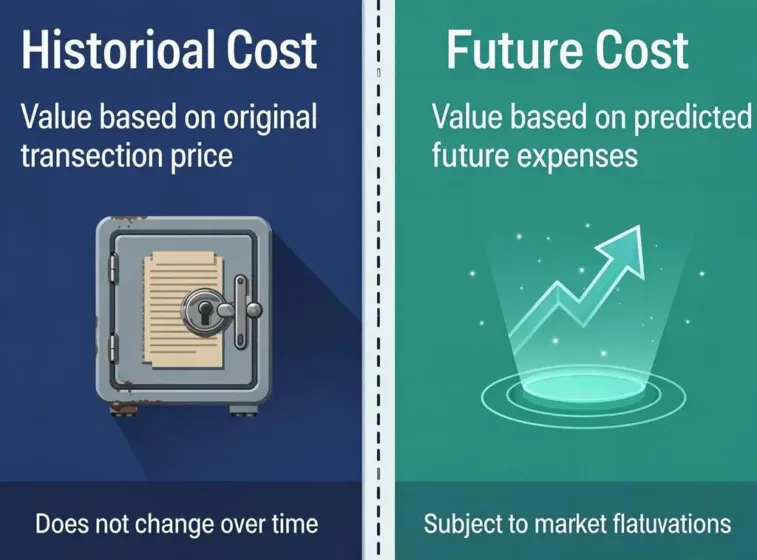
Understand Future Cost and Historical Cost; Future cost of capital refers to the expected cost of funds to be raised to finance a project. In contrast, historical cost represents cost incurred in the past in acquiring funds. In financial decisions, future cost of capital is relatively more relevant and significant. While evaluating the viability of a project, the finance manager compares expected earnings from the project with an expected cost of funds to finance the project.
Here are explained; What is the Future Cost and Historical Cost?
Future Cost and Historical Cost; Likewise, in making financing decisions, the attempt of the finance manager is to minimize the future cost of capital and not the costs already defrayed. This does not imply that historical cost is not relevant at all. In fact, it may serve as a guideline in predicting future costs and in evaluating the past performance of the company.
Future cost: Future costs are based on forecasts. The costs relevant for most managerial decisions are forecasts of future costs or comparative conjunctions concerning future situations. An estimated quantification of the amount of a prospective expenditure. Forecasting of future costs is required for expense control, the projection of future income statements; appraisal of capital expenditures, the decision on new projects and on an expansion programme and pricing.
Historical Cost: Historical cost is an accounting method in which the assets of the firm are recorded in the books of accounts at the same value at which it was first purchased. Cost and historical cost usually mean the original cost at the time of a transaction. The historical cost method is the most widely used methods of accounting as it is easy for a firm to ascertain what price was paid for the asset.
📋 Future Cost and Historical Cost – Here’s the clearest way to think about it:
- Historical cost = what you DID pay (past, used in financial reporting).
- Future cost = what you EXPECT to pay (future, used for decisions and budgets).
I’ll break both (Future Cost and Historical Cost) down, show how they’re used in practice, and compare them with examples.
Quick comparison: Future Cost and Historical Cost
| Aspect | Historical cost | Future cost |
|---|---|---|
| Time direction | Past: already incurred | Future: yet to be incurred |
| Main use | Financial reporting (balance sheet, income statement) | Management decisions, budgets, forecasts, pricing, make-or-buy |
| Measurability | Verifiable from invoices and contracts | Estimated; requires judgment and assumptions |
| Role in decisions | Usually irrelevant (sunk) for future decisions | Central to relevant-cost analysis if it differs by option |
| Standards | Embedded in GAAP/IFRS as “cost” measurement basis | Not a formal measurement base in GAAP/IFRS; a managerial concept |
| Example | Purchase price of a machine bought in 2021 | Expected maintenance cost next year; cost of a future project |
High-level relationship (diagram); Future Cost and Historical Cost

1. What is Historical Cost?
Definition
- Historical cost is the original cash or cash-equivalent amount paid to acquire an asset or incur a liability at the time of the transaction. It’s a “past” cost based on actual transactions.
- Under the IFRS Conceptual Framework, historical cost is one of the two broad measurement bases (the other is current value), and it is the most commonly used basis in practice. IFRS Standards typically use a mixed measurement system, with many items recorded at historical cost and then adjusted for depreciation, impairment, etc.
Key characteristics
- Based on actual transaction price (invoice, contract).
- Recorded at acquisition and usually not subsequently adjusted for changes in market value (except where standards require revaluation, impairment, or amortized cost).
- Highly verifiable and objective, which supports reliability in financial reporting.
Simple example
- On 10 March 2026, a company buys a machine for:
- Invoice price: $100,000
- Delivery and installation: $5,000
- Setup costs: $2,000
- Historical cost of the machine = $100,000 + $5,000 + $2,000 = $107,000. This amount is recorded as an asset (Property, Plant & Equipment) and then depreciated over its useful life.
Where you see historical cost in accounting
- Non-current assets: PPE, intangible assets, investment property usually initially measured at cost (historical cost).
- Inventory: measured at cost (including purchase price, conversion costs) unless net realizable value is lower.
- Many financial liabilities: initially measured at the proceeds received (historical consideration), with subsequent measurement using effective interest (amortized cost).
Why historical cost is used in financial reporting
- Reliability: Because it’s based on actual transactions, it’s objective and easier to audit.
- Comparability over time: Transactions are recorded at original amounts, which helps track the original outlay.
- Simplicity and cost-effectiveness: Easier and cheaper to implement than continual revaluation to fair value.
Limitations of historical cost
- It doesn’t reflect current market value.
- A building bought decades ago may be carried at $1 million when its market value is now $5 million.
- In inflationary environments, historical cost can significantly understate the economic value of assets.
- Mixing historical cost and current values (as IFRS often does) can make some statement totals harder to interpret, though the trade‑off is generally considered acceptable for relevance.
2. What is Future Cost?
Definition
- Future cost is an expected cost that has not yet been incurred. It represents cash outflows (or resource consumption) that will happen if a particular course of action is undertaken. It is a forward‑looking concept used primarily in management accounting and decision-making.
- In decision-making, “relevant costs” are a subset of future costs: those future costs that differ between alternatives and affect cash flows. Costs that do not differ are irrelevant for that decision.
Key characteristics
- Forward-looking: based on estimates, forecasts, and assumptions.
- Decision-oriented: used for budgets, pricing, capital investment, make-or-buy, and other choices.
- May include:
- Expected outlay costs (materials, labour, overhead).
- Avoidable fixed costs.
- Opportunity costs (benefits foregone from the next best alternative).
Simple examples
- Budgeting:
- You estimate next year’s raw material cost will be $500,000 based on expected prices and production volume.
- This $500,000 is a future cost used in the budget.
- Make-or-buy decision:
- Making a part in-house next year is expected to cost $12 per unit (future cost).
- Buying from a supplier is expected to cost $10 per unit (future cost).
- The difference ($2 per unit) is a relevant future cost for the decision.
- Capital budgeting:
- A new machine is expected to require:
- Purchase price: $120,000 (future outlay).
- Annual maintenance: $5,000 for each of the next 5 years (future costs).
- These expected future cash flows are used to evaluate whether the investment is worthwhile.
- A new machine is expected to require:
3. How Future Cost and Historical Cost are used differently
Financial reporting (external) → mainly historical cost
- The balance sheet and income statement are largely built on transaction-based, historical cost numbers (adjusted for depreciation, impairment, amortization, etc.).
- Purpose: to provide objective, verifiable information about what actually happened.
- Example:
- Land purchased in 2015 for $200,000 is shown at $200,000 (cost) unless it is revalued under an applicable standard (e.g., certain models under IFRS for investment property).
Management accounting (internal) → mainly future costs
- Budgets and forecasts:
- Revenue, expenses, and capital expenditures projected for future periods.
- Decision-making:
- Relevant cost analysis focuses on future costs and revenues that will differ between alternatives.
- Example:
- When deciding whether to discontinue a product, you consider future revenues and future avoidable costs, not the historical cost of equipment bought years ago. Historical cost may be relevant only to the extent of future disposal proceeds or tax effects.
Performance evaluation and control
- Budget vs actual: compares actual results (which become historical once incurred) with the budget (which was based on future cost estimates).
- Variance analysis: examines differences between expected (future) costs and actual (historical) costs to control operations.
4. Future Cost and Historical Cost in decisions
Sunk cost trap: why historical cost is usually irrelevant
- A sunk cost is a historical cost that has already been incurred and cannot be recovered by future decisions. Rational decision-making should ignore sunk costs and focus on future costs.
Example:
- A company spent $50,000 (historical cost) developing a new product.
- The market changed; expected future sales will generate only $30,000 of future contribution.
- The $50,000 is sunk; the decision should be based on whether the future benefits ($30,000) exceed the additional future costs needed to launch, not on the past $50,000.
When historical cost can indirectly inform future cost estimates
- While historical cost itself is past, it provides data to estimate future costs:
- Past actual labour rates help forecast future labour costs.
- Past material usage patterns help budget future material quantities.
- So historical records feed the forecasting process, but the amounts used in decisions are future estimates, not the old historical numbers.
A side-by-side decision example
- Scenario: A company is deciding whether to replace an old machine with a new one.
| Item | Historical cost (old machine) | Future cost (relevant to decision) |
|---|---|---|
| Old machine’s purchase price | $80,000 (paid 5 years ago; sunk) | Ignored for decision (sunk) |
| Old machine’s disposal value | — | Estimated sale proceeds now: $5,000 (future cash inflow) |
| New machine’s price | — | Purchase price: $120,000 (future cash outflow) |
| Operating costs | Past year’s maintenance: $3,000 | Expected annual operating cost of old vs new machine (future outlays) |
| Savings/costs | — | Expected labour savings with new machine: $10,000 per year (future) |
- Here, the decision uses:
- Future savings and future outlays (including disposal value),
- Not the historical $80,000 cost of the old machine (except perhaps for tax depreciation effects, which can create future tax cash flows).
5. Treatment under IFRS/GAAP: historical cost as a measurement basis
- IFRS Conceptual Framework:
- Identifies two broad measurement bases: historical cost and current value (e.g., fair value).
- Notes that a single measurement basis would not always provide the most relevant information, so IFRS uses a mixed measurement model.
- Historical cost remains the most commonly used basis, particularly for PPE and many intangibles, often combined with impairment testing.
- Under US GAAP:
- Historical cost is also the primary basis for most assets, with exceptions like certain financial instruments measured at fair value.
- In simple terms:
- “Historical cost” is a formal measurement basis in the accounting framework.
- “Future cost” is not a formal measurement base in GAAP/IFRS; it’s a managerial concept used internally.
6. Common pitfalls to avoid
- Confusing “book value” (carrying amount based on historical cost less depreciation) with “current value” or “replacement cost” when making decisions.
- Treating historical cost as relevant to a future decision (sunk cost fallacy).
- Assuming all future costs are relevant:
- Future costs that do NOT differ between alternatives are irrelevant for that particular decision (e.g., allocated fixed overhead that will be incurred regardless).
- Mixing financial reporting numbers (historical) with decision numbers (future) without clearly labelling them:
- This can cause miscommunication between accountants and managers.
7. Short “exam-style” summary
- Historical cost:
- The original cash or cash equivalent amount paid at acquisition.
- Used as the initial measurement basis for assets and liabilities under GAAP/IFRS.
- Reliable and verifiable but may not reflect current market values.
- Future cost:
- Expected cost to be incurred in future periods.
- Central to budgets, forecasts, and relevant-cost analysis in decision-making.
- Only future costs that differ between alternatives are relevant for a given decision.
- Key relationship:
- Financial reporting primarily uses historical costs.
- Management decisions primarily use future costs (and benefits).
- Historical cost data are useful mainly to help estimate future costs and to evaluate past performance.
Future Cost and Historical Cost – If you want, I can next:
- Work through numerical examples (make-or-buy, special order, keep-or-drop) highlighting which costs are historical (sunk) and which are future (relevant), or
- Contrast historical cost with “current cost”/replacement cost in more detail.