
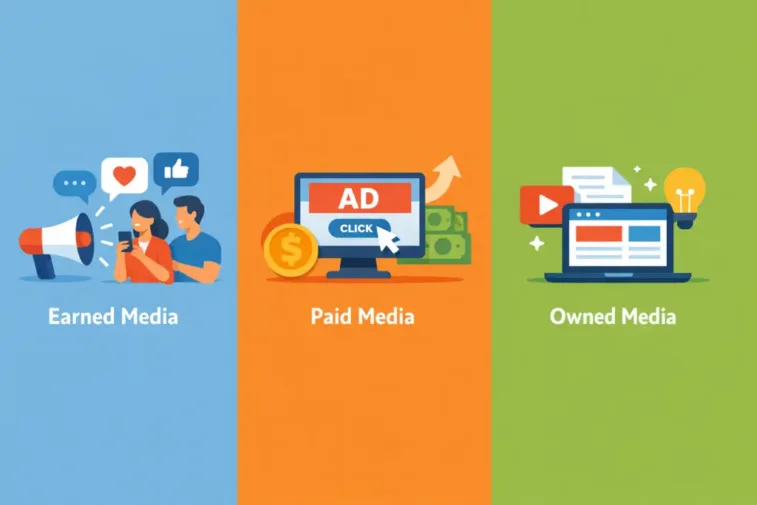
Drive traffic & boost sales. Master the difference between earned media vs paid media vs owned media. Find the best strategy for your business goals.
2026 Complete Guide: Earned Media vs Paid Media vs Owned Media
Earned Media vs Paid Media vs Owned Media differences? Discover the key differences and learn which channel delivers the highest ROI for your marketing strategy.
📋 Here’s a clear, 2026-ready guide to earned media vs paid media vs owned media — with definitions, examples, pros/cons, and how to combine them effectively.
Quick summary (the short version)
- Owned media = channels you control: your website, blog, email list, app, and your brand’s social accounts. You decide the message and placement.
- Paid media = placements you pay for: search ads, social ads, sponsored content, retail media, connected TV, etc. You buy reach and targeting.
- Earned media = exposure you earn from others: press coverage, reviews, social mentions, shares, recommendations. You don’t own or pay for the placement; it’s organic word-of-mouth.
- In 2026, the best strategies integrate all three (often via the PESO model: Paid, Earned, Shared, Owned), with AI search, social commerce, and authenticity playing much bigger roles.
High-level picture: how the three work together
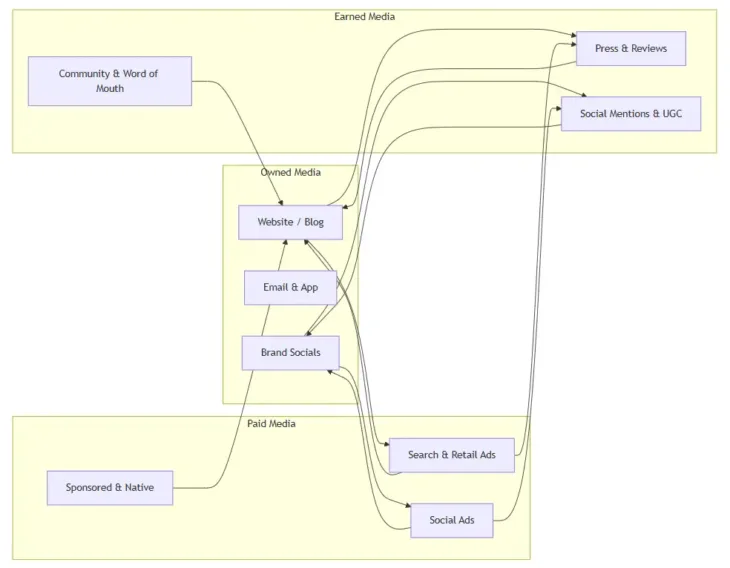
Think of it as a system:
- Owned is your “home base” (where you want traffic to land and convert).
- Paid turbocharges reach and targeting to send people to your owned properties and can spark earned media.
- Earned builds trust and credibility, which makes both paid and owned more effective.
1. Owned media: your brand’s home base
Definition
Owned media is digital content your company creates and controls: website, blog, emails, and your brand’s social posts. A key goal is to appear prominently in organic search so people can find you without you paying per click.
Typical examples
- Your website (including product/landing pages).
- Your blog and resource hub (articles, guides, white papers).
- Email/newsletter lists.
- Your brand’s social media accounts (LinkedIn company page, Instagram profile, X account, YouTube channel, etc.).
- Your mobile app and webinars you host.
- Podcast you produce and control.
Key characteristics
- You control: message, design, timing, and placement.
- It’s “always on” — an asset you build over time.
- Primary cost is time and people (content, SEO, product/marketing), not media spend.
- Strong SEO- and brand-building engine: good owned content supports search visibility and nurtures prospects across the funnel.
Pros
- Full control over brand and message.
- Compounding returns: great content keeps bringing organic traffic and leads over time.
- Improves with SEO: well-optimized owned content ranks and captures intent without recurring ad costs.
- Critical hub: all other media (paid and earned) ideally point here where you control the experience.
Cons
- Slow to scale at first; you need ongoing content and SEO work.
- Success depends heavily on quality and relevance; no media spend can fix weak content.
- You’re still subject to platform algorithms (e.g., organic social reach) and SEO changes.
2. Paid media: reach you buy
Definition
Paid media is any marketing effort where you pay to display promotional content across social media, search engines, or other websites. It commonly includes paid search and display advertising.
Typical examples (2026 edition)
- Search ads: Google Ads, Microsoft Ads text ads and Shopping ads.
- Social ads: Meta (Facebook/Instagram), TikTok, LinkedIn, X, Pinterest, Snapchat ads.
- Retail media networks: Amazon Ads, Walmart Connect, other retailer ad platforms. These are growing fast and powered by first-party purchase data.
- Sponsored/native content: branded articles, “recommended for you” widgets (e.g., Taboola/Outbrain), sponsored newsletter spots.
- Connected TV (CTV) and streaming ads (including shoppable overlays).
- Influencer/creator partnerships where you pay for posts, videos, or lives.
- AI-driven ad platforms and “autonomous” campaign systems that optimize targeting and creative.
Key characteristics
- You pay for placement and reach.
- You control targeting (who, when, where), budget, and creative.
- Reach is immediate and scalable, but stops when you stop paying (unless you convert people into owned/earned channels).
- Increasingly AI-optimized and automated in 2026.
Pros
- Speed and scale: you can launch a campaign and reach thousands or millions in hours.
- Precise targeting: by demographics, interests, behavior, intent keywords, lookalikes, retargeting, etc.
- Measurability: strong tracking for impressions, clicks, conversions, ROAS.
- Great for:
- Launches and promotions.
- Retargeting.
- Testing messages and creative at scale.
- Competing in high-intent environments (search, retail media).
Cons
- Ongoing cost; performance can drop once budgets stop.
- Rising CPCs in core channels like search as AI-mediated search changes user behavior and competition.
- Privacy and signal loss are pushing reliance on first-party data and walled gardens (e.g., retail media, social platforms).
- Ad fatigue and skepticism; consumers increasingly tune out or avoid “ad-y” content.
3. Earned media: trust you earn
Definition
Earned media is public exposure through word of mouth, customer reviews, social media mentions, or media coverage that results from your content or service quality and relevancy. Unlike paid and owned, it originates organically outside your company — it’s neither paid for nor owned by you.
Typical examples
- Press and media coverage: news articles, features, round-ups in trade or mainstream outlets.
- Reviews and ratings: Google reviews, Trustpilot, G2, App Store/Google Play, Yelp, TripAdvisor.
- Social mentions and tags: people posting about you, tagging you, or discussing your brand on TikTok, LinkedIn, X, Instagram, Reddit, etc.
- Shares and reposts of your owned content.
- User-generated content (UGC): unboxing videos, how-to posts, memes, testimonials created by users.
- Podcast/radio/TV appearances where you’re featured (without paying for the slot).
- Community word-of-mouth: recommendations in Slack/Discord communities, forums, and private groups.
- Positive mentions in newsletters, blogs, or influencer content that you didn’t pay for.
Key characteristics
- You don’t control the message or placement; others do.
- Highly trusted: people place far more trust in personal recommendations than in ads — Nielsen data shows 88% trust recommendations from people they know.
- Can amplify credibility and reach dramatically at no direct media cost.
- Often plays a bigger role closer to purchase decisions (consideration/decision stages).
Pros
- High trust and authenticity; third-party validation is powerful.
- Can go viral and reach audiences beyond your usual target.
- Supports SEO: media coverage often includes backlinks; reviews and social signals can indirectly influence search visibility.
- Feeds into paid and owned: use quotes, logos, and UGC in ads and on-site to boost conversion.
Cons
- Unpredictable: you can’t guarantee coverage or sentiment.
- Negative earned media (bad reviews, scandals) spreads fast and needs active management.
- Requires real relationship-building (with journalists, creators, communities) and consistently good products/experiences.
- Takes time to build momentum.
4. Direct comparison: earned vs paid vs owned
Earned Media vs Paid Media vs Owned Media: Here’s a concise comparison:
- Control:
- Owned: highest. You control message and placement.
- Paid: high, but constrained by budget and platform rules.
- Earned: lowest. You influence but don’t control.
- Cost structure:
- Owned: mostly internal (people, tools, production); not per-impression.
- Paid: direct media spend (CPC, CPM, CPA); scales with budget.
- Earned: no media cost, but requires investment in PR, product, community, and sometimes influencer partnerships.
- Primary role in the funnel:
- Owned: works across the funnel — discovery (SEO), consideration (content, social), and conversion (landing pages, emails).
- Paid: strongest at the top (awareness) and for retargeting mid-to-bottom funnel.
- Earned: especially powerful at consideration and decision stages, where recommendations and reviews tip choices.
- Trust:
- Owned: moderate (people know it’s your voice).
- Paid: lower (it’s clearly an ad).
- Earned: highest (perceived as unbiased or peer-driven).
- Speed to impact:
- Owned: slower; builds over time.
- Paid: fast; immediate reach and feedback.
- Earned: variable; can be slow or sudden (viral hit or PR crisis).
- Measurement:
- Owned: traffic, engagement, conversions, SEO rankings, content performance.
- Paid: impressions, clicks, conversions, ROAS, cost per acquisition.
- Earned: mentions, sentiment, share of voice, referral traffic, influence on conversions (often tracked via surveys or attribution models).
5. How the landscape is changing in 2026
Earned Media vs Paid Media vs Owned Media: A few 2026-specific shifts reshape how earned media vs paid media vs owned media interact:
- AI and “agentic” search:
- Discovery is moving from traditional search queries to AI-mediated recommendations. People ask ChatGPT or other LLMs for recommendations instead of clicking through pages of results.
- For paid: broad keyword bidding is becoming less efficient; the focus shifts to high-intent terms and precise audiences.
- For owned: structured, machine-readable data and clear, authoritative content help AI systems understand and recommend you (some call this “GEO” — generative engine optimization).
- For earned: mentions in credible outlets, reviews, and positive community sentiment may feed into AI answers and recommendations.
- Retail media networks & on-platform commerce:
- Retail media (Amazon Ads, Walmart Connect, etc.) is one of the fastest-growing ad channels, driven by first-party purchase data.
- Social commerce crosses $100B in the US in 2026, with TikTok Shop alone at ~$23B; shoppable video and live shopping become more default.
- Implication: more purchasing happens on platforms you don’t own (marketplaces and social apps). Your owned presence (e.g., website) may not always be the final purchase point, but it still matters for brand, storytelling, and reviews.
- Authenticity and AI overload:
- AI content is everywhere, so “raw,” human-feeling content is outperforming overly polished, AI-perfect creative.
- This amplifies the value of earned media and UGC as trusted, human signals.
- Brands that lean into authenticity in both owned and paid creative tend to see better engagement and trust.
- Social media trends:
- Social is becoming a first-party data and research engine (social intelligence).
- “Search-first” behavior means your owned and paid content on social must be optimized for discovery and answer-style content.
- Creator/influence partnerships are increasingly ROI-focused; lines between paid (sponsored creator posts) and earned (organic creator love) are important to manage clearly.
6. When to prioritize each type (with simple rules of thumb)
Earned Media vs Paid Media vs Owned Media: Use this as a practical guide:
- Prioritize Owned when:
- You want long-term, compounding assets (SEO, content library, brand story).
- You need a reliable hub to capture demand from all other channels.
- You’re in a trust-sensitive category where detailed information and education matter.
- Prioritize Paid when:
- You need immediate reach or are launching something new.
- You want precise targeting or retargeting (e.g., cart abandoners, high-intent searchers).
- You’re testing offers, messages, or creative at scale.
- You’re competing in heavy-auction channels like search or retail media and can’t rely on organic alone.
- Prioritize Earned when:
- You need credibility and social proof to close deals.
- You want to stand out in saturated markets where ads look the same.
- You have strong stories, data, or customers worth talking about.
- You’re managing or rebuilding reputation (crisis response, trust repair).
In practice, you rarely “prioritize” just one — you balance them.
7. Putting it together: a simple 2026 framework
Earned Media vs Paid Media vs Owned Media: Think in terms of three loops:
- Owned → Paid → Earned
- Create strong owned content (campaign pages, research, stories).
- Use paid to promote that content to the right audiences quickly.
- If the content resonates, people share it, journalists pick it up, and creators talk about it — that’s earned.
- Earned → Owned → Paid
- Earned coverage (press, reviews, UGC) builds trust.
- Capture that on your owned properties (logos on your site, review widgets, case studies).
- Use the best earned messages and assets in your paid ads (“As seen in…”; real customer quotes).
- Paid → Earned
- Paid amplification can kickstart earned loops: promote a video, it gains views, people start discussing and creating their own versions or responses — organic earned activity follows.
Earned Media vs Paid Media vs Owned Media: A simple planning question: “For this campaign, how will each media type help, and how do they feed each other?”
8. Example scenarios
- B2C DTC brand launching a new product:
- Owned: New landing page, blog story, email sequence.
- Paid: TikTok/Instagram ads, Meta retargeting, Google Shopping, Amazon ads.
- Earned: Send product to creators and journalists; encourage reviews; share UGC from early customers; respond to comments and posts to fuel conversation.
- B2B SaaS company:
- Owned: In-depth guide, research report, webinars, case studies.
- Paid: LinkedIn sponsored content, search ads for high-intent terms, retargeting.
- Earned: Thought leadership quotes in trade press, guest posts, podcast interviews, reviews on G2, customer advocacy on LinkedIn.
- Local service business:
- Owned: Website with clear service pages, FAQs, and a blog; Google Business Profile.
- Paid: Local search ads, social ads targeting the geography, retargeting site visitors.
- Earned: Google reviews, mentions in local community groups, word-of-mouth referrals, local press features.
9. Common mistakes to avoid
- Over-relying on paid and underinvesting in owned:
- You keep paying for traffic but have nowhere compelling to send it or no way to nurture without more ad spend.
- Expecting earned media for free:
- Earned requires investment in relationships, product quality, and often support (PR, community management, review programs). It’s not “free” even if there’s no media buy.
- Treating the three as silos:
- The best teams plan campaigns where earned media vs paid media vs owned media are designed together from day one and feed each other.
- Ignoring 2026 shifts:
- Overlooking AI/LLM discovery and retail media.
- Using overly polished, generic creative instead of authentic, human-feeling content.
Earned Media vs Paid Media vs Owned Media: If you tell me your industry (e.g., B2B SaaS, DTC ecommerce, local services) and your main goal (awareness, leads, sales, trust), I can turn this into a concrete, prioritized mix of earned, paid, and owned actions tailored to your 2026 plan.