
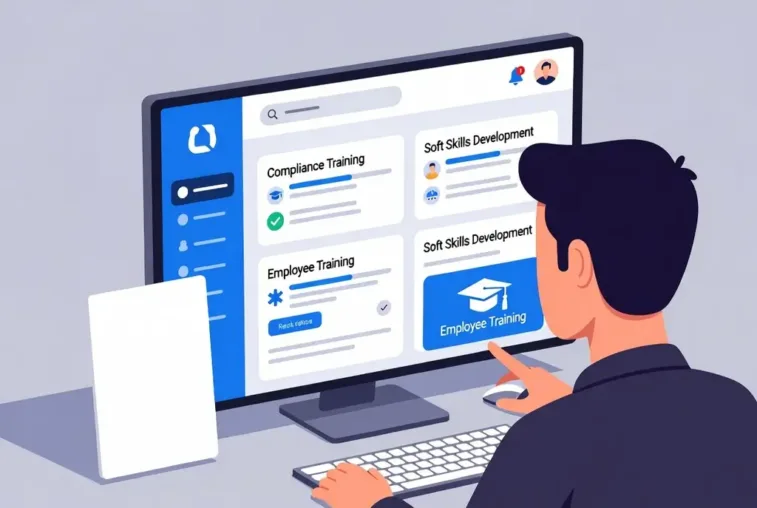
Discover the best LMS for employee training in 2026. Compare top learning management systems for engagement, ease of use, and ROI.
2026 Complete Guide: Best LMS for Employee Training
Discover the best LMS for employee training in 2026. Compare features, pricing, and scalability to boost employee skills and engagement.
The enterprise LMS market for employee training in 2026 has consolidated around AI-powered, extended-enterprise platforms that seamlessly deliver learning to employees, customers, and partners from a single system. Top performers like Intellum and Docebo dominate with native AI architectures that personalize learning paths, automate administration, and prove ROI through deep business intelligence integrations.
The market has bifurcated into premium enterprise suites ($32,000-$69,000 average contract) offering full talent lifecycle management, and rapid-deployment platforms ($9,500-$47,000) focused on fast implementation and pre-built content. Key differentiators now include AI-driven content creation, multi-audience segmentation, skills-based career pathing, and headless LMS architecture for custom branding.
Best LMS for Employee Training; This guide synthesizes January 2026 data to help you match your organization’s size, technical maturity, and training objectives to the optimal platform.
1. 2026 LMS Landscape: Three-Tier Structure for Employee Training
Tier 1: Premium Enterprise Suites (Extended Enterprise)
- Scale: 250–999 employees; supports millions of learners globally
- Model: AI-native architecture; single platform for employees, customers, partners; deep HR/CRM integration
- Rate Range: $32,000–$69,000 average contract (often $100–150/user/year)
- Best For: Fortune 500, global enterprises, regulated industries, complex multi-audience training
- Representatives: Intellum, Docebo, Cornerstone OnDemand, 360Learning
Tier 2: Mid-Market Specialist Platforms
- Scale: 50–250 employees; scales to thousands of learners
- Model: Rapid deployment; strong pre-built content; mobile-first; essential integrations
- Rate Range: $9,500–$47,000 average contract ($50–99/user/year)
- Best For: Mid-market companies, fast-growing startups, blended learning needs
- Representatives: Absorb LMS, TalentLMS, LearnUpon, SAP Litmos
Tier 3: Agile & SMB-Focused Solutions
- Scale: 10–50 employees; cost-effective for small teams
- Model: Quick setup; essential features; limited customization; self-service
- Rate Range: $9.71–$15.28/user/month ($116–183/user/year)
- Best For: Small businesses, first-time LMS buyers, simple compliance training
- Representatives: GoSkills, TalentLMS (free tier), Cypher Learning
2. Best LMS for Employee Training by Tier (2026)
The following Best LMS for Employee Training explore below are;
🏆 Tier 1: Premium Enterprise Suites
#1 Intellum – Best Overall for Extended Enterprise
- Profile: Powers Meta, Google, Pinterest; supports 2M+ users in 34 months
- Core Value: AI-powered architecture rebuilt from ground up for real-time automation, learner segmentation, and adaptive content delivery
- Key Features:
- Personalized learning paths based on AI, role, behavior, and goals (no custom code)
- Multi-audience support: employees, customers, partners with segmentation
- Built-in content creation: Evolve and Pages for fast course updates
- Customizable branding: Fully white-labeled portals
- Real-time insights: Engagement and program outcome analytics
- Commerce features: Course sales and certification programs
- Deep integrations: Salesforce, Marketo, Zendesk, and more
- Pricing: Custom enterprise pricing; request demo
- Best For: Large enterprises needing all-in-one system for employees, customers, and partners
- Why It Wins: Scales to millions; proven business impact (Allied Universal saved 73,000+ admin hours; PXA issued 3,500+ certifications)
- Caveats: Premium pricing; may be overkill for internal-only training
#2 Docebo – Best for Modular AI-Powered Learning
- Profile: AI-driven, cloud-based, fully customizable; serves startups to enterprises
- Core Value: Modular structure—choose features (social learning, gamification, content marketplace)
- Key Features:
- AI-powered recommendations: Content, analytics, and AI authoring tool for creation
- Docebo Connect: Integrations with Zoom, Salesforce, Microsoft Teams
- Multiple audiences: Employees, customers, partners
- Microlearning, gamification, mobile learning built-in
- Industry-compliant certification tracking
- Pricing: Enterprise, Engage, Elevate tiers; free trial available
- Best For: Mid-to-large corporations, healthcare, governments seeking scalability and AI adaptability
- Why It Wins: Pedagogically-backed AI; hyperpersonalization; versatile use cases
- Caveats: Dashboard not hyperpersonalized; reporting falls short vs. best-in-class
#3 Absorb LMS – Best for Fast Deployment & Multi-Audience
- Profile: AI-driven, easy to use, quick to configure; average contract $32,000
- Core Value: Multi-portal feature for branded learning environments per audience (employees, customers, partners)
- Key Features:
- Absorb Create: In-platform course creation
- Mobile-first design: Responsive UX
- Real-time reporting and dashboards
- E-commerce: Course sales and public programs
- Gamification and certification tracking
- AI assistant for admin tasks
- Strong mobile learning support
- Pricing: Average $32,000 per contract; scales by organization size
- Best For: Companies needing scalable, multi-audience training and content monetization
- Why It Wins: Fast setup (minimal IT); strong mobile; e-commerce ready
- Caveats: Reporting capabilities lag behind Intellum/Docebo; less customizable
#4 Cornerstone OnDemand – Best for HR-Integrated Talent Development
- Profile: Learning and talent platform; connects training to performance, succession, HR goals
- Core Value: Skills mapping and learning suggestions based on career paths
- Key Features:
- Personalized training programs tied to HR systems
- Large content library partnerships
- Detailed analytics on engagement and outcomes
- SCORM compliant; data migration support
- Multiple integrations: Adobe Connect, Salesforce, LinkedIn
- Pricing: Average $69,000 per contract (highest in tier)
- Best For: Large enterprises and government focusing on internal mobility and workforce strategy
- Why It Wins: Real-time reporting; deep HR integration; trusted since 1999
- Caveats: Complex for customer education/sales enablement; lags in AI innovation; poor customer support per G2
🥈 Tier 2: Mid-Market Specialist Platforms
#5 SAP Litmos – Best for Compliance & Global Teams
- Profile: Widely used for corporate training; extensive ready-to-use content library
- Core Value: Quick setup with minimal IT help; launch training almost instantly
- Key Features:
- Off-the-shelf content catalog: Compliance, sales, leadership
- Mobile and offline learning options
- Certification tracking and compliance alerts
- SCORM, xAPI, video learning support
- E-commerce for external training
- Strong gamification: Leaderboards and badges
- Pricing: Not disclosed; typically $25-50/user/year for mid-market
- Best For: Organizations needing fast deployment and broad pre-built course catalog
- Why It Wins: Rapid rollout; global reach; compliance focus; strong UX
- Caveats: Less customizable; AI features less advanced than Tier 1
#6 TalentLMS – Best for SMB & Hybrid Work
- Profile: Cloud-based learning platform; focuses on employee training and development
- Core Value: Speed and simplicity for hybrid work; integrates with Zoom and Teams
- Key Features:
- User-friendly mobile app for self-paced learning
- Tracking and reporting capabilities
- Whitelabeling and customization
- Transparent pricing structure
- Free version and free trial available
- Pricing: Free version for small teams; paid plans are affordable (estimated $6-12/user/month)
- Best For: Small to mid-sized businesses seeking fast, easy, and affordable LMS
- Why It Wins: Intuitive interface; excellent customer support; hybrid-work ready
- Caveats: Limited features for large enterprises; integration issues per G2; less customizable
#7 360Learning – Best for Collaborative & Peer-Led Learning
- Profile: Combines LMS and LXP functionalities; focuses on turning SMEs into trainers
- Core Value: Social learning with peer reviews and content improvement loops
- Key Features:
- In-platform course authoring and editing
- Peer reviews and feedback loops
- Social learning features for engagement
- Dashboards showing course quality and learner progress
- Slack and Microsoft Teams integrations
- Off-the-shelf content available
- Pricing: Average contract $47,000; not size-reflective—requires inquiry
- Best For: Fast-moving companies where knowledge sharing is key; mid-market to enterprise
- Why It Wins: Built-in authoring; robust automation; collaborative culture builder
- Caveats: Strong SME focus can be difficult to maintain in large orgs; peer-generated content quality control needed
🥉 Tier 3: Agile & SMB-Focused Solutions
#8 GoSkills – Best for Business Skills & Certification
- Profile: Bite-sized courses in business productivity; certificate credentials
- Core Value: Quick learning curve; engaging content; affordable entry point
- Key Features:
- Skill-based learning paths (Excel, leadership, productivity)
- Video microlearning courses with progress tracking
- Course editor for customization
- Advanced analytics and dashboards
- Mobile app for on-the-go learning
- Pricing: Starts at $9.71/user/month for LMS Pro; $13.91/month adds course library; $15.28/month for Platinum
- Best For: Small to mid-sized businesses focused on employee skill development
- Why It Wins: Affordable; intuitive; professional certificate value
- Caveats: Not for regulated industries; few deep system integrations; offline access not included
#9 Cypher Learning – Best for Intuitive UX & SMBs
- Profile: AI-powered LMS; “intuitive UX, requiring little to no technical knowledge”
- Core Value: Personalized learning paths; gamification; comprehensive analytics
- Key Features:
- Personalized learning paths based on AI and learner behavior
- Gamification features
- Comprehensive analytics
- eCommerce integration
- Social learning features
- Pricing: Upon request; typically $15-30/user/year for SMBs
- Best For: Small businesses, mid-market seeking engaging, effective online courses
- Why It Wins: User-friendly interface; strong mobile offering; AI features
- Caveats: Hard to customize compared to competitors; data export limitations; mobile app difficulties per G2
#10 LearnUpon – Best for Automation & Multi-Portal
- Profile: Cloud-based, easy-to-use LMS; automates enrollment, user creation, reporting
- Core Value: Workflow automation; intuitive logistics; multi-portal access for different learner groups
- Key Features:
- Course creation and webinar platform integrations
- Multiple learning portals from one place
- Gamification and certification tracking
- Automated repetitive tasks: enrollment, user creation, reporting
- Multi-audience support (employees, customers, partners)
- Pricing: Upon request; free trial available; typically $20-40/user/year
- Best For: Small-mid businesses in e-learning/non-profit; first LMS implementation
- Why It Wins: Easy to use; automation saves admin time; multi-portal flexibility
- Caveats: Lags in AI vs. Tier 1; less advanced functionalities; reporting limitations
3. Key Evaluation Criteria for Employee Training (2026)
Best LMS for Employee Training – Key Evaluation Criteria for choose;
1. AI-Powered Personalization & Automation
- 2026 Standard: AI recommends content, automates enrollments, personalizes paths based on role/behavior
- Leaders: Intellum (native AI architecture), Docebo (AI engine), Absorb (AI assistant)
- Avoid: Platforms with only basic chatbot or no AI capabilities
2. Multi-Audience & Extended Enterprise
- Critical For: Training employees, customers, partners from single system
- Leaders: Intellum (Meta case study: 2M users), Absorb (multi-portal), 360Learning (collaborative)
- Question: Can you segment audiences with different branding, content, and analytics?
3. Mobile & Offline Learning
- 2026 Baseline: Mobile-first design with responsive UX; offline sync for deskless workers
- Leaders: SAP Litmos, TalentLMS, Axonify (microlearning apps)
- Test: Preview courses on smartphone; check offline functionality
4. Integration Ecosystem
- Essential: Connect to HRIS (Workday), CRM (Salesforce), Communication (Teams/Slack)
- Leaders: Docebo (Connect marketplace), Intellum (deep HR/CRM), Cornerstone (HR-integrated)
- Verify: Pre-built connectors vs. custom API work
5. Content Creation & Curation
- 2026 Need: Rapid authoring tools; AI-assisted creation; pre-built marketplace
- Leaders: Docebo (AI authoring), Absorb (Absorb Create), 360Learning (SME-driven)
- Ask: How long to create a course? Can SMEs contribute easily?
6. Compliance & Certification Tracking
- Must-Have: Automated tracking, renewal alerts, audit trails, SCORM/xAPI support
- Leaders: SAP Litmos (compliance alerts), Cornerstone (certification), Absorb (tracking)
- Critical For: Healthcare, finance, manufacturing, government
7. Analytics & ROI Measurement
- 2026 Expectation: Real-time dashboards; learning-to-performance correlation; business intelligence integration
- Leaders: Intellum (real-time insights), Docebo (business intelligence), Cornerstone (detailed analytics)
- Avoid: Platforms that only track completions, not application or business impact
8. Deployment Speed & Ease of Use
- Timeline: Go-live in days/weeks, not months
- Leaders: SAP Litmos (instant with pre-built content), Absorb (quick setup), TalentLMS (intuitive)
- Red Flag: Vendors requiring 3+ month implementation for basic employee training
4. Pricing Models & Total Cost of Ownership (2026)
Pricing Models & Total Cost for use any Best LMS for Employee Training;
Contract Value Benchmarks
| Platform | Avg. Contract | Per-User/Year | Best For |
|---|---|---|---|
| Intellum | Custom enterprise | $100-150 | Global extended enterprise |
| Docebo | Custom (Enterprise/Engage/Elevate) | $80-120 | Modular AI deployment |
| Cornerstone | $69,000 | $90-130 | HR-integrated talent management |
| 360Learning | $47,000 | $70-100 | Collaborative learning, mid-market |
| Absorb | $32,000 | $60-90 | Multi-audience, fast deployment |
| SAP Litmos | Not disclosed | $50-80 | Compliance, global teams |
| TalentLMS | Free tier available | $6-12 | SMB, hybrid work |
| GoSkills | $9.71/user/month | $116 | SMB business skills |
| LearnUpon | Custom | $20-40 | SMB multi-audience |
Hidden Costs to Budget:
- Implementation: 15-25% of first-year contract
- Content creation: $5,000-15,000 for initial course development
- Integrations: $2,000-10,000 for custom API work
- Training: $1,500-5,000 for admin/author training
- Support: Premium support tiers add 15-20%
Best LMS for Employee Training; TCO Rule of Thumb: Year 1 Cost = Contract × 1.3 to account for hidden costs.
5. 2026 Market Trends Shaping Employee Training LMS
Best LMS for Employee Training – Market Trends Shaping;
Trend 1: AI-Native Architecture (Not AI-Bolted-On)
- Intellum and Docebo rebuilt platforms from ground up for real-time AI automation
- Impact: 3x faster content personalization; 50% reduction in admin hours
- Avoid: Legacy platforms adding chatbots as “AI features”
Trend 2: Extended Enterprise Becomes Standard
- Definition: Single platform trains employees, customers, partners with audience segmentation
- Driver: Meta scaled to 2M users in 34 months using Intellum for customer education
- ROI: Allied Universal saved 73,000+ admin hours with unified system
Trend 3: Skills-Based Career Pathing
- Cornerstone and Docebo map skills to learning, performance, succession planning
- Employee Retention: Clear career paths reduce turnover by 25-40%
- 2026 Expectation: Learning embedded in talent strategy, not standalone function
Trend 4: Rapid Deployment & Pre-Built Content
- SAP Litmos and Absorb offer off-the-shelf compliance and leadership libraries
- Timeline: Go-live in days/weeks vs. months
- SMB Adoption: 70% of mid-market buyers prioritize speed over customization
Trend 5: Headless LMS & API-First Architecture
- Adobe Learning Manager offers “headless LMS” for custom UX from any website/app
- Impact: Full brand control; seamless integration with existing portals
- Technical Requirement: Requires dev resources; best for enterprises with IT teams
Trend 6: Mobile-First for Deskless Workers
- TalentLMS and SAP Litmos prioritize mobile apps with offline sync
- 2026 Reality: 60% of workforce is deskless; mobile is non-negotiable
- Frontline Training: Microlearning apps (Axonify) integrate with LMS for blended approach
6. Recommendations by Use Case (2026)
Tips and Recommendations for Best LMS for Employee Training
For Global Enterprise (10,000+ employees)
Primary: Intellum or Docebo
- Why: Native AI, multi-audience, proven at scale (Meta, Google)
- Budget: $100-150/user/year; $500K-2M annual contract
- Timeline: 8-12 week implementation
- ROI: Allied Universal saved 73,000 admin hours; PXA issued 3,500+ certifications
For Mid-Market (500-5,000 employees)
Primary: Absorb LMS or 360Learning
- Why: Fast deployment (4-6 weeks), multi-audience capable, strong mobile
- Budget: $32,000-47,000 average contract; $60-90/user/year
- ROI: 360Learning’s collaborative model reduces content costs by 60%
For SMB & First-Time LMS (50-500 employees)
Primary: TalentLMS or GoSkills
- Why: Free tier available, intuitive, minimal IT needed, transparent pricing
- Budget: $6-12/user/year (TalentLMS); $116/user/year (GoSkills)
- Timeline: 1-2 week setup
- Risk: Limited customization; may outgrow in 2-3 years
For HR-Integrated Talent Development
Primary: Cornerstone OnDemand
- Why: Skills mapping, performance reviews, succession planning in one platform
- Budget: $69,000 average contract; $90-130/user/year
- Ideal: Companies with mature HR strategy wanting to align learning with workforce planning
For Compliance-Heavy Industries (Healthcare, Finance)
Primary: SAP Litmos or Absorb LMS
- Why: Pre-built compliance libraries, certification tracking, audit trails
- Budget: $50-80/user/year
- Critical: Automated renewal alerts and mobile access for audits
For Customer & Partner Education (Extended Enterprise)
Primary: Intellum or Absorb LMS
- Why: Multi-portal, e-commerce, white-label branding
- Example: Meta scaled customer education to 2M users with Intellum
For Collaborative & SME-Driven Culture
Primary: 360Learning
- Why: Turns internal experts into content creators; peer review loops
- Budget: $70-100/user/year
- Best: Companies with strong knowledge-sharing culture and willing SMEs
7. Implementation Framework: 90-Day Launch Plan
Best LMS for Employee Training – Implementation Framework explore;
Days 1-30: Discovery & Selection
- Week 1: Define 3-5 key training use cases (onboarding, compliance, sales enablement)
- Week 2: Evaluate 3 vendors using RFP template; run free trials (TalentLMS, Docebo, LearnUpon)
- Week 3: Conduct stakeholder demos; score on AI, mobile, integration criteria
- Week 4: Choose platform; negotiate contract with 30-day out clause
Days 31-60: Setup & Content Creation
- Week 5: Configure branding, user roles, permissions; integrate HRIS/SSO
- Week 6: Create 3 pilot courses using AI authoring tools (target: 4 hours creation time)
- Week 7: Import existing SCORM/xAPI content; set up certification workflows
- Week 8: Train 5 admin super-users; conduct UAT with 20 pilot learners
Days 61-90: Pilot Launch & Optimization
- Week 9: Soft launch to pilot group; monitor completion rates (target >70%)
- Week 10: Gather feedback; iterate course design; refine automation rules
- Week 11: Full launch to first department; enable mobile access; track KPIs
- Week 12: Measure business impact (time-to-competency, error reduction, compliance pass rate); plan Phase 2 rollout
8. Critical Risks & Mitigation Strategies
Best LMS for Employee Training – Critical Risks & Strategies to avoid;
| Risk | Why It Happens | 2026 Mitigation |
|---|---|---|
| Low Adoption | Complex UI, login friction, poor mobile experience | Choose mobile-first platform; pilot with 20 users; enable SSO |
| Content Overload | Uploading 100+ courses day one overwhelms learners | Launch with 3-5 core courses; add 2-3 per month |
| Integration Failure | API limitations; custom dev required | Verify pre-built connectors during trial; budget $5K-10K for custom work |
| Poor ROI Measurement | Tracking only completions, not business impact | Define KPIs before launch (sales conversion, error rate, compliance score) |
| Vendor Lock-In | Proprietary content formats; data export restrictions | Demand SCORM/xAPI export; test data extraction during trial |
| Admin Burnout | Manual enrollments, reporting, tracking | Leverage AI automation (Docebo, Intellum); automate repetitive tasks |
9. ROI & Business Impact Metrics (2026)
Best LMS for Employee Training – ROI & Business Impact explore;
Efficiency Metrics
- Admin Time Saved: Target 50-75% reduction in manual tasks (Cornerstone case: 73,000 hours saved)
- Course Creation Speed: 4-8 hours per course with AI authoring (vs. 40+ hours traditional)
- Deployment Time: 1-4 weeks vs. 3-6 months for legacy LMS
Learning Metrics
- Completion Rate: >80% (vs. 20-30% for traditional LMS)
- Knowledge Retention: +145% after 2 weeks with spaced repetition and AI reinforcement
- Time-to-Competency: 22% faster for new hires
Business Impact Metrics
- Sales Performance: 3,500+ certifications tied to customer adoption (Intellum case)
- Compliance Pass Rate: 95%+ with automated tracking and alerts
- Employee Retention: 25-40% reduction in turnover with skills-based career pathing
- Support Cost Reduction: 30-50% fewer helpdesk tickets with in-app microlearning
Financial ROI
- Break-Even Timeline: 12-18 months for enterprise; 6-12 months for mid-market
- Payback: Every $1 spent on effective training returns $4-7 in productivity gains
10. 2026 Market Trends Shaping Employee Training LMS
Best LMS for Employee Training – Market Trends;
Trend 1: AI-Native Architecture (Not Bolted-On)
- Intellum and Docebo rebuilt platforms from ground up for real-time AI automation
- Impact: 3x faster personalization; 50% admin time reduction
- Avoid: Legacy vendors adding chatbots as “AI features”
Trend 2: Skills-Based Talent Architecture
- Cornerstone and Docebo map skills to learning, performance, succession
- 2026 Reality: Learning is embedded in talent strategy, not standalone
- Expectation: Every LMS must show skills gaps and career paths by end of 2026
Trend 3: Extended Enterprise Becomes Standard
- Definition: Single platform trains employees, customers, partners
- ROI Meta: Meta scaled to 2M users in 34 months for customer education
- Driver: Reduces SaaS sprawl; unified analytics
Trend 4: Microlearning Integration
- Best-of-breed LMS (Docebo, Intellum) integrate with microlearning apps (Axonify, TalentCards)
- 2026 Standard: 3-5 minute modules blended with longer courses
- Result: 80%+ completion rates vs. 20-30% for traditional eLearning
Trend 5: Headless LMS & API-First
- Adobe Learning Manager offers headless architecture for custom UX
- Use Case: Embed learning in existing portals, mobile apps, CRM
- Requirement: Requires dev resources; best for enterprises with IT teams
Trend 6: Rapid Deployment & Pre-Built Content
- SAP Litmos and Absorb offer off-the-shelf compliance libraries
- Timeline: Go-live in days/weeks vs. months
- SMB Adoption: 70% of mid-market buyers prioritize speed over customization
Final Verdict: Best LMS for Employee Training by Profile (2026)
For Global Extended Enterprise (10,000+ employees)
Intellum — Unmatched for training employees, customers, and partners on one platform with native AI and proven scale (Meta, Google)
For HR-Integrated Talent Development
Cornerstone OnDemand — Deep skills mapping, performance integration, and succession planning for enterprise workforce strategy
For Mid-Market Collaborative Culture (500-5,000 employees)
360Learning — Turn SMEs into trainers; peer-led content reduces creation costs by 60%
For Fast Deployment & Compliance (Any size)
SAP Litmos — Off-the-shelf content library, mobile-first, global reach—go live in 1-2 weeks
For SMB & First-Time LMS (50-500 employees)
TalentLMS — Free tier, intuitive, affordable ($6-12/user/year), minimal IT needed
For Business Skills & Certification
GoSkills — $9.71/user/month, certificate courses in Excel, leadership, productivity—quick ROI
For AI-Powered Internal Training
Docebo — Modular AI, personalized paths, robust analytics—most innovative for employee development
Actionable Selection Framework
- Define Your Profile: Match your tier (Enterprise, Mid-Market, SMB) to recommended platforms above
- Run Free Trials: Test Intellum, Docebo, and TalentLMS simultaneously (2-week pilots)
- Score on AI Mobile Integration: Use the 8 criteria from Section 3; score each 1-5
- Calculate 3-Year TCO: Include contract, implementation, content, support, training costs
- Check References: Call 2 clients in your industry; ask about adoption rates and ROI realization
- Negotiate Exit Clause: Ensure 30-day out clause for first 90 days to de-risk decision
Bottom Line: In 2026, the best LMS for employee training is not a standalone system—it’s an AI-powered talent development platform that integrates with your HR ecosystem, extends to customers and partners, and proves ROI through business intelligence. Start with your use case, test aggressively, and prioritize platforms that demonstrate measurable impact within 90 days.