
Discover the best inexpensive wines that deliver great taste without breaking the bank. Top picks for quality, value, and flavor—shop now and save!
2026 Complete Guide: Best Inexpensive Wines
You don’t have to spend a lot to drink well in 2026. In fact, major critics keep finding tons of bottles at $12–$20 that score 90 points or better. Best Inexpensive Wines; Wine Enthusiast even notes that at $20 or under, you’re looking at about $4 or less per glass for high-quality wine.
Best Inexpensive Wines; Below is a practical guide: what “inexpensive” means, where the value is today, specific bottles to look for, and how to shop smart.
Quick definition: what counts as “inexpensive” (2026)
For this guide, “inexpensive” generally means:
- Everyday cheap: up to about $12–$15
- Solid but still a bargain: roughly $15–$20
- Still a “value” if it overdelivers: $20–$30 (but I’ll stay mostly under $20)
Best Inexpensive Wines; Major value lists (Wine Enthusiast’s Best Buys, Wine Spectator’s Top 10 Values and Value Wines, James Suckling’s Top 100 Value Wines) focus heavily on wines under $20, with some stretching to $30–$40.
Where the value is right now (by style)
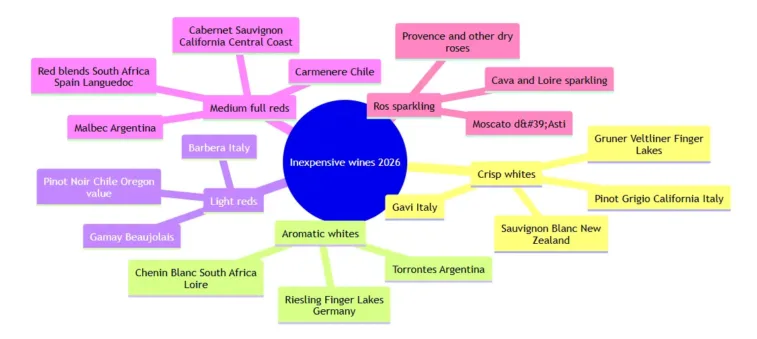
High-value regions and grapes (cheat sheet)
Best Inexpensive Wines; If you want to reliably find good bottles under ~$18, start with these:
- Crisp, fresh whites:
- Sauvignon Blanc: Marlborough (New Zealand), Chile, Loire (France)
- Pinot Grigio/Gris: Northeast Italy, Oregon, California
- Gavi (Cortese): Piedmont, Italy
- Grüner Veltliner: Austria, and now also New York’s Finger Lakes
- Aromatic/off-dry whites:
- Riesling: Germany (kabinett/feinherb), New York’s Finger Lakes, Washington
- Chenin Blanc: South Africa, Loire Valley
- Torrontés: Argentina
- Lighter, chillable reds:
- Gamay (Beaujolais)
- Barbera d’Asti or Barbera d’Alba (Piedmont, Italy)
- Value Pinot Noir: Chile (Leyda Valley), Oregon (entry-level Willamette)
- Medium to fuller-bodied reds:
- Cabernet Sauvignon: California’s Central Coast, Paso Robles; Washington; Coonawarra (Australia)
- Malbec: Mendoza, Argentina
- Carménère: Chile (Peumo, Cachapoal)
- Red blends: South Africa, Spain, Languedoc-Roussillon
- Rosé and sparkling:
- Dry rosé: Provence, other parts of France, South America, US
- Bubbles: Cava (Spain), Crémant de Loire, other French regions; Moscato d’Asti for a sweet sparkler
Concrete bottle recommendations (all roughly $12–$20)
Best Inexpensive Wines; These are not the only good cheap wines, but they’re actual, recently recommended bottles from major critics’ value lists.
Crisp / aromatic whites
- La Raia 2024 Pleo Cortese (Gavi, Piedmont, Italy) – about $15; 93 pts – a stunning, floral Gavi with orchard fruit and spring-blossom aromatics.
- Kirkland Signature 2023 Pinot Grigio/Gris (California) – about $14; 93 pts – fresh and zippy with melon, citrus, and cucumber notes.
- King Estate 2023 Pinot Gris (Willamette Valley, Oregon) – about $20; 90 pts – lemon, basil, and iced tea aromatics; versatile with food.
- Dr. Konstantin Frank 2023 Grüner Veltliner (Finger Lakes, New York) – about $20; 92 pts – floral, citrusy, and dry; great with spicy Asian food.
- Fox Run 2023 Silvan Riesling (Seneca Lake, Finger Lakes) – about $20; 92 pts – dry and food-friendly with lime, lemongrass, and nectarine.
- Antigal 2024 UNO Sauvignon Blanc (Mendoza, Argentina) – about $15; 89 pts – simple but enjoyable lime and stone fruit with a crisp finish.
- Framingham True Nature 2023 Sauvignon Blanc (Marlborough, New Zealand) – about $18; 90 pts – classic Marlborough mix of tropical, citrus, and herbal notes with zippy acidity.
- Starmont 2023 Sauvignon Blanc (North Coast, California) – about $20; 93 pts – fresh and zesty with nectarine, pear, and vanilla cream.
Off-dry / dessert-style whites
- Saracco 2024 Moscato d’Asti (Piedmont, Italy) – about $20; noted in Wine Enthusiast’s Best Buys as a consistently excellent, gently sweet sparkler with peach and floral notes.
- Cascina Galarin 2023 Prá Dône Moscato Bianco (Moscato d’Asti, Piedmont, Italy) – about $20; 92 pts – fragrant, with jasmine, mint, peach, and apricot.
Lighter-style reds
- Westmount 2023 Gamay Noir (Willamette Valley, Oregon) – about $20; 91 pts – juicy and energetic with dark berry and dark-chocolate notes; great chillable red.
- Quinta da Romaneira 2020 Liceiras Tinta Cão (Douro, Portugal) – about $15; 94 pts – a rare single-varietal Tinta Cão, rich and spicy, remarkable value.
Medium / fuller-bodied reds
- J. Lohr 2022 Seven Oaks Cabernet Sauvignon (Paso Robles, California) – about $17; 90 pts – reliable, widely available Cab with dark fruit and soft tannins.
- William Hill Estate 2022 Cabernet Sauvignon (North Coast, California) – about $17; 90 pts – opulent dark fruit with spice and chewy tannins.
- Marques de Casa Concha 2022 Carménère (Peumo, Chile) – about $20; 90 pts – classic Carménère with red fruit, peppercorn, and soft but firm tannins.
- Miguel Torres 2021 Cordillera Carménère (Cachapoal Valley, Chile) – about $20; 91 pts – more structured Carménère with strawberry, peppercorn, and herb.
- Kanonkop 2021 Kadette Red (Stellenbosch, South Africa) – about $19; 90 pts – a Pinotage-based Cape blend with ripe berries and plush fruit.
Rosé
- Domaines Bunan 2024 Le Petit Rouviere Rosé (Provence, France) – about $18; 92 pts – stony, mineral-driven Provençal rosé with cooked strawberry hints.
Sparkling
- Bouvet-Ladubay 2021 Saphir Brut (Saumur, Loire, France) – about $20; 92 pts – a serious, bready, fresh bubbly from Loire, great value compared to many Champagnes.
A few slightly higher-value “step-up” bottles ($18–$30)
Best Inexpensive Wines; From Wine Spectator’s Top 10 Values of 2025 (all $40 or less; several are under $30):
- Wente Chardonnay Central Coast Morning Fog 2023 – about $18; 90 pts – balanced Chardonnay (half stainless, half neutral oak) with freshness and creaminess.
- Grounded Wine Co. Cabernet Sauvignon California 2023 – about $18; 90 pts – an approachable, fruit-forward Cab from multiple CA regions.
- Invivo Sauvignon Blanc Marlborough X (Sarah Jessica Parker Blend 6) 2024 – about $19; 92 pts – vibrant, complex Marlborough SB with a touch of skin contact and oak.
- Michele Chiarlo Barbera d’Asti Le Orme 2023 – about $19; 90 pts – juicy, food-friendly Barbera, great with pizza or tomato-based dishes.
- La Crema Pinot Noir Willamette Valley 2022 – about $28; 92 pts – a step-up Oregon Pinot with raspberry, cinnamon, and smoky spice.
- Bodega Garzón Tannat Reserva 2023 – about $22; 91 pts – a more approachable, maritime-influenced Uruguayan Tannat with balanced tannins.
If you only remember 5 go-to bottles (under $20)
- Crisp white: La Raia 2024 Pleo Cortese (Gavi, Italy) – ~$15.
- Aromatic white: Dr. Konstantin Frank 2023 Grüner Veltliner (Finger Lakes, NY) – ~$20.
- Light red: Westmount 2023 Gamay Noir (Willamette Valley, Oregon) – ~$20.
- Full red: J. Lohr 2022 Seven Oaks Cabernet Sauvignon (Paso Robles) – ~$17.
- Rosé: Domaines Bunan 2024 Le Petit Rouviere Rosé (Provence) – ~$18.
How to find great inexpensive wines (buying strategy)
Best Inexpensive Wines; Use these principles whenever you shop:
- Start with regions and grapes, not brands
- Look for:
- Argentina: Malbec, Torrontés
- Chile: Carménère, Sauvignon Blanc, value Pinot Noir
- New Zealand: Sauvignon Blanc
- South Africa: Chenin Blanc, Pinotage, Cabernet, red blends
- Portugal: Douro reds, Vinho Verde (very cheap whites)
- Spain: Rioja (Crianza), Garnacha, Monastrell, value blends
- Loire: Crisp whites (Sauvignon Blanc, Chenin), sparkling (Saumur, Vouvray)
- Italy: Gavi, Pinot Grigio, Barbera, Primitivo, Nero d’Avola
- US: California Chardonnay and Cab from Central Coast; Oregon Pinot Gris and entry-level Pinot; Washington Riesling and Cab.
- Use retailer tools to filter by score and price
- Total Wine & More: “20 Highly Rated Wines Under $20,” plus filters for price under $15 and 90+ points.
- Wine Spectator: “Value Wines” section that aggregates high-scoring wines at specific price bands (e.g., all wines <$15 at 87+ points; $15–$25 at 90+ points; reds and whites ≤$20 at 90+ points).
- Wine Enthusiast: annual Best Buys list (Top 100 under $20) with scores and notes.
- Trust the “house” wines and big-budget labels
- Private-label or “house” wines from good retailers often overdeliver (e.g., Kirkland Signature wines at Costco show up in Wine Enthusiast’s Best Buys list).
- Large, quality-focused producers (like Wente, J. Lohr, Marques de Casa Concha, Miguel Torres, Invivo, La Crema, Bodega Garzón) have the scale to keep prices reasonable while maintaining quality.
- Shop by “shelf talkers” and shelf tags
- Many supermarkets and big-box retailers put shelf tags with:
- Critical scores (e.g., “WE 93”, “WS 90”).
- “Top Value,” “Best Buy,” or staff pick stickers.
- These tags are often pulled directly from lists like Wine Enthusiast’s Best Buys or Wine Spectator’s Value Wines.
- Be flexible with vintage
- For inexpensive wines, the exact vintage matters less than for premium bottles. Retailers often rotate vintages while keeping the same label and price.
- If you see a recommended bottle in a slightly older or newer vintage, it’s usually fine—especially for fresh whites and rosés within a year or two, and reds within a few years.
- Don’t ignore sparkling and rosé
- Sparkling and rosé used to be pricier categories, but there are now many strong values:
- Bouvet-Ladubay Saphir Brut (Loire) at $20 and 92 points is a case in point.
- The International Wine Challenge and other competitions regularly single out supermarket rosés under £10–£12 as “Great Value” buys.
- These are excellent for parties and gifting without breaking the bank.
- Watch for discounts and mixed-case deals
- Many retailers offer 10–20% off if you buy 6–12 bottles, which can turn a $17 bottle into a sub-$14 bottle.
- “Flash sale” sites and email newsletters (e.g., Wine Enthusiast’s own shop emails) frequently promote value-focused wines from their Top 100 lists.
Food-pairing ideas for cheap wines
- Crisp whites (Sauvignon Blanc, Pinot Grigio, Gavi, Grüner):
- Seafood, salads, goat cheese, veggie dishes, spicy Thai or Vietnamese (especially Grüner and Riesling).
- Aromatic whites (Riesling, Chenin, Torrontés):
- Asian cuisine, curries, spicy dishes, roasted chicken, pork.
- Light reds (Gamay, Barbera, value Pinot Noir, Douro reds):
- Roast chicken, duck, pork chops, mushroom dishes, pizza and pasta (Barbera).
- Medium/full reds (Cab, Malbec, Carménère, blends):
- Burgers, steaks, stews, chili, grilled lamb, hearty pasta.
- Rosé:
- Charcuterie, salads, grilled fish, roasted chicken, Mediterranean dishes.
- Sparkling (Cava, Loire, Moscato):
- Appetizers, salty snacks, fried foods, light desserts (Moscato).
Quick shopping checklist
Best Inexpensive Wines; When you’re in the aisle:
- Set your price band first (e.g., “I want $12–$18”).
- Pick a style based on the food or occasion:
- Light white, aromatic white, light red, big red, rosé, or sparkling.
- Focus on high-value regions (Chile, Argentina, South Africa, Portugal, parts of Spain and Italy, New Zealand).
- Look for shelf tags or neck stickers with scores 90+ or “Best Buy”/Value mentions.
- If a specific recommended bottle isn’t there, grab something from:
- The same region and grape (e.g., another Mendoza Malbec, another Marlborough Sauvignon).
- The same producer’s entry-level line (e.g., other Wente, J. Lohr, Marques de Casa Concha bottlings).
Bottom line
Best Inexpensive Wines; In 2026, you can absolutely find excellent wines for $12–$20 across all styles—fresh whites, aromatics, reds for weeknight pizzas, and even serious sparkling and rosé. Use recent critic value lists like Wine Enthusiast’s Best Buys under $20 and Wine Spectator’s Value Wines as your treasure map, lean on high-value regions and grapes, and don’t be afraid to rely on retailer “90+ point” shelf tags to guide you.