
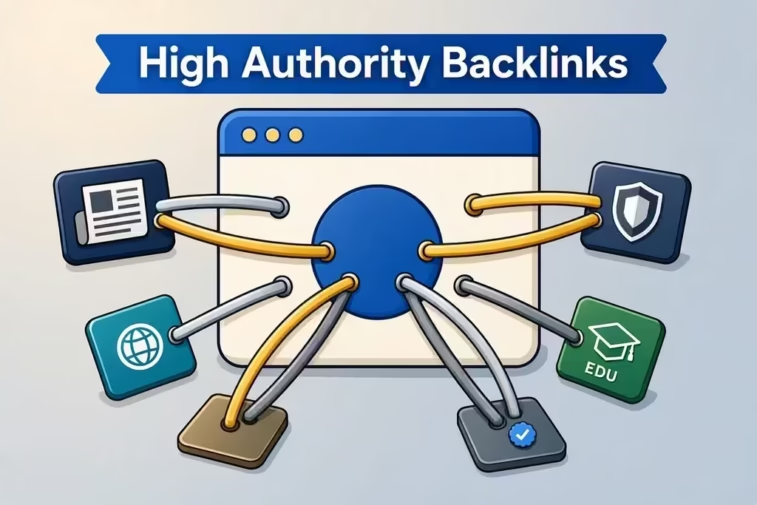
High authority backlinks still move rankings in 2026. Learn the six-point quality test, seven proven earning strategies, real costs and Google’s rules.
High Authority Backlinks: The Complete Guide for 2026
High authority backlinks are hyperlinks from websites that search engines already trust — established publishers, industry-leading publications, government and university domains, and major trade media — judged by link-quality signals such as topical relevance, real organic traffic, genuine editorial standards and dofollow placement inside original content.
The divider between pages that rank and pages that disappear is not content length — it is who links to them. Ahrefs’ study of 953 million pages found 94.74 percent get zero Google traffic, and its 14.1-billion-link analysis found 66.31 percent of pages carry no backlinks at all. High Authority Backlinks: Backlinko’s study of 11.8 million results found the #1 position averages 3.8 times more backlinks than positions two through ten. Authority links sit exactly on that line.
Agencies sell “high authority” placements priced purely on Domain Rating, and evaluation guides recycle the same thresholds without a testing method. This guide fixes that: the three authority metrics decoded, a six-point quality test, an evidence table, seven earning strategies with named cases, Google’s enforcement timeline, 2026 pricing and a 90-day plan. Every statistic carries a named source and a year.
What Are High Authority Backlinks?
High Authority Backlinks: A backlink is a link from one site to another, a vote of confidence search engines count. A high authority backlink is a vote from an electorate that carries weight: publications with strict editorial review, long-lived link profiles and audiences citers trust. Every niche has its own credible layer — trade associations, university departments, industry news desks — whose links move rankings more than their fame suggests.
Authority has no official list. Google publishes no trusted-domain roster, so the industry leans on third-party proxies — Ahrefs’ Domain Rating, Moz’s Domain Authority, Semrush’s Authority Score — logarithmic 0–100 scales built on backlink profiles. They are useful first-pass filters and terrible final judges: inflatable by redirects and networks, blind to relevance, silent on editorial context. That is why practitioners evaluate links with a quality test, not a threshold.
The Three Authority Metrics, Decoded
Three metrics dominate link evaluation, and they are not interchangeable. High Authority Backlinks: Each scores a link profile differently, and each has blind spots where cheap link sellers operate:
Table 5 — Domain Rating vs. Domain Authority vs. Authority Score
| Metric | Provider | Scale and basis | Watch-outs |
|---|---|---|---|
| Domain Rating (DR) | Ahrefs | 0–100, logarithmic; strength of the domain’s dofollow external link profile | Ignores relevance and traffic; inflatable via redirects and networks |
| Domain Authority (DA) | Moz | 1–100, logarithmic; machine-learning model over a 40+ trillion link index | Strictly relative — DA 30 is strong in one industry, weak elsewhere |
| Authority Score (AS) | Semrush | 0–100, logarithmic; blends organic traffic, backlink quality and spam signals | High DR with low AS flags a fake traffic profile |
Use the metrics as a funnel, not a verdict. Ahrefs treats DR 60–70+ as the band where sites start looking genuinely authoritative, and Moz notes each ten-point jump gets progressively harder on the logarithmic scale. The critical correction is relevance: a DR 40 site in your niche is more credible to Google than a DR 60 site outside it. Any score must still survive the six-point test below.
The Six-Point Quality Test That Beats Any Single Metric
Backlinko’s 2026 guidance reduces link quality to four signals — topical relevance, source credibility, editorial placement and link status. Add traffic and hygiene checks, and they form a ten-minute test per prospect:
- Topical relevance. The linking site, page and surrounding copy should all relate to yours. A marketing blog linking to an analytics platform passes; the same score from a random sports blog does not.
- Real organic traffic. Check the domain in Ahrefs or Semrush first. A 70 DR site with 200 monthly visitors is selling links, not earning readers — genuine publishers show traffic matching their niche.
- Editorial placement. The link should exist because an editor added it inside original content, not because someone bought a slot. In-content links in an article’s first half carry the most weight; footer link farms carry almost none.
- Dofollow status in context. Followed links pass authority directly; nofollow became a hint rather than a directive in 2019, so major-outlet nofollows still drive referral traffic, brand recognition and AI citations.
- Outbound link hygiene. Inspect what else the site links to. A domain pointing at casinos, essay mills and crypto pumps devalues everything it links, regardless of its own score.
- Anchor and position quality. Varied, descriptive anchors inside relevant copy outperform exact-match anchors repeated at scale — the oldest spam fingerprint. One natural link high in a relevant article beats ten forced ones in footers.
The red flags that disqualify a prospect instantly, regardless of its metrics:
- Private blog networks — interlinked sites with thin content, mirrored design and rotated owners
- “Write for us” pages advertising paid placement with a price list attached
- Domain-rating spikes without traffic growth, usually bought redirects
- Guaranteed link counts or “50 placements in 30 days” vendor offers
- AI-written sites with no named authors — evaluation guides describe them as on borrowed time
Do High Authority Backlinks Still Move Rankings? The 2026 Evidence
High Authority Backlinks: Google has confirmed links as a ranking signal since PageRank, but its stance has evolved. In 2019 nofollow became a hint rather than a directive. The December 2022 link spam update began systematically neutralizing purchased and exchanged links, and through 2023 Google’s search relations team stated repeatedly that links matter less than a decade ago. The 2026 summary: links remain a confirmed ranking input whose value depends entirely on quality — low-quality links died first, and authority links are the survivor class.
The evidence still points one direction. Backlinko’s study found the #1 position averages 3.8 times more backlinks than positions two through ten, with referring domains correlating with rankings more than any other factor. Ahrefs’ link studies found 66.31 percent of pages have zero backlinks and 26.29 percent more have three or fewer — the median page competes with almost no link equity, so a handful of genuine authority links separates you from two-thirds of the competition. Correlation is not causation, but no study has found the reverse relationship.
The AI era adds a second reason authority links matter. Ahrefs’ 300,000-keyword study measured top-position CTR falling 34.5 percent when an AI Overview is present. Backlinko’s 2026 guidance describes links doing four jobs — passing authority, driving referrals, placing the brand in editorial context AI systems learn from, and building trust — through its Authority Signal Stack of editorial links, contextual citations and ambient presence. Whitespark’s 2026 survey agrees: best-of lists are the top AI citation factor, and mentions are becoming the new link. Angi’s water-heater cost guide shows the compounding: 900+ backlinks and AI Overview appearances for 200+ keywords.
Table 6 — What the verified evidence base shows
| Evidence | Finding | Source |
|---|---|---|
| #1 result vs. positions 2–10 | The top Google result averages 3.8× more backlinks than the next nine | Backlinko, 11.8M results |
| Pages with zero backlinks | 66.31% of pages have no referring domains; 26.29% more have three or fewer | Ahrefs, 14.1B links |
| Pages with zero Google traffic | 94.74% of 953M analyzed pages receive no organic visits | Ahrefs traffic study |
| Outreach reply rates | 8.5% average reply across 12M cold link-building emails | Backlinko outreach study |
| AI Overviews and clicks | Top-position CTR drops 34.5% when an AI Overview is present | Ahrefs, 300K keywords |
| AI visibility factors | Best-of lists are the #1 AI citation factor; unlinked mentions rank 12th | Whitespark 2026 |
Read the table as a portfolio, not a debate: authority links concentrate ranking power, remain scarce, and on AI-mediated pages also purchase the editorial context language models quote. That triple return separates the strategies ahead from the schemes Google devalues on sight.
How to Earn High Authority Backlinks: Seven Strategies Ranked
High Authority Backlinks: Every durable method trades difficulty for ceiling: fast tactics produce weak links, while DR 90 editorial placements demand real assets and real time. The menu ranks the seven strategies that survive Google’s current enforcement by authority ceiling — the tier of publisher each can realistically reach:
Table 7 — The seven-strategy high authority backlink menu
| Strategy | Authority ceiling | Difficulty | First results | Best for |
|---|---|---|---|---|
| Digital PR and data studies | Very high | High | 1–3 months | Brands with data or strong stories |
| Journalist platforms | High — DR 80–90 news desks | Low–Medium | Days–weeks | Experts with quotable opinions |
| Citation magnets | High, compounding | Medium | 3–12 months | Teams building real resources |
| The moving man method | Medium–High | Medium | Weeks | Niches with outdated resources |
| Guest posting, done properly | Medium–High | Medium | 4–8 weeks | Subject-matter experts |
| Unlinked brand mentions | Medium | Low | Weeks | Brands already getting press |
| Link reclamation | Medium | Low | Days | Established sites with history |
Sequence matters more than selection: reclamation and journalist platforms generate fast wins, digital PR and citation magnets compound for years. Run one fast tactic and one compounding tactic concurrently from week one.
1. Digital PR and Original Data Studies
Digital PR creates news that journalists cite, and it is the top tactic for 34 percent of SEOs (Reporter Outreach, 2026). Ahrefs’ campaigns show the ceiling: the Taylor Swift private-jet emissions analysis earned links from nearly 2,000 referring domains in a month; a ChatGPT statistics page collected 60+ placements including Yahoo News and Time, both DR 92; and a video-characters study landed 20+ links including the Daily Express at DR 89. Backlinko’s advice: build campaigns with timeliness, accuracy, relevance and urgency, tie them to news cycles, and pitch story leads, not press releases.
Data journalism works because reporters need citable numbers on deadline, so a proprietary dataset — transaction data, customer surveys, public-filing analysis — becomes a primary source that keeps earning links long after launch. Budget one substantial study per quarter and treat outreach as distribution.
2. Become the Source: Journalist Platforms
Journalist query platforms connect reporters hunting for expert quotes with sources who provide them. Cision shut down Connectively, the successor to HARO, in December 2024; the replacements are established: Featured, Qwoted, Source of Sources and the free Help a B2B Writer. Backlinko attributes 600+ of its wins to Featured alone, from 200,000+ pitches — a 0.3 percent win rate proving the arbitrage is specificity. Experts who answer with data, named credentials and quotable sentences win; generic answers never surface. Ten quality pitches per week produces a steady drip of DR 70–90 editorial links.
3. Build Citation Magnets
A citation magnet is an asset built to be cited: original research, a definitive statistics roundup, a free calculator or template published on its own URL. The economics: high fixed cost, near-zero marginal cost, returns that compound instead of decaying. Backlinko’s site holds 3.4 million backlinks concentrated in a few thousand high-quality links, and its 2019 content study still generates new links years later. Ahrefs’ ChatGPT statistics page earned 60+ free placements because reporters searching for adoption numbers had nowhere better to cite. Publish the asset, pitch journalists already covering the topic, then let search and AI citations compound.
4. The Moving Man Method and Broken-Link Building
The web rots — Ahrefs’ link-rot research found 66.5 percent of links to dead pages were never replaced. The moving man method claims it: find niche pages that were renamed, moved or deleted, identify who still links to them, and pitch your equivalent as the replacement. Nico Digital earned 311 backlinks from a single competitor’s deleted pricing page by finding its remaining inbound links and offering an updated alternative. Applied to dead resources, the loop is broken-link building — editors accept it because you do their QA. Both clear the six-point test: the replacement sits in the same editorial context as the dead link.
5. Guest Posting, Engineered for Relevance
Guest posting survives because the March 2024 scaled content abuse policy killed the industrial version: mass-produced posts on sites built to host them. The defensible version prioritizes topical alignment over raw authority, pitches articles the audience actually needs, and writes for usefulness rather than placement. Backlinko’s documented case is Black Lapel, whose carefully placed guest post generated 150+ direct sales — relevance-driven placements convert readers, not just search engines. Cap the volume, target genuinely editorial publications, and remember: a DR 50 trade journal practitioners read outperforms a DR 70 content farm nobody does.
6. Reclaim Unlinked Brand Mentions
Brands with any press history already own a backlog of links they never received: news stories, reviews and interviews naming the company without a link. Finding them takes minutes with search operators or a monitoring tool, and a polite request converts a meaningful share — the editorial decision to cite you is already made. The upside doubled in 2026: Whitespark ranks unlinked-mention quantity 12th among AI visibility factors, so even linkless mentions shape how AI systems describe your brand. Run this sweep monthly — the cheapest authority maintenance in the playbook.
7. Link Reclamation
Reclamation recovers authority you already earned but stopped receiving. Sites move, pages get renamed, links point at 404s — and with two-thirds of dead-page links never fixed, the recovery surface is enormous. Crawl your profile in Ahrefs Webmaster Tools or Search Console, list links to broken or redirected pages, then restore the destination or add 301s to pass the equity through. Audit partner, supplier and press pages linking to old URLs in the same pass. Reclamation produces no new coverage, but it is the highest-return few hours an established site can spend.
What to Avoid: Google’s Link Rules and Enforcement
High Authority Backlinks: Every tactic above is designed to survive scrutiny; the schemes below are designed to look like they already did. Google’s enforcement timeline shows where the lines moved:
- 2019 — nofollow becomes a hint; rel=sponsored and rel=ugc introduced for paid and user-generated links
- December 2022 — the link spam update rolls out over weeks, neutralizing purchased and exchanged links at scale
- March 2024 — the core update cuts unhelpful content by 40–45% and adds spam policies for expired domain abuse, scaled content abuse and site reputation abuse
- May 2024 — site reputation abuse enforcement begins, targeting “parasite SEO” placements inside trusted publications
- 2025–2026 — manual actions continue against link networks and pay-to-play publisher sections
The practical avoid list: never buy placements promising guaranteed DR bands — a DR 70 link priced at 50 dollars lives on a private blog network. Do not join reciprocal exchange rings or sitewide footer arrangements, and do not scale exact-match anchors — the fingerprint the December 2022 update was built to catch. Buying links is not illegal but violates guidelines: the risk is devaluation or a manual penalty, and Google requires rel=sponsored on paid placements. The economics settle it — earned editorial links cost 300 to 1,500 dollars because they are finite; everything cheaper is counterfeiting something.
What High Authority Backlinks Cost in 2026
High Authority Backlinks: Costs split by route: earn links with labor, or buy them with money and risk. The buying-side data is unusually well documented because link buyers report what they pay:
Table 8 — 2026 backlink acquisition cost benchmarks
| Route | Typical 2026 cost | Source |
|---|---|---|
| Agency / marketplace placements | $300–750 per link | SalesHive 2026 pricing |
| Editorial placements on real sites | $600–1,500 per link | BuzzStream 2026 study |
| Average accepted price per link | $508.95 | Editorial.Link marketplace data |
| Buyers paying $300+ per link | 76% | Reporter Outreach 2026 survey |
| Full digital PR campaign | $1,000+ per campaign | Reporter Outreach 2026 survey |
| Journalist platforms | Free–$99 per month | Featured, Qwoted, Help a B2B Writer |
On the earning side the currency is volume against an 8.5 percent reply rate: 1,000 personalized pitches produce roughly 85 conversations, and realistic conversion into live DR 60+ placements lands in the low single digits. That arithmetic justifies every agency invoice — and explains why one strong data study outperforms link buying at the same budget. Anything priced dramatically below these benchmarks is not a discount; it is a different product.
Your First 90 Days: The High Authority Backlink Plan
Authority link building fails from trying everything at once; it succeeds from one audit, two fast tactics and one compounding asset in parallel. This sequence fits a single marketing hire:
- Baseline the profile (weeks 1–2). Audit referring domains, anchor mix and broken links in Google Search Console and Ahrefs Webmaster Tools — both free, per our best free marketing SEO tools guide. Benchmark the three competitors outranking you.
- Reclaim what is yours (weeks 2–4). Fix links pointing at 404s, restore moved pages with 301s, claim unlinked mentions and update partner pages. It costs hours, not budget, and typically funds the first visible DR movement.
- Start the journalist routine (weeks 3–12). Create expert profiles on Featured, Qwoted and Help a B2B Writer and send ten specific, data-backed pitches per week. Target three to five DR 60+ editorial mentions by day 90.
- Build one citation magnet (weeks 4–8). Produce one exceptional asset — a proprietary data study, statistics page or useful calculator — and pitch it to the ten journalists already covering the topic. One asset is enough; ten mediocre posts are not.
- Measure and compound (ongoing). Track monthly referring-domain growth, DR movement and — new for 2026 — whether your brand appears in AI Overviews for priority queries. Refresh the magnet quarterly; repeat the mention sweep monthly.
High Authority Backlinks FAQ
What is considered a high authority backlink?
A high authority backlink is a followed, editorially placed link from a site with a strong third-party score — commonly DR or DA 60+ — that also passes the quality test: topical relevance, real organic traffic, genuine editorial standards and clean outbound linking. The score is only the first filter; relevance and placement decide whether it moves rankings.
How many high authority backlinks do I need to rank?
There is no universal number — the honest benchmark is competitive. Pull the referring-domain counts of the three pages outranking you and treat that as your floor. Because 66.31 percent of pages have no backlinks at all, even a handful of genuine authority links separates most pages from two-thirds of the web; competitive keywords require dozens.
Are high authority backlinks better than many low-authority links?
Yes, decisively. Authority links concentrate ranking equity, arrive with editorial trust that survives algorithm updates, and place your brand in contexts AI systems quote — while low-quality link volume now triggers neutralization under the December 2022 link spam update. A natural profile contains some modest links; what it must not contain is purchased network volume.
What DR or DA is considered high authority?
Industry practice treats DR 60–70 and above as the high-authority band, with DR 70+ as the premium filter. Both scales are logarithmic and relative, so each ten-point climb gets harder and context matters: a DR 40 site in your niche is more credible to Google than a DR 60 site outside it. Treat the score as a screening step, never the verdict.
Do nofollow links from high authority sites help?
Yes, in three ways. Since 2019 nofollow is a hint rather than a directive, so it can still contribute ranking value. Major outlets nofollow by default, and those links still drive referral traffic, brand recognition and the editorial context AI systems learn from. A natural profile contains followed and unfollowed links in normal proportion — all-followed looks manufactured.
Can I buy high authority backlinks?
Paying for placement violates Google’s guidelines, and the December 2022 link spam update exists to neutralize it; discovery risks devaluation or a manual penalty on your whole profile. If you ever pay for exposure, Google requires rel=sponsored markup. Genuine editorial placements cost 300 to 1,500 dollars — the same budget on digital PR or journalist platforms buys links that last.
How long does it take to get high authority backlinks?
Reclamation works within days, journalist platforms within days to weeks, guest posts in four to eight weeks, and a digital PR campaign in one to three months. Citation magnets take three to twelve months to compound but keep earning for years afterward. Links are SEO’s slowest lever; the 90-day plan above sequences the fast tactics against the compounding ones.
Do backlinks still matter in the AI search era?
Yes — as both a ranking input and an AI-visibility input. Links now do four jobs: passing authority, driving referrals, placing your brand in editorial context language models learn from, and building trust. Backlinko’s Authority Signal Stack pairs links with citations and ambient mentions, and Whitespark’s 2026 survey finds best-of list presence is the top AI citation factor.
The Bottom Line
High authority backlinks remain the scarcest currency in search: 66.31 percent of pages have none, the top result carries 3.8 times more links than its rivals, and Google’s enforcement has made the genuine article harder to fake and more valuable to own. The winning method is unchanged — publish things credible editors want to cite, then make citing effortless — but execution now runs through the six-point test, the seven ranked strategies and the cost benchmarks above, so budget flows toward editorial reality instead of counterfeit DR.
Put the plan in context. Paid visibility bridges the gap while link equity compounds — banner ads and CTV advertising drive the branded searches that make passive link acquisition possible. Businesses competing on geography should pair this playbook with our guide to local link building, where community relevance outranks raw DR. If the budget is zero, start with our free SEO tool stack and earn your way up from there.