
Boost your AI projects. Discover the 9 best platform for freelance ai data annotation to hire skilled freelance data annotation experts quickly and efficiently.
2026 Complete Guide: 9 Best Platform for Freelance AI Data Annotation
Here’s a straight answer first, then the detailed guide.
Find vetted talent for image, text & video annotation. Compare the 9 best platform for freelance ai data annotation to scale your AI training data.
Main takeaways (2026):
- There is no single “best” platform for everyone. The right choice depends on:
- your skills (generalist vs specialist like coding, medicine, law),
- your language and country,
- whether you want high pay per hour vs. lots of available tasks.
- Top-tier options for freelance AI data/LLM annotation in 2026 include:
- DataAnnotation.tech – best for LLM evaluation and reasoning tasks; pay commonly starts around $20–$30/hour, higher for specialists.
- Outlier – focused on LLM response review and human feedback, with relatively easy onboarding and flexible project work.
- Remotasks – best for computer vision (image/video/LiDAR) annotation; entry-level tasks can pay low (~$3–$7/hr) with advanced tasks up to ~$10–$20+/hr.
- TELUS International AI – strong for multilingual search evaluation and structured AI programs (ex-Lionbridge).
- Appen – long-running platform with lots of entry-level tasks and some specialist roles; widely used but pay can be modest.
- OpenTrain AI – an aggregator that pulls jobs from 20+ platforms (DataAnnotation, Outlier, Micro1, etc.) into one feed, with one profile and inbox.
- General marketplaces (Upwork, Freelancer, Arc.dev) – good for higher-paying, longer-term projects if you can land direct clients.
Typical pay for US-based remote annotation in 2025–2026: about $15–$20/hour for basic tasks; $20–$30+/hour for domain-specialist work (medical, legal, finance, coding).
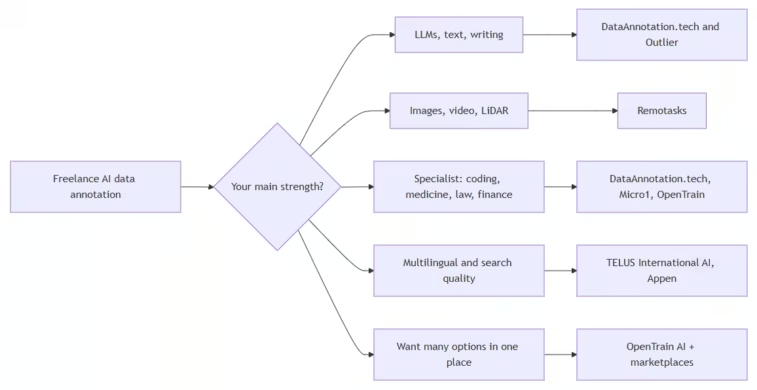
Quick decision map
Use this to decide where to focus first:
1. Platforms that specialize in LLM / text / reasoning
Best Platform for Freelance AI Data Annotation; These are the best bet if you like reading, writing, logic, or evaluating chatbots.
1) DataAnnotation.tech (LLM evaluation & AI training)
- What it is:
- A platform focused on AI response comparison, evaluation, and human feedback for LLMs (ranking answers, judging correctness, providing structured feedback).
- Why it’s strong:
- Official site states pay generally starts at $20–$30/hour for general annotation work and can reach $50–$100+/hour for STEM specialists.
- Tasks are more reasoning-heavy than simple labeling, which can be good experience and resume material.
- Legitimacy signals: no fees to join, payouts via PayPal/ACH, and the company reports paying over $20M to 100,000+ contractors since 2020, with positive reviews on Indeed.
- Typical tasks:
- Ranking or rewriting AI-generated answers.
- Evaluating responses for helpfulness, accuracy, safety.
- Domain-specific tasks (coding, math, law, medicine, finance) for qualified users.
- Pros:
- Some of the best rates among LLM-focused platforms for skilled contributors.
- Good for building AI/ML-relevant experience on your CV if you frame it right (e.g., improved model quality metrics).
- Cons:
- Assessment can be tough and not everyone passes.
- Work availability can vary; there can be dry spells.
- Best for:
- People comfortable with English, logic, and explanations.
- Specialists (coders, doctors, lawyers, finance pros) who can command higher rates.
- Pay reality:
- Expect $20–$30/hour for general LLM tasks if you’re in a supported region; significantly more for high-skill domains, per the company’s FAQ and blog.
2) Outlier (LLM response evaluation)
- What it is:
- An AI training platform focused on reviewing and evaluating AI-generated responses and completing structured human feedback tasks; often used for LLM evaluation and alignment work.
- Why it’s strong:
- Onboarding is relatively easy and project-based.
- Tasks align with modern LLM training (RLHF-style work).
- Typical tasks:
- Judging which AI response is better.
- Providing critiques or edits to model outputs.
- Pros:
- Flexible, project-based work.
- Less emphasis on visual tasks; more on language and reasoning.
- Cons:
- As with most platforms, project volume fluctuates.
- Entry tests and quality guidelines can be strict.
- Best for:
- Freelancers who like text and reasoning tasks.
- People who want to supplement DataAnnotation.tech with another LLM-focused platform.
3) OpenTrain AI (aggregator across many platforms)
- What it is:
- A free-for-freelancers platform that aggregates AI training and data labeling jobs from 20+ platforms into one feed and gives you one profile to apply to multiple places.
- Why it’s useful:
- Instead of checking 10+ sites, you see roles from DataAnnotation, Outlier, Micro1, Mercor, etc., in one dashboard and apply with one profile.
- Filters by domain, language, and pay rate; sample roles include math reasoning evaluator (~$45/hr), RLHF red-teaming (~$65/hr), medical data review (~$55/hr), code review (~$75/hr), etc.
- Pros:
- Saves time and reduces chance of missing opportunities.
- Good if you’re exploring the ecosystem and want to see what’s available.
- Cons:
- You still need to pass each underlying platform’s assessments.
- You’re depending on OpenTrain’s aggregation staying up to date.
- Best for:
- People who want a “one-stop shop” to discover and apply to AI training jobs.
- Specialists (coding, medical, legal, finance) seeking higher-paying roles.
2. Platforms that specialize in image / video / LiDAR annotation
Best Platform for Freelance AI Data Annotation; These are ideal if you prefer visual tasks or have an interest in computer vision / autonomous driving data.
1) Remotasks (computer vision focus)
- What it is:
- A global online platform for AI training and data annotation tasks, with a strong focus on image, video, and LiDAR annotation for computer vision and autonomous driving.
- Typical tasks:
- 2D image annotation (bounding boxes, polygons, classification).
- Video annotation (tracking objects across frames).
- 3D LiDAR point-cloud labeling (more advanced, pays better).
- Occasional text/data tasks, project-dependent.
- Pay:
- Basic annotation tasks: around $3–$7/hour.
- Advanced tasks (e.g., LiDAR): around $10–$20+/hour, depending on skill and speed.
- Pros:
- Good training and structured progression into higher-paid tasks.
- Legitimate platform widely used for CV projects.
- Cons:
- Low starting pay for simple tasks; not ideal if you need high hourly income immediately.
- Inconsistent task availability; training can be time-consuming.
- Best for:
- People interested in computer vision / autonomous driving.
- Those willing to invest time in training to reach better-paying tasks.
3. Large, established providers (multilingual & search evaluation)
Best Platform for Freelance AI Data Annotation; These companies run structured programs for major tech clients. They can be good if you want more “job-like” projects and especially if you’re multilingual.
1) TELUS International AI
- What it is:
- A global AI services provider offering search evaluation, AI training, and linguistic data work for big tech companies; now operates many programs that used to be under Lionbridge AI.
- Typical tasks:
- Search quality evaluation (rating search results).
- Multilingual AI training and linguistic tasks.
- Various data annotation and evaluation roles by project.
- Pros:
- Established, legitimate employer with formal projects.
- Strong options for multilingual contributors.
- Cons:
- Application process can be longer and more structured.
- Pay is often moderate; these are usually part-time / independent contractor roles.
- Best for:
- People who speak multiple languages and want structured projects.
- Those who prefer working with a large, known company.
2) Appen
- What it is:
- One of the longest-running AI data annotation companies, offering a wide range of remote AI training, language, and data labeling projects worldwide.
- Typical tasks:
- Basic data labeling and microtasks.
- Language-related projects (translation, transcription, relevance).
- Some specialized roles for experienced annotators.
- Pros:
- Very widely used; often a common entry point into AI training.
- Huge variety of projects across languages and domains.
- Cons:
- Pay per task can be low compared to newer LLM-focused platforms.
- Task availability and communication quality vary by project.
- Best for:
- Beginners who want to get experience.
- People in many countries looking for their first AI annotation projects.
4. Higher-end & specialist freelance platforms
Best Platform for Freelance AI Data Annotation; These are not pure “microtask” sites, but they’re excellent if you have strong skills and want better pay or longer-term contracts.
1) Micro1 (via OpenTrain or direct)
- What it is:
- An AI workforce/staffing platform connecting companies with vetted global talent for AI training, evaluation, and domain-specific projects. It’s known for higher-paying roles that often require subject-matter expertise (medicine, law, finance, advanced STEM).
- Typical roles:
- Domain expert evaluation (medical, legal, finance).
- Code review and reasoning tasks.
- Pros:
- Higher pay potential relative to basic microtask platforms.
- Fits well if you have professional credentials.
- Cons:
- Harder to get in; they screen for expertise.
- More competitive than basic task platforms.
- Best for:
- Subject-matter experts seeking well-paid AI training/evaluation work.
2) Mercor and Braintrust (via OpenTrain or direct)
- What they are:
- Talent networks/marketplaces connecting vetted professionals to AI, data, and engineering projects; used for AI training, evaluation, and model-related work rather than open microtasks.
- Pros:
- Focus on higher-skill, longer-term engagements.
- Better fit if you want to move beyond “task work” into project-based roles.
- Cons:
- Not beginner-friendly; requires relevant skills and a strong profile.
- Best for:
- Experienced professionals wanting to pivot into AI-adjacent work.
3) General freelance marketplaces
- Platforms:
- Upwork: Data Annotation category with many remote freelance jobs.
- Freelancer: Data annotating jobs with hourly rates posted (e.g., ~$10/hour listings in 2026).
- Arc.dev: Remote data annotation and related roles at global tech companies.
- Pros:
- Direct client relationships.
- Potential for higher hourly rates and long-term contracts.
- Cons:
- You must pitch and compete; not “login and do tasks.”
- Fees and taxes are your responsibility.
- Best for:
- People with some experience who want to escape low-paying microtasks.
5. Pay reality and what’s actually “best”
Best Platform for Freelance AI Data Annotation; From independent 2026 analysis of US-based remote annotation roles:
- Entry-level US annotators: about $15–$20/hour.
- Domain-specific roles (medical, legal, finance, coding): about $20–$30/hour.
- Lead annotators / QA / project coordinators: about $28–$40/hour.
Highly marketed LLM platforms like DataAnnotation.tech claim general rates starting around $20–$30/hour, with specialist work (e.g., STEM) at $50–$100+/hour.
Computer-vision microtask platforms like Remotasks show a wider spread: basic tasks at roughly $3–$7/hour, advanced tasks around $10–$20+/hour.
What “best” really means for you:
- Highest pay per hour → specialist LLM evaluation (DataAnnotation.tech, Micro1, Outlier) or direct clients on Upwork/Arc.
- Easiest entry → Appen, Remotasks (after training), general marketplaces.
- Most consistent and “job-like” → TELUS International AI, Appen programs, Micro1/Braintrust/Mercor for experts.
- Most options in one place → OpenTrain AI as an aggregator.
6. How to choose the right platform(s) for you
Step 1 – Assess your profile:
- English level (native/fluent vs. working proficiency).
- Specialist knowledge (coding, medicine, law, finance, multilingual).
- Time commitment (hours per week).
- Pay expectations and location (some platforms are US-only or country-specific).
- Preference for task type (text reasoning vs. images/video vs. audio).
Step 2 – Start with a primary platform:
- Strong English + reasoning/interest in LLMs:
- Primary: DataAnnotation.tech.
- Secondary: Outlier.
- Prefer visual tasks, computer vision interest:
- Primary: Remotasks (after training).
- Multilingual or want structured projects:
- Primary: TELUS International AI.
- Secondary: Appen.
- Specialist (MD, JD, CPA, engineer, etc.):
- Primary: DataAnnotation.tech specialist tracks and Micro1 (via OpenTrain or direct).
- Want a “one dashboard” view:
- Use OpenTrain AI to discover and apply to multiple platforms at once.
Step 3 – Diversify and build reputation:
- Aim for 2–3 active platforms to reduce risk of dry spells.
- Keep a simple log of hours, tasks, and pay to track effective hourly rates.
- Frame your work on your CV with impact (“Evaluated Xk samples with Y% accuracy”) as suggested in 2026 career guidance for annotation roles.
7. Red flags and how to avoid bad platforms
Best Platform for Freelance AI Data Annotation; From recent 2026 guides on legitimate AI training work and scam-spotting:
- Avoid any platform that:
- Asks you to pay an upfront fee to “apply” or “get access.”
- Promises guaranteed full-time income with unstable project pipelines.
- Uses only crypto or untraceable payment methods.
- Prefer platforms that:
- Have clear public information (site, FAQs, reviews).
- Pay via standard methods (PayPal, Wise, ACH, bank transfer).
- Have independent reviews (Indeed, Trustpilot, etc.). For example, DataAnnotation.tech shows thousands of reviews and regular payments; Remotasks has many employee reviews confirming it’s a real platform.
8. Practical starter plan (1–2 weeks)
Day 1–2:
- Create profiles on:
- DataAnnotation.tech.
- OpenTrain AI (to discover other opportunities).
- At least one other that fits your profile (Remotasks if you like visual tasks, or TELUS/Appen if you’re multilingual).
Day 3–5:
- Complete assessments/training for each platform.
- Read guidelines carefully; accuracy matters more than speed early on.
Day 6–14:
- Start with whichever platform approves you first.
- Log your hours and note:
- Which tasks you’re fastest at.
- Which pay best per hour.
- Over time, shift effort toward the platforms and tasks that give you the best combination of pay and fit.
If you share:
- your country,
- your skills (generalist vs. specialist),
- and whether you prefer text vs. visual tasks,
Best Platform for Freelance AI Data Annotation; I can narrow this down to a concrete 3-platform stack tailored to you.