
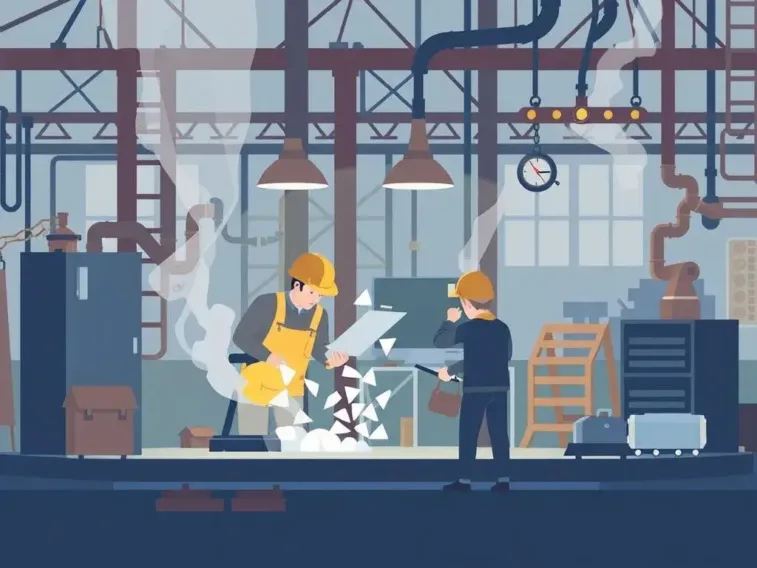
Industrial discipline is essential for maintaining order and productivity in the workplace. Explore its definition, types, causes, code, and maintenance strategies to foster a harmonious work environment and enhance organizational success. Discover actionable tips to implement effective disciplinary practices.
Industrial Discipline: Definition, Types, Causes, Code, and Maintenance
Industrial discipline refers to the orderly conduct of employees within an organization, adhering to established rules and regulations. It fosters cooperation towards shared goals, promoting a harmonious work environment, enhancing productivity, and ensuring organizational success. Discipline can be self-imposed or enforced, with both forms playing crucial roles in industrial settings.
Definition of Industrial Discipline
Industrial discipline signifies the orderly conduct of employees within an organization, adhering to established rules, regulations, and conventions. It’s a force that encourages individuals to follow procedures to achieve objectives. In a broader sense, discipline means orderliness, the opposite of confusion.
A comprehensive definition views industrial discipline as the orderly management of affairs by an organization’s members. They comply with necessary regulations, driven by a desire to cooperate harmoniously toward shared goals, willingly recognizing the need to align their individual wishes with the group’s requirements.
Historically, discipline was likened to military regimentation. However, its core meaning is the antithesis of chaos, irregularity, and disorder in human behavior. Mary C. Niles connects the origin of “discipline” to “to learn,” suggesting its purpose is to guide proper conduct rather than merely punish.
Discipline is crucial for success in any endeavor, and its importance is amplified in an industrial setting. It fosters peace and harmony, improving the work environment, boosting labor productivity, increasing production, and ultimately helping the organization achieve its objectives and prosperity.
Discipline can be self-imposed or enforced. Self-imposed discipline involves employees regulating their own conduct, leading to spontaneous work and internal motivation. Enforced discipline, on the other hand, comes from management. While self-imposed discipline is a more powerful motivator, managers may need to rely on enforced discipline for uncooperative employees.
Types of Industrial Discipline
Industrial discipline is broadly categorized into two types:
- Positive Discipline
- Negative Discipline
Although there isn’t a rigid procedure for disciplinary action, it generally involves these steps:
- Issuing a charge sheet: A letter detailing misconduct and also requesting an explanation.
- Considering the explanation: Reviewing the employee’s response.
- Issuing a show-cause notice: If there’s prima facie evidence of misconduct.
- Serving a notice of enquiry: Specifying the enquiry officer, time, date, and also place when sufficient misconduct observed.
- Holding an enquiry: Ensuring the employee has an opportunity to be heard, in line with natural justice. Findings recorded, and also disciplinary action suggested.
- Making a final order of punishment: Deciding the nature of disciplinary action after misconduct is proven, considering the employee’s record, and also potential impact on others.
- Appeal: Allowing the employee to appeal if they believe the enquiry or action was improper.
- Follow-up: Implementing proper follow-up after disciplinary action.
Causes of Indiscipline in Industries
Indiscipline often stems from managerial shortcomings and lapses, including:
- Arbitrary disciplinary measures by management.
- Neglecting employee grievances.
- Favoritism and nepotism in promotions and placements.
- Overly bossy management.
- Communication gaps between management and staff.
- Lack of adequate supervision.
- Using “secret police” methods for information gathering.
- Provocation by union leaders.
- Factionalism.
- Personal animosity and also jealousy.
- “Divide and rule” policies.
While some causes may originate with employees, many are management-induced. Regardless of the cause, indiscipline can have serious consequences, leading to frustration, stunted human personality, and embittered relations, ultimately denying individual freedom.
Code of Discipline in Indian Industry
In July 1957, the 15th session of the Indian Labour Conference addressed industrial discipline, formulating principles for resolving grievances and disputes through negotiation, conciliation, and voluntary arbitration. The Code of Discipline came into effect in June 1958, serving as a truce between organized labor and management.
Key principles included:
- No lockouts or strikes without notice.
- No unilateral actions.
- Also, No “go-slow” tactics.
- No deliberate damage to plant or property.
- No acts of violence, intimidation, coercion, or instigation.
- Utilization of existing dispute settlement machinery.
- Prompt implementation of awards and agreements.
- Avoiding agreements that harm cordial industrial relations.
These principles were fully integrated into the Code of Discipline and ratified by major national labor organizations (INTUC, UTUC, AITUC, HMS) and employer federations (Employers’ Federation of India, All India Organisation of Industrial Employers, All India Manufacturers’ Organisation).
Despite its implementation, the Code of Discipline did not prevent significant strikes in various industries. Its effectiveness was reviewed in 1965 and again in 1967, leading to the proposal for a National Arbitration Promotion Board to encourage voluntary arbitration.
How to Maintain Industrial Discipline
Maintaining industrial discipline is a complex task requiring efficient handling. Various methods can be adopted:
- Employee consultation: Involve workers in framing rules and regulations.
- Clear rules: Ensure rules and regulations well-defined.
- Open communication: Bridge communication gaps between management and workers.
- New employee orientation: Provide proper guidance for new hires.
- Visual aids: Use charts, graphs, and other methods to enhance worker understanding.
- Judicious penalties: Apply penalties only when absolutely necessary.
- Fair punishment: Avoid victimisation as the aim of punishment.
- Eliminate bias: Avoid favoritism, nepotism, and casteism.
- Management adherence: Ensure managerial staff uphold the laws they establish.
- Code of conduct: Develop and follow a clear code of conduct or discipline.
- Disciplinary committee: Form a dedicated disciplinary committee.
- Appeal mechanism: Establish a suitable system for aggrieved parties to appeal.
When indiscipline occurs, measures must be taken to enforce discipline. Paul Pigors and Charles A. Myres suggest a “clinical approach” involving:
- Preliminary investigation.
- Informal, friendly talk.
- Oral warning or reprimand.
- Written or official warning.
- A graduated series of penalties, such as disciplinary lay-off, demotion, transfer, and, as a last resort, discharge.
In India, disciplinary actions adhere to the principles of natural justice. The accused must be given an opportunity to defend themselves, a neutral judge must be appointed, and punishment should be proportionate to the offense. Disciplinary action follows a domestic enquiry, involving an Enquiry Officer, a charge-sheet, an opportunity for explanation, notice of enquiry, proceedings, findings, and communication of the decision. Firms proceed with extreme caution before implementing any disciplinary action.
🔧 7 Essential Tips for Industrial Discipline Success
Below is a concise, field-tested checklist—drawn from 2025 HR compliance bulletins and industrial best-practice sources—that turns “discipline” into “development” while keeping your site safe, productive and legally defensible.
1. Start with a Crystal-Clear Policy
- Write it once, share it everywhere – include dress, attendance, mobile use, safety breaches in the handbook & intranet.
- Concrete examples – “Hard-hat off = verbal warning 1; tampering with LOTO = written warning 1.”
- Mandatory onboarding read – e-signature proof; manager discusses it during site induction.
Result: 47 % fewer disputes when rules are explicit and accessible.
2. Investigate Before You Act
- Gather facts fast – CCTV, sensor logs, witness statements, maintenance records.
- Use a standard investigation form – who, what, when, impact, evidence.
- Keep it confidential – private interviews, secure digital file, GDPR-compliant.
Tip: “Hard evidence > hearsay” prevents wrongful-dismissal claims.
3. Apply Progressive Discipline Consistently
| Step | Example | Document |
|---|---|---|
| Verbal Warning | First safety breach | Signed note in file |
| Written Warning | Repeat breach within 12 mo | Formal letter + improvement plan |
| Final Warning / PIP | Serious breach or repeat | PIP with SMART targets + timeline |
| Suspension / Demotion | Major safety violation | Formal notice + union sign-off |
Rule: Same offence = same step; variations must be documented and justified.
4. Document Everything, Every Time
- Date, time, witness, evidence, action, signature – never rely on memory.
- Use digital logs – cloud HRIS with audit trail; photo/video evidence attached.
- Store securely – access-controlled, backed-up, retention = labour-law period + 2 yrs.
Legal shield: Documented process = 80 % defence in wrongful-dismissal suits.
5. Coach, Don’t Punish—Use PIPs as Growth Tools
- PIP = Performance Improvement Plan, not penalty.
- SMART targets – “Reduce rework to <2 % within 30 days”.
- Resources provided – training budget, mentor, new tools.
- Weekly check-ins – 15-min stand-up, progress logged, praise publicly.
Outcome: 65 % of PIP employees reach target when coaching is provided.
6. Coach Managers—They’re the Frontline
- Annual discipline workshop – role-play scenarios, legal updates, union rules.
- Manager scorecard – “Discipline consistency index” (variance < 5 %).
- HR oversight – review all written warnings before issue.
Fact: Inconsistent manager = #1 legal risk; training drops claims 42 %.
7. Review & Refine Quarterly
- Quarterly audit – variance analysis, trend heat-map, union feedback.
- Update policy – new tech (e.g., AI sensors), remote-work rules, ESG metrics.
- Broadcast wins – “Site X cut safety breaches 30 % after new PIP process”.
Cycle: Audit → Update → Train → Broadcast → Repeat.
🔑 One-Line Take-Away
Clear rules, hard evidence, fair coaching, relentless review—industrial discipline becomes a performance engine, not a punishment tool.
Copy the 7-step loop, run one quarterly audit, and turn your site into a benchmark for safe, fair, high-performance industrial discipline.